
Can we give aspirin if the person already took paracetamol
Yes, generally you can take aspirin and paracetamol (acetaminophen) together - they work by different mechanisms and don't have a direct drug-drug interaction. Paracetamol works centrally, while aspirin is a peripheral COX inhibitor/NSAID. They're sometimes combined intentionally for better pain relief.
Searching sources...
Reading File
Searching the Web
aspirin paracetamol acetaminophen combination safety interaction
Finding Sources
Finding Sources
Finding Sources
Reading File
Reading File
Here is a complete answer:
Can You Give Aspirin After Paracetamol?
Yes, in most adults it is safe to take aspirin and paracetamol (acetaminophen) together. There is no direct pharmacokinetic or pharmacodynamic interaction between them - drugs.com confirms no interaction between the two. They are actually sometimes combined intentionally for better pain control.
Why They Can Be Combined
They work through completely different mechanisms, so they do not compete or interfere with each other:
| Drug | Mechanism |
|---|---|
| Paracetamol | Inhibits COX enzymes in the brain (central), modulates cannabinoid/serotonin systems. Has no significant anti-inflammatory effect in peripheral tissues. |
| Aspirin | Irreversibly inhibits COX-1 peripherally by acetylating a serine residue. Anti-inflammatory, antiplatelet, antipyretic. |
Because their sites of action differ, combining them can provide additive pain relief - this is the principle behind "multimodal analgesia."
- Morgan and Mikhail's Clinical Anesthesiology, 7e, p. 362
- Katzung's Basic and Clinical Pharmacology, 16th Ed., p. 1027
Important Cautions
While the combination is generally safe, there are situations to watch for:
-
Gastric bleeding risk - Aspirin irritates the gastric mucosa. Alcohol use alongside either drug increases this risk further.
-
Liver strain - Paracetamol is hepatotoxic in overdose (via the NAPQI metabolite). The maximum safe dose is 4 g/day in healthy adults (some sources now recommend staying under 3 g/day in elderly or those with liver risk factors). Aspirin can also cause mild hepatic enzyme elevations at high doses.
-
Bleeding/antiplatelet effect - Aspirin irreversibly inhibits platelet aggregation for ~7 days. If the person has a bleeding risk, hemophilia, or is on anticoagulants, aspirin should be avoided regardless of paracetamol.
-
Children - Aspirin is contraindicated in children with viral illness due to the risk of Reye's syndrome. Paracetamol is the preferred antipyretic/analgesic for children.
-
Peptic ulcer history - Paracetamol is preferred over aspirin in these patients. If the person already took paracetamol, there is no need to add aspirin.
-
Aspirin-induced bronchospasm - Some patients (especially asthmatics) get bronchospasm from aspirin. Paracetamol is the safe alternative.
Practical Takeaway
If a person took paracetamol and still needs more pain relief or has a specific reason for aspirin (e.g., cardiovascular prophylaxis), aspirin can be given safely - just respect the usual aspirin indications and contraindications listed above. There is no need to wait for the paracetamol to wear off.
What is the reason of left hand heavyness
Reading File
Left arm heaviness is a symptom that can range from benign musculoskeletal causes to serious cardiac emergencies. The most important thing to know is that left arm/hand heaviness combined with chest pain, sweating, or shortness of breath = possible heart attack and requires immediate emergency care.
Searching sources...
Finding Sources
Searching the Web
causes of left hand arm heaviness medical differential diagnosis
Finding Sources
Finding Sources
Finding Sources
Finding Sources
Reading File
Reading File
Loading Image
Here is a thorough breakdown of the causes of left hand/arm heaviness:
Causes of Left Hand/Arm Heaviness
⚠️ URGENT WARNING: If the left arm heaviness comes with chest pain, chest tightness, sweating, nausea, jaw pain, or shortness of breath - call emergency services (911/112) immediately. This is a classic presentation of a heart attack.
1. Cardiac Causes (Most Dangerous - Rule Out First)
Angina Pectoris / Heart Attack (Myocardial Infarction)
This is the most important cause to consider. The heart itself has no pain receptors on its surface, so cardiac ischemia is felt as "referred pain" in remote areas - most classically the left arm and hand.
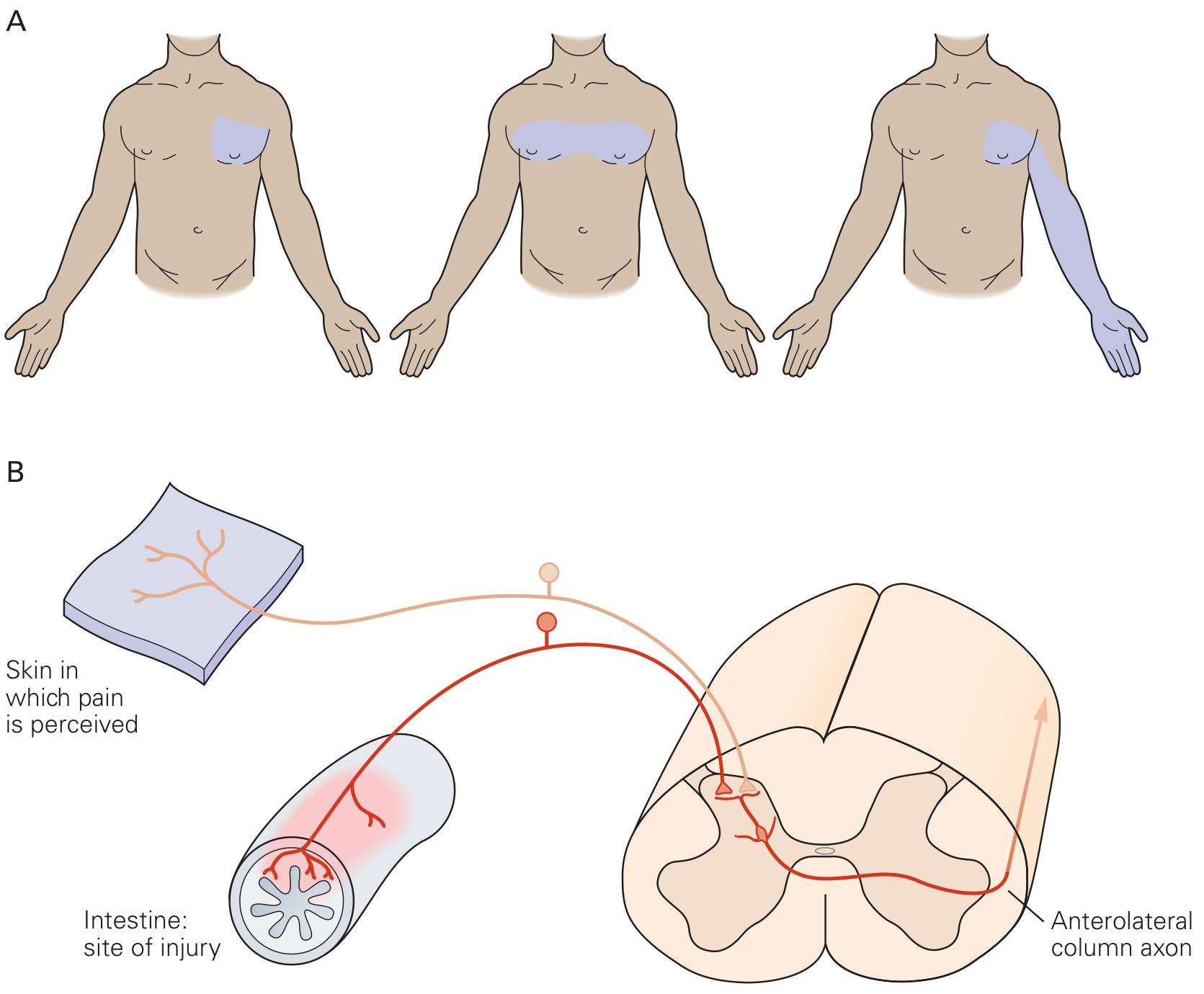
The diagram above shows how cardiac pain is felt as referred pain - because visceral and somatic nerve fibers converge at the same spinal cord level, the brain misinterprets the source.
-
Angina is classically described as squeezing, pressure, tightness, fullness, or heaviness - not always sharp pain
-
It typically starts in the chest (substernal) and radiates to the left arm, neck, jaw, or shoulder
-
When it extends down the arm, it usually follows the ulnar (inner) aspect of the arm to the hand
-
Associated symptoms: sweating, nausea, shortness of breath, fatigue, anxiety
-
Rosen's Emergency Medicine, p. 997
-
Eric Kandel - Principles of Neural Science, 6th Ed., p. 523
2. Neurological Causes
a) Cervical Radiculopathy (Pinched Nerve in the Neck)
- Compression of nerve roots C5-C8 in the cervical spine causes heaviness, numbness, tingling, or weakness in the arm/hand
- Usually caused by a herniated disc or bone spur
- Pain often worsens with neck movement
b) Stroke or TIA (Transient Ischemic Attack)
- Sudden onset weakness or heaviness affecting one entire side (arm + leg + face) = stroke until proven otherwise
- Other signs: facial droop, slurred speech, confusion, vision changes
- This is an emergency - call 999/911
c) Thoracic Outlet Syndrome (TOS)
- Compression of nerves and blood vessels between the collarbone and first rib
- Causes shoulder and arm pain, heaviness, numbness (especially in the inner arm/hand)
- Neurogenic TOS is the most common form
- Harrison's Principles of Internal Medicine, 22e
d) Carpal Tunnel Syndrome / Peripheral Neuropathy
- Compression of the median nerve at the wrist causes heaviness, numbness, tingling in the hand (especially thumb side)
- Worse at night or with repetitive hand use
3. Musculoskeletal Causes
- Muscle strain or overuse - the most common benign cause; from exercise, heavy lifting, or repetitive movements
- Shoulder joint problems - rotator cuff injury, frozen shoulder (adhesive capsulitis), bursitis
- Cervical spondylosis - age-related wear of cervical vertebrae compressing nerves
- Costochondritis - inflammation of rib cartilage, can mimic cardiac pain
4. Vascular Causes
- Subclavian artery stenosis - reduced blood flow to the left arm causing heaviness and fatigue on use
- Deep vein thrombosis (DVT) of the arm - swelling, heaviness, and discoloration; rare but serious
- Raynaud's phenomenon - blood vessel spasm causing cold, heavy, discolored fingers
5. Other Causes
| Cause | Key Feature |
|---|---|
| Multiple sclerosis | Episodes of arm heaviness + other neurological symptoms |
| Hypothyroidism | Bilateral heaviness, fatigue, cold intolerance |
| Anxiety/panic attack | Can mimic cardiac symptoms with arm tingling and heaviness |
| Lymphedema | Heaviness due to fluid buildup (e.g., after surgery) |
| Vitamin B12 deficiency | Numbness and heaviness in limbs |
When to Seek Emergency Care Immediately
Seek emergency help if the heaviness is accompanied by:
- Chest pain, pressure, or tightness
- Sweating, nausea, or vomiting
- Sudden weakness on one entire side of the body
- Difficulty speaking or understanding speech
- Sudden vision changes
- Shortness of breath at rest
For isolated, gradual-onset heaviness without any of these features, a routine medical evaluation (physical exam, ECG, nerve conduction studies if needed) is the appropriate step.
Lip spams reason is what
Lip spasms (involuntary twitching or trembling of the lip) are usually benign and caused by muscle fatigue, caffeine, or stress. However, they can sometimes indicate neurological or metabolic issues worth investigating.
Searching sources...
Finding Sources
Searching the Web
lip spasms twitching causes medical reasons
Finding Sources
Finding Sources
Reading File
Finding Sources
Finding Sources
Here is a complete breakdown of why lip spasms/twitching happen:
Causes of Lip Spasms (Lip Twitching)
Lip spasms are involuntary, rapid twitching or trembling of the upper or lower lip muscles. They happen due to a miscommunication between the facial nerve and the lip muscles it controls. Causes range from harmless to serious.
1. Common / Benign Causes (Most Frequent)
| Cause | Why It Happens |
|---|---|
| Too much caffeine | Caffeine overstimulates nerves and muscles, causing spontaneous firing |
| Stress and anxiety | Tension increases muscle excitability and causes minor facial twitches |
| Fatigue / sleep deprivation | Tired muscles fire erratically; face muscles are especially sensitive |
| Dehydration | Reduces electrolyte balance, disrupting normal nerve-muscle signaling |
| Potassium deficiency | Low potassium causes muscle hyperexcitability and twitching throughout the body |
These are self-limiting and resolve with rest, hydration, and reducing caffeine.
2. Electrolyte / Metabolic Causes
Low Calcium (Hypocalcemia) - this is one of the classic medical causes of facial and lip spasms.
- Low calcium increases neuromuscular excitability, causing muscle twitching, spasms, and in severe cases, tetany
- Chvostek's sign: tapping the facial nerve just in front of the ear causes a twitch of the lip/facial muscles - this is a direct clinical test for hypocalcemia
- Other symptoms: tingling in fingers and around the mouth (perioral paresthesia), muscle cramps, heart arrhythmias
- Frameworks for Internal Medicine; K.J. Lee's Essential Otolaryngology
Low Magnesium (Hypomagnesemia)
- Magnesium is needed for normal muscle relaxation; low levels cause similar twitching and spasms as low calcium
Low Potassium (Hypokalemia)
- Causes widespread muscle twitching and cramps, including in the face and lips
3. Neurological Causes
Hemifacial Spasm
- Involuntary, painless, intermittent twitching of one entire side of the face, including the lip
- Usually caused by a blood vessel pressing on the facial nerve (CN VII) at its root exit zone in the brainstem
- Starts around the eye (orbicularis oculi), then gradually spreads to involve the lip muscles (orbicularis oris, buccinator)
- Can be worsened by stress, anxiety, and fatigue
- Persists even during sleep
- Localization in Clinical Neurology, 8th Ed., p. 802
Bell's Palsy (Facial Nerve Injury)
- After a Bell's palsy episode, abnormal nerve regeneration can cause involuntary lip twitching (synkinesis)
Essential Tremor
- A benign tremor disorder that can affect the lips, chin, and jaw
Parkinson's Disease
- Can cause a characteristic "pill-rolling" rest tremor that sometimes involves the lips and chin ("lip tremor")
Tourette Syndrome / Facial Tics
- Repetitive involuntary lip movements are a type of facial tic
4. Drug-Related Causes
Certain medications list fasciculation (muscle twitching) as a side effect:
- Corticosteroids (e.g., prednisone)
- Estrogens / hormonal medications
- Stimulant drugs (amphetamines, cocaine)
- Lithium toxicity
- Antipsychotics - can cause tardive dyskinesia, which includes involuntary lip and mouth movements (lip smacking, chewing movements)
5. Less Common / Serious Causes
| Cause | Key Feature |
|---|---|
| Hypoparathyroidism | Low PTH → low calcium → perioral tingling + lip spasms |
| Multiple sclerosis | Demyelination of facial nerve pathways; can cause facial spasms |
| Brain tumor / AVM | Compressing facial nerve pathways; associated with other neurological signs |
| Amyotrophic Lateral Sclerosis (ALS) | Widespread fasciculations including facial muscles |
| Herpes labialis (cold sore) | Viral reactivation of HSV-1 irritates the lip nerve, sometimes causing tingling/twitching before the sore appears |
When to See a Doctor
Seek medical attention if:
- The twitching is persistent (lasting more than a few weeks)
- It is spreading to involve other facial muscles or one whole side of the face
- There is associated facial weakness, numbness, or drooping
- You have tingling around the mouth and fingertips (suggests low calcium)
- You notice involuntary mouth movements (chewing, smacking) - this could be tardive dyskinesia from medications
For occasional, brief lip twitching without other symptoms: reduce caffeine, get adequate sleep, stay hydrated, and ensure your diet has enough potassium and magnesium.
This is a shared conversation. Sign in to Orris to start your own chat.