
Neonatal resuscitation
Reading File
Neonatal resuscitation covers the initial assessment and stabilization of a newborn at birth, following the NRP (Neonatal Resuscitation Program) algorithm - evaluating tone, breathing, and heart rate, then proceeding through steps of warming/drying, airway positioning, stimulation, oxygen delivery, positive pressure ventilation (PPV), chest compressions, and epinephrine if needed.
Searching sources...
Finding Sources
Searching PubMed
"neonatal resuscitation" guidelines
Good results. Now let me read the most comprehensive sections in parallel - the Rosen's algorithm section and the Morgan & Mikhail section.
Reading File
Reading File
Now let me read the Rosen's algorithm section and the Barash section in parallel:
Reading File
Reading File
Finding Sources
Let me read more of the Rosen's algorithm section and the Tintinalli section for epinephrine/advanced resuscitation:
Reading File
Reading File
I now have excellent content. Let me also read the Rosen's section on special situations (meconium, prematurity) and the APGAR score section:
Reading File
Loading Image
I now have comprehensive content for a thorough answer. Let me compile it all.
Neonatal Resuscitation
Approximately 10% of newborns require some assistance at birth, and fewer than 1% need advanced resuscitative measures. The vast majority respond to the initial steps alone.
Pre-Birth Preparation
Before every delivery, a team briefing and equipment check should be completed. Key equipment includes:
- Radiant warmer, warm blankets, plastic wrap (for preterm)
- Bulb syringe, suction catheter (sizes 5, 8, 10 Fr) at ~100 mmHg
- Self-inflating bag (450/750 mL) + age-appropriate masks
- Laryngoscope with straight blades (00, 0, 1)
- ETT sizes 2.5-4.0 mm (uncuffed), stylets, CO2 detector
- Umbilical catheters (3.5 and 5 Fr) for vascular access
Key maternal history questions: gestational age, multiple gestation, meconium presence, medications/drugs, maternal fever, prenatal anomalies.
The NRP Algorithm (Step by Step)
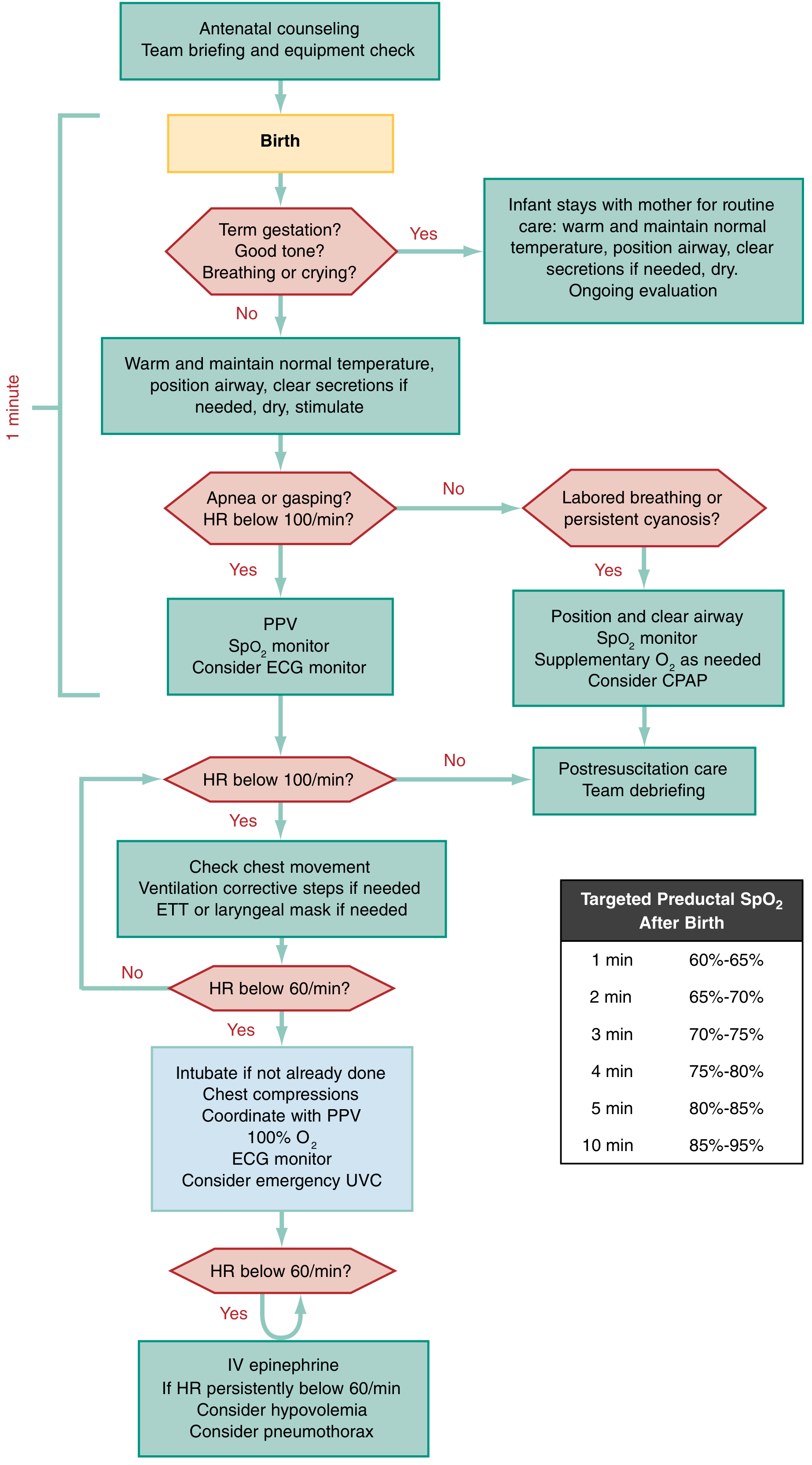
AHA Neonatal Resuscitation Algorithm - ROSEN's Emergency Medicine
Step 1 - Initial Assessment (within 60 seconds - "The Golden Minute")
Ask three questions simultaneously:
- Term gestation?
- Good tone?
- Breathing or crying?
If all three are YES → infant stays with mother for routine care (warm, dry, position airway, observe).
If ANY is NO → proceed to resuscitation steps.
Step 2 - Initial Steps (Warm, Dry, Stimulate)
- Place under radiant warmer
- Position airway (slight neck extension, "sniffing" position)
- Clear secretions only if obstructed (mouth first, then nose)
- Dry and stimulate (rub the back, flick soles of feet)
- Delayed cord clamping 1-3 minutes for vigorous term infants
Suction precautions: Overly vigorous/deep suctioning causes vagal stimulation, bradycardia, and apnea. Use only if obstruction is present, and keep suction <100 mmHg.
Step 3 - Re-assess: Labored Breathing or Persistent Cyanosis (HR >100)?
- Position and clear airway
- Monitor SpO2 (on right hand/wrist - preductal)
- Supplemental O2 as needed to reach targeted saturations
- Consider CPAP
Targeted Preductal SpO2 After Birth:
| Time | Target SpO2 |
|---|---|
| 1 min | 60-65% |
| 2 min | 65-70% |
| 3 min | 70-75% |
| 4 min | 75-80% |
| 5 min | 80-85% |
| 10 min | 85-95% |
Oxygen Note: Resuscitation with 100% O2 is no longer recommended. Start with room air (21%) for term infants and 21-30% FiO2 for preterm (<35 weeks). Titrate upward to achieve target SpO2. 100% O2 is reserved for HR <60 bpm after 90 seconds. Hyperoxia causes oxidative stress and cardiac/renal/neurologic injury. - ROSEN's Emergency Medicine
Step 4 - Apnea, Gasping, or HR <100 bpm → Positive Pressure Ventilation (PPV)
- Rate: 40-60 breaths/min
- Pressure: 30 cm H2O (term); 20-25 cm H2O (preterm)
- Best indicators of effectiveness: chest rise and increasing HR (usually within 5-10 breaths)
- Apply SpO2 monitor and consider ECG monitor (3-lead ECG is more accurate than pulse oximetry or umbilical palpation for HR)
APGAR Score (assessed at 1, 5, and 10 minutes):
| Parameter | 0 | 1 | 2 |
|---|---|---|---|
| Heart rate | Absent | <100/min | ≥100/min |
| Respiratory effort | Absent | Weak/irregular | Strong, crying |
| Muscle tone | Limp | Some flexion | Active motion |
| Reflex irritability | None | Grimace | Cry/cough/sneeze |
| Color | Blue/pale all over | Blue extremities | Completely pink |
The 1-minute score guides need for resuscitation; the 5-minute score assesses efficacy.
If PPV is not working - use MR SOPA:
- Mask - adjust seal
- Reposition the head
- Suction mouth then nose
- Open mouth with jaw thrust
- Pressure - increase (max 40 cm H2O)
- Airway - definitive (intubate)
Step 5 - HR Still <100 After PPV → Check Ventilation, Consider Intubation
Check chest movement and take ventilation corrective steps. If still no improvement, intubate or place LMA.
Intubation indications:
- Ineffective or prolonged bag-mask ventilation
- Tracheal suctioning for non-vigorous infant with meconium
- Chest compressions
- Extremely low birth weight or anatomic anomalies (e.g., diaphragmatic hernia)
ETT size by weight/gestational age:
| Gestational Age | Weight | ETT Size |
|---|---|---|
| <28 weeks | <1000 g | 2.5 mm |
| 28-34 weeks | 1000-2000 g | 3.0 mm |
| 34-38 weeks | 2000-3000 g | 3.5 mm |
| >38 weeks | >3000 g | 3.5-4.0 mm |
ETT confirmation: expired CO2 via capnography (gold standard: plain radiograph).
Post-intubation deterioration - DOPE mnemonic:
- Dislodged tube
- Obstructed tube
- Pneumothorax
- Equipment failure
Step 6 - HR <60 bpm Despite Adequate Ventilation → Chest Compressions
- Begin compressions if HR <60 after 30 seconds of adequate ventilation
- Ratio: 3:1 compressions to ventilations (90 compressions + 30 breaths = 120 events/min)
- Technique: Thumb-encircling method (preferred) - both thumbs on lower 1/3 of sternum, fingers encircling the chest
- Depth: ~1/3 of AP chest diameter
- Escalate FiO2 to 100%
- Establish emergency umbilical vein catheter (UVC)
- ECG monitor essential
If cardiac arrest is known to be of primary cardiac etiology, a 15:2 ratio (as in pediatric CPR) may be more appropriate. - ROSEN's Emergency Medicine
Step 7 - HR Still <60 After Compressions → Epinephrine ± Volume Expansion
Epinephrine:
| Route | Concentration | Dose |
|---|---|---|
| IV/IO (preferred) | 1:10,000 | 0.01-0.03 mg/kg |
| Endotracheal (less reliable) | 1:10,000 | 0.05-0.1 mg/kg (higher dose) |
- Give IV/IO rapidly; repeat every 3-5 minutes if HR remains <60
- Endotracheal route has unreliable absorption and is a last resort
Volume expansion (if suspected blood loss/hypovolemia):
- Normal saline, lactated Ringer's, or PRBCs
- 10 mL/kg IV over 5-10 minutes
If HR persistently <60: consider pneumothorax, hypovolemia.
Special Situations
Meconium-Stained Amniotic Fluid
Current NRP guidelines no longer recommend routine intubation and tracheal suctioning for all meconium-stained deliveries. Tracheal suctioning via ETT is only indicated if:
- Meconium is present AND
- Infant has poor tone, poor respiratory effort, or HR <100 bpm after 1 minute of appropriate PPV
Vigorous infants with meconium-stained fluid should be treated like any other newborn. - ROSEN's Emergency Medicine
Preterm Infants
- Initiate resuscitation with 21-30% FiO2 (not room air alone, not 100% O2)
- Use plastic wrap/bag to prevent hypothermia (do not dry first for <32 weeks)
- Lower ventilation pressures (20-25 cm H2O)
- Higher risk of respiratory distress syndrome - early surfactant considerations
Threshold of Viability
Infants born at 22-25 weeks pose ethical challenges. Decisions about resuscitation should incorporate gestational age, birth weight, parental wishes, and institutional capability.
Discontinuing Resuscitation
- If no cardiac activity for >10 minutes despite adequate resuscitative efforts, discontinuing resuscitation is reasonable
- Decisions should be individualized, with input from the team and family - Tintinalli's Emergency Medicine
Post-Resuscitation Complications
Common complications to monitor for after resuscitation:
- Hypoglycemia (check glucose early)
- Transient tachypnea of the newborn
- Meconium aspiration syndrome
- Pneumothorax
- Electrolyte disturbances
- Severe hyperbilirubinemia
- Sepsis
- Intraventricular hemorrhage (in preterm)
For infants who required chest compressions/CPR at birth, therapeutic hypothermia should be considered if they meet criteria for hypoxic-ischemic encephalopathy (HIE).
2025 AHA/AAP Guideline Update
The 2025 AHA/American Academy of Pediatrics guidelines (PMID: 41122887, Circulation, October 2025) represent the most current update, superseding the 2020 guidelines. Key changes from earlier versions include refinements in oxygen management, ECG monitoring recommendations, and approaches to threshold-of-viability resuscitation.
Sources:
- ROSEN's Emergency Medicine, Ch. 159
- Tintinalli's Emergency Medicine, Ch. 108
- Barash Clinical Anesthesia, 9e, Ch. 41
- Morgan & Mikhail's Clinical Anesthesiology, 7e
- AHA/AAP 2025 Neonatal Resuscitation Guidelines [PMID: 41122887]
This is a shared conversation. Sign in to Orris to start your own chat.