
Causes of different murmers and their features
Reading File
Finding Sources
Finding Sources
The best sources are Harrison's and Fuster & Hurst. Let me read the comprehensive murmur sections from both.
Reading File
Reading File
Reading File
Reading File
Now let me get the systolic murmur causes table from Harrison's (the big table that appeared to be cut off) and the early/late systolic section:
Reading File
I now have comprehensive material. Let me also fetch the murmur diagram image from Harrison's:
Loading Image
Loading Image
I now have all the information needed for a comprehensive answer. Here is a full synthesis:
Heart Murmurs: Causes and Features
What Produces a Murmur?
Murmurs arise from audible turbulence due to:
- Accelerated flow through normal or abnormal orifices
- Flow through a narrowed/irregular orifice into a dilated vessel/chamber
- Backward (regurgitant) flow through an incompetent valve, VSD, or PDA
Grading (I–VI): Grade 1 = barely audible; Grade 3+ = loud (structurally significant); Grade 4+ = palpable thrill; Grade 5 = heard with stethoscope edge only; Grade 6 = heard off chest.
Murmur Timing Diagrams
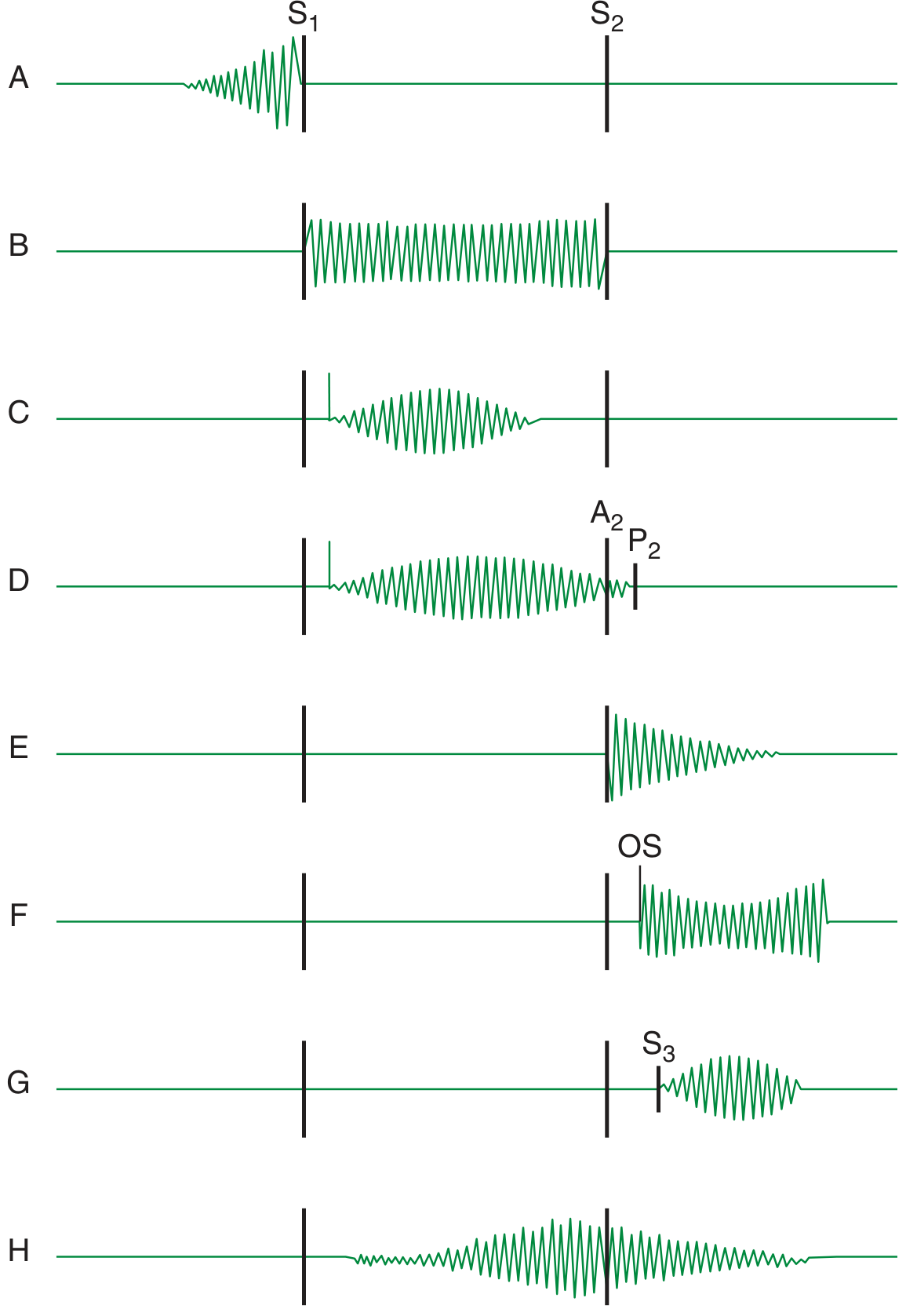
A = presystolic (MS/TS in sinus rhythm); B = holosystolic (MR/TR/VSD); C = ejection murmur with ejection click (AS); D = PS murmur spilling past A2; E = AR diastolic murmur; F = MS after opening snap; G = short mid-diastolic after S3; H = continuous murmur (PDA)
SYSTOLIC MURMURS
Mechanism Comparison
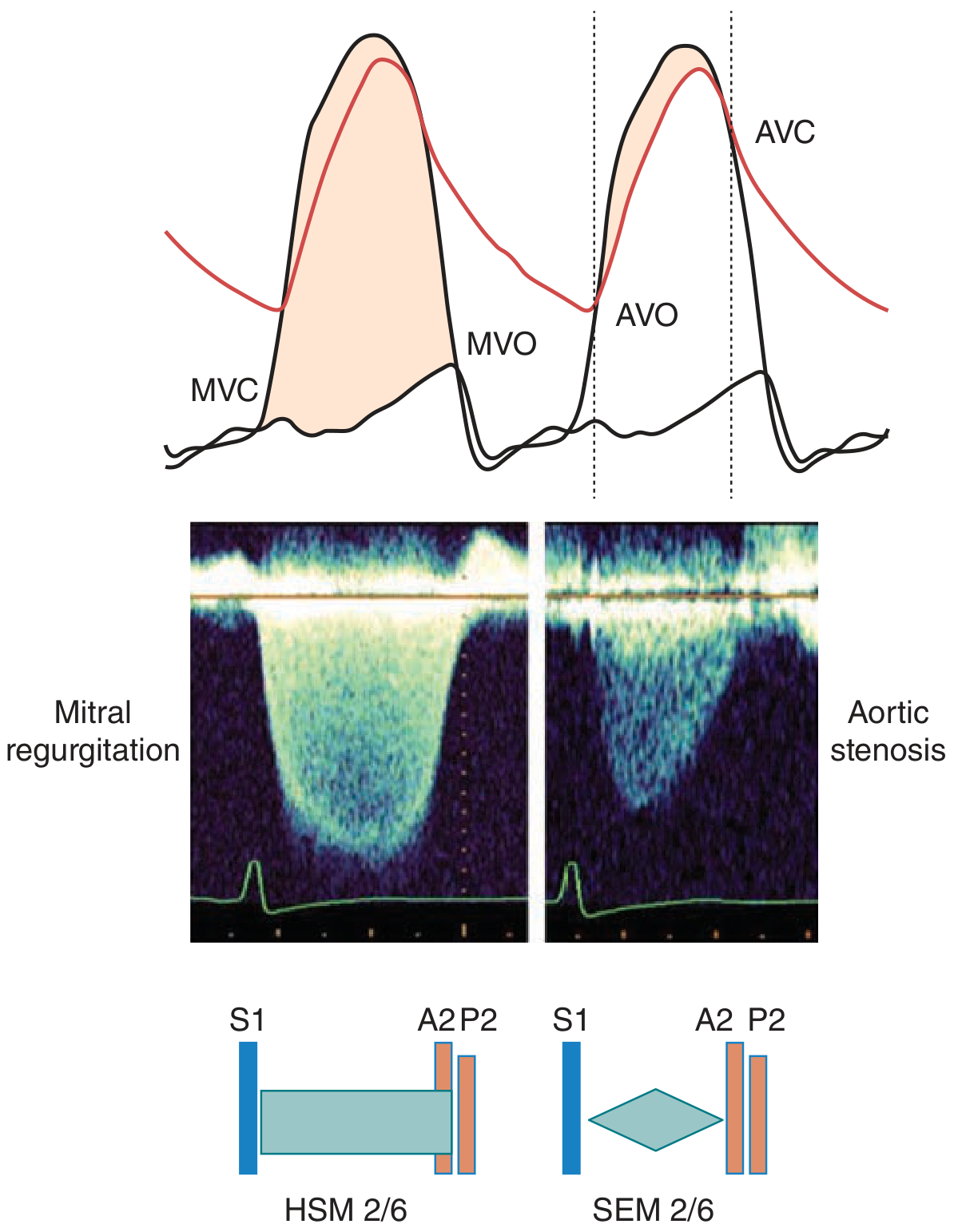
AV regurgitation (MR) → holosystolic plateau murmur from MVC to MVO. Semilunar valve obstruction (AS) → ejection murmur from AVO to AVC, with crescendo-decrescendo (diamond) shape.
1. Holosystolic (Pansystolic) Murmurs
Extend from S1 to S2 — caused by a sustained pressure gradient between two chambers throughout systole.
| Condition | Cause | Best Heard | Key Features |
|---|---|---|---|
| Mitral regurgitation (MR) | Mitral prolapse, rheumatic, flail leaflet, ischemia, dilated CMP | Apex | High-pitched, blowing, plateau quality; radiates to axilla (posterior jet) or LSB (anterior jet). "Honking" quality in MVP. |
| Tricuspid regurgitation (TR) | Functional RV dilation, endocarditis, carcinoid | Lower LSB | Increases with inspiration (Carvallo's sign); regurgitant CV waves in JVP |
| VSD (large) | Congenital / acquired | LSB 3rd–4th ICS | Harsh; loud (grade 4–5) in small restrictive VSDs; becomes limited to early systole if pulmonary HTN develops |
2. Early Systolic Murmurs
Begin at S1, end before midsystole.
| Condition | Cause | Features |
|---|---|---|
| Acute severe MR | Papillary muscle rupture, chordal tear | Early decrescendo; into a normal-sized, non-compliant LA; best heard medial to apex |
| Small muscular VSD | Congenital; defect closes during contraction | Localized to LSB, grade 4–5; absent signs of pulmonary HTN |
| TR with normal PA pressure | Infective endocarditis | Soft (grade 1–2), LSB, increases with inspiration; no right heart failure signs |
3. Midsystolic (Ejection) Murmurs
Begin after S1, end before S2 — crescendo-decrescendo shape.
| Condition | Cause | Best Heard | Key Features |
|---|---|---|---|
| Aortic stenosis (AS) | Calcific (elderly), bicuspid AV, rheumatic | Right 2nd ICS → carotids | Harsh, radiates to carotids; Gallavardin effect (purer/higher at apex); associated with slow-rising pulse, narrow PP, absent A2 in severe disease |
| Pulmonic stenosis (PS) | Congenital | Left 2nd ICS | Preceded by ejection click; murmur peaks later and spills past A2; wide split S2; P2 delayed/soft |
| HOCM | Dynamic LV outflow obstruction | LSB / apex | Increases with Valsalva and standing (reduced preload); decreases with squatting; does NOT radiate to carotids |
| Aortic sclerosis | Thickened non-obstructive AV leaflets | Right 2nd ICS | Grade 1–2; normal A2; no carotid radiation; normal carotid upstroke |
| High-flow states | Anemia, fever, pregnancy, hyperthyroidism, AV fistula | Variable | Soft, grade 1–2, no associated abnormal heart sounds |
| ASD | Increased flow across PV | Left 2nd ICS | Fixed wide split S2 is the key finding; murmur itself is often soft |
4. Late Systolic Murmurs
| Condition | Cause | Features |
|---|---|---|
| Mitral valve prolapse (MVP) | Myxomatous degeneration | Preceded by a mid-systolic click; murmur moves earlier with standing/Valsalva (reduces preload, earlier prolapse); moves later with squatting |
DIASTOLIC MURMURS
1. Diastolic Rumbles (Low-pitched, best with bell)
| Condition | Cause | Best Heard | Key Features |
|---|---|---|---|
| Mitral stenosis (MS) | Rheumatic fever (most common) | Apex (left lateral decubitus) | Low-pitched, rumbling; opening snap (OS) precedes it; presystolic accentuation in sinus rhythm; duration ∝ severity |
| Tricuspid stenosis (TS) | Rheumatic (usually with MS), carcinoid | Lower LSB | Rare; increases with inspiration |
| Austin-Flint murmur | Aortic regurgitation jet strikes anterior MV leaflet | Apex | Mid-diastolic rumble; mimics MS but no opening snap, no loud S1 |
| Flow rumble | Increased AV valve flow (severe MR/TR, ASD, VSD) | Apex or LSB | Due to volume overload causing relative stenosis across AV valve |
2. Diastolic Decrescendo Murmurs (High-pitched, use diaphragm)
| Condition | Cause | Best Heard | Key Features |
|---|---|---|---|
| Aortic regurgitation (AR) | Bicuspid AV, rheumatic, endocarditis, aortic root dilation, aortitis | Left sternal border (3rd ICS) | High-pitched blowing; heard leaning forward + breath held; murmur at right 2nd ICS → root dilation; duration and intensity ∝ severity. Wide pulse pressure, collapsing pulse, Corrigan's, water-hammer signs |
| Pulmonary regurgitation (PR) | Functional (pulmonary HTN) — Graham Steell murmur | Left 2nd ICS | Low-pitched (primary PR); high-pitched in Graham Steell (follows loud P2); increases with inspiration (differentiates from AR) |
CONTINUOUS MURMURS
Begin in systole, continue through S2 into diastole — caused by a persistent pressure gradient across both phases of the cardiac cycle.
| Condition | Notes |
|---|---|
| Patent ductus arteriosus (PDA) | Classic "machinery" murmur; loudest at left infraclavicular/2nd ICS; peaks at S2 |
| Ruptured sinus of Valsalva aneurysm | Sudden onset; aorta → RV/RA |
| Coronary/systemic AV fistula | Continuous over affected area |
| Cervical venous hum | Benign; disappears with neck compression or supine position |
| Mammary souffle of pregnancy | Benign; disappears with pressure on stethoscope |
| Aortopulmonary septal defect | Rare congenital |
| Pulmonary artery branch stenosis | Peripheral; radiates to both lung fields |
Summary: Key Differentiating Maneuvers
| Maneuver | Effect | Use |
|---|---|---|
| Valsalva / Standing | ↓ preload → louder HOCM/MVP; softer AS/MR | HOCM vs AS |
| Squatting | ↑ preload → softer HOCM/MVP; louder AS/MR | HOCM vs AS |
| Inspiration | ↑ right heart filling → louder TR, PR, TS | Right-sided murmurs |
| Handgrip | ↑ afterload → louder MR, AR; softer HOCM | MR vs HOCM |
| Leaning forward | Better transmission of AR | AR detection |
| Left lateral decubitus | Better MS detection | MS |
Sources: Harrison's Principles of Internal Medicine 22E, pp. 326–334; Fuster & Hurst's The Heart 15th Ed., pp. 95–100
Examination findings in aortic regurgitation
Reading File
Finding Sources
Finding Sources
Reading File
Now let me get the detailed clinical examination section from Braunwald's block 9 (which has the clinical stages table) and the dedicated AR chapter:
Reading File
Reading File
Good content from Braunwald's. Let me now get the earlier section with the peripheral signs and pulse findings:
Reading File
Reading File
Excellent — this is the key physical examination section. Now I have all the content needed. Let me compile the comprehensive answer:
Examination Findings in Aortic Regurgitation
Causes (for context)
| Valvular | Aortic Root | Combined |
|---|---|---|
| Bicuspid AV, rheumatic, infective endocarditis, calcific degeneration | Hypertension, Marfan syndrome, aortic dissection, syphilitic aortitis, Ehlers-Danlos, Takayasu, giant cell aortitis, atherosclerotic aneurysm | Bicuspid AV + root dilation, ankylosing spondylitis |
General Inspection
| Sign | Description |
|---|---|
| de Musset's sign | Head nodding/bobbing with each heartbeat — from large stroke volume |
| Awareness of heartbeat | Patient notices pounding in chest, especially supine on left side |
Pulse & Blood Pressure
| Sign | Description |
|---|---|
| Corrigan's pulse (water-hammer pulse) | Abrupt distension then rapid collapse of the arterial pulse; best felt by elevating the patient's arm and palpating the radial artery |
| Bisferiens pulse | Double-peak systolic pulse; best appreciated in the brachial and femoral arteries |
| Wide pulse pressure | Elevated systolic (increased stroke volume) + reduced diastolic (runoff into LV); e.g. 160/40 mmHg |
| Hill's sign | Popliteal systolic BP exceeds brachial by >20 mmHg in moderate AR, >60 mmHg in severe AR |
| Duroziez's sign | Systolic and diastolic bruit heard over the femoral artery when partially compressed with stethoscope |
| Müller's sign | Pulsation of the uvula |
| Quincke's sign | Capillary pulsation visible at the nail bed on gentle pressure |
| Traube's sign | "Pistol-shot" (booming systolic and diastolic sounds) over the femoral artery |
Note: Diastolic BP measured at phase IV Korotkoff (muffling), not disappearance, as sounds may persist to zero in severe AR.
Precordium
| Finding | Description |
|---|---|
| Displaced apex beat | Laterally and inferiorly displaced — reflecting LV dilation (cor bovinum in severe chronic disease) |
| Hyperdynamic apex | Diffuse, forceful, volume-overloaded character |
| Palpable rapid filling wave | Felt at apex |
| Systolic thrill | At the base of heart or suprasternal notch due to augmented stroke volume |
| Carotid shudder | Palpable vibratory sensation in the carotid arteries |
Auscultation
The Murmur
- Character: High-pitched, blowing, decrescendo diastolic murmur beginning immediately after A2
- Best heard: Sitting forward, leaning forward, breath held in deep expiration, using the diaphragm firmly at the left sternal border (3rd–4th ICS)
- Location clue:
- Left sternal border → primary valvular disease
- Right sternal border (upper) → aortic root dilation
- Severity correlates with duration (not intensity):
- Mild AR → early diastolic only, soft, high-pitched blowing
- Severe AR → holodiastolic, may have rough/musical quality
- "Cooing dove" or musical quality → eversion or perforation of an aortic cusp
- In severe AR with LV decompensation: late diastolic component disappears as LV and aortic pressures equalize
Other Auscultatory Findings
| Finding | Significance |
|---|---|
| Austin Flint murmur | Mid-diastolic/pre-systolic low-pitched apical rumble in severe AR — AR jet strikes anterior MV leaflet causing it to vibrate; mimics MS but without opening snap |
| Systolic ejection murmur (harsh, at base, radiating to carotids) | Due to greatly increased LV stroke volume and ejection rate — does not indicate concurrent AS; carotid palpation differentiates |
| S3 gallop | Indicates elevated LV end-diastolic volume; suggests impaired LV function in severe AR |
| Soft or absent A2 | Severe valvular AR (leaflet destruction) |
Summary: Key Named Signs
| Eponym | Sign |
|---|---|
| Corrigan's / water-hammer pulse | Collapsing pulse |
| de Musset's sign | Head bobbing |
| Duroziez's sign | Femoral double bruit |
| Hill's sign | Popliteal BP > brachial BP |
| Traube's sign | Pistol-shot femorals |
| Quincke's sign | Nail-bed capillary pulsation |
| Müller's sign | Uvular pulsation |
| Austin Flint murmur | Apical diastolic rumble (no MS) |
| Gallavardin effect (if concurrent AS) | Systolic murmur sounds purer at apex |
Acute vs Chronic AR — Key Differences on Exam
| Feature | Chronic AR | Acute AR (e.g. endocarditis, dissection) |
|---|---|---|
| Pulse pressure | Wide | May be normal/only mildly elevated |
| Apex beat | Displaced, hyperdynamic | Not displaced (LV not yet dilated) |
| Diastolic murmur | Long, holodiastolic | Short, early diastolic only (rapid LV/Ao pressure equalization) |
| S1 | Normal | Soft or absent (premature mitral valve closure) |
| Signs of LV failure | Late | Early and prominent (pulmonary oedema, shock) |
| Wide pulse pressure signs (Corrigan etc.) | Present | May be absent |
Sources: Braunwald's Heart Disease 11E, pp. 718–720; Fuster & Hurst's The Heart 15th Ed., pp. 97–98; Harrison's Principles of Internal Medicine 22E
This is a shared conversation. Sign in to Orris to start your own chat.