
Hunter russel syndrome
Reading File
Hunter syndrome (Mucopolysaccharidosis type II) is an X-linked recessive lysosomal storage disorder caused by deficiency of iduronate-2-sulfatase, leading to accumulation of heparan sulfate and dermatan sulfate in tissues.
Searching sources...
Finding Sources
Finding Sources
Searching PubMed
"Hunter syndrome" OR "mucopolysaccharidosis II"
Good results. Now let me read the key sections from Andrews' Dermatology, Goldman-Cecil Medicine, and the Otolaryngology text for comprehensive coverage.
Reading File
Reading File
Reading File
Now let me get the Goldman-Cecil treatment section and the genetics text, plus fetch the skin image.
Reading File
Reading File
Loading Image
I now have comprehensive information to provide a detailed answer on Hunter syndrome. Let me compile it.
Hunter Syndrome (Mucopolysaccharidosis Type II)
Overview
Hunter syndrome (MPS II) is an X-linked recessive lysosomal storage disorder, making it unique among the mucopolysaccharidoses - all others are autosomal recessive. It almost exclusively affects males. The causative gene is IDS (iduronate-2-sulfatase gene on chromosome Xq28).
- Goldman-Cecil Medicine, p. 2748 | Emery's Elements of Medical Genetics, p. 290
Pathophysiology
Deficient enzyme: Iduronate-2-sulfatase (iduronate sulfate sulfatase, I2S)
Consequence: Inability to break down glycosaminoglycans (GAGs), specifically:
- Dermatan sulfate
- Heparan sulfate
These accumulate progressively in lysosomes throughout the body - in connective tissue, viscera, the CNS, and the cardiovascular system.
- Andrews' Diseases of the Skin, p. 628
Clinical Features
Males usually present between ages 2 and 5 years. The disease has a broad phenotypic spectrum from severe (neuronopathic) to attenuated forms.
Facial & Skeletal
- Coarse facial features (gargoylism)
- Large head, prominent forehead
- Flattened nasal bridge
- Large tongue (macroglossia)
- Short stature
- Joint stiffness and limited mobility
- Abnormal vertebral shape on spinal X-ray
Neurological
- Progressive mental and physical deterioration (severe form)
- Cervical myelopathy (due to dural thickening and GAG deposition in the cervical spine)
- Raised intracranial pressure (may require VP shunting)
Hearing
- Combined conductive and sensorineural hearing loss - very characteristic of MPS II
Eyes
- No corneal clouding (key distinguishing feature from Hurler syndrome/MPS I)
Cardiovascular
- Cor pulmonale
- Cardiac valvular thickening/dysfunction
- Coronary involvement
Respiratory
- Obstructive airway disease (narrowed upper airways)
- Sleep apnea
- Restrictive lung disease
Abdomen
- Hepatosplenomegaly
Dermatological (Pathognomonic Skin Findings)
- Extensive dermal melanocytosis (atypical Mongolian spots - large, in unusual locations beyond back and buttocks) - often the initial presentation in infancy
- Pebbly skin lesions: firm, flesh-colored to white papules and nodules coalescing into a cobblestone/reticular pattern, seen on the upper back, neck, chest, proximal arms, or thighs (in ~10% of patients)
- Histology: increased dermal mucin, metachromatic granules in dermal fibroblasts, eccrine sweat glands, and epidermal keratinocytes
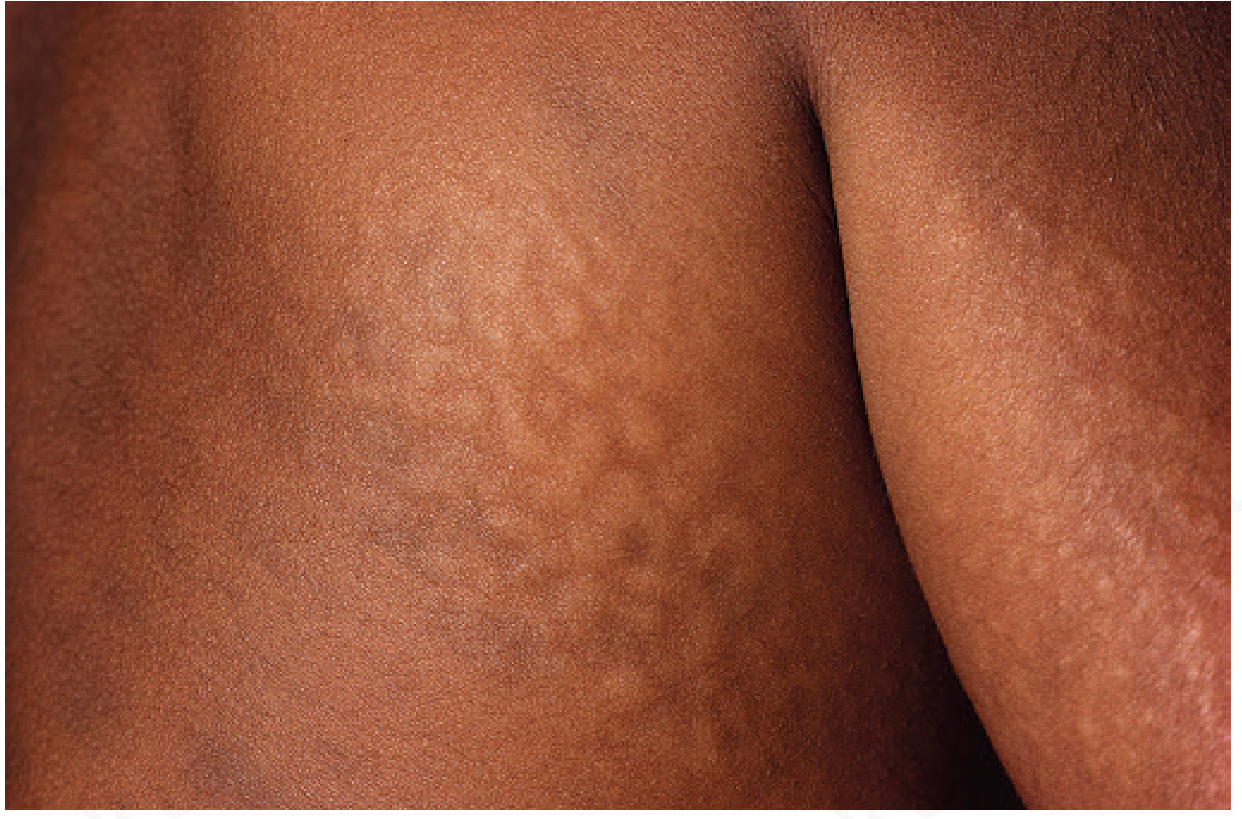
- Andrews' Diseases of the Skin, p. 628
How It Differs from Hurler Syndrome (MPS I)
| Feature | Hunter (MPS II) | Hurler (MPS I) |
|---|---|---|
| Inheritance | X-linked recessive | Autosomal recessive |
| Corneal clouding | Absent | Present |
| GAG stored | Dermatan + heparan sulfate | Same |
| Deficient enzyme | Iduronate-2-sulfatase | Alpha-L-iduronidase |
| Skin lesions | Characteristic papules | Less prominent |
Diagnosis
- Urine GAG analysis: Elevated dermatan sulfate and heparan sulfate in urine
- Enzyme assay: Absent or markedly reduced iduronate-2-sulfatase activity in leukocytes or serum
- Molecular testing: Direct IDS gene analysis (confirms diagnosis, identifies carrier females)
- Supportive investigations: Skeletal survey, echocardiography, ophthalmologic exam, audiology
- Emery's Elements of Medical Genetics, p. 290 | Goldman-Cecil Medicine, p. 2748
Prognosis
- Severe (neuronopathic) form: progressive deterioration, death usually in adolescence
- Attenuated form: survival into adulthood is possible with less severe neurological involvement
Treatment
Enzyme Replacement Therapy (ERT)
- Idursulfase (Elaprase) - recombinant I2S, given by IV infusion every 2 weeks
- Reduces somatic burden (hepatosplenomegaly, joint mobility, respiratory function) but has limited CNS penetration for neurological disease
- A 2024 systematic review (PMID 39201256) confirms its efficacy for somatic manifestations of MPS II
Hematopoietic Stem Cell Transplantation (HSCT)
- Considered in selected patients, especially early in disease course
- Better outcomes when done early; does not reliably prevent mental retardation
- Less established for MPS II compared to MPS I (Hurler)
Supportive Management
-
VP shunting if intracranial hypertension develops
-
Hearing aids / ENT surveillance for combined hearing loss
-
Cardiology monitoring and surgery for valvular disease
-
Orthopedic surgery for joint replacement and spinal stabilization
-
Carpal tunnel release (common in adults)
-
Adenotonsillectomy / CPAP for obstructive airway disease and sleep apnea
-
Anesthesia precautions: high risk due to narrow airway and cervical instability - requires specialist preparation
-
Goldman-Cecil Medicine, p. 2748 | Andrews' Diseases of the Skin, p. 628 | K.J. Lee's Essential Otolaryngology, p. 1019
Key Memory Points
- Only X-linked MPS (vs all others being autosomal recessive)
- Enzyme: iduronate-2-sulfatase (IDS gene)
- GAGs: dermatan + heparan sulfate in urine
- No corneal clouding (unlike Hurler)
- Cobblestone skin papules + atypical Mongolian spots = pathognomonic clues
- Combined hearing loss is characteristic
- Treatment: idursulfase (ERT) + supportive multisystem care
This is a shared conversation. Sign in to Orris to start your own chat.