
MAC-BAR
Reading File
MAC-BAR is a mnemonic used in clinical medicine. Let me look this up properly.
Searching sources...
Finding Sources
Searching the Web
MAC-BAR mnemonic medical anesthesia clinical
Now let me pull the relevant textbook content for a more complete answer.
Reading File
Reading File
Let me also fetch the figure showing the MAC-BAR relationship with fentanyl.
Loading Image
Here is a complete explanation of MAC-BAR:
MAC-BAR (Block Adrenergic Response)
Definition
MAC-BAR is the minimum alveolar concentration (MAC) of a volatile anesthetic required to block the adrenergic (sympathetic) response to a noxious surgical stimulus - specifically, to prevent an increase in heart rate or mean arterial pressure >15% in response to skin incision in 50% of patients.
- The "BAR" stands for Block Adrenergic Response
- It was originally determined by measuring venous catecholamine levels in response to surgical incision
Numeric Value
MAC-BAR is significantly higher than standard MAC:
| MAC Variant | Approximate Value | Clinical Meaning |
|---|---|---|
| MAC-Awake | ~0.3-0.5 MAC | 50% of patients open eyes to command |
| MAC | 1.0 MAC (reference) | 50% of patients do not move to surgical incision |
| MAC-BAR | ~1.5-1.7 MAC | Blocks autonomic/adrenergic response to incision in 50% of patients |
| MAC-BAR₉₅ | ~2.0 MAC | Blocks autonomic response in 95% of patients |
Because MAC-BAR requires roughly 1.5-1.7x the standard MAC, achieving it with a volatile agent alone risks significant hemodynamic instability (hypotension, myocardial depression). This is why balanced anesthesia incorporating opioids is standard practice.
Why MAC-BAR Matters Clinically
The autonomic response to surgical incision - tachycardia, hypertension, pupil dilation, and catecholamine release - is mediated by the sympathetic nervous system. Standard MAC (immobility) suppresses spinal cord-mediated movement, but higher brain centers controlling the sympathetic axis require greater anesthetic depth to be suppressed. Thus:
- Standard MAC → prevents movement (spinal reflex)
- MAC-BAR → prevents sympathetic surge (supraspinal/cardiovascular reflex)
Reducing MAC-BAR with Opioids
Opioids profoundly reduce MAC-BAR, which is the pharmacologic rationale for opioid use in balanced anesthesia:
- Fentanyl at 3 ng/mL reduces the MAC of sevoflurane by ~61%
- This same dose-dependent reduction applies to MAC-BAR (see figure below)
- A ceiling effect exists: increasing fentanyl beyond ~6 ng/mL provides diminishing returns in MAC-BAR reduction
- Remifentanil similarly shows synergistic reduction of both MAC and MAC-BAR with sevoflurane
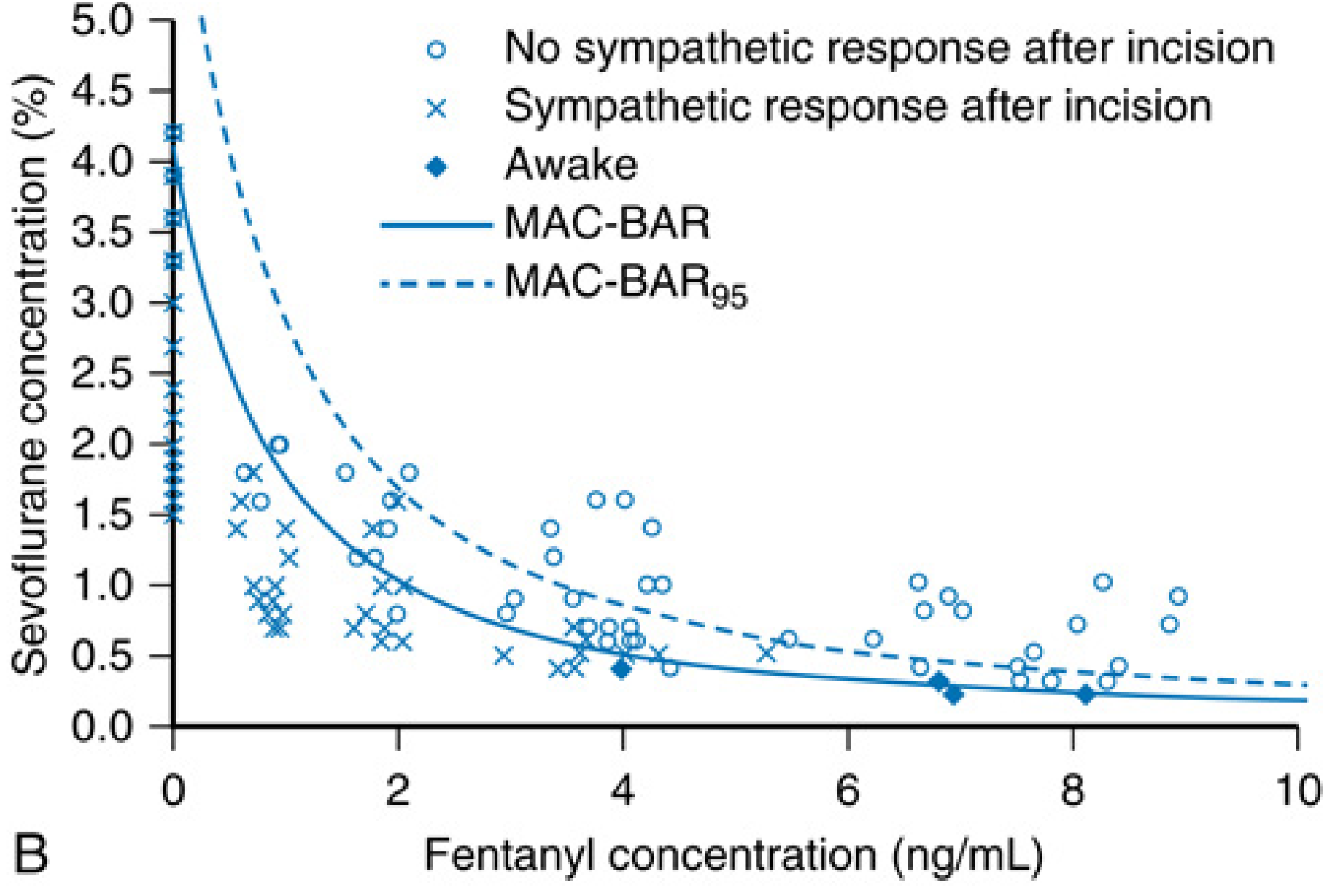
Figure: Reduction of sevoflurane MAC-BAR (solid line) and MAC-BAR₉₅ (dashed line) with increasing fentanyl plasma concentrations. Note the initial steep decrease with low fentanyl doses, followed by a plateau (ceiling effect) at higher concentrations. - Miller's Anesthesia, 10e
Key Points Summary
- MAC-BAR ≈ 1.5 MAC (roughly 50% higher than standard MAC)
- It reflects the dose needed to block the adrenergic stress response, not just movement
- Clinically impractical to achieve with volatile agent alone due to hemodynamic side effects
- Opioids (especially fentanyl, remifentanil) synergistically lower MAC-BAR, enabling the use of lower volatile agent concentrations while still blunting the stress response
- This is the fundamental basis for opioid-based balanced anesthesia
Sources: Barash's Clinical Anesthesia, 9e, p. 1407-1408; Miller's Anesthesia, 10e, p. 2831-2834
Reflex sympathetic dystrophy
Reading File
Your credits are exhausted. Your daily credits reset tomorrow, or you can purchase a top-up for more.
This is a shared conversation. Sign in to Orris to start your own chat.