
SYSTEMIC LUPUS Erythematosis
Reading File
Finding Sources
Finding Sources
Searching Images
systemic lupus erythematosus butterfly rash clinical
The best comprehensive sources are the Andrews' Diseases of the Skin and Textbook of Family Medicine. Let me read those sections now.
Reading File
Reading File
Finding Sources
Let me get the Harrison's section on SLE and continue reading the Andrews' Diseases of the Skin text:
Reading File
Reading File
Reading File
I now have comprehensive information. Let me compile the full response.
Systemic Lupus Erythematosus (SLE)
Definition & Overview
SLE is a generalized autoimmune disease of unknown cause characterized by the production of antibodies to numerous antigens — most importantly, antibodies directed against the cell nucleus (ANAs). Immune complex deposition results in inflammation and vasculitis, causing multiorgan pathology. — Textbook of Family Medicine 9e
Epidemiology
- Predominantly affects young to middle-aged women (peak ages 15–40)
- Female:male ratio is 2:1 before puberty, rising to 4:1 after puberty
- Prevalence ~1 in 1000–2500 in the general population; up to 1 in 250 in African American women aged 18–65
- Strong familial tendency; associated with MHC genes DR2, DR3, DR4, DR5
- 5-year survival rate: ~90% after diagnosis
- Monozygotic twin concordance is only ~25%, indicating environmental triggers are critical
Pathogenesis
| Mechanism | Detail |
|---|---|
| Genetic susceptibility | >100 loci identified; HLA-DR3, C4 null alleles (Europeans), DNASE1L3, TREX1 mutations |
| Autoantibody production | Anti-dsDNA, anti-Sm, anti-Ro/SSA, anti-La/SSB, antiphospholipid antibodies |
| Immune complex deposition | Complement-mediated tissue damage; reduced clearance by reticuloendothelial system |
| T-cell dysfunction | Reduced T-suppressor cell function; B-cell overproduction of γ-globulins |
| Type I interferon pathway | Increased IFN-inducible proteins; nucleic acid sensing gene abnormalities |
| Triggers | UV light (externalizes Ro/SSA antigen), infections, stress, drugs, hormones |
— Andrews' Diseases of the Skin 13e; Textbook of Family Medicine 9e
Clinical Manifestations
(From Harrison's Principles of Internal Medicine 22E, Table 368-1)
| System | Features |
|---|---|
| Constitutional | Fatigue, malaise, fever, weight loss |
| Cutaneous | Photosensitivity, malar rash, discoid rash, SCLE, oral/nasal ulcers, alopecia, bullous lupus, vasculitic lesions |
| Musculoskeletal | Arthralgia, polyarthritis, myalgia, Jaccoud deformity, avascular necrosis |
| Renal | Proteinuria ≥500 mg/24h, cellular casts, nephrotic syndrome, ESRD |
| Neuropsychiatric | Cognitive dysfunction, seizures, psychosis, stroke, transverse myelitis, mood disorders |
| Cardiopulmonary | Pleuritis, pericarditis, myocarditis, Libman-Sacks endocarditis, pneumonitis, pulmonary hypertension |
| Hematologic | Hemolytic anemia, leukopenia, lymphopenia, thrombocytopenia, venous/arterial thrombosis |
| Vascular | Raynaud's phenomenon, stroke, MI, DVT/PE |
| GI | Nausea, abdominal pain, elevated liver enzymes, lupus peritonitis, pancreatitis |
| Ocular | Sicca syndrome, episcleritis, retinal vasculitis |
Cutaneous Manifestations in Detail
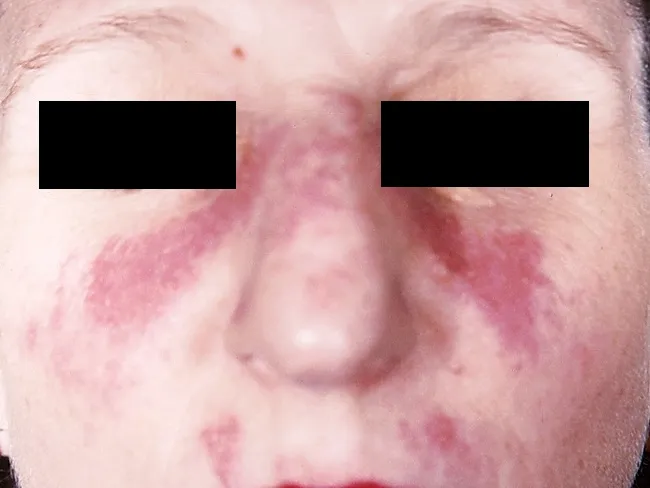
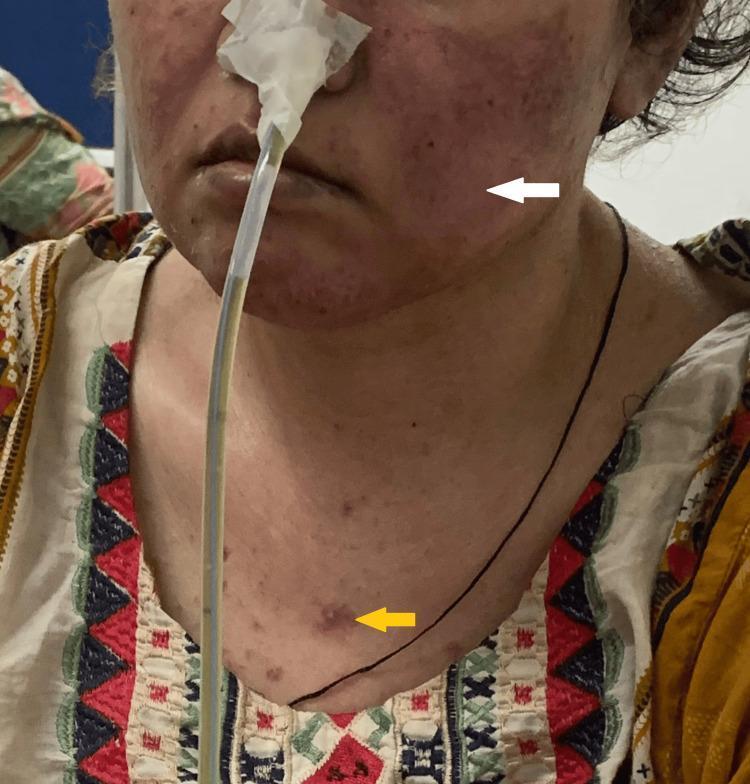
The butterfly (malar) rash — the hallmark that gave lupus its name (Latin: wolf) — appears in only one-third of patients, typically after sun exposure, affecting the malar area and nasal bridge with characteristic sparing of the nasolabial folds (unlike dermatomyositis). Edema may be present; biopsies show interface dermatitis with perivascular lymphoid infiltrate. It resolves without scarring.
Subacute cutaneous LE (SCLE) occurs in sun-exposed areas (upper torso) as annular or papulosquamous lesions; ~70% have anti-Ro antibodies; no scarring.
Discoid LE (DLE): Raised, adherent-scaled plaques with follicular plugging; heals with scarring and dyspigmentation.
Bullous LE: Vesicles or bullae, often widespread.
— Andrews' Diseases of the Skin 13e; Textbook of Family Medicine 9e
Classic Malar (Butterfly) Rash
Diagnostic Criteria
ACR 11-Criteria (≥4 required for diagnosis)
- Malar rash
- Discoid rash
- Photosensitivity
- Oral ulcers
- Arthritis (non-erosive)
- Serositis (pleuritis or pericarditis)
- Renal disorder (proteinuria >0.5 g/day or cellular casts)
- Neurologic disorder (seizures or psychosis without other cause)
- Hematologic disorder (hemolytic anemia, leukopenia, thrombocytopenia)
- Immunologic disorders (anti-dsDNA, anti-Sm, APLAs)
- Positive ANA
Four of these 11 criteria, present serially or simultaneously, confirm the diagnosis. Note that 4 of the 11 are mucocutaneous findings.
SLICC Criteria (higher sensitivity)
≥4 criteria including ≥1 clinical AND ≥1 immunologic, OR biopsy-proven lupus nephritis with positive ANA or anti-dsDNA.
The newer EULAR/ACR 2019 criteria require ANA ≥1:80 as an entry criterion.
— Andrews' Diseases of the Skin 13e; Harrison's 22E
Autoantibodies
| Antibody | Prevalence in SLE | Specificity | Clinical Correlation |
|---|---|---|---|
| ANA | ~95–99% | Low | Best screening test |
| Anti-dsDNA | 40–60% | 75–99% | Disease activity, lupus nephritis |
| Anti-Sm | ~30% | 55–100% | Highly specific for SLE |
| Anti-Ro/SSA | ~30–40% | Moderate | SCLE, photosensitivity, neonatal lupus |
| Anti-La/SSB | ~15–20% | Moderate | Neonatal lupus, secondary Sjögren's |
| Antiphospholipid (APLAs) | ~30–40% | Moderate | Thrombosis, pregnancy loss |
Anti-dsDNA and anti-Sm are essentially diagnostic of SLE when positive.
— Harrison's 22E; Andrews' Diseases of the Skin 13e
Lupus Nephritis
Renal involvement is a major determinant of prognosis. ISN/RPS classes:
| Class | Histology |
|---|---|
| I | Minimal mesangial |
| II | Mesangial proliferative |
| III | Focal proliferative (<50% glomeruli) |
| IV | Diffuse proliferative (≥50% glomeruli) — most severe |
| V | Membranous |
| VI | Advanced sclerotic |
Classes III, IV, V (and combinations) require active immunosuppression.
Special Situations
Neonatal lupus: Anti-Ro/anti-La antibodies cross the placenta → complete heart block, transient cutaneous lupus, and cytopenias in the neonate.
Drug-induced lupus: Hydralazine, procainamide, isoniazid, minocycline, TNF inhibitors. Associated with anti-histone antibodies; resolves on drug withdrawal.
Pregnancy: SLE increases risk of miscarriage (especially with APLAs), fetal growth restriction, and preeclampsia. Postpartum flares are common.
Management
General Principles
- All patients: hydroxychloroquine (reduces flares, organ damage, mortality — mainstay)
- Avoid UV light, use broad-spectrum sunscreen
- Screen for and manage cardiovascular risk factors (accelerated atherosclerosis)
Organ-specific Treatment
| Manifestation | Treatment |
|---|---|
| Mild (skin, joints) | Hydroxychloroquine, NSAIDs, low-dose corticosteroids, topical steroids |
| Moderate–severe | Systemic corticosteroids + immunosuppressants (azathioprine, MMF) |
| Lupus nephritis (class III/IV) | MMF or cyclophosphamide + corticosteroids; belimumab or voclosporin as add-on |
| Refractory nephritis | Rituximab (anti-CD20) |
| Hemolytic anemia / severe thrombocytopenia | Rituximab, corticosteroids |
| APS/thrombosis | Warfarin (preferred over DOACs) |
| CNS lupus (psychosis, vasculitis, TM) | High-dose steroids + MMF, cyclophosphamide, or rituximab |
| Serositis | NSAIDs, colchicine, low-dose steroids |
Biologics
- Belimumab (anti-BLyS): FDA-approved for SLE and lupus nephritis
- Voclosporin (calcineurin inhibitor): FDA-approved (2021) for lupus nephritis
- Anifrolumab (anti-IFN-α receptor): FDA-approved for active SLE
— Harrison's Principles of Internal Medicine 22E; Textbook of Family Medicine 9e; Andrews' Diseases of the Skin 13e
Prognosis & Monitoring
- Major causes of early death: active lupus, infections (immunosuppression), renal failure
- Major causes of late death: cardiovascular disease (accelerated atherosclerosis), damage accrual
- Monitor with anti-dsDNA titers and complement levels (C3/C4) — low C3/C4 + rising anti-dsDNA = impending flare
- Screen regularly for lupus nephritis (urine protein:creatinine ratio, sediment), blood pressure, lipids, and bone density (if on steroids)
This is a shared conversation. Sign in to Orris to start your own chat.