
Syphillis in neonates born to VDRL positive mother
Reading File
Now let me search the medical library for congenital syphilis content in parallel.
Finding Sources
Finding Sources
Searching PubMed
"congenital syphilis" AND "neonates"
Good results. Let me now read the most relevant sections in parallel - from Creasy & Resnik (MFM), Fitzpatrick's, and Goldman-Cecil.
Reading File
Reading File
Reading File
Excellent content. Now let me read the treatment/management sections and the neonate evaluation sections from Creasy & Resnik and Fitzpatrick's.
Reading File
Reading File
Reading File
Now let me get the neonatal evaluation and treatment section from Fitzpatrick's (the Jarisch-Herxheimer and treatment section) and the CDC-based neonatal management algorithm from Creasy & Resnik.
Reading File
Finding Sources
I now have comprehensive data to provide a thorough answer. Let me also fetch one image from the textbook to include.
Loading Image
Loading Image
I now have all the content needed for a comprehensive answer. Here is the complete synthesis:
Congenital Syphilis: Neonates Born to VDRL-Positive Mothers
Transmission and Risk
Treponema pallidum can cross the placenta as early as 6 weeks' gestation, though fetal immune response and anatomic damage are not apparent until after 16 weeks. Transmission risk depends on the stage of maternal infection:
| Maternal Stage | Risk of Transmission |
|---|---|
| Primary / Secondary syphilis | 50-100% |
| Early latent (<1 year) | ~40% |
| Late latent (>1 year) | ~10% |
Intrapartum transmission is also possible via contact with active genital lesions. ~30-40% of cases result in stillbirth. Of surviving infants, two-thirds are asymptomatic at birth and develop signs within 3-8 weeks.
- Creasy & Resnik's Maternal-Fetal Medicine; Fitzpatrick's Dermatology, Vol. 1-2
Classification: Case Definition
Confirmed Case
Infant in whom T. pallidum is identified by dark-field microscopy, fluorescent antibody, or specific stains in specimens from lesions, placenta, umbilical cord, or autopsy material.
Presumptive Case
Any infant whose mother had untreated or inadequately treated syphilis at delivery, OR any infant with a reactive treponemal test plus any one of:
- Clinical evidence of congenital syphilis on examination
- Reactive CSF VDRL test
- Elevated CSF WBC (>5/mm³) or protein (>50 mg/dL)
- Reactive FTA-ABS (19S IgM fraction)
Clinical Features
Early Congenital Syphilis (onset <2 years of age)
Skin:
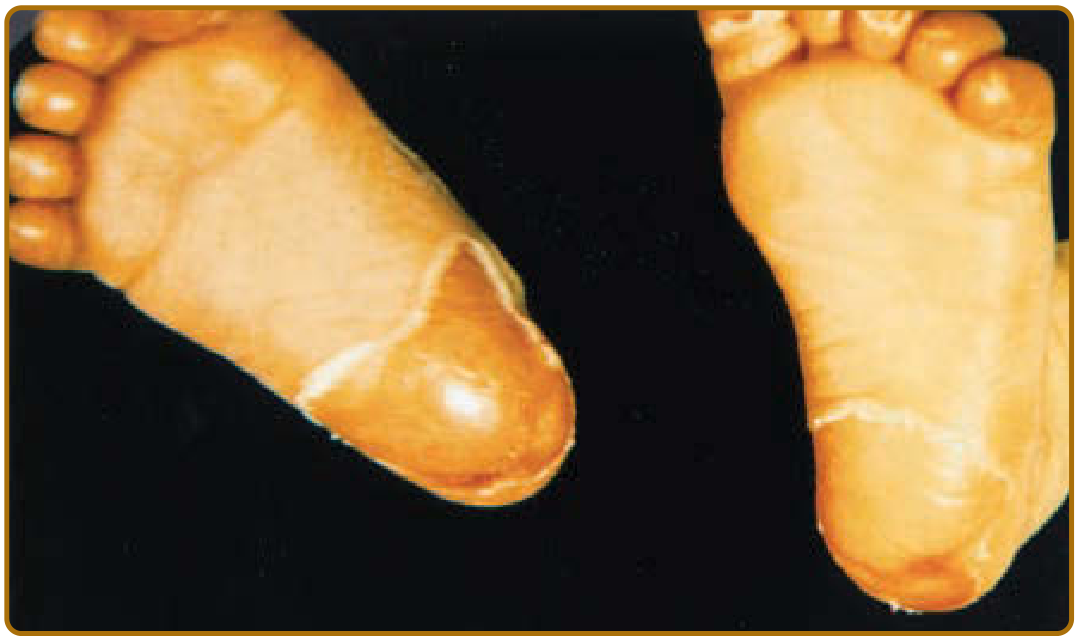
- If present at delivery: bullous eruptions ("syphilitic pemphigus") - very infectious
- Rash appearing ≥2 weeks after birth: copper-red maculopapular lesions, predominantly palms and soles, with desquamation and crusting
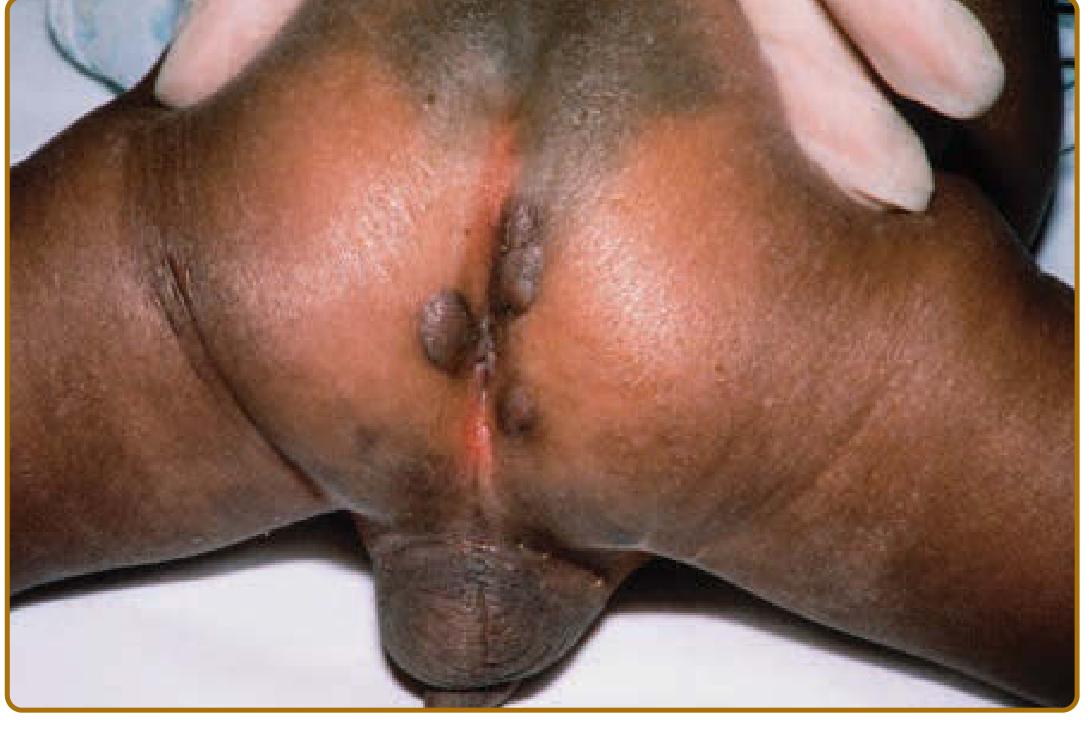
- Condyloma lata, mucous patches, perioral/perianal/pernasal fissures
- Skin may appear dry, wrinkled, cafe-au-lait hue in fair-skinned neonates
Systemic:
- "Snuffles" - persistent, often blood-tinged rhinitis (nasal discharge); very infectious
- Hepatosplenomegaly and jaundice
- Lymphadenopathy
- Hemolytic anemia, leukocytosis, thrombocytopenia
- Hydrops fetalis (nonimmune edema)
- Parrot pseudoparalysis - immobility of an extremity due to painful osteochondritis (the infant refuses to move the affected limb)
- Periostitis on long-bone X-rays
- Neurosyphilis, chorioretinitis, iritis
Note: Chancres do NOT occur unless infection is acquired intrapartum during passage through the birth canal.
Late Congenital Syphilis (onset >2 years of age)
These are largely irreversible sequelae from scarring and persistent inflammation:
| Feature | Description |
|---|---|
| Hutchinson teeth | Upper central incisors - widely spaced, centrally notched, screwdriver-shaped |
| Mulberry molars | Poorly formed cusps on first molars |
| Interstitial keratitis | Corneal vascularization, leading to blindness |
| 8th nerve deafness | Sensorineural hearing loss |
| Saddle nose | Destruction of nasal cartilage |
| Saber shins | Anterior bowing of tibia from chronic periostitis |
| Frontal bossing | "Olympian brow" - prominent frontal bones |
| Rhagades | Linear scars at angles of mouth/nares/anus |
| Clutton joints | Late-onset symmetric knee arthritis |
| Higoumenakia sign | Thickening of sternoclavicular clavicle |
| Neurologic | Mental retardation, hydrocephalus, general paresis, optic nerve atrophy |
Hutchinson teeth + interstitial keratitis + 8th nerve deafness = Hutchinson's triad
Serologic Diagnosis in Neonates
This is the trickiest area due to passive transfer of maternal IgG antibodies (both treponemal and nontreponemal) across the placenta:
- Nontreponemal tests (VDRL, RPR): Quantitative test must be done on infant serum (not cord blood - cord blood may be contaminated with maternal blood giving false positives)
- Treponemal tests (FTA-ABS, TPPA) are difficult to interpret in neonates and not recommended by CDC for diagnosis in this setting
- Maternal IgG can persist in infant serum for up to 15 months
- Infant IgM (which does NOT cross placenta) positivity is diagnostic of fetal infection
Key Interpretation Rule:
A neonate's VDRL/RPR titer 4-fold higher than the mother's titer at delivery suggests active congenital infection rather than passive transfer.
- Fitzpatrick's Dermatology, Vol. 1-2; Goldman-Cecil Medicine
Evaluation of the Neonate (CDC Framework)
All neonates born to VDRL/RPR-positive mothers should undergo:
- Full physical examination for signs of congenital syphilis
- Quantitative nontreponemal test on infant serum (not cord blood)
- Dark-field microscopy or PCR of suspicious lesions or nasal discharge
- Placental examination with specific staining or T. pallidum PCR
For neonates with proven, highly probable, or possible congenital syphilis:
- CSF analysis: VDRL reactivity, WBC count, protein level
- Long-bone radiographs: periostitis, metaphyseal lucencies
- Chest X-ray
- Liver function tests
- Neuroimaging
- Ophthalmologic examination
- Auditory brainstem response (ABR)
Treatment
Penicillin G is the only proven treatment. T. pallidum is inhibited by <0.01 µg/mL of penicillin G. Because treponemes divide slowly, serum levels must be maintained for many days.
Neonates with Proven or Highly Probable Congenital Syphilis:
Aqueous crystalline penicillin G 50,000 units/kg IV every 12 hours (first 7 days of life) then every 8 hours (after 7 days), for a total of 10 days
OR
Procaine penicillin G 50,000 units/kg IM once daily for 10 days
CSF abnormalities or confirmed neurosyphilis: aqueous penicillin G IV is strongly preferred.
Neonates with Possible Congenital Syphilis (asymptomatic, adequate maternal treatment uncertain):
Benzathine penicillin G 50,000 units/kg IM as a single dose may be considered after full evaluation.
Adequacy of Maternal Treatment:
Treatment of the mother before 16 weeks of pregnancy usually prevents clinical illness in the neonate. Later treatment may not prevent late sequelae. Treatment is considered adequate only if:
- Benzathine penicillin G was given in appropriate dose and stage
- Treatment was completed >30 days before delivery
- Maternal titres showed appropriate 4-fold decline
Prognosis and Follow-up
- Penicillin is highly effective at eradicating infection
- 60-90% of exposed neonates are asymptomatic at birth but may develop signs within the first 3 months without treatment
- Adverse outcomes with untreated maternal infection: stillbirth rate ~29-35%, neonatal mortality ~14%, preterm birth ~28%, fetal growth restriction in ~21%
- Nontreponemal titers should be followed at 3, 6, and 12 months; titers should decline by 4-fold within 3-6 months
- Late sequelae (interstitial keratitis, 8th nerve deafness, Clutton joints) may appear in the first two decades of life even after adequate neonatal treatment
- Goldman-Cecil Medicine; Creasy & Resnik's Maternal-Fetal Medicine
Key Differentials for Early Congenital Syphilis
The presentation of symptomatic congenital syphilis resembles other TORCH infections:
- Cytomegalovirus (CMV)
- Toxoplasmosis
- Herpes simplex virus (HSV)
- Rubella
Recent evidence note: A 2025 systematic review (PMID: 41671009) examined effectiveness of treating gestational syphilis in the last trimester on congenital syphilis incidence, reinforcing that late treatment still reduces but does not eliminate risk.
This is a shared conversation. Sign in to Orris to start your own chat.