
Explain the mechanism of hormone action(peptide)
Reading File
Now let me search the library for relevant content on peptide hormone mechanisms.
Finding Sources
Finding Sources
Excellent sources found. Let me read the most relevant sections in parallel.
Reading File
Reading File
Reading File
Let me read more of the Guyton & Hall and Costanzo sections for full details on the signaling pathways, and also fetch the diagram.
Reading File
Reading File
Loading Image
Let me read more of the Costanzo section covering the full cAMP, IP3/Ca²⁺ and tyrosine kinase mechanisms, and fetch the leptin receptor diagram too.
Reading File
Loading Image
Let me get the rest of the Costanzo section (IP3/Ca²⁺, tyrosine kinase, cGMP) and also fetch the adenylyl cyclase diagram.
Reading File
Loading Image
Now let me get the IP3/Ca²⁺ mechanism and tyrosine kinase sections, and search for a phospholipase C diagram.
Reading File
Searching Images
phospholipase C IP3 DAG calcium second messenger peptide hormone
I now have comprehensive content from multiple authoritative textbooks. Let me fetch the phospholipase C mechanism diagram from Costanzo and the GPCR signaling overview.
Loading Image
Loading Image
I now have everything needed to give a comprehensive, well-illustrated answer. Here it is:
Mechanism of Action of Peptide Hormones
Overview
Peptide hormones (small peptides, polypeptides, and proteins) are water-soluble and therefore cannot cross the lipid bilayer of the cell membrane. They exert their effects by binding to receptors on the cell surface, triggering intracellular signaling cascades via second messengers. The hormone itself is the "first messenger"; the intracellular molecule it generates is the "second messenger."
The major intracellular pathways are:
- Adenylyl cyclase / cAMP pathway (via Gs or Gi proteins)
- Phospholipase C / IP3–Ca²⁺ pathway (via Gq proteins)
- Tyrosine kinase / JAK-STAT pathway (enzyme-linked receptors)
- Guanylyl cyclase / cGMP pathway
Step 0 — G Proteins: The Molecular Switch
Most peptide hormone receptors are coupled to heterotrimeric G proteins (α, β, γ subunits). When no hormone is bound, the α subunit holds GDP and the complex is inactive.
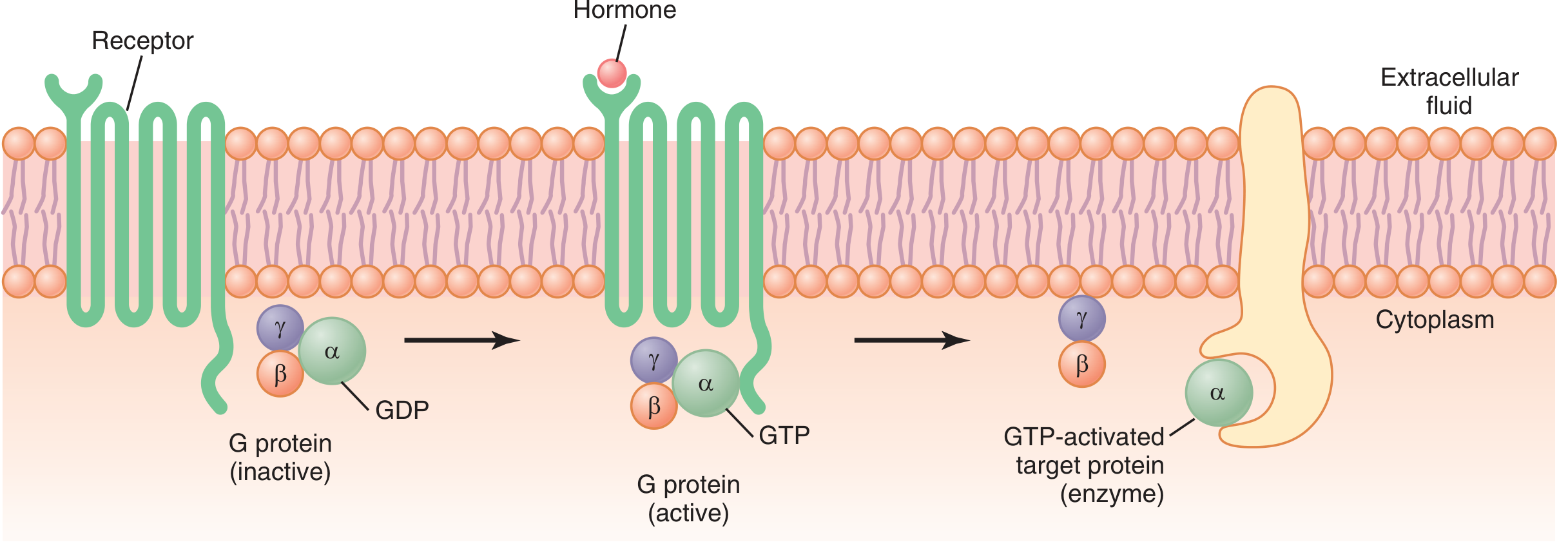
- Gs proteins → stimulate adenylyl cyclase (↑ cAMP)
- Gi proteins → inhibit adenylyl cyclase (↓ cAMP)
- Gq proteins → activate phospholipase C (↑ IP3 + DAG)
The α subunit self-inactivates via intrinsic GTPase activity, which hydrolyzes GTP → GDP, restoring the inactive state. This is an essential "off switch."
Guyton and Hall Textbook of Medical Physiology, p. 910
Pathway 1 — Adenylyl Cyclase / cAMP Mechanism
Hormones using this pathway: TSH, ACTH, FSH, LH, PTH, glucagon, ADH (V2 receptor), calcitonin, β-adrenergic agonists (catecholamines)
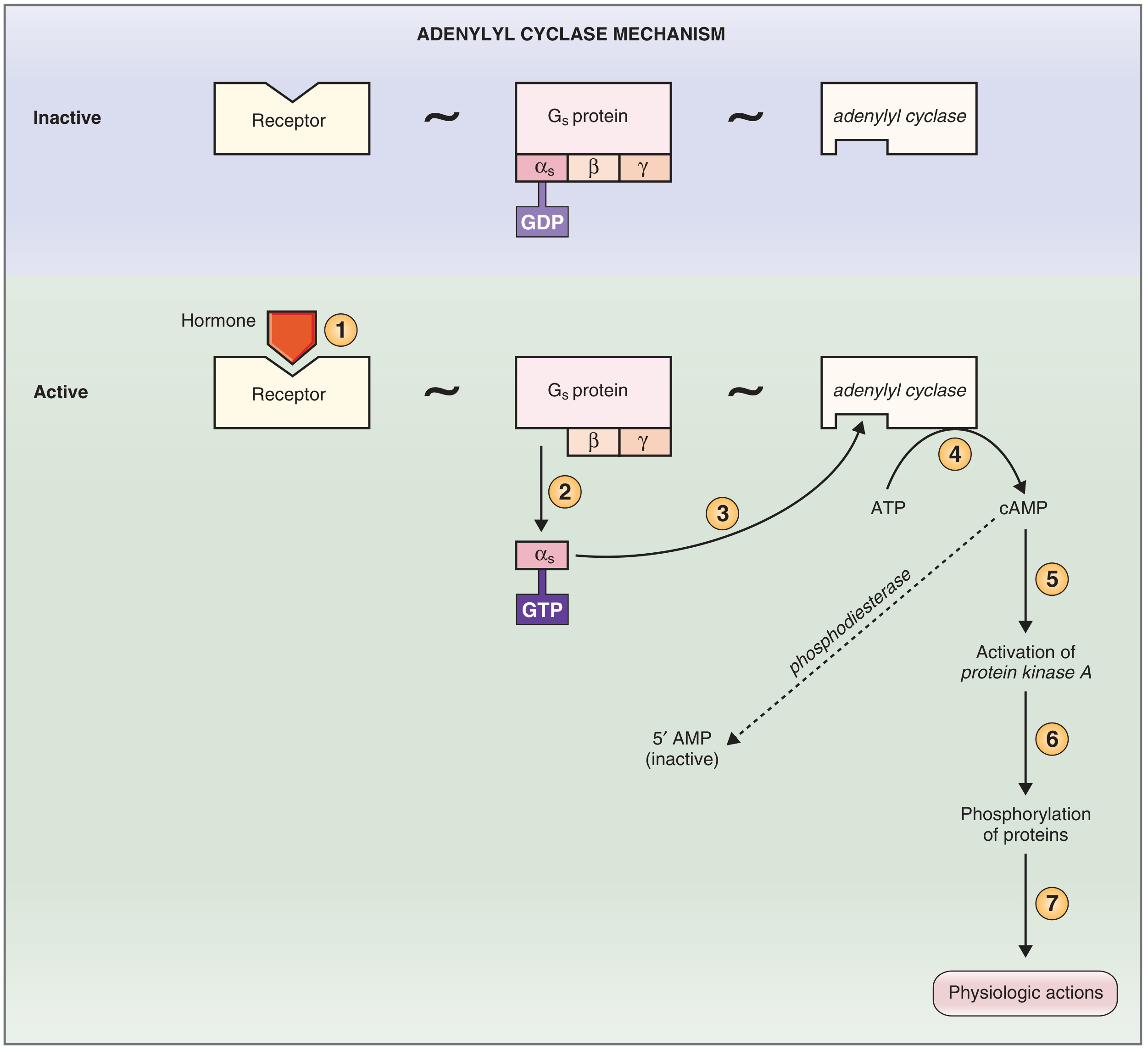
Steps (numbered in diagram):
| Step | Event |
|---|---|
| ① | Hormone binds receptor → conformational change in αs subunit |
| ② | GDP released from αs, replaced by GTP; αs dissociates from βγ |
| ③ | αs–GTP migrates within membrane, binds and activates adenylyl cyclase |
| ④ | Adenylyl cyclase converts ATP → cAMP (second messenger) |
| ⑤ | cAMP activates protein kinase A (PKA) |
| ⑥ | PKA phosphorylates intracellular proteins (serine/threonine residues) |
| ⑦ | Phosphorylated proteins execute the final physiologic actions |
Termination: The enzyme phosphodiesterase degrades cAMP → 5′ AMP (inactive), switching off the signal.
Costanzo Physiology 7th Edition, p. 406–407
Pathway 2 — Phospholipase C / IP3–Ca²⁺ Mechanism
Hormones using this pathway: GnRH, TRH, oxytocin (uterus), angiotensin II, ADH (V1 receptor), α1-adrenergic agonists
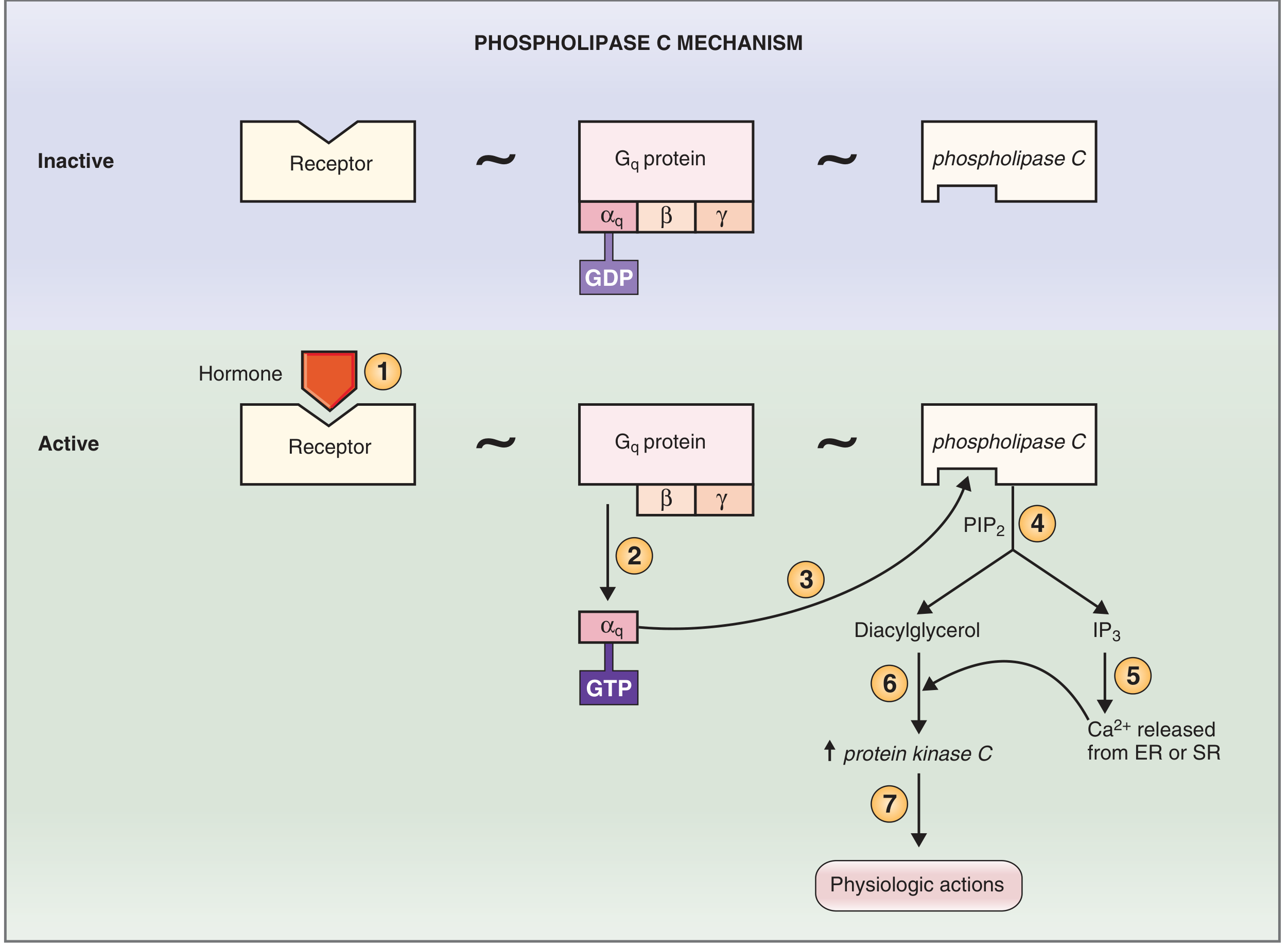
Steps:
| Step | Event |
|---|---|
| ① | Hormone binds receptor → conformational change in αq subunit |
| ② | GDP exchanged for GTP; αq detaches from βγ |
| ③ | αq–GTP activates phospholipase C (PLC) |
| ④ | PLC cleaves PIP2 (phosphatidylinositol 4,5-bisphosphate) → diacylglycerol (DAG) + IP3 |
| ⑤ | IP3 diffuses to the ER/SR → triggers Ca²⁺ release into cytoplasm |
| ⑥ | Ca²⁺ + DAG together activate protein kinase C (PKC) |
| ⑦ | PKC phosphorylates target proteins → physiologic actions |
Additional Ca²⁺ effects: Ca²⁺ binds calmodulin → activates Ca²⁺-calmodulin-dependent kinase (CaMK) → phosphorylates further substrates (e.g., MLCK for smooth muscle contraction in oxytocin action).
Costanzo Physiology 7th Edition, p. 407–408
Pathway 3 — Tyrosine Kinase / JAK-STAT (Enzyme-Linked Receptors)
Hormones using this pathway: Insulin, IGF-1, growth hormone, leptin, prolactin, EGF, PDGF, VEGF
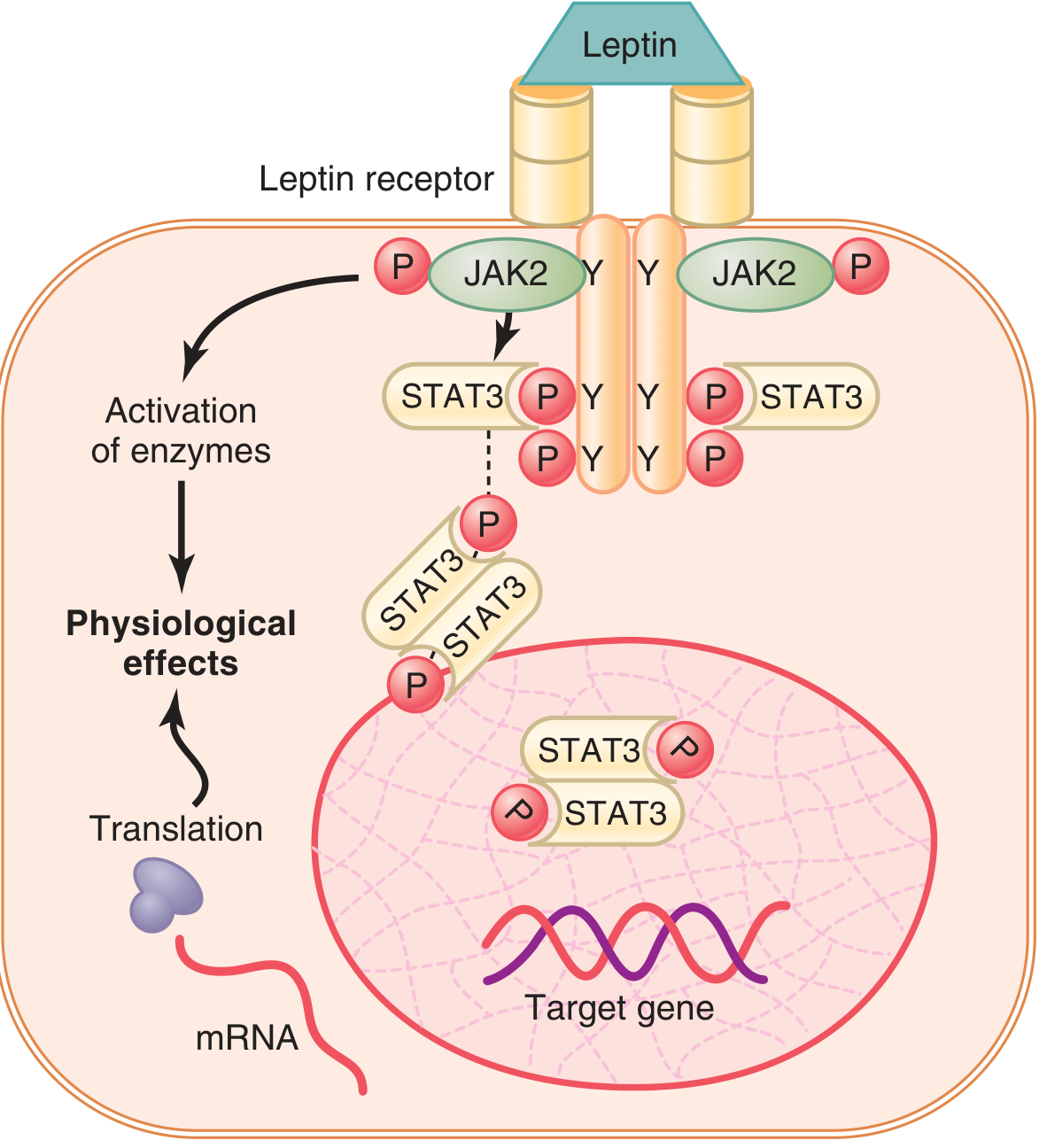
These receptors have intrinsic or associated enzymatic activity on their intracellular domain — no G protein intermediary is needed.
Mechanism (using leptin/GH as example):
- Hormone binds to the extracellular domain of the receptor (which exists as a homodimer)
- Binding causes dimerization/conformational change → activates associated JAK2 (Janus kinase)
- JAK2 autophosphorylates (transphosphorylation between the two receptor halves)
- Phosphorylated JAK2 recruits and phosphorylates STAT proteins (Signal Transducers and Activators of Transcription)
- Phospho-STAT dimers translocate to the nucleus → bind DNA → gene transcription → new protein synthesis
Parallel rapid pathways activated by JAK2:
- MAPK (mitogen-activated protein kinase) → cell growth/proliferation
- PI3K (phosphatidylinositol 3-kinase) → cell survival, metabolism
Insulin's intrinsic tyrosine kinase:
Insulin binds its receptor (which has intrinsic tyrosine kinase activity in the β subunits) → receptor autophosphorylates → phosphorylates IRS-1/IRS-2 (insulin receptor substrate) → activates PI3K–Akt pathway → GLUT4 translocation, glycogen synthesis, lipogenesis.
Guyton and Hall Textbook of Medical Physiology, p. 911
Pathway 4 — Guanylyl Cyclase / cGMP Mechanism
Hormones using this pathway: Atrial natriuretic peptide (ANP), B-type natriuretic peptide (BNP), NO (nitric oxide)
Steps:
- ANP binds to its receptor, whose intracellular domain is guanylyl cyclase
- Binding activates guanylyl cyclase → converts GTP → cGMP
- cGMP activates cGMP-dependent protein kinase (PKG)
- PKG phosphorylates target proteins → natriuresis, vasodilation, reduced aldosterone secretion
Nitric oxide uses a cytosolic (soluble) guanylyl cyclase in smooth muscle → relaxation.
Costanzo Physiology 7th Edition, p. 408
Signal Amplification
A key feature of peptide hormone action is signal amplification at each step of the cascade. A single hormone-receptor binding event activates many G proteins, each activating many adenylyl cyclase molecules, each producing thousands of cAMP molecules, each activating many PKA molecules — resulting in enormous amplification of a very small initial signal.
Receptor Regulation
| Mechanism | Definition | Example |
|---|---|---|
| Down-regulation | ↓ receptor number or affinity when hormone levels chronically elevated | Progesterone ↓ its own uterine receptors |
| Up-regulation | ↑ receptor number or affinity | Low TSH → ↑ TSH receptors on thyroid |
| Desensitization | Receptor phosphorylation by GRK → β-arrestin binding → internalization | β-adrenergic receptor after sustained catecholamine exposure |
Costanzo Physiology 7th Edition, p. 404–406
Summary Table
| Pathway | G Protein | Effector Enzyme | Second Messenger | Kinase | Example Hormones |
|---|---|---|---|---|---|
| Adenylyl cyclase | Gs (↑) / Gi (↓) | Adenylyl cyclase | cAMP | PKA | TSH, ACTH, PTH, glucagon, FSH, LH |
| Phospholipase C | Gq | Phospholipase C | IP3 + DAG + Ca²⁺ | PKC, CaMK | GnRH, TRH, oxytocin, ADH (V1) |
| Tyrosine kinase | None (direct) | Receptor/JAK TK | Phosphotyrosine | JAK2, MAPK, PI3K | Insulin, GH, leptin, IGF-1 |
| Guanylyl cyclase | None (direct) | Guanylyl cyclase | cGMP | PKG | ANP, BNP |
The unifying principle: peptide hormones act on plasma membrane receptors, never entering the cell, and rely on intracellular second messengers and kinase cascades to translate the extracellular signal into a cellular response.
Focus on cAMP and IP3 pathway and explain in higher cont3x
Finding Sources
Finding Sources
Focus on cAMP and IP3 pathway and explain in higher context
Finding Sources
Finding Sources
Finding Sources
Finding Sources
Reading File
Finding Sources
Finding Sources
Excellent. Now let me read the deeper content from Medical Physiology (Boron & Boulpaep), Harper's, and Guyton & Hall for the high-context molecular detail on both pathways.
Reading File
Reading File
Reading File
Now let me get the deep IP3/Ca²⁺ content from Boron & Boulpaep (Medical Physiology) and the CREB nuclear signaling content, plus fetch key diagrams.
Reading File
Reading File
Loading Image
Now let me get the deep IP3 pathway from Medical Physiology and fetch the CREB diagram and IP3/PLC Guyton diagram.
Finding Sources
Loading Image
Loading Image
Now let me get the deep IP3/Ca²⁺ mechanism from Boron & Boulpaep Medical Physiology and the calmodulin/PKC content.
Finding Sources
Finding Sources
Can you stay relevant to cbme curriculum
Before I tailor this, let me confirm which CBME curriculum you're following:
Asking for Preferences
Which CBME curriculum are you following? · Which year/phase are you in?
Searching the Web
NMC CBME Phase 1 India biochemistry physiology peptide hormone cAMP IP3 learning objectives competencies
Finding Sources
You've run out of free credits. Sign up for a free account to continue using Orris.
This is a shared conversation. Sign in to Orris to start your own chat.