

Solve this fcps part 1 mcq with reason
Reading File
Finding Sources
Reading File
Answer: A — Rapid Ejection
Reason
The cardiac cycle has 4 phases:
| Phase | Valvular Event | What Happens |
|---|---|---|
| Phase 1 (Diastole) | AV valves open | Ventricular filling (rapid → slow → atrial kick) |
| Phase 2 (Systole) | AV valves close | Isovolumetric contraction — all valves shut, pressure builds |
| Phase 3 (Systole) | Semilunar valves open | Rapid ejection → then slower ejection |
| Phase 4 (Diastole) | Semilunar valves close | Isovolumetric relaxation — all valves shut again |
The semilunar valves (aortic + pulmonary) open at the start of Phase 3 — Rapid Ejection. This occurs once ventricular pressure during isovolumetric contraction (Phase 2) rises high enough to exceed aortic/pulmonary arterial pressure, forcing the semilunar valves open and allowing blood to eject rapidly.
Why the distractors are wrong:
- B (Slow ejection): The semilunar valves are already open during slow ejection — they opened at the start of Phase 3.
- C (Isovolumetric contraction): All four valves are closed during this phase — pressure is rising but hasn't yet exceeded outflow vessel pressure.
- D (Isovolumetric relaxation): Semilunar valves have just closed to begin this phase; AV valves haven't opened yet either.
The correct answer is A — Rapid Ejection.
— Medical Physiology (Boron & Boulpaep), Table 22-1, p. 745
Also explain the discussed topic in this MCQ
Finding Sources
Finding Sources
Reading File
Reading File
Reading File
Loading Image
Searching Images
Wiggers diagram cardiac cycle pressure volume phases
Loading Image
Here is a comprehensive explanation of the Cardiac Cycle — the topic of this MCQ.
The Cardiac Cycle
The cardiac cycle is the complete sequence of events from one heartbeat to the next. At 75 beats/min, one cycle lasts ~800 ms — systole (~300 ms) and diastole (~500 ms). It is governed by 4 phases, defined by the opening and closing of two sets of valves.
The Two Valve Sets
| Valve Type | Valves | Location |
|---|---|---|
| AV (inlet) valves | Mitral (left), Tricuspid (right) | Between atria and ventricles |
| Semilunar (outlet) valves | Aortic (left), Pulmonary (right) | Between ventricles and great arteries |
Key principle: Valves open and close passively based on pressure gradients — they open when upstream pressure > downstream pressure, and close when the reverse occurs.
The 4 Phases of the Cardiac Cycle
Phase 1 — Ventricular Filling (Diastole)
- AV valves: OPEN | Semilunar valves: CLOSED
- Ventricular pressure falls below atrial pressure → AV valves open
- Blood flows passively from atria into ventricles
- Sub-phases:
- Rapid filling (early): large pressure gradient, fast flow
- Diastasis (mid): slow trickle, pressures nearly equalized
- Atrial contraction (end): P wave on ECG; atrial "kick" adds ~20% of stroke volume at rest (up to 40% during exercise)
- Ends when the ventricle begins to contract and ventricular pressure exceeds atrial pressure → AV valves close → produces S1 heart sound
Phase 2 — Isovolumetric Contraction (Systole)
- ALL valves: CLOSED
- Triggered by QRS complex on ECG
- Ventricular muscle contracts → pressure rises rapidly
- Volume does not change (no blood in or out) — hence "isovolumetric"
- Ends when ventricular pressure exceeds aortic/pulmonary pressure → semilunar valves open
- This is the phase of maximum energy expenditure with no ejection
Phase 3 — Ventricular Ejection (Systole) ← Semilunar valves are OPEN here
- AV valves: CLOSED | Semilunar valves: OPEN
- Sub-phases:
- Rapid ejection (early): pressure peaks, ~70% of stroke volume ejected quickly — semilunar valves open at the START of this sub-phase
- Slow (reduced) ejection (late): pressure begins to fall, flow slows
- Stroke volume = ~70 mL (out of end-diastolic volume of ~130 mL)
- Ejection fraction (EF) = SV/EDV = ~55–65%
- Ends when ventricular pressure falls below aortic pressure → semilunar valves close → produces S2 heart sound (dub)
Phase 4 — Isovolumetric Relaxation (Diastole)
- ALL valves: CLOSED
- Ventricular muscle relaxes → pressure drops rapidly
- Volume unchanged (no blood in or out)
- Ends when ventricular pressure falls below atrial pressure → AV valves open → cycle repeats
Summary Table
| Phase | AV Valves | Semilunar Valves | What Happens |
|---|---|---|---|
| 1. Ventricular Filling | Open | Closed | Blood fills ventricles |
| 2. Isovolumetric Contraction | Closed | Closed | Pressure builds, no flow |
| 3. Ventricular Ejection | Closed | Open | Blood ejected to arteries |
| 4. Isovolumetric Relaxation | Closed | Closed | Pressure drops, no flow |
Pressure-Volume Loop (Wiggers Diagram concept)
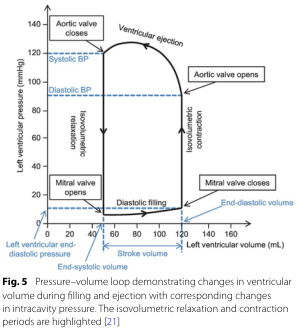
Reading the loop clockwise:
- Bottom right → top right: Isovolumetric contraction (pressure rises, volume fixed)
- Top right → top left: Ventricular ejection (volume falls as blood is pumped out)
- Top left → bottom left: Isovolumetric relaxation (pressure drops, volume fixed)
- Bottom left → bottom right: Diastolic filling (volume rises, low pressure)
Cardiac Cycle Phases in Context
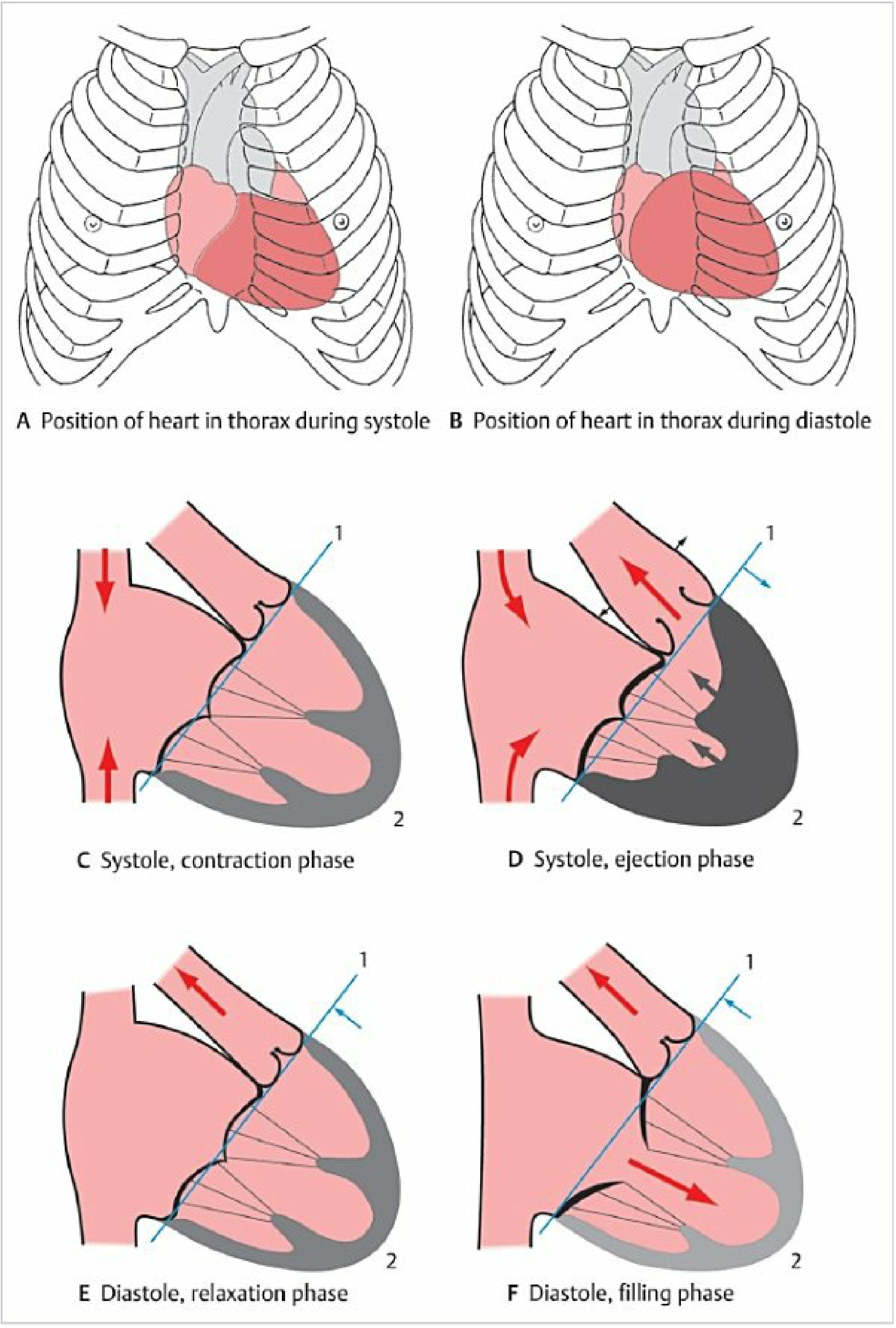
- C = Systole, contraction phase (isovolumetric contraction)
- D = Systole, ejection phase (semilunar valves open)
- E = Diastole, relaxation phase (isovolumetric relaxation)
- F = Diastole, filling phase (AV valves open)
Heart Sounds
| Sound | Cause | Timing |
|---|---|---|
| S1 ("lub") | AV valve closure | Start of systole (end of Phase 1) |
| S2 ("dub") | Semilunar valve closure | Start of diastole (end of Phase 3) |
| S3 (pathological) | Rapid ventricular filling sound | Early diastole |
| S4 (pathological) | Stiff ventricle during atrial kick | Late diastole |
Key Exam Points to Remember
- Isovolumetric contraction & relaxation = ALL valves closed; volume unchanged
- Semilunar valves open at the start of rapid ejection (Phase 3) — the MCQ answer
- AV valves open at the start of ventricular filling (Phase 1)
- S1 = AV closure; S2 = semilunar closure
- Ejection fraction ~55–65% is normal; <40% indicates systolic dysfunction
— Medical Physiology (Boron & Boulpaep), Table 22-1 & pp. 745–746 | Color Atlas of Human Anatomy Vol. 2, pp. 86–87
This is a shared conversation. Sign in to Orris to start your own chat.