
Structure of eyes
Reading File
Finding Sources
Searching Images
structure of the eye anatomy diagram
Reading File
Reading File
Loading Image
Reading File
Reading File
Reading File
Reading File
Loading Image
Reading File
I now have comprehensive information from the textbooks to provide a thorough answer. Here is a structured overview of the eye:
Structure of the Eye
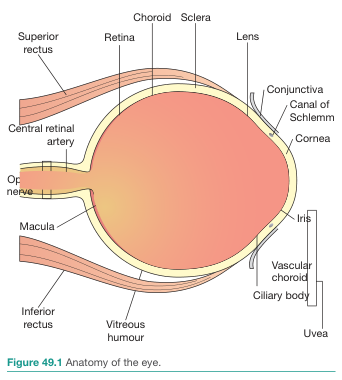
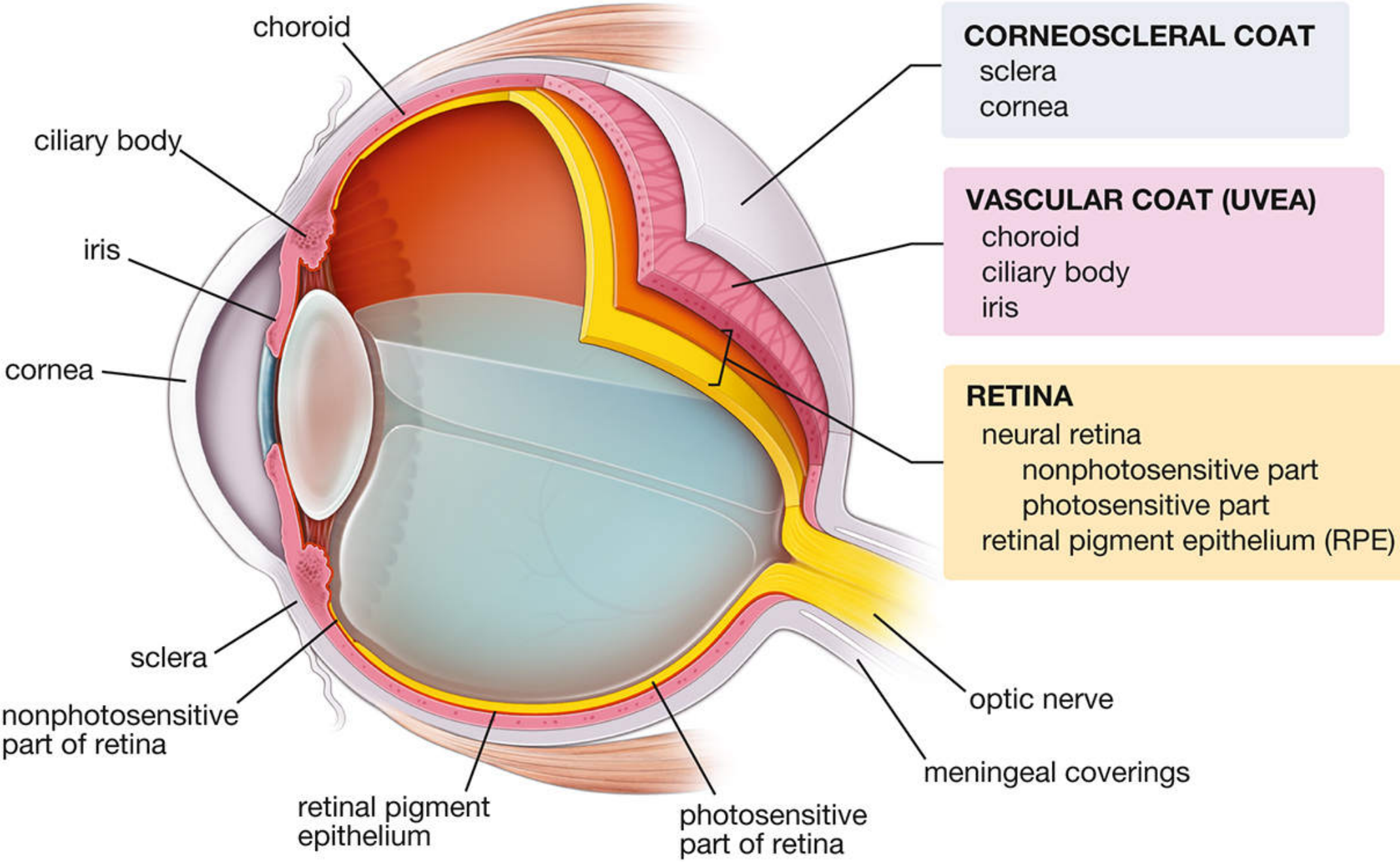
The eye measures approximately 25 mm in diameter and sits in the bony orbital socket, suspended by six extrinsic (extraocular) muscles and cushioned by adipose tissue. Its wall is organized into three concentric layers.
1. Outer Layer — Corneoscleral Coat (Fibrous Layer)
Sclera
- Forms the posterior five-sixths of the eyeball — the "white of the eye"
- Composed of dense fibrous connective tissue; provides mechanical protection and attachment points for extraocular muscles
- In children, slightly blue-tinged due to thinness; in elderly, yellowish due to lipofuscin accumulation
- Penetrated posteriorly by the optic nerve
Cornea
- Covers the anterior one-sixth of the eye; transparent and avascular
- 0.5 mm thick at center, ~1 mm at periphery
- The most powerful focusing (refracting) element of the eye
- Consists of five layers:
- Corneal epithelium — nonkeratinized stratified squamous epithelium
- Bowman membrane — acellular anterior basement membrane
- Corneal stroma — thickest layer; regularly arranged collagen lamellae and keratocytes
- Descemet membrane — acellular posterior basement membrane
- Corneal endothelium — single layer of flat cells; maintains corneal transparency via active fluid pumping
Limbus
- The corneoscleral junction; contains the trabecular meshwork (spaces of Fontana) and the canal of Schlemm (scleral venous sinus), which drain aqueous humor
2. Middle Layer — Vascular Coat (Uvea)
The uvea has three components: choroid, ciliary body, and iris.
Choroid
- Lines the posterior portion of the eye between sclera and retina
- Richly vascular (venous plexuses, capillary layers); nourishes the outer retina
- Dense melanin pigment absorbs stray light to minimize internal glare
- Firmly attached to the retinal pigment epithelium
Ciliary Body
- A ring-like thickening just posterior to the corneoscleral junction
- Contains the ciliary muscle (smooth muscle): contraction changes lens shape → accommodation for near vision
- Ciliary processes produce aqueous humor, which fills the posterior and anterior chambers
- Zonular fibers (suspensory ligaments) run from ciliary processes to the lens equator
Iris
- A pigmented muscular diaphragm with a central aperture — the pupil
- Contains two smooth muscles:
- Sphincter pupillae — constricts pupil (parasympathetic)
- Dilator pupillae — dilates pupil (sympathetic)
- Iris pigmentation determines eye color; its stroma arises from mesoderm, while both epithelial layers are derived from neural ectoderm
3. Inner Layer — Retina
The retina has two distinct parts:
Retinal Pigment Epithelium (RPE)
- Single layer of pigmented cells; outer layer of the retina
- Supports and maintains photoreceptors; phagocytoses shed outer segments
Neural Retina (Photosensitive Part)
- Lines the posterior two-thirds of the eye (terminates anteriorly at the ora serrata)
- Contains five principal cell types arranged in layers:
- Photoreceptors (rods and cones) — detect light
- Bipolar cells — relay signals from photoreceptors
- Ganglion cells — axons form the optic nerve
- Horizontal cells — lateral processing in outer plexiform layer
- Amacrine cells — lateral processing in inner plexiform layer
Key retinal landmarks:
- Fovea centralis (within the macula) — highest visual acuity; densely packed cones, no overlying neurons
- Optic disk (optic disc) — where ganglion cell axons exit; no photoreceptors → "blind spot"
- Macula lutea — surrounds the fovea; contains high cone density
Non-Photosensitive Retina
- Anterior to the ora serrata; a simple two-layered epithelium lining the ciliary body and posterior iris surface
Optical Media (Transparent Structures)
| Structure | Location | Function |
|---|---|---|
| Cornea | Anterior wall | Primary refraction (~2/3 of total) |
| Aqueous humor | Anterior + posterior chambers | Nourishes avascular cornea/lens; maintains intraocular pressure |
| Lens | Behind iris | Fine-tuning of focus (accommodation) |
| Vitreous humor | Posterior chamber | Gel filling 80% of globe; maintains shape |
Lens
- Biconvex, avascular, transparent structure
- Enclosed in an elastic capsule; composed of lens fibers derived from epithelial cells
- Shape changed by ciliary muscle via zonular fibers for accommodation
Aqueous Humor
- Produced by ciliary processes → flows from posterior chamber → through pupil → anterior chamber → drained via trabecular meshwork into canal of Schlemm
- Blockage of this pathway raises intraocular pressure → glaucoma
Vitreous Body
- Transparent gel (mostly water + collagen + hyaluronic acid)
- Occupies the space between lens and retina; maintains the globe's spherical form
Accessory Structures
- Conjunctiva — thin mucous membrane lining the inner eyelids and folding over the anterior sclera (not cornea)
- Extraocular muscles (6 muscles) — superior/inferior rectus, medial/lateral rectus, superior/inferior oblique — inserted into the sclera for eye movement
- Eyelids and lacrimal apparatus — provide mechanical protection and corneal lubrication
Sources: Histology: A Text and Atlas with Correlated Cell and Molecular Biology (9th ed.), pp. 2369–2390; Neuroscience: Exploring the Brain (5th ed.), pp. 827–829
This is a shared conversation. Sign in to Orris to start your own chat.