

Explain me this
Reading File
I'll research stroke MRI protocol findings and DWI/FLAIR imaging patterns to help explain this scan.
search_medical_text
stroke MRI DWI FLAIR protocol acute infarct findings interpretation
Harrison's Principles of Internal Medicine, Twenty First Edition
Page 12121
search_medical_image
brain MRI DWI FLAIR acute ischemic stroke infarct
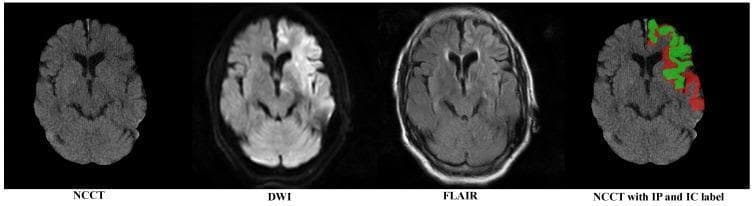
Hugging Face pmc clinical VQA raw
Page 0
GradeResponse
GradeResponse
Here is a detailed explanation of this MRI scan:
Patient & Scan Details
- Patient: Basanagouda Patil, 59-year-old male
- Date: 03 July 2025
- Protocol: Stroke Protocol MRA (MR Angiography)
- Institution: S. Nijalingappa Medical College, Bagalkot
- Sequences shown: DWI (Diffusion-Weighted Imaging) on the left half + T2W FLAIR Axial on the right half
What is a Stroke Protocol MRI?
A stroke protocol MRI is an emergency scan ordered when a stroke is suspected. It typically includes:
| Sequence | Purpose |
|---|---|
| DWI (Diffusion-Weighted Imaging) | Detects acute infarct within minutes of onset — shows restricted diffusion as bright white areas |
| T2W FLAIR (Fluid Attenuated Inversion Recovery) | Shows infarct/edema as bright signal; takes ~6 hours to become positive |
| ADC map | Confirms true restriction vs. shine-through artifact |
| MRA (MR Angiography) | Assesses for vessel occlusion |
What the Images Show
Left Panel — DWI Sequences
- Multiple axial slices from base of skull up to vertex
- DWI highlights areas of acute ischemia as bright (hyperintense) spots — the brain tissue where blood flow has been cut off and water movement is restricted at the cellular level (cytotoxic edema)
- Looking at this film, there appear to be areas of abnormal bright signal in the basal ganglia / deep white matter regions on multiple slices, suggesting acute ischemic infarction
Right Panel — T2W FLAIR Sequences
- Corresponding slices in FLAIR
- FLAIR suppresses normal CSF (which appears dark), making lesions stand out as bright areas
- There appear to be hyperintense (bright) lesions in the periventricular white matter and deeper structures, consistent with infarct and/or chronic small vessel ischemic disease
DWI–FLAIR Mismatch (Clinical Significance)
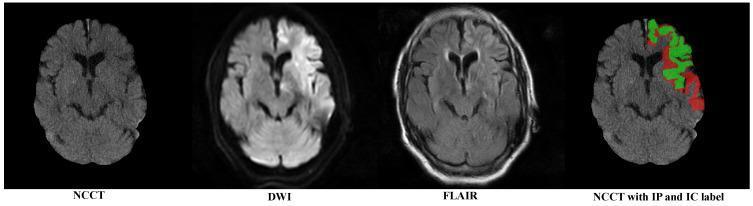
As shown above, when DWI is bright but FLAIR is still normal/near-normal in the same region, this is called DWI-FLAIR mismatch — a reliable sign that the stroke occurred within ~4.5 hours (the thrombolysis window). This is critical because it helps determine if the patient can receive clot-busting therapy (tPA/alteplase).
According to Harrison's Principles of Internal Medicine (p. 12121):
"The discrepancy between the region of poor perfusion and the diffusion deficit is called diffusion-perfusion mismatch and provides an estimate of the ischemic penumbra. Without specific therapy, the region of infarction will expand into much or all the perfusion deficit."
Summary of Likely Findings
Based on what is visible in this scan for a 59-year-old male on a stroke protocol:
- Acute ischemic stroke — likely affecting the basal ganglia / internal capsule / deep white matter territory
- Possible lacunar infarcts (small deep infarcts, common in hypertensive patients)
- Possible background chronic small vessel ischemic changes (white matter hyperintensities on FLAIR)
- The MRA component would assess whether a major artery (like the middle cerebral artery) is occluded
Important Note
This is a radiological interpretation for educational purposes only. The formal radiology report from Dr. S.K. Masaraddi (signed at the bottom) should be the primary document used for clinical decision-making. The treating neurologist will correlate these images with the patient's symptoms, examination, and clinical history to determine the appropriate management (IV thrombolysis, thrombectomy, antiplatelet therapy, etc.).
This is a shared conversation. Sign in to Orris to start your own chat.