
MI 2.3 - Antigens and antibodies: structure, properties, classes of immunoglobulins (IgG, IgA, IgM, IgD, IgE) • MI 2.4 - Lymphocytes: T cells (subtypes, MHC restriction), B cells, antigen presentation In dono competency ko mujhe apporba sastry book ke according conceptually samjhao poori detail me concepts and flowchart and pnemonics ke saath
Reading File
Finding Sources
Finding Sources
Finding Sources
Finding Sources
Finding Sources
Finding Sources
Reading File
Finding Sources
Finding Sources
Reading File
Finding Sources
Loading Image
Finding Sources
Reading File
Reading File
Ab mere paas sufficient content hai. Main ab ek comprehensive, detailed notes likhta hoon dono competencies ke liye - Apurba Sastry style mein, Hindi-English mix mein, flowcharts, mnemonics, aur diagrams ke saath.
🧬 MI 2.3 + MI 2.4 - Complete Immunology Notes
(Apurba Sastry Syllabus ke According - Conceptual + Flowchart + Mnemonics)
📌 MI 2.3 - Antigens aur Antibodies: Structure, Properties, Immunoglobulin Classes
🔷 ANTIGEN (Ag) - Kya hai?
Antigen = Woh substance jo:
- Immune response induce kare (Immunogenicity)
- Apne specific antibody se react kare (Antigenicity/Reactivity)
Antigen ki Properties - Mnemonic: "FISH-MC"
| Letter | Property | Explanation |
|---|---|---|
| F | Foreign nature | Self-antigens usually recognized nahi hote |
| I | Immunogenicity | Immune response trigger karne ki ability |
| S | Size (High MW) | >10,000 Da ideal; <1000 Da usually non-immunogenic |
| H | High complexity | Complex chemical structure chahiye |
| M | Macromolecular nature | Proteins > Polysaccharides > Lipids |
| C | Chemical nature | Proteins best immunogens hain |
Important Terms:
- Hapten = Antigenic but NOT immunogenic alone (e.g., penicillin, drugs) - Carrier protein se milne par immunogenic ban jaata hai
- Epitope (Antigenic determinant) = Antigen ka woh specific region jo antibody se bind karta hai
- Paratope = Antibody ka woh region jo epitope se bind karta hai
- Adjuvant = Immunogenicity badhane wala substance (e.g., Freund's adjuvant, Alum)
🔷 ANTIBODY (Ig) - Basic Structure
Y-shaped Structure - Mnemonic: "2H + 2L = Ig"
        ┌─────────────────────────────────────┐
        │         ANTIBODY STRUCTURE          │
        │                                     │
        │    Fab   N    N   Fab               │
        │     ╲   /      ╲  /                 │
        │      VH-VL    VH-VL  ← Variable     │
        │      CH1-CL  CH1-CL  ← Constant     │
        │        |  Hinge  |                  │
        │        CH2    CH2   ←  Fc region    │
        │        CH3    CH3                   │
        │               C terminus            │
        └─────────────────────────────────────┘
Chains:
- 2 Heavy chains (H chains) - ~50,000 Da each → Class determine karta hai (μ, γ, α, ε, δ)
- 2 Light chains (L chains) - ~25,000 Da each → Types: Kappa (κ) or Lambda (λ)
- Connected by disulfide bonds
Regions:
| Region | Full Form | Function |
|---|---|---|
| Fab | Fragment Antigen Binding | Antigen se bind karta hai (2 sites/molecule) |
| Fc | Fragment Crystallizable | Complement activation, opsonization, placental transfer, mast cell binding |
| Hinge | - | Flexibility deta hai; complement activation ka site |
| VH + VL | Variable Heavy + Light | CDR (Complementarity Determining Regions) = Paratope |
| CH + CL | Constant Heavy + Light | Effector functions |
Papain vs Pepsin Cleavage:
Papain  →  2 Fab + 1 Fc         (cuts ABOVE hinge)
Pepsin  →  1 F(ab')₂ + pFc'     (cuts BELOW hinge)
Mnemonic: "Papain = Parts into 3; Pepsin = Peeled Fc"
🔷 IMMUNOGLOBULIN CLASSES - Detailed
Mnemonic for 5 Classes: "MADGE"
M-A-D-G-E = IgM, IgA, IgD, IgG, IgE
📊 Master Comparison Table
| Property | IgG | IgA | IgM | IgD | IgE |
|---|---|---|---|---|---|
| Heavy chain | γ (gamma) | α (alpha) | μ (mu) | δ (delta) | ε (epsilon) |
| Structure | Monomer | Monomer/Dimer/sIgA | Pentamer | Monomer | Monomer |
| MW (kDa) | 150 | 160/320/385 | 900 | 185 | 190 |
| Serum conc. | Highest (800-1600 mg/dL) | 200-400 | 50-200 | 0.3-40 μg/dL | 0.01-0.04 |
| Subclasses | IgG1,2,3,4 | IgA1, IgA2 | None | None | None |
| Half-life | 23 days (longest) | 6 days | 5 days | 3 days | 2.5 days |
| Complement | Yes (IgG1>IgG3>IgG2; IgG4=No) | No (alternate) | Best (classical) | No | No |
| Placental transfer | Yes (only one) | No | No | No | No |
| J chain | No | Yes (dimer) | Yes | No | No |
| Secretory component | No | Yes (sIgA only) | No | No | No |
🔵 IgG - "The Most Important"
- Serum mein sabse zyada (75-80% of total Ig)
- 4 subclasses: IgG1 > IgG2 > IgG3 > IgG4 (abundance order)
- Only Ig that crosses placenta → Neonatal passive immunity (FcRn receptor se)
- Secondary immune response mein predominant
- Functions: Neutralization, Opsonization, ADCC, Complement (classical pathway)
- IgG3 = Longest hinge region
- IgG4 = Complement activate nahi karta; allergy mein blocking antibody
Mnemonic for IgG: "GP NoCo" = Greatest in Plasma, Neonatal immunity, Opsonization, Complement activation (except IgG4)
🟢 IgA - "The Secretory Antibody"
- 2 forms:
- Serum IgA = Monomer
- Secretory IgA (sIgA) = Dimer + J chain + Secretory Component (SC)
- SC (Secretory Component) = Epithelial cells se milta hai; proteolytic enzymes se protect karta hai
- Location: Tears, saliva, colostrum, breast milk, intestinal secretions, respiratory tract
- First line of defense at mucosal surfaces
- IgA1 = Serum mein predominant; longer hinge
- IgA2 = Secretions mein more; shorter hinge; more resistant to bacterial proteases
Mnemonic: "IgA = Mucosal Army" - saliva, tears, milk, gut sab jagah
🔴 IgM - "The First Responder"
- Pentameric (5 monomers + 1 J chain) in serum
- Monomeric form = B cell surface receptor (BCR)
- Primary immune response mein FIRST antibody produced
- Best complement activator (classical pathway) - because pentameric structure zyada C1q bind karta hai
- "Star to Staple" conformational change on antigen binding → complement activation
- 10 antigen binding sites (10-valent) → highest avidity
- Cannot cross placenta
- IgM in neonate = In utero infection ka sign (congenital rubella, toxoplasmosis, syphilis)
Mnemonic: "IgM = First and Five" - First antibody in primary response, Pentamer (5 subunits)
🟡 IgD - "The Mystery Immunoglobulin"
- Very low serum concentration
- Mainly on B cell surface (along with monomeric IgM) as antigen receptor
- Function: B cell maturation and activation control
- Long hinge region (like IgD has a very long extended hinge with polyanionic character)
- Some evidence of protection against respiratory pathogens
Mnemonic: "IgD = Differentiation marker of B cells"
🟠 IgE - "The Allergy Antibody"
- Lowest serum concentration (trace amounts)
- Most of IgE is cell-bound - bound to FcεRI receptors on:
- Mast cells
- Basophils
- Type I hypersensitivity (Anaphylaxis):
- Antigen → Crosslinks IgE on mast cells → Degranulation → Histamine, leukotrienes
- Parasitic infections mein elevated (especially helminths)
- Like IgM, has extra CH domain (Cε2,3,4 + Cε1) instead of hinge
- Half-life in serum = 2.5 days; on mast cell surface = weeks
Mnemonic: "IgE = Eosinophils + Emergency (anaphylaxis) + Enemies (parasites)"
🔄 FLOWCHART: Antibody Classes at a Glance
ANTIGEN enters body
         ↓
PRIMARY RESPONSE → IgM produced first (days 3-7)
         ↓
         → IgG follows (days 10-14) - class switching

SECONDARY RESPONSE → Faster, More IgG, Higher titer
         ↓
    ┌────┴──────────────┐
    ↓                   ↓
Serum Abs           Mucosal protection
(IgG dominant)      (IgA dominant)
    ↓                   ↓
Placenta          Secretions (tears/saliva/milk)
(IgG only)
    ↓
Neonatal protection (6 months)
📌 MI 2.4 - Lymphocytes: T Cells, B Cells, Antigen Presentation
🔷 LYMPHOCYTES - Overview
                    LYMPHOCYTES
                         │
           ┌─────────────┼─────────────┐
           ↓             ↓             ↓
         T CELLS       B CELLS      NK CELLS
     (Thymus-derived) (Bone marrow) (Large granular)
       70-80%         10-15%         5-10%
🔷 T LYMPHOCYTES - Complete Detail
Origin aur Maturation:
Bone Marrow (Stem cells)
         ↓
    Thymus migration
         ↓
CORTEX: Positive Selection
(VDJ rearrangement → TCR formation)
(Only cells that can recognize self-MHC survive)
         ↓
MEDULLA: Negative Selection
(Cells reactive to self-antigens → deleted = Central Tolerance)
         ↓
Mature naive T cells → Peripheral blood/lymph nodes
T Cell Surface Markers - Mnemonic: "All T Cells Display CD3"
- All T cells: CD2, CD3, CD7 (and TCR)
- T helper: CD4
- T cytotoxic: CD8
T CELL SUBTYPES - Mnemonic: "THINK HARD"
T CELLS
   │
   ├── CD4+ T Helper (Th) cells
   │         ├── Th1 → Cell-mediated immunity (IFN-γ, IL-2)
   │         ├── Th2 → Humoral immunity (IL-4, IL-5, IL-13)
   │         ├── Th17 → Inflammation (IL-17, IL-22)
   │         ├── Treg → Suppression (IL-10, TGF-β, FoxP3+)
   │         └── Tfh → Germinal center, helps B cells
   │
   ├── CD8+ Cytotoxic T cells (CTL/Tc)
   │         → Kill virus-infected/tumor cells
   │         → Perforin, Granzymes, FasL
   │
   └── γδ T cells
             → No classical MHC restriction
             → First line defense at epithelial surfaces
Th1 vs Th2 - Key Comparison
| Feature | Th1 | Th2 |
|---|---|---|
| Differentiated by | IL-12, IFN-γ | IL-4 |
| Transcription factor | T-bet | GATA-3 |
| Cytokines produced | IFN-γ, IL-2, TNF-β | IL-4, IL-5, IL-10, IL-13 |
| Function | Cell-mediated immunity, Macrophage activation | Humoral immunity, IgE production, Eosinophils |
| Diseases associated | Tuberculosis, autoimmunity | Allergy, asthma, parasitic infections |
| Cross-inhibit? | IFN-γ inhibits Th2 | IL-4, IL-10 inhibit Th1 |
Mnemonic: "Th1 = ONE macrophage killer; Th2 = TWO (to help B cells make Ab)"
Regulatory T cells (Treg):
- CD4+ CD25+ FoxP3+ → Master regulator
- Suppress excessive immune responses
- Prevent autoimmunity
- Produce: IL-10, TGF-β
- FoxP3 mutation → IPEX syndrome (Immune dysregulation, Polyendocrinopathy, Enteropathy, X-linked)
🔷 MHC RESTRICTION - "The Golden Rule of T Cells"
Concept:
T cells can ONLY recognize antigen when it is presented on MHC molecules of the SAME individual (self-MHC).
     SELF-MHC + Peptide
           ↓
     TCR can recognize
           ↓
     T cell ACTIVATED

     FOREIGN MHC + Peptide  OR  Self-MHC without peptide
           ↓
     T cell CANNOT recognize
           ↓
     No activation
MHC Classes aur T cell Restriction:
| MHC Class | Present to | CD marker | Antigen type | Example cells |
|---|---|---|---|---|
| Class I (HLA-A,B,C) | CD8+ CTL | CD8 | Endogenous (intracellular/viral) | All nucleated cells |
| Class II (HLA-DR,DP,DQ) | CD4+ Th | CD4 | Exogenous (extracellular) | APC: DCs, Macrophages, B cells |
Golden Mnemonic: "8 × 1 = 8; 4 × 2 = 8"
- CD8 binds MHC class 1
- CD4 binds MHC class 2
🔷 ANTIGEN PRESENTATION - Flowchart
Pathway 1: MHC Class I (Endogenous/Cytosolic Antigens)
Viral protein synthesized in cytosol
         ↓
Ubiquitinated → Proteasome (Immunoproteasome: LMP2, LMP7)
         ↓
Peptides (8-10 amino acids)
         ↓
TAP1/TAP2 transporters → ER lumen
         ↓
Peptide + MHC-I heavy chain + β2-microglobulin
         ↓
Stable trimeric complex
         ↓
Golgi → Cell surface
         ↓
Presented to CD8+ T cells (CTL)
         ↓
Cell KILLING (perforin/granzyme)
Pathway 2: MHC Class II (Exogenous/Extracellular Antigens)
Extracellular antigen (bacteria/protein)
         ↓
Endocytosis/Phagocytosis by APC
(DCs, Macrophages, B cells)
         ↓
Endosome (acidified) → Phagolysosome
         ↓
Proteolytic degradation → Peptides (15-20 aa)
         ↓
MHC-II α+β chains synthesized in ER
         ↓
Invariant chain (Ii/CD74) blocks groove → CLIP peptide
         ↓
Ii degraded → CLIP removed by HLA-DM
         ↓
Antigenic peptide binds MHC-II groove
         ↓
MIIC compartment → Cell surface
         ↓
Presented to CD4+ T helper cells
         ↓
Help to B cells → Antibody production
OR Macrophage activation
Cross-Presentation (Special):
- Dendritic cells can present exogenous antigens on MHC-I (cross-presentation)
- Important for tumor immunity and viral vaccines
🔷 B LYMPHOCYTES
Origin aur Markers:
- Bone marrow mein mature hote hain
- Surface markers: CD19, CD20, CD21, CD22, CD23, SIg (Surface Immunoglobulin = BCR)
- BCR = Monomeric IgM + IgD on surface
B Cell Activation - 2 Pathways:
PATH 1: T-DEPENDENT ANTIGENS (Proteins)
─────────────────────────────────────
Antigen → B cell BCR binds
         ↓
B cell presents peptide on MHC-II
         ↓
CD4+ Th2 cell recognizes + provides help
(CD40L on Th2 binds CD40 on B cell)
         ↓
Cytokines: IL-4, IL-5, IL-6
         ↓
B cell proliferation → Germinal center
         ↓
Somatic hypermutation (affinity maturation)
         ↓
Class switching: IgM → IgG/IgA/IgE
         ↓
Plasma cells (Ab secretion) + Memory B cells

PATH 2: T-INDEPENDENT ANTIGENS
────────────────────────────────
(Polysaccharides, LPS, Flagellin)
         ↓
Directly cross-link BCR (multivalent)
         ↓
No T cell help needed
         ↓
Only IgM produced (no class switching)
         ↓
No memory cells
B Cell Markers - Mnemonic: "B cells have 19-20 vision"
CD19, CD20 = Classic B cell markers (Rituximab targets CD20!)
🔷 NK CELLS (Natural Killer Cells)
- Large Granular Lymphocytes
- Markers: CD16 (FcγRIII), CD56; Negative for CD3
- Kill cells that have LOST MHC-I (virally infected/tumor cells)
- Mechanism: "Missing self" hypothesis - Normal cells express MHC-I → NK inhibited; MHC-I absent → NK kills
- Also perform ADCC (Antibody Dependent Cellular Cytotoxicity) via CD16
🔷 ANTIGEN PRESENTING CELLS (APCs)
| APC Type | Location | Special features |
|---|---|---|
| Dendritic cells | All tissues | Most potent APC; high MHC-II; CD83; Birbeck granules (Langerhans cells) |
| Macrophages | Everywhere | MHC-II+; CD14+; phagocytosis ++ |
| B cells | Lymphoid | BCR concentrates antigen efficiently |
Best APC = Dendritic cells (especially for naive T cell priming)
🔄 MASTER FLOWCHART: Antigen enters body → Immune response
ANTIGEN
    │
    ├─── Phagocytosed by MACROPHAGE/DC
    │              ↓
    │    Processed → MHC-II peptide complex
    │              ↓
    │    Presented to CD4+ T HELPER cell
    │              ↓
    │    ┌──────────────────┐
    │    │   Th1             │ → Activates macrophages (DTH)
    │    │   Th2             │ → Helps B cells → Antibodies
    │    │   Th17            │ → Neutrophil recruitment
    │    └──────────────────┘
    │
    └─── Direct infection of cell
                   ↓
         Endogenous peptide → MHC-I
                   ↓
         CD8+ CTL activated
                   ↓
         CELL KILLING (perforin/granzyme)
📝 QUICK REVISION MNEMONICS SUMMARY
| Mnemonic | What it covers |
|---|---|
| FISH-MC | Properties of antigen |
| MADGE | 5 Ig classes (M,A,D,G,E) |
| GP NoCo | IgG properties |
| IgA = Mucosal Army | IgA location |
| IgM = First and Five | Primary response + pentamer |
| IgE = Eosinophils+Emergency+Enemies | IgE functions |
| 8×1; 4×2 = 8 | CD8→MHC-I; CD4→MHC-II |
| B cells have 19-20 vision | CD19, CD20 markers |
| Th1=ONE killer; Th2=TWO helper | Th1 vs Th2 |
| THINK HARD | T cell subtypes |
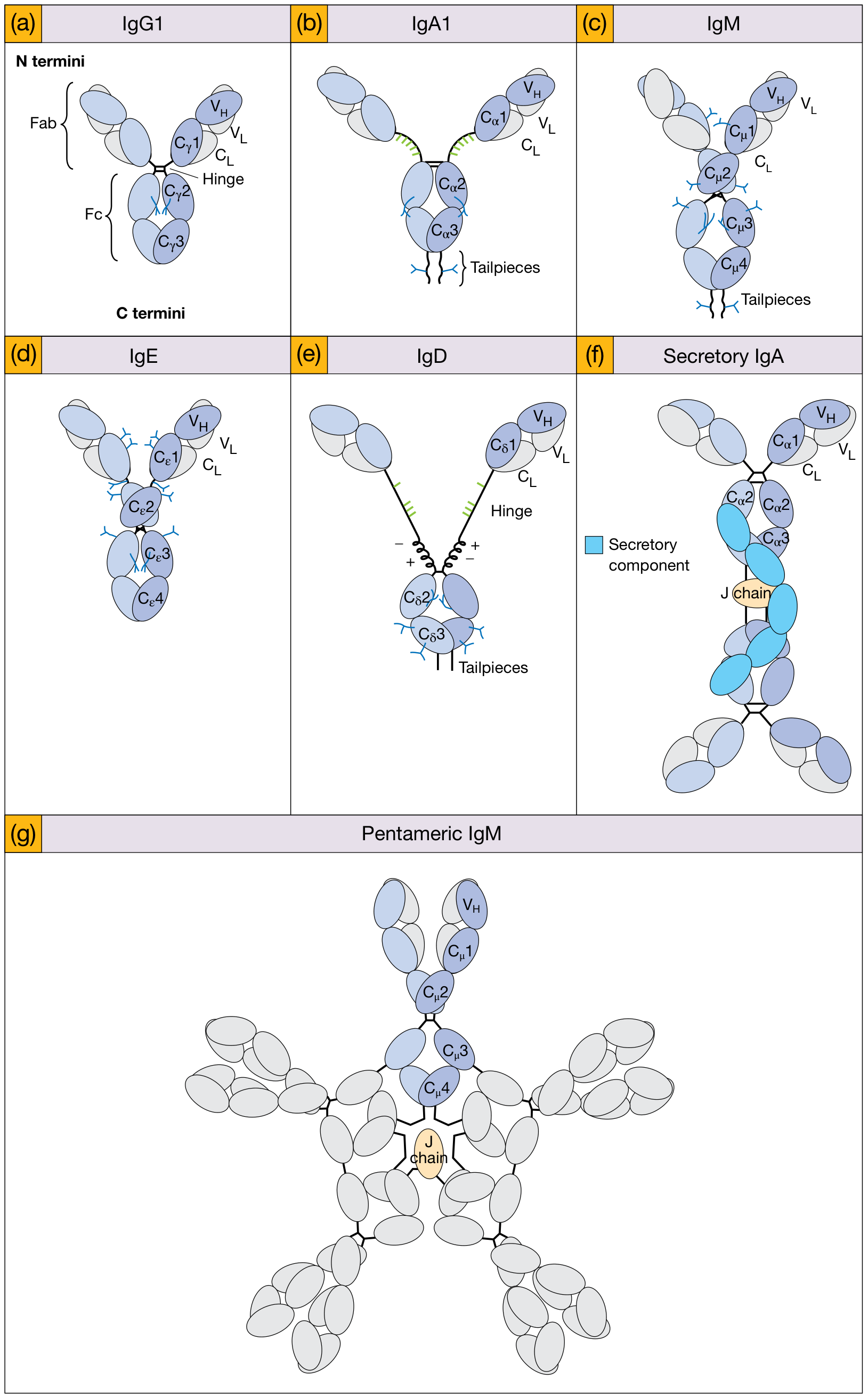
🖼️ Immunoglobulin Structures - Textbook Diagram
Yeh image Roitt's Essential Immunology se hai - saare 5 Ig classes ki schematic structures dikhata hai:
⚠️ HIGH-YIELD EXAM POINTS (Apurba Sastry Style)
- IgG = Only Ig crossing placenta; longest half-life (23 days); secondary immune response
- IgM = First antibody in primary response; best complement activator; pentamer; in utero infection marker in neonates
- sIgA = Mucosal immunity; dimer + J chain + secretory component; resists gut proteases
- IgE = Lowest in serum; anaphylaxis; parasite immunity; bound to mast cells/basophils
- IgD = B cell surface marker; no effector function known clearly
- CD4 restricts to MHC-II (exogenous antigens); CD8 restricts to MHC-I (endogenous antigens)
- TAP1/TAP2 = Essential for Class I pathway (transports peptides to ER)
- Invariant chain (Ii/CLIP) = Protects MHC-II groove until correct peptide arrives; removed by HLA-DM
- Dendritic cells = Best APCs for naive T cell priming
- NK cells = CD16+, CD56+, CD3- ; "Missing self" killing; no MHC restriction
- FoxP3 = Master transcription factor of Treg cells; mutation → IPEX syndrome
- Neonatal IgM elevated = Congenital infection (TORCH - Toxoplasma, Rubella, CMV, Herpes)
Sources: Roitt's Essential Immunology, Cellular and Molecular Immunology (Abbas), Janeway's Immunobiology - sab Apurba Sastry ke syllabus ke saath aligned hain.
This is a shared conversation. Sign in to Orris to start your own chat.