
Acute coronary syndrome
"acute coronary syndrome"[MeSH Terms] AND management
Acute Coronary Syndrome (ACS)
Definition and Classification
| Entity | ST on ECG | Troponin | Key feature |
|---|---|---|---|
| Unstable Angina (UA) | No ST elevation | Negative | New, worsening, or rest angina - no myonecrosis |
| NSTEMI | No ST elevation (may have ST depression/T-wave changes) | Positive | Myonecrosis without persistent ST elevation |
| STEMI | Persistent ST elevation (>20 min) | Positive | Full-thickness injury, complete occlusion |
- Goldman-Cecil Medicine, p. 638
Epidemiology
- ~1.2 million Americans hospitalized annually with ACS
- About two-thirds have NSTE-ACS; one-third have STEMI
-
50% of NSTE-ACS patients are older than 65 years; nearly half are women
- Strong associations with atherosclerosis risk factors, peripheral vascular disease, and chronic inflammatory disorders (rheumatoid arthritis, psoriasis, lupus)
Pathophysiology
Type 1 MI - Plaque Rupture (Most Common)
- Oxidized LDL deposition triggers macrophage and T-lymphocyte infiltration at the plaque border
- These inflammatory cells secrete cytokines (TNF, IL-1, IFN-γ) that inhibit collagen synthesis and enzymes (matrix metalloproteinases, cathepsins) that degrade collagen and elastin, thinning the fibrous cap
- Sites of low shear stress (vessel bifurcations) accumulate lipids and inflammatory cells, accelerating cap thinning
- Plaque neovascularization (driven by VEGF, FGF, etc.) makes the plaque structurally fragile
Type 2 MI - Supply/Demand Mismatch
- Reduced supply: hypotension, severe anemia, hypoxemia, coronary vasospasm (Prinzmetal angina), cocaine, triptans, spontaneous coronary artery dissection (SCAD - especially peripartum women)
- Increased demand: tachycardia, severe hypertension, thyrotoxicosis
- Goldman-Cecil Medicine, p. 638-639
Clinical Presentation
- Substernal chest pain/pressure, often radiating to the left arm, jaw, or back
- Diaphoresis, nausea, dyspnea
- Dyspnea alone, syncope, fatigue, weakness, abdominal pain, delirium
- "Classic" chest pain occurs in only ~50% of patients aged ≥85 years
- One-third of women >65 years with AMI present with abdominal pain alone
- Acute heart failure at presentation occurs in ~50% of STEMI patients ≥85 years (vs. 1.7% in those <65)
- Rosen's Emergency Medicine, p. 4015-4021
Diagnosis
ECG
- STEMI: New ST elevation ≥1 mm in ≥2 contiguous limb leads, or ≥2 mm in ≥2 contiguous precordial leads (or new LBBB)
- NSTEMI/UA: ST depression, T-wave inversions, or normal ECG
- Serial ECGs should be obtained if initial is non-diagnostic
Biomarkers
- High-sensitivity troponin (hsTn) is the cornerstone biomarker - can detect myonecrosis within 1-3 hours of symptom onset
- Serial measurements at 0h and 1-3h (or 0h/3h/6h depending on assay)
- Unstable angina: troponin remains negative throughout
Risk Stratification Scores
- Age ≥65, ≥3 CAD risk factors, prior coronary stenosis ≥50%, ST deviation on ECG, ≥2 anginal events in prior 24h, aspirin use in prior 7 days, elevated cardiac markers
- Score 0-2 = low risk; 3-4 = intermediate; 5-7 = high risk
- Advantage: simple integer sum, calculable at bedside without a computer
-
Derived from a large international registry (less-selected population)
-
Score ≥140 = high risk; better calibration between predicted and observed mortality than TIMI
-
Includes renal insufficiency as a variable (an advantage over TIMI)
-
Available at gracescore.org
-
Fuster and Hurst's The Heart, 15th Ed.; Sabiston Textbook of Surgery
Management
Immediate General Measures (MONA-B framework)
- Monitoring: continuous ECG, pulse oximetry, IV access
- Oxygen: only if SpO2 <90%
- Nitrates: sublingual/IV for ongoing ischemia (contraindicated if hypotension, RV infarction, or PDE5 inhibitor use within 24-48h)
- Aspirin: 325 mg chewed loading dose immediately for all ACS
- Beta-blockers: oral, within 24h if no signs of HF, low-output state, or AV block (reduce heart rate and myocardial oxygen demand)
Antithrombotic Therapy
- Aspirin 75-100 mg/day indefinitely
- P2Y12 inhibitor added to aspirin for 12 months:
- Ticagrelor (preferred over clopidogrel - faster onset, more potent, shown to reduce mortality in PLATO trial)
- Prasugrel (use for PCI patients; avoid if history of TIA/stroke, age >75, weight <60kg)
- Clopidogrel (alternative, especially if ticagrelor/prasugrel contraindicated or not available)
- Unfractionated heparin (UFH), low-molecular-weight heparin (LMWH, e.g., enoxaparin), fondaparinux, or bivalirudin
- LMWH/fondaparinux preferred over UFH for NSTE-ACS in most patients (lower bleeding risk)
- Anticoagulation continued through PCI or until hospital discharge in medically managed patients
Invasive Strategy Timing (NSTE-ACS)
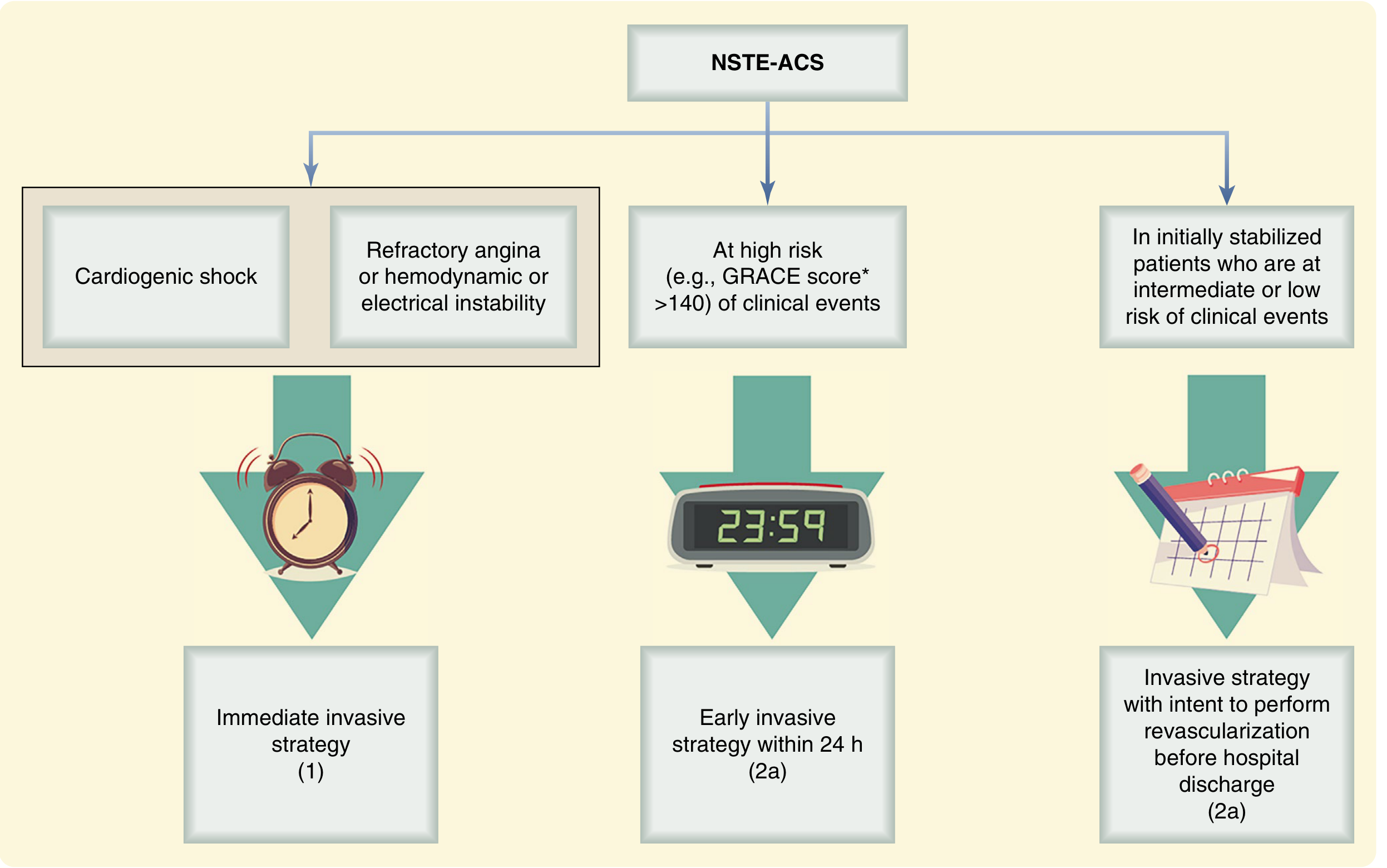
| Risk Level | Timing | Indications |
|---|---|---|
| Immediate (<2h) | Immediate invasive | Cardiogenic shock, refractory angina, hemodynamic/electrical instability |
| Early (<24h) | Early invasive | GRACE score >140, troponin elevation, new ST depression |
| Selective (before discharge) | Invasive strategy | Initially stabilized, low/intermediate risk |
STEMI-Specific Management
- Primary PCI is the gold standard - target door-to-balloon time <90 minutes (or <120 minutes if transferred)
- Fibrinolysis (alteplase, tenecteplase) if PCI not available within 120 minutes of first medical contact; followed by "pharmaco-invasive" strategy (coronary angiography within 24h)
Other Medications
- High-intensity statins (atorvastatin 40-80 mg or rosuvastatin 20-40 mg): started in-hospital, continued indefinitely - stabilize plaque, reduce LDL
- ACE inhibitors/ARBs: for all patients with EF <40%, hypertension, or diabetes
- Aldosterone antagonists (eplerenone): if EF <40% post-MI, no significant renal impairment or hyperkalemia
Complications
| Complication | Timing | Notes |
|---|---|---|
| Arrhythmias (VF, VT) | Early (first 24-48h) | Leading cause of early death; continuous monitoring essential |
| Cardiogenic shock | Within hours to days | ~7-10% of STEMI; high mortality; require urgent PCI + hemodynamic support |
| Acute mitral regurgitation | Days 2-7 | Papillary muscle rupture; severe pulmonary edema; needs urgent surgery |
| Free wall rupture | Days 3-5 | Catastrophic; pericardial tamponade |
| Ventricular septal defect | Days 3-7 | New harsh systolic murmur; cardiogenic shock |
| Right ventricular infarction | Accompanies inferior STEMI | Hypotension + clear lungs; avoid nitrates/diuretics; fluids are treatment |
| Dressler syndrome | Weeks post-MI | Pericarditis, pleuritis, fever; autoimmune; treat with NSAIDs/colchicine |
Secondary Prevention (Post-ACS)
- Aspirin indefinitely
- P2Y12 inhibitor for 12 months (duration may be adjusted based on bleeding vs. ischemic risk)
- High-intensity statin indefinitely
- Beta-blocker (especially if reduced EF)
- ACE inhibitor/ARB
- Cardiac rehabilitation
- Risk factor modification: smoking cessation, BP control, diabetes management, weight loss
Recent Evidence Updates (2024-2026)
-
DAPT de-escalation (Valgimigli et al., Lancet 2024, PMID 39226909): De-escalation to ticagrelor monotherapy (dropping aspirin after 1-3 months) vs. 12 months of DAPT - individual patient-level meta-analysis showing reduced bleeding without excess ischemic risk.
-
Elderly ACS - invasive vs. conservative (Reddy et al., JAMA Intern Med 2025, PMID 40549394): Meta-analysis of early invasive vs. conservative strategy in older patients with ACS - supports early invasive approach in selected elderly patients.
-
Aspirin vs. P2Y12 monotherapy post-PCI (Laudani et al., JACC Cardiovasc Interv 2025, PMID 40803759): Network meta-analysis comparing aspirin monotherapy vs. P2Y12 inhibitor monotherapy after PCI for ACS - ongoing evolution of post-PCI antithrombotic strategy.
Give in a colorful and using images
What format would you like the colorful visual output in?
A comprehensive, colorful medical infographic about Acute Coronary Syndrome (ACS). The infographic should have a clean white background with vibrant color sections. Include the following clearly labeled sections with icons and visuals: 1. TOP HEADER: Bold title "ACUTE CORONARY SYNDROME (ACS)" with a red heart icon and subtitle "A Complete Clinical Overview" 2. ACS SPECTRUM (horizontal banner): Three colored boxes side by side showing the spectrum: - Yellow box: "Unstable Angina" - No ST elevation, Troponin NEGATIVE, Ischemia no necrosis - Orange box: "NSTEMI" - No ST elevation, Troponin POSITIVE, Partial occlusion - Red box: "STEMI" - ST elevation >20 min, Troponin POSITIVE, Complete occlusion 3. PATHOPHYSIOLOGY section (blue background): Diagram showing atherosclerotic plaque rupture → platelet aggregation → thrombus → coronary occlusion. Include labels: "Thin fibrous cap", "Lipid core", "Macrophages", "Thrombus formation" 4. CLINICAL FEATURES section (green background): Two columns: - Classic symptoms (chest icon): Chest pain/pressure, Diaphoresis, Dyspnea, Nausea, Arm/jaw radiation - Atypical symptoms (warning icon): Abdominal pain, Fatigue, Syncope, Delirium (especially elderly and women) 5. DIAGNOSIS section (purple background): - ECG strip showing ST elevation for STEMI and ST depression for NSTEMI - Biomarkers: Troponin (high sensitivity), CK-MB, BNP - Risk Scores: TIMI Score (0-7) and GRACE Score (>140 = high risk) 6. MANAGEMENT section (teal/dark blue background): - IMMEDIATE: Aspirin 325mg, O2 if SpO2<90%, Nitrates, Beta-blockers, Heparin - INVASIVE STRATEGY timing: Immediate (<2h) for shock/instability | Early (<24h) for GRACE>140 | Selective (before discharge) for low risk - STEMI: Primary PCI door-to-balloon <90 min OR Fibrinolysis if PCI unavailable 7. COMPLICATIONS section (orange background): Icons for: Arrhythmia (VF/VT), Cardiogenic shock, Papillary muscle rupture (MR), Free wall rupture, VSD, RV infarction, Dressler syndrome 8. SECONDARY PREVENTION (bottom, green): Pills icons for: Aspirin (lifelong), P2Y12 inhibitor (12 months), Statin (high-intensity), Beta-blocker, ACE inhibitor, Cardiac rehab Overall style: Modern medical infographic, vivid colors for each section, clear sans-serif fonts, anatomical heart illustrations, ECG waveform visuals, and clinical icons throughout. Professional and educational.