
Define glucoma
Glaucoma is a group of eye diseases that damage the optic nerve, usually due to elevated intraocular pressure (IOP). It is one of the leading causes of irreversible blindness worldwide. The two main types are open-angle glaucoma (chronic, painless, gradual vision loss) and angle-closure glaucoma (acute, painful, medical emergency). Treatment includes eye drops to lower IOP, laser therapy, or surgery.
Searching sources...
Reading File
Finding Sources
Searching the Web
glaucoma definition types pathophysiology 2024
Reading File
Reading File
Loading Image
Reading File
Here is a comprehensive definition of Glaucoma drawn from authoritative medical textbooks:
Glaucoma
Definition
Glaucoma is a collection of diseases in which optic neuropathy is usually associated with elevated intraocular pressure (IOP). It is characterized by progressive deterioration of the optic nerve that leads to irreversible visual field loss and, ultimately, blindness. Notably, some individuals with normal IOP may still develop characteristic optic nerve and visual field changes - this is called normal-tension (low-tension) glaucoma.
(Robbins & Kumar Basic Pathology, p. 868)
Pathophysiology
To understand glaucoma, it helps to understand how aqueous humor flows in the eye:
- Aqueous humor is produced in the ciliary body
- It passes from the posterior chamber through the pupil into the anterior chamber
- Most drains out through the trabecular meshwork (located at the angle between the corneal periphery and the iris)
- From there it exits via Schlemm's canal
When this drainage is impaired - whether through resistance at the trabecular meshwork or physical obstruction of the angle - pressure builds up and damages the optic nerve.
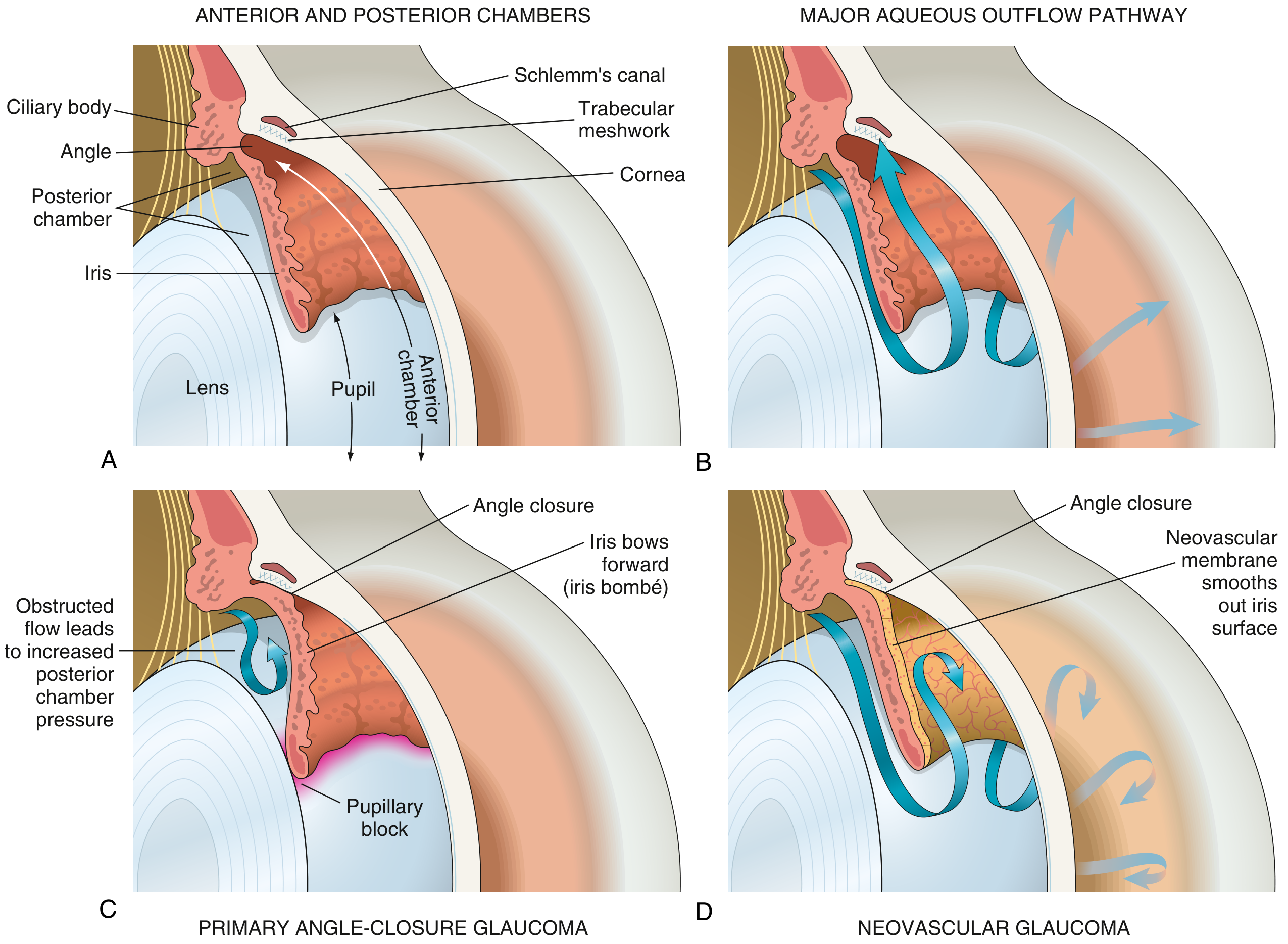
Fig: (A) Normal eye anatomy. (B) Normal aqueous outflow through trabecular meshwork. (C) Primary angle-closure glaucoma - iris bows forward (iris bombé), causing pupillary block and angle closure. (D) Neovascular glaucoma - a fibrovascular membrane occludes the trabecular meshwork.
Classification
Based on the mechanism of impaired drainage, glaucoma is divided into two major categories:
1. Open-Angle Glaucoma
- The anterior chamber angle is anatomically open, but drainage resistance is increased
- Caused by increased aqueous production or resistance to outflow at the trabecular meshwork
- Primary open-angle glaucoma (POAG) is the most common form overall
- Secondary open-angle glaucoma may be caused by deposition of particulate matter (e.g., red blood cells after trauma, or cells from a necrotic tumor)
- Typically chronic, painless, and slow - patients often have no symptoms until late in the disease
2. Angle-Closure Glaucoma
- The anterior chamber angle is physically narrowed or closed, blocking aqueous egress
- Primary angle-closure glaucoma: occurs in anatomically predisposed eyes where the iris bows forward (iris bombé) and occludes the trabecular meshwork
- Secondary angle-closure may result from neovascular membranes (e.g., in diabetes, retinal vein occlusion) pulling the iris across the drainage angle
- Can present as an acute emergency with sudden severe eye pain, redness, blurred vision, halos, nausea, and vomiting
(Robbins & Kumar Basic Pathology, p. 869)
Consequences (Optic Nerve Damage)
Both types cause:
- Optic neuropathy with progressive visual field defects, starting in the periphery
- Diffuse loss of retinal ganglion cells
- Thinning of the retinal nerve fiber layer
- In advanced cases: optic disc cupping and optic nerve atrophy
The visual field defects are most significant within a 30° radius from the fixation point. Classic patterns include arcuate scotomas, nasal steps, and ultimately tunnel vision.
(Kanski's Clinical Ophthalmology, 10th ed.)
Risk Factors
- Elevated IOP (most important modifiable risk factor)
- Age (prevalence increases with age)
- Family history / genetics
- Race (POAG more common in people of African descent; angle-closure more common in East Asians)
- Hyperopia (far-sightedness) - predisposes to angle closure
- Diabetes mellitus
- Myopia (near-sightedness) - predisposes to POAG
- Thin central corneal thickness
- Prior eye injury or corticosteroid use
Treatment Goals
Treatment aims to lower IOP to halt optic nerve damage. Options include:
| Approach | Examples |
|---|---|
| Topical medications | Prostaglandin analogs (first-line), beta-blockers, alpha-agonists, carbonic anhydrase inhibitors |
| Laser therapy | Laser trabeculoplasty (open-angle); laser iridotomy (angle-closure) |
| Surgery | Trabeculectomy, tube-shunt implants |
For acute angle-closure glaucoma, the goal is to rapidly reduce IOP with IV/oral medications, then perform a definitive procedure (laser iridotomy) to prevent recurrence. Per the AAFP 2023 guidelines, prompt referral to ophthalmology is essential.
In summary: Glaucoma = a group of optic neuropathies, usually from elevated IOP, causing irreversible progressive vision loss through ganglion cell death and optic nerve damage. Early detection via regular eye exams is the key to preventing blindness.
This is a shared conversation. Sign in to Orris to start your own chat.