
Write a short note on OHA Corticosteroid and steroid withdrawal syndrome
Reading File
Now let me search the medical library for both topics in parallel.
Finding Sources
Finding Sources
Good results found. Now let me read the key sections in parallel.
Finding Sources
Reading File
Reading File
Reading File
Reading File
Reading File
Reading File
Reading File
I now have comprehensive information from multiple authoritative textbooks. Let me compile the short note.
Oral Hypoglycemic Agents (OHA)
OHAs (also called oral antidiabetic drugs) are used primarily for type 2 diabetes mellitus. They work through several distinct mechanisms.
Classification and Mechanisms
1. Biguanides - Metformin
The preferred first-line agent for type 2 DM.
- Mechanism: Reduces hepatic gluconeogenesis (main effect), slows intestinal glucose absorption, and improves peripheral insulin sensitivity. Does NOT stimulate insulin secretion - hence low risk of hypoglycemia.
- Pharmacokinetics: Well absorbed orally, excreted unchanged in urine.
- Adverse effects: GI (diarrhea, nausea, vomiting) - mitigated by slow dose titration with meals. Risk of lactic acidosis (rare but fatal). Long-term use causes vitamin B12 deficiency.
- Contraindications: eGFR <30 mL/min/1.73 m², IV contrast procedures, severe hepatic failure, acute MI/sepsis/decompensated heart failure.
2. Sulfonylureas (2nd generation: Glipizide, Glyburide, Glimepiride)
- Mechanism: Block ATP-sensitive K+ channels on pancreatic β-cells → membrane depolarization → Ca²⁺ influx → insulin exocytosis. They are insulin secretagogues.
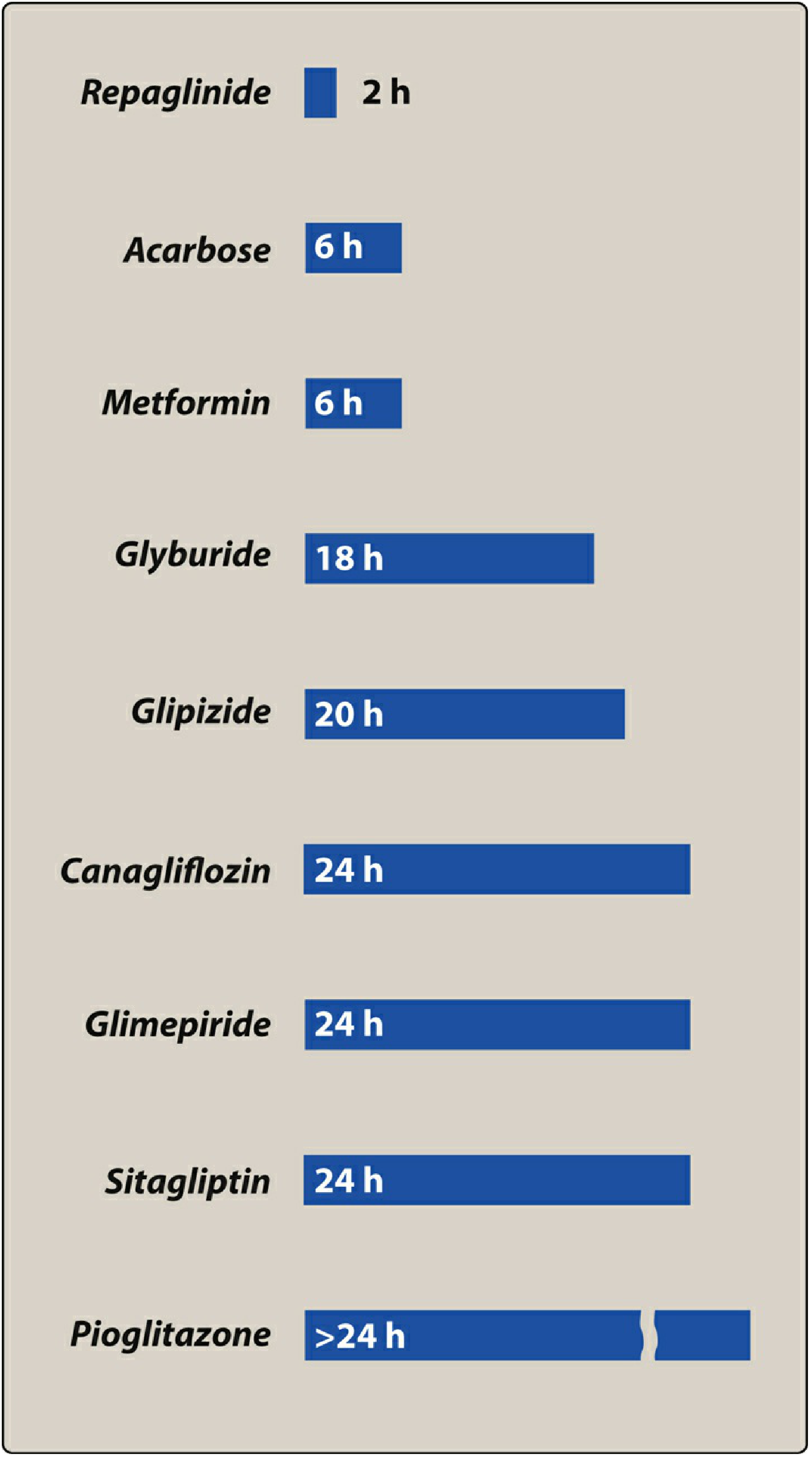
- Duration: 12-24 hours.
- Adverse effects: Hypoglycemia (most significant), weight gain, hyperinsulinemia.
- Caution: In renal impairment - glipizide/glimepiride are safer; glyburide accumulates and worsens hypoglycemia risk. Also use cautiously in the elderly.
3. Meglitinides (Repaglinide, Nateglinide)
- Mechanism: Similar to sulfonylureas (stimulate insulin secretion) but with rapid onset and shorter duration - act primarily on postprandial glucose.
- Taken before meals.
- Adverse effects: Hypoglycemia (less than sulfonylureas), weight gain.
- Should NOT be combined with sulfonylureas (overlapping mechanism, serious hypoglycemia risk).
4. Thiazolidinediones / TZDs (Pioglitazone, Rosiglitazone) - "Glitazones"
- Mechanism: PPAR-γ (peroxisome proliferator-activated receptor gamma) agonists → increase peripheral insulin sensitivity (especially in adipose tissue and muscle). Do not directly stimulate insulin release.
- Adverse effects: Weight gain, fluid retention/edema, increased risk of fractures, heart failure (contraindicated in NYHA class III-IV).
- Rarely cause significant hypoglycemia alone.
5. DPP-4 Inhibitors (Gliptins: Sitagliptin, Saxagliptin, Alogliptin)
- Mechanism: Inhibit dipeptidyl peptidase-4, which degrades GLP-1 and GIP → increased incretin levels → glucose-dependent insulin release and reduced glucagon.
- Adverse effects: Upper respiratory infections, nasopharyngitis; low hypoglycemia risk.
6. SGLT2 Inhibitors (Gliflozins: Empagliflozin, Dapagliflozin, Canagliflozin)
- Mechanism: Inhibit sodium-glucose cotransporter-2 in the proximal renal tubule → increased urinary glucose excretion.
- Added benefits: Cardiovascular and renal protection (major trials).
- Adverse effects: Genital mycotic infections, UTIs, euglycemic DKA (especially perioperatively - must be held before surgery), volume depletion.
7. Alpha-glucosidase Inhibitors (Acarbose, Miglitol)
- Mechanism: Inhibit intestinal brush border enzymes → delayed carbohydrate digestion and absorption → blunts postprandial hyperglycemia.
- Adverse effects: Flatulence, diarrhea, abdominal bloating (due to colonic fermentation of unabsorbed carbohydrates).
- No systemic hypoglycemia risk when used alone.
8. GLP-1 Receptor Agonists (Exenatide, Liraglutide, Semaglutide) - Injectable but classified with OHAs
- Mechanism: Mimic GLP-1 → stimulate insulin release (glucose-dependent), suppress glucagon, slow gastric emptying, promote satiety and weight loss.
Corticosteroids and Steroid Withdrawal Syndrome
Corticosteroids - Overview
Corticosteroids are synthetic analogs of the naturally occurring adrenal cortex hormones. They are broadly divided into:
- Glucocorticoids (e.g., hydrocortisone, prednisolone, dexamethasone, methylprednisolone) - primarily anti-inflammatory and metabolic effects.
- Mineralocorticoids (e.g., fludrocortisone, aldosterone) - primarily salt and water regulation.
Relative Potencies (Goodman & Gilman)
| Agent | Anti-inflammatory Potency | Na-Retaining Potency | Equivalent Dose |
|---|---|---|---|
| Hydrocortisone | 1 | 1 | 20 mg |
| Cortisone | 0.8 | 0.8 | 25 mg |
| Prednisolone | 4 | 0.8 | 5 mg |
| Methylprednisolone | 5 | 0.5 | 4 mg |
| Dexamethasone | 25-30 | ~0 | 0.75 mg |
| Fludrocortisone | 10 | 125 | - |
Mechanisms of Action
- Glucocorticoids bind intracellular receptors → translocate to nucleus → alter gene transcription → suppress inflammatory mediators (IL-1, IL-6, TNF-α, prostaglandins, leukotrienes).
- They also suppress the HPA (hypothalamic-pituitary-adrenal) axis via negative feedback - the key basis of withdrawal problems.
Adverse Effects of Chronic Supraphysiologic Use
- Metabolic: Hyperglycemia, hypokalemic alkalosis, dyslipidemia.
- Cardiovascular: Hypertension, fluid retention.
- Musculoskeletal: Osteoporosis, proximal myopathy (weakness of proximal limbs, can impair ambulation - type II fiber atrophy), growth arrest in children.
- Immunologic: Increased infection susceptibility, reactivation of latent TB.
- GI: Gastritis, peptic ulceration (especially when combined with NSAIDs).
- Ophthalmologic: Cataracts, glaucoma.
- CNS/Behavioral: Insomnia, mood changes, psychosis.
- Cutaneous: Striae, easy bruising (ecchymoses), fat redistribution (Cushingoid habitus - buffalo hump, moon face, central obesity).
Steroid Withdrawal Syndrome
When corticosteroids are abruptly stopped or rapidly tapered after prolonged use, two distinct problems arise:
1. HPA Axis Suppression (Most Serious)
- Prolonged exogenous corticosteroids suppress pituitary ACTH and hypothalamic CRH via negative feedback.
- On withdrawal, the HPA axis cannot mount a sufficient cortisol response.
- Result: Acute adrenal insufficiency (adrenal crisis) - the most severe and life-threatening complication.
- Risk: Patients who received supraphysiologic doses for 2-4 weeks within the preceding year, or those with Cushingoid appearance, should be presumed to have some degree of HPA impairment.
- Recovery time: Several weeks to months; in some individuals up to 1 year or longer.
2. Glucocorticoid Withdrawal Syndrome (Steroid Pseudorheumatism)
A characteristic syndrome distinct from adrenal insufficiency, consisting of:
- Fever
- Myalgia
- Arthralgias (joint pain - can mimic the underlying disease for which steroids were started)
- Malaise
- Fatigue
This syndrome can be difficult to differentiate from a flare of the underlying disease (e.g., IBD, rheumatoid arthritis, asthma). In IBD patients, this is specifically called pseudorheumatism - arthralgias that coincide with steroid withdrawal and require escalation of the corticosteroid dose.
Additionally, pseudotumor cerebri (benign intracranial hypertension - raised ICP with papilledema) can rarely occur on steroid reduction or withdrawal.
Management of Steroid Withdrawal
- Gradual tapering - most important principle. Protocols involve either gradual daily dose reduction or transition to alternate-day regimens before final taper.
- Never abruptly stop steroids after prolonged therapy.
- If signs of acute adrenal insufficiency (hypotension, nausea, vomiting, altered consciousness) develop - immediately return to a higher dose.
- If withdrawal syndrome symptoms (myalgia, arthralgia, fever, malaise) appear without evidence of adrenal crisis, slow the rate of taper.
- Stress dosing - patients on chronic steroids or recently tapered need supplemental "stress doses" during surgery, infection, or major physiologic stress.
Key Rule: The most frequent problem with steroid withdrawal is flare-up of the underlying disease for which steroids were prescribed - always consider this before diagnosing true withdrawal syndrome.
- Goodman & Gilman's Pharmacological Basis of Therapeutics
- Lippincott Illustrated Reviews: Pharmacology
- Rheumatology, 2-Volume Set (Elsevier, 2022)
This is a shared conversation. Sign in to Orris to start your own chat.