
Erectile dysfunction
"erectile dysfunction"[MeSH Terms] AND treatment
erectile dysfunction pathophysiology vascular neurogenic mechanism diagram
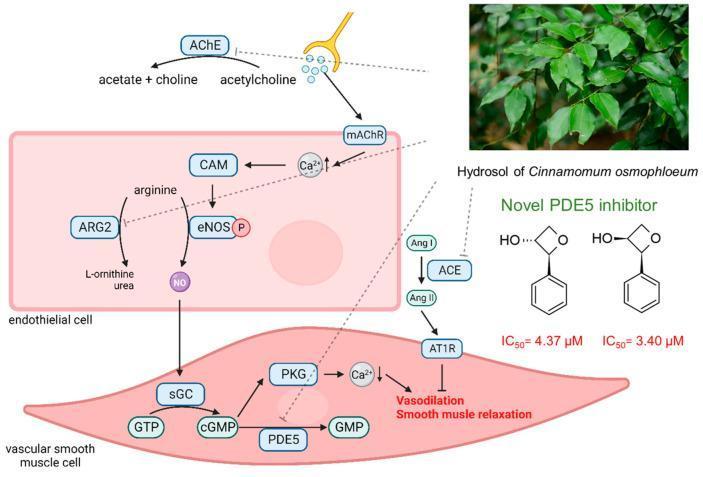
This pathophysiology diagram illustrates the biochemical mechanism by which Cinnamomum osmophloeum hydrosol influences erectile function through multi-pathway enzymatic inhibition within endothelial and vascular smooth muscle cells (VSMCs). The flowchart highlights four primary inhibitory targets: AChE (acetylcholinesterase), which breaks down acetylcholine into acetate and choline; ARG2 (arginase 2), which competes for arginine to produce L-ornithine and urea; ACE (angiotensin-converting enzyme), which converts Angiotensin I to the vasoconstrictor Angiotensin II; and PDE5 (phosphodiesterase type 5), which degrades cGMP. The diagram depicts the positive signaling cascade where acetylcholine activates muscarinic receptors (mAChR), increasing calcium and calmodulin (CAM) to activate phosphorylated eNOS (eNOS-P). This results in nitric oxide (NO) production, which diffuses to VSMCs to stimulate soluble guanylate cyclase (sGC). The sGC converts GTP to cGMP, activating protein kinase G (PKG) and leading to smooth muscle relaxation and vasodilation. Two novel PDE5 inhibitor isomers (trans- and cis-phenyloxetan-3-ol) are shown with their respective IC50 values (4.37 µM and 3.40 µM), demonstrating their structural role in maintaining cGMP levels to treat erectile dysfunction.
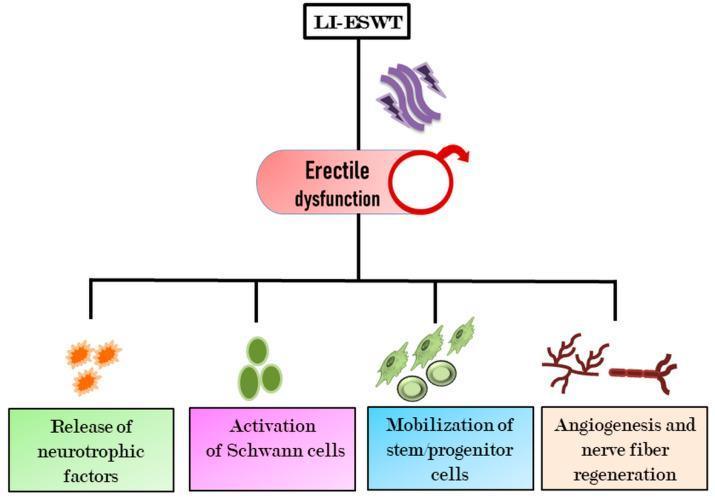
This pathophysiology diagram illustrates the therapeutic mechanisms of Low-Intensity Extracorporeal Shock Wave Therapy (LI-ESWT) in the treatment of erectile dysfunction (ED). The central flowchart displays LI-ESWT as the primary intervention, targeting a node labeled 'Erectile dysfunction' marked with a male symbol. Downstream of this interaction, the diagram identifies four key regenerative processes stimulated by shockwave energy: 1) Release of neurotrophic factors (depicted by orange star-burst icons), 2) Activation of Schwann cells (represented by green ovoid cell icons), 3) Mobilization of stem/progenitor cells (illustrated as green undifferentiated cells), and 4) Angiogenesis and nerve fiber regeneration (visualized as red branching vascular and neural structures). The diagram summarizes the biological pathways by which LI-ESWT promotes tissue repair, neovascularization, and improved hemodynamics within the penile corpora cavernosa. It is designed as an educational overview of regenerative medicine and urological therapy for medical students and clinicians.
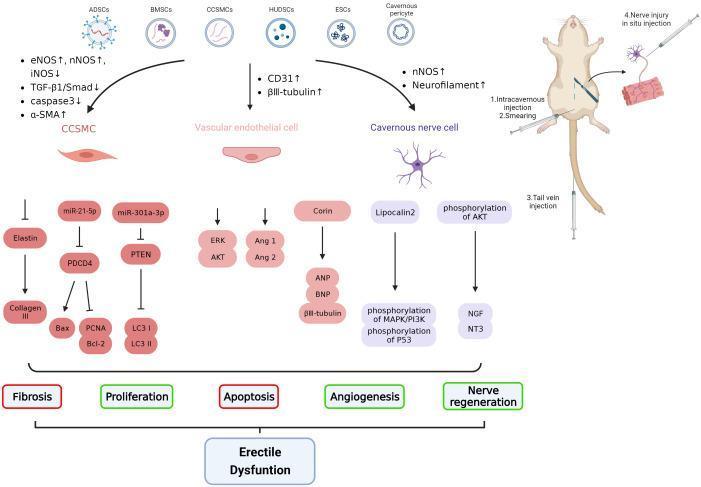
A multi-panel pathophysiology diagram and algorithm illustrating the molecular mechanisms of exosome therapy for erectile dysfunction (ED). The left and central sections detail signaling pathways initiated by various stem-cell-derived exosomes (ADSCs, BMSCs, CCSMCs, HUDSCs, and ESCs) and cavernous pericytes. These cells influence molecular targets in three key cell types: corpora cavernosum smooth muscle cells (CCSMC), vascular endothelial cells, and cavernous nerve cells. Key molecular shifts include up-regulation of eNOS, nNOS, α-SMA, and neurofilaments, alongside down-regulation of iNOS, TGF-̢1/Smad, and caspase-3. The diagram maps these signaling cascades (involving miR-21-5p, PTEN, ERK, AKT, and NGF) to five physiological outcomes: reduction in fibrosis and apoptosis, and promotion of proliferation, angiogenesis, and nerve regeneration. The right panel depicts an animal model (rat) demonstrating four therapeutic delivery methods: intracavernous injection, smearing, tail vein (systemic) injection, and nerve injury in situ injection. This educational infographic summarizes how regenerative medicine targets the underlying vascular and neural pathology of ED.
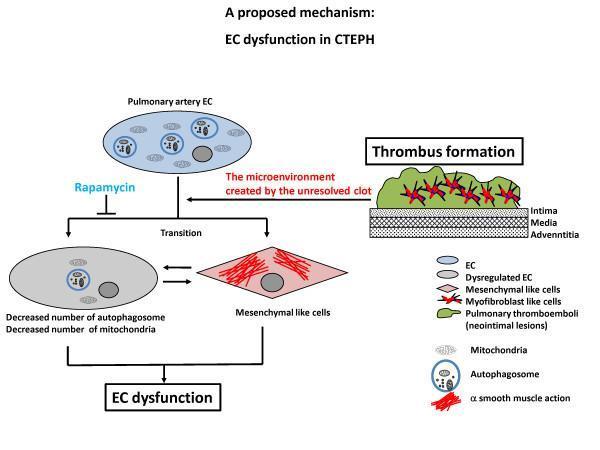
This pathophysiology diagram illustrates a proposed mechanism for endothelial cell (EC) dysfunction in Chronic Thromboembolic Pulmonary Hypertension (CTEPH). The process originates with 'Thrombus formation,' showing pulmonary thromboemboli (neointimal lesions) atop the intima, media, and adventitia layers of the vascular wall. This creates a microenvironment influenced by the unresolved clot, which acts upon pulmonary artery ECs. The schematic depicts two primary pathways for EC transformation: 1) Transition into 'Mesenchymal like cells' (Endothelial-to-Mesenchymal Transition/EnMT), characterized by a spindle shape and red filaments representing α-smooth muscle actin, and 2) transformation into 'Dysregulated ECs,' identified by a decreased number of autophagosomes and mitochondria. Both pathways converge to result in 'EC dysfunction.' The drug Rapamycin is shown as an inhibitory agent blocking the pathway toward dysregulated ECs. A detailed legend identifies cellular components including myofibroblast-like cells, mitochondria (small blue ovals), and autophagosomes (double-membrane circular structures). This diagram serves as an educational summary of how chronic clots contribute to pulmonary vascular remodeling and metabolic cellular defects.
Erectile Dysfunction (ED)
Definition
Epidemiology
- 10-15% of all adult American men suffer from ED, with incidence rising steeply with age. - Goldman-Cecil Medicine
- In a landmark study, 52% of men aged 40-70 experienced some degree of ED.
- Prevalence by age: ~2% at ages 40-49; ~6% at 50-59; ~17% at 60-69; ~39% at age 70+. - Textbook of Family Medicine 9e
- ED is especially prevalent in men with type 2 diabetes mellitus, after radical prostatectomy, and in men with lower urinary tract symptoms/BPH.
- ED is associated with increased cardiovascular risk - men with ED often develop cardiac symptoms later, suggesting a shared pathophysiologic continuum.
Pathophysiology
- Sexual stimulation activates parasympathetic (and non-adrenergic, non-cholinergic) neurons in the corpus cavernosum.
- These release nitric oxide (NO) from nerve endings and endothelial cells.
- NO activates guanylate cyclase, raising intracellular cyclic GMP (cGMP) in cavernosal smooth muscle.
- cGMP causes smooth muscle relaxation → vasodilation → rapid blood inflow into the corpora cavernosa.
- Engorgement compresses small emissary veins against the tunica albuginea → venous occlusion → sustained erection.
- Phosphodiesterase type 5 (PDE5) degrades cGMP, terminating erection. - Textbook of Family Medicine 9e; Medical Physiology
Etiology and Classification
| Category | Examples |
|---|---|
| Vasculogenic | Atherosclerosis, hypertension, hyperlipidemia, DM, smoking (most common organic cause) |
| Neurogenic | Radical prostatectomy, pelvic surgery/radiation, spinal cord injury, peripheral neuropathy, Parkinson's disease, MS |
| Endocrine | Hypogonadism (testosterone deficiency), hyperprolactinemia, hyper/hypothyroidism |
| Psychogenic | Depression, anxiety, relationship conflict, performance anxiety (most common overall cause) |
| Drug-induced | See table below - medications account for up to 25% of ED cases |
| Systemic illness | Renal failure, liver disease, metabolic syndrome |
| Aging | Even with normal testosterone, endothelial dysfunction increases with age |
Drugs Commonly Associated with ED (Goldman-Cecil Table 216-9):
- Antidepressants: SSRIs, TCAs, MAOIs
- Antihypertensives: beta-blockers, clonidine, verapamil
- Cardiac drugs: amiodarone, digoxin
- Diuretics: thiazides, spironolactone
- H2-blockers: cimetidine, ranitidine
- Hormonal agents: corticosteroids, antiandrogens, LHRH agonists, 5-alpha-reductase inhibitors (finasteride, dutasteride)
Diagnosis
- History: detailed medical and sexual history (patient and partner); screen for psychosocial factors (depression, anxiety, substance use, libido, relationship issues). Use the Sexual Health Inventory for Men (SHIM) questionnaire.
- Physical exam: genitourinary, cardiovascular, endocrine, and neurologic systems; prostate examination.
- Labs: fasting glucose or HbA1c, lipid panel, urinalysis, renal function, morning serum testosterone. Prolactin, LH, and free testosterone if hypogonadism is suspected (do not measure routinely - hyperprolactinemia accounts for <2% of ED). - Textbook of Family Medicine 9e; Goldman-Cecil
- Special tests (rarely needed): penile duplex Doppler ultrasound (for vascular insufficiency or veno-occlusive disease), nocturnal penile tumescence, cavernosometry.
Treatment
Step 1: Address Underlying Causes
- Lifestyle: weight loss (improves erectile function in obese men), exercise, smoking cessation, alcohol reduction. - Textbook of Family Medicine 9e
- Optimize glycemic control in diabetes.
- Review and adjust medications if a drug cause is suspected (weigh risks/benefits).
- Psychosexual counseling for psychogenic ED (though evidence is limited).
Step 2: First-Line - PDE5 Inhibitors
| Drug | Usual Dose | Onset | Duration | Notes |
|---|---|---|---|---|
| Sildenafil (Viagra) | 50 mg (25-100 mg) | 20-60 min | ~4-5 hrs | Take on demand; food reduces absorption |
| Vardenafil (Levitra) | 5-20 mg | 25-60 min | 4-6 hrs | - |
| Tadalafil (Cialis) | 10-20 mg on demand; 2.5-5 mg daily | 30-60 min | up to 36 hrs | Daily dosing option; also treats BPH/LUTS |
| Avanafil | 50-200 mg | ~15 min | ~6 hrs | Fastest onset |
- Effective in ~60% of men overall; lower response rates in DM, spinal cord injury, post-prostatectomy.
- Contraindications: concurrent nitrate use (risk of severe hypotension from cGMP accumulation). Also caution with alpha-blockers (orthostatic hypotension). - Goldman-Cecil Medicine
- Side effects: headache, flushing, nasal congestion, dyspepsia; sildenafil can cause transient "blue vision" (PDE6 inhibition in the retina). - Medical Physiology
Step 3: Second-Line Therapies
- Intracavernosal alprostadil (prostaglandin E1 injection) - highly effective, including post-prostatectomy
- Intraurethral alprostadil (MUSE suppository, 125-1000 mcg) - less invasive than injection
- Vacuum erection device - non-pharmacologic, effective in most men
- Low-intensity extracorporeal shock wave therapy (LI-ESWT) - emerging regenerative approach; stimulates angiogenesis, nerve fiber regeneration, Schwann cell activation, and neurotrophic factor release (see diagram below)
Step 4: Third-Line - Surgical
- Penile prosthesis implantation (inflatable or malleable) - reserved for failed medical therapy; high patient satisfaction rates.
Special Considerations
Post-Prostatectomy ED
- ED after radical prostatectomy depends on: age (<65 years), preoperative potency, and bilateral neurovascular bundle (NVB) preservation.
- Recovery is gradual: ~38% potent at 3 months, 54% at 6 months, 73% at 12 months, 86% at 18 months (Walsh et al.). - Campbell Walsh Wein Urology
- PDE5 inhibitors (on-demand dosing) aid recovery; early penile rehabilitation contributes to long-term recovery.
ED in Peyronie's Disease
- Prevalence of ED in Peyronie's disease is 37-58%.
- Penile arterial insufficiency in 36%, veno-occlusive disease in 59% of those with Peyronie's and ED. - Campbell Walsh Wein Urology
ED as a Cardiovascular Sentinel
- ED often precedes the onset of overt cardiovascular symptoms, making it an opportunity for early cardiac risk stratification and intervention. - Textbook of Family Medicine 9e
Recent Evidence (2024-2026)
- A 2024 systematic review and network meta-analysis (PMID 39279185) examined nutraceutical interventions for ED, though evidence remains far weaker than for PDE5 inhibitors.
- A 2025 systematic review (PMID 39269577) specifically assessed antihypertensive medications and ED, with a focus on beta-blockers, confirming the association.
- A 2025 systematic review (PMID 40219032) on Tribulus terrestris supplementation found limited, inconsistent evidence for improving ED or testosterone levels.
Erection on masturbation relations with ED
"erectile dysfunction" AND "masturbation" AND psychogenic
erection during masturbation but not intercourse psychogenic vs organic erectile dysfunction clinical significance
Erection During Masturbation vs. During Intercourse - The Psychogenic vs. Organic ED Distinction
The Core Clinical Principle
Psychogenic vs. Organic ED: The Diagnostic Table
| Feature | Psychogenic ED | Organic ED |
|---|---|---|
| Onset | Sudden | Gradual |
| Progression | Complete, immediate loss | Incremental, progressive |
| Pattern | Situational (partner/context-dependent) | Global (fails in all situations) |
| Waking/morning erections | Present and normal | Poor or absent |
| Masturbation erections | Normal or near-normal | Poor or absent |
| Nocturnal erections (NPT) | Normal | Abnormal |
| Libido | Usually preserved | May be reduced (if hormonal) |
| Age group | More common in younger men | More common in older men |
| Associated factors | Anxiety, depression, relationship stress, new partner, major life event | Diabetes, vascular disease, smoking, surgery, medication, neuropathy |
Why Masturbation Erections Are Preserved in Psychogenic ED
- There is no performance pressure or fear of judgment
- The man is in a familiar, controlled environment
- There is no partner anxiety, fear of inadequacy, or expectation to perform
- Arousal is purely self-generated, allowing the NO-cGMP pathway to function freely
- Raises noradrenaline levels in the corpus cavernosum
- Causes vasoconstriction and smooth muscle contraction - the opposite of what is needed for erection
- Suppresses the parasympathetic NO release that drives erection
- Creates a vicious cycle: failure → more anxiety → more sympathetic activation → more failure
The Role of Nocturnal Penile Tumescence (NPT)
- Psychogenic ED: NPT is normal - erections during sleep are preserved
- Organic ED: NPT is abnormal or absent
Important Nuances
1. It Is Rarely Black and White
- A man with mild vascular disease may initially have partial ED → develops performance anxiety → the psychogenic layer amplifies the organic problem
- Some diabetics with established neuropathy still have a significant psychogenic component - Campbell Walsh Wein Urology; Kaplan & Sadock
2. Situational Pattern Matters Beyond Masturbation
- Erections with one partner but not another
- Erections with visual stimulation but not with a specific partner
- Erections early in a relationship but lost after conflict or intimacy problems
- Erections at home but not in unfamiliar situations
3. Excessive Masturbation and Psychogenic ED
4. Young Men With ED
Clinical Approach When Masturbation Erections Are Normal
- Minimal/no organic workup needed - basic labs (testosterone, glucose, lipids) are still reasonable but no need for vascular imaging or NPT testing
- Psychosexual history - explore anxiety, depression, relationship issues, pornography use, sexual trauma, partner dynamics
- First-line treatment: Psychosexual counseling or sex therapy (cognitive-behavioral approaches), rather than jumping straight to PDE5 inhibitors
- PDE5 inhibitors can still help - by breaking the anxiety-failure-anxiety cycle and restoring confidence, even in pure psychogenic ED; they are often used as a short-term "circuit breaker" while addressing the underlying psychology
- Treat comorbid depression/anxiety - SSRIs can help mood but may worsen ED (a therapeutic dilemma); bupropion is a useful alternative as it has lower sexual side effects