
Treatment plan for a 1.4 kg newborn whose mother is HbSAg positive and he is exhibiting symptoms of down syndrome
Reading File
Checking Date & Time
This is a complex clinical scenario covering three simultaneous issues: extreme prematurity/very low birth weight (1.4 kg), maternal HBsAg positivity (vertical transmission prevention), and Down syndrome management. I'll run parallel searches across all three areas.
Finding Sources
Finding Sources
Finding Sources
Good hits. Now let me read the most relevant sections in detail — the Harriet Lane and Red Book for VLBW/HBsAg management, and specific Down syndrome neonatal management.
Reading File
Reading File
Finding Sources
Excellent detail from the Red Book. Now let me read more of the HBsAg section (birth weight <2000g specific management) and the VLBW neonate management section from Harriet Lane, plus the Down syndrome neonatal workup.
Reading File
Finding Sources
Reading File
Excellent. Now let me fetch the HBsAg flowchart image and search for specific Down syndrome newborn workup guidelines, plus VLBW neonatal stabilization details.
Loading Image
Finding Sources
Finding Sources
I now have comprehensive data from all three search threads. Let me also quickly check the Harriet Lane for VLBW stabilization specifics and check one quick pubmed search for recent guidelines.
Finding Sources
Searching PubMed
"very low birth weight" AND "Down syndrome" neonatal management
I now have sufficient information to compile a thorough treatment plan. Let me mark todos complete and synthesize.---
Treatment Plan: 1.4 kg Neonate, HBsAg-Positive Mother, Suspected Down Syndrome
This infant carries three simultaneous high-priority clinical issues that must be managed in parallel:
- Very Low Birth Weight (VLBW) — 1.4 kg (weight <1500 g by definition)
- Vertical Hepatitis B exposure — mother is HBsAg positive
- Suspected Trisomy 21 (Down syndrome) — requires urgent workup and monitoring
I. VLBW Neonatal Stabilization (Immediate — Delivery Room & NICU)
A. Thermal Management
- Immediately place in a preheated incubator or radiant warmer; target skin temperature 36.5–37.5°C
- Use polyethylene wrap at delivery to minimize insensible heat/water loss
- VLBW neonates have very high total body water (up to 90% body weight) and are extremely vulnerable to hypothermia and dehydration
B. Respiratory Support
- Assess with APGAR score at 1 and 5 minutes
- Monitor for respiratory distress syndrome (RDS) — the single biggest cause of morbidity in premature neonates
- Initiate CPAP early if there is grunting, nasal flaring, or retractions
- Prepare for exogenous surfactant therapy if FiO₂ requirements rise (>0.30 on CPAP) or if CXR confirms RDS
- Target oxygen saturation 91–95% (avoid hyperoxia — risk of retinopathy of prematurity)
- Avoid unnecessary intubation; use non-invasive ventilation preferentially
C. Cardiovascular / Hemodynamic
- Continuous cardiorespiratory monitoring
- Blood pressure monitoring — Mean Arterial Pressure (MAP) should be ≥ gestational age in weeks (as a rough guide)
- Watch for patent ductus arteriosus (PDA), extremely common in VLBW infants; VLBW is a specific risk factor for hemodynamically significant PDA
- Note: Down syndrome carries ~50% risk of congenital heart disease — echocardiogram is mandatory (see below)
D. Fluid and Nutrition
- Start IV 10% dextrose (D10W) at 60–80 mL/kg/day on Day 1; adjust based on glucose monitoring
- VLBW/preterm neonates have higher glucose needs and are prone to hypoglycemia — check blood glucose within 30 minutes of birth and every 1–3 hours initially; maintain ≥45–50 mg/dL
- Begin parenteral nutrition (PN) early — amino acids from Day 1, lipids from Day 2 if tolerating
- Advance enteral feeds (breast milk preferred) as soon as hemodynamically stable; mothers with hepatitis B can breastfeed safely once prophylaxis is administered to the infant
- Electrolyte monitoring: Na, K, Ca — VLBW infants are prone to electrolyte disturbances due to high insensible losses
E. Infection Prophylaxis/Sepsis
- VLBW preterm neonates are at high risk for early-onset neonatal sepsis
- Obtain blood culture; start empirical ampicillin + gentamicin if there are any signs of sepsis or chorioamnionitis was present
- Standard precautions if mother had clinical hepatitis; coordinate with infection control
- Rosen's Emergency Medicine: "An acceptable regimen includes dual therapy with ampicillin and gentamicin" for preterm neonates with suspected infection
F. Hematologic
- Monitor CBC — watch for anemia, thrombocytopenia (early sign of sepsis)
- Vitamin K 0.5 mg IM at birth (VLBW dose)
- Coagulation parameters differ from term infants — monitor PT/aPTT
G. Other Monitoring
- Screen for hyperbilirubinemia (phototherapy thresholds are lower in preterm infants)
- Ophthalmology follow-up at 31 weeks PMA (or 4 weeks after birth, whichever is later) for retinopathy of prematurity (ROP) screening
- Cranial ultrasound to screen for intraventricular hemorrhage (IVH) — VLBW infants have significantly increased risk
II. Hepatitis B Prophylaxis (Birth to <12 Hours — Critical Window)
This is a time-sensitive emergency intervention. The algorithm below applies directly to this infant (birth weight <2000 g, mother HBsAg positive):
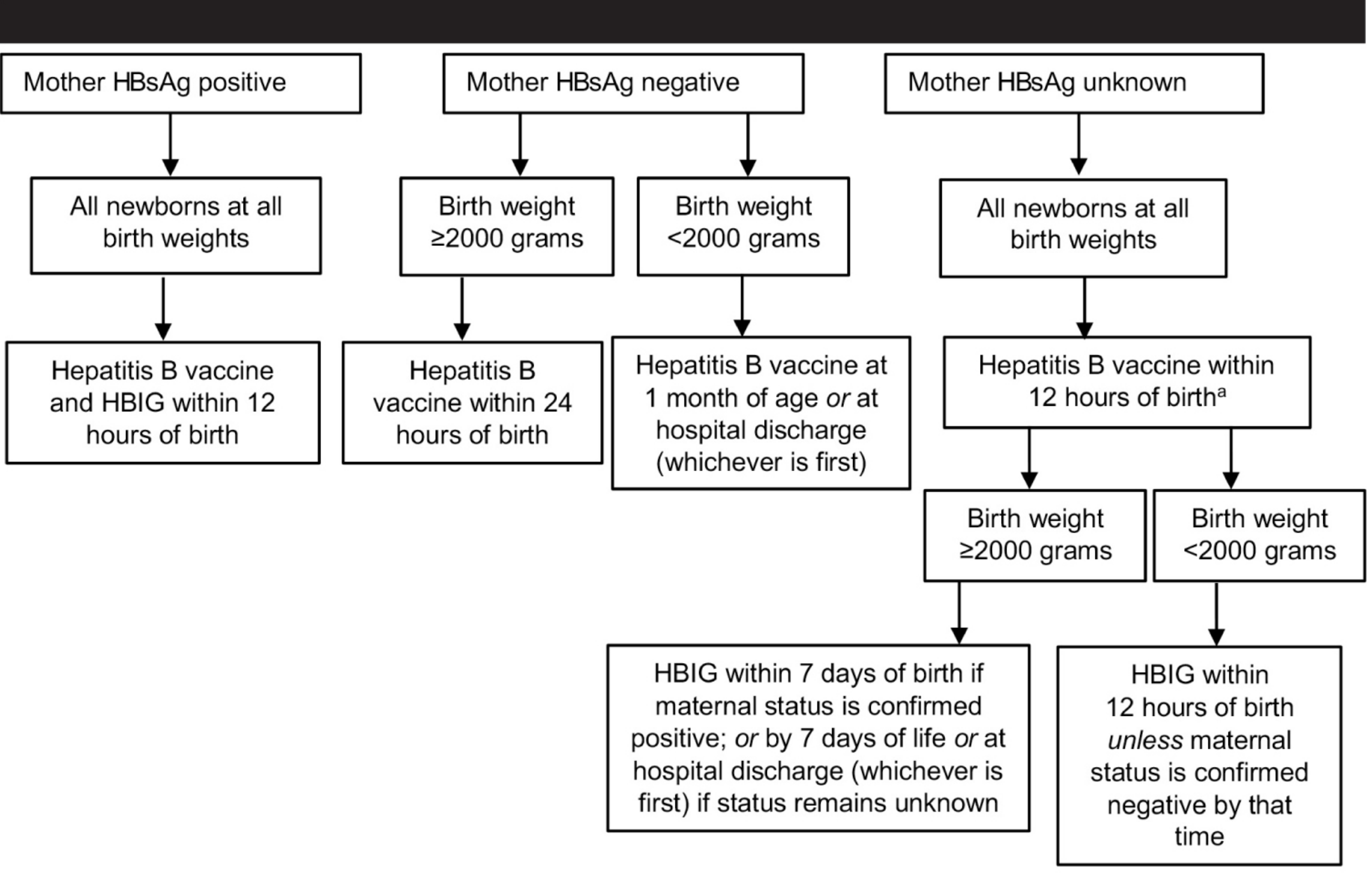
Action Steps:
| Intervention | Timing | Dose / Details |
|---|---|---|
| HepB vaccine (dose 0) | Within 12 hours of birth | 0.5 mL IM (Recombivax HB 5 mcg or Engerix-B 10 mcg); this dose does NOT count toward the 3-dose series |
| HBIG (Hepatitis B Immune Globulin) | Within 12 hours of birth | 0.5 mL IM — administer at a different anatomic site from the vaccine |
| Subsequent vaccine doses | Months 1, 2–3, and 6 (single-antigen) | Total 4 doses for infants <2000 g (the extra dose compensates for the diminished immunogenicity of the birth dose) |
| Breastfeeding | Safe once vaccine + HBIG given | No additional HBV risk to infant after prophylaxis |
| Follow-up serology | 9–12 months of age | Test for anti-HBs AND HBsAg; anti-HBs ≥10 mIU/mL = protected |
Key principles:
- HBIG effectiveness diminishes with delay; the window is likely ≤7 days — must act within 12 hours
- Without prophylaxis, vertical transmission occurs in 70–90% of HBsAg+/HBeAg+ mothers; prophylaxis reduces this to <10%
- Confirm maternal HBV DNA and HBeAg status — if HBeAg positive or high viral load, maternal antiviral treatment may be indicated (tenofovir) — this does not change the infant's immediate management
- If maternal HBV status is confirmed HBsAg-positive, vaccinate as above regardless of birth weight — Red Book 2021, AAP, p. 636–639
III. Down Syndrome (Trisomy 21) — Neonatal Workup and Management
Clinical diagnosis may be suspected based on:
- Generalized hypotonia (most prominent early sign)
- Oblique (upslanting) palpebral fissures
- Flat facial profile / flat nasal bridge
- Abundant neck skin / short neck
- Single palmar (simian) crease
- Fifth finger clinodactyly
- Short broad hands
Confirmation requires karyotype. Hypotonia may complicate feeding and airway management in this already compromised preterm VLBW infant.
A. Confirm Diagnosis
- Chromosomal karyotype (peripheral blood) — order immediately; confirms trisomy 21 vs. translocation vs. mosaic
- Microarray-comparative genomic hybridization (CGH) can also be used
B. Cardiac Workup — Urgent
- Echocardiogram within the first few days of life
- ~50% of Down syndrome infants have congenital heart disease (CHD); most common lesion: atrioventricular septal defect (AVSD/endocardial cushion defect), also VSD, ASD, PDA, TOF
- Cardiology consultation immediately — significant CHD may require surgical planning
- Swanson's Family Medicine Review: "Any newborn identified with the features of trisomy 21 should have a screening echocardiogram"
C. Other Structural Anomalies
- Abdominal X-ray / clinical evaluation for duodenal atresia (double-bubble sign) — significantly more common in Down syndrome; presents with bilious vomiting
- Screen for tracheoesophageal fistula (TE fistula) and esophageal atresia
- Renal ultrasound (renal anomalies possible)
D. Endocrine
- Congenital hypothyroidism screening (included in standard newborn metabolic screening panel) — Down syndrome has elevated incidence; confirm TSH/T4 on newborn screen
- If screen is abnormal, start levothyroxine promptly
E. Hematologic
- Down syndrome newborns have an increased incidence of transient abnormal myelopoiesis (TAM) — a transient leukemoid reaction that can evolve into leukemia in ~20%
- Order CBC with differential and blood smear — look for blast cells
- Hematology consultation if CBC shows circulating blasts
- Monitor for polycythemia (hematocrit >65%), particularly important given preterm status
F. Neurodevelopment / Airway
- Hypotonia impacts feeding ability — early speech therapy/occupational therapy consultation for feeding assessment
- Atlantoaxial instability screening is not needed in the immediate neonatal period but is required before activities causing cervical flexion (typically at ~3–5 years)
- Early intervention programs should be initiated as early as possible
G. Ophthalmologic
- Neonatal eye exam; cataracts can occur in Down syndrome
H. Audiology
- Hearing screen (standard newborn hearing screening — particularly important as hearing loss is common in Down syndrome)
I. Genetic Counseling
- Offer to parents once stable — discuss recurrence risk (depends on karyotype type: free trisomy ~1%, translocation higher)
IV. Priority Summary: Immediate First 12 Hours
| Priority | Action |
|---|---|
| 1 | Admit to NICU; radiant warmer / incubator; cardiorespiratory monitoring |
| 2 | HepB vaccine (0.5 mL IM) + HBIG (0.5 mL IM) within 12 hours — different sites |
| 3 | Blood glucose monitoring; IV D10W; Vitamin K 0.5 mg IM |
| 4 | Blood culture; consider empirical ampicillin + gentamicin |
| 5 | Respiratory support — CPAP/surfactant as needed |
| 6 | Echocardiogram — urgent (50% CHD risk) |
| 7 | CBC with differential + blood smear (TAM screen) |
| 8 | Chromosomal karyotype |
| 9 | Abdominal assessment for duodenal atresia |
| 10 | Newborn metabolic screen (TSH, PKU, etc.) |
Sources
- Red Book 2021 — AAP Committee on Infectious Diseases, Hepatitis B, pp. 636–639
- The Harriet Lane Handbook, 23rd ed. — Newborn Assessment, VLBW definitions
- Rosen's Emergency Medicine — Preterm neonate empirical antibiotic therapy
- Thompson & Thompson Genetics and Genomics in Medicine, 9th ed. — Down Syndrome clinical features
- Swanson's Family Medicine Review — Echocardiogram indication in Down syndrome
- Miller's Anesthesia, 10th ed. — Neonatal oxygen saturation targets, NICU thermoregulation
- Barash Clinical Anesthesia, 9th ed. — Fluid/glucose management in VLBW neonates
Note: This plan should be implemented by a neonatologist in a Level III/IV NICU. The combination of VLBW, suspected Down syndrome (with potential congenital heart disease), and HBV exposure makes this a high-complexity case requiring multidisciplinary input from neonatology, cardiology, hematology, genetics, and infectious disease.The treatment plan above addresses all three concurrent clinical problems comprehensively. A few key points to emphasize:
Most time-critical action: HepB vaccine + HBIG must both be given within 12 hours of birth — this cannot be delayed regardless of the infant's prematurity or instability, as the window of HBIG effectiveness closes rapidly. The birth dose at this weight (<2000 g) does NOT count toward the 3-dose series, so a total of 4 doses will be given.
Most dangerous unknown: The echocardiogram result. With a 50% rate of CHD in Down syndrome — including potentially severe defects like complete AVSD — there may be a cardiac emergency requiring urgent cardiology input that supersedes other management priorities.
Most nuanced VLBW issue: This infant is at the lower end of VLBW (1.4 kg) and will require sustained NICU care; feeding, growth, and neurodevelopmental follow-up will be a long-term commitment, particularly given the co-existing Down syndrome.
This is a shared conversation. Sign in to Orris to start your own chat.