
What is the significance of using 3 fingers during pulse examination
Reading File
Finding Sources
Searching the Web
significance of 3 fingers in pulse examination clinical medicine
Finding Sources
Reading Web Page
https://www.quora.com/What-is-the-significance-of-using-3-fi…
Finding Sources
Finding Sources
Reading File
Finding Sources
Finding Sources
Finding Sources
Searching the Web
three finger technique radial pulse index middle ring finger role proximal middle distal clinical significance
Searching Images
three finger radial pulse palpation technique
Loading Image
Here is a comprehensive explanation of the significance of using 3 fingers during pulse examination:
Why 3 Fingers Are Used in Pulse Examination
The Finger Placement
The index (2nd), middle (3rd), and ring (4th) fingers are placed along the course of the radial artery at the wrist. The thumb is never used — it has its own strong pulsation from the princeps pollicis artery, which would be confused with the patient's pulse.
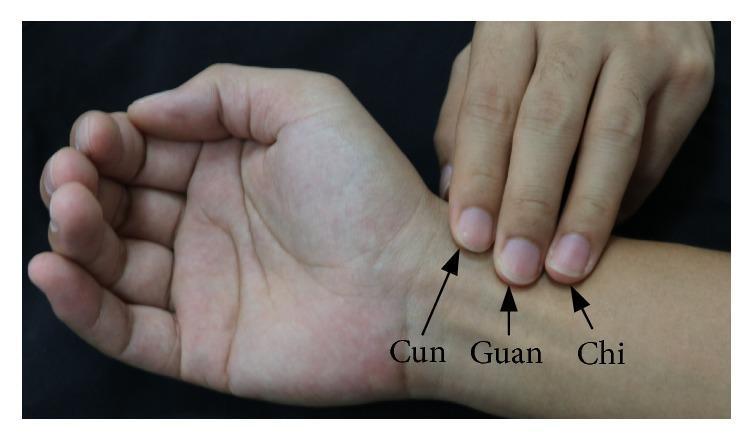
Role of Each Finger in Western Clinical Medicine
| Finger | Position | Function |
|---|---|---|
| Index finger (proximal) | Closest to the elbow | Occludes inflow — compresses the artery proximally to stabilize it against the underlying radius |
| Middle finger | Centre | Primary sensing finger — used to assess rate, rhythm, volume, character, and waveform |
| Ring finger (distal) | Closest to the hand | Blocks backflow — prevents retrograde blood from confusing the palpation |
The middle finger effectively becomes the "reading" finger while the other two act as a controlled vascular clamp on either side, isolating a segment of the artery for accurate assessment.
Why Not Just One Finger?
- A single finger may miss the vessel entirely, especially in patients with anatomical variation, obesity, or hypotension
- Greater surface coverage increases the likelihood of locating the point of maximum pulsation
- With three fingers, you can sense the propagation of the pulse wave along the artery (i.e., proximal to distal travel), which contributes to assessing pulse character
- It allows simultaneous comparison across a short arterial segment — useful for detecting abnormalities in pulse volume
What Is Assessed with 3 Fingers
- Rate — counted over 30–60 seconds
- Rhythm — regular vs. irregular (e.g., atrial fibrillation, ectopics)
- Volume (amplitude) — large (hyperdynamic) vs. small (low output states)
- Character/waveform — e.g., pulsus tardus et parvus in aortic stenosis, collapsing pulse in aortic regurgitation, pulsus alternans in LV failure
- Vessel wall condition — thickening, tortuosity (atherosclerosis)
- Radio-radial and radio-femoral delay — assessed with simultaneous bilateral palpation
— Fuster and Hurst's The Heart, 15th Edition
Traditional Chinese Medicine (TCM) Perspective
In TCM, the three positions have distinct diagnostic meanings:
- Cun (index finger, distal) — reflects the Heart and Lung
- Guan (middle finger, over radial styloid) — reflects the Liver, Gallbladder, Spleen, and Stomach
- Chi (ring finger, proximal) — reflects the Kidney
Each position is examined at three depths of pressure (superficial, medium, deep), yielding the "three positions, nine indicators" (三部九候) system — a highly systematized pulse diagnostic framework used for over 2,000 years.
Summary
The three-finger technique provides better arterial coverage, stabilizes the vessel, eliminates artefact from the examiner's own pulse, and allows simultaneous sensing across a segment of the artery. This makes it both more accurate and more informative than single-finger palpation. In TCM, the positional significance extends to organ-system mapping, making the three-finger placement foundational to diagnosis.
This is a shared conversation. Sign in to Orris to start your own chat.