
Treatment of dka
DKA (Diabetic Ketoacidosis) Treatment - Quick Overview
The core pillars of DKA treatment are: fluids (aggressive IV rehydration), insulin (to stop ketogenesis), potassium replacement (critical before starting insulin), and treating the precipitating cause. Monitoring and correction of electrolytes - especially potassium, bicarbonate, and phosphate - is essential throughout.
Searching sources...
Reading File
Now I'll search the medical library and PubMed in parallel for comprehensive DKA treatment content.
Finding Sources
Searching PubMed
"diabetic ketoacidosis" AND management
Searching Images
diabetic ketoacidosis DKA management flowchart insulin fluid treatment
Good - found key sections. Now reading all three in parallel.
Reading File
Reading File
Reading File
I have rich content from three major textbooks. Let me also get the management section from Rosen's which was truncated, and fetch the flowchart image.
Reading File
Loading Image
Excellent - I now have comprehensive information from three major textbooks plus the clinical flowchart. Let me compile the full answer.
Treatment of Diabetic Ketoacidosis (DKA)
DKA management rests on four simultaneous pillars: fluid resuscitation, insulin therapy, electrolyte replacement (especially potassium), and identifying and treating the precipitating cause. The order matters - potassium must be checked and repleted BEFORE insulin is started.
1. Initial Assessment & Monitoring
Before and during treatment, obtain:
- Serum glucose, electrolytes (Na, K, Cl, HCO3), BUN/Creatinine
- Arterial or venous blood gas
- Urinalysis, urine/serum ketones
- CBC with differential
- ECG (QTc prolongation is common in DKA and can precipitate torsades de pointes)
- Blood cultures, chest X-ray if infection suspected
Monitor during treatment: bedside glucose every hour, electrolytes and venous blood gas every 2 hours, fluid input/output meticulously. - Rosen's Emergency Medicine, p. 2544
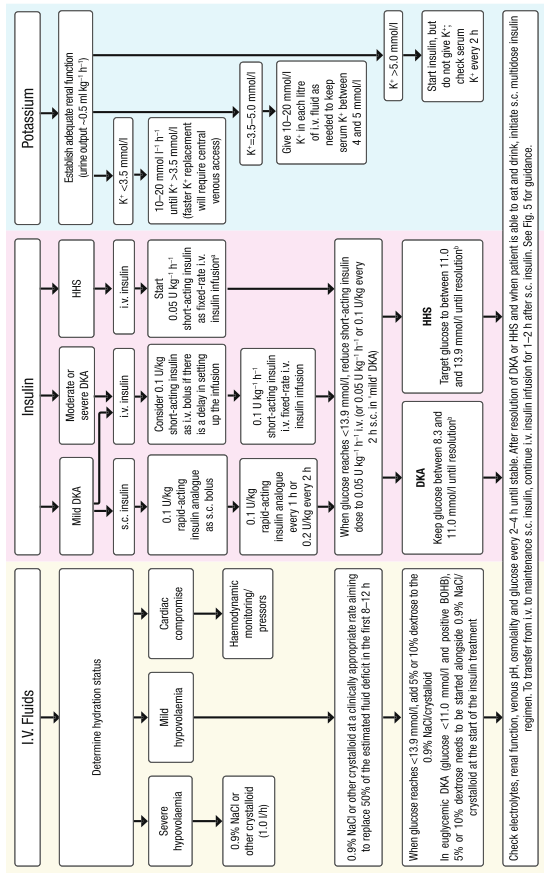
2. IV Fluid Resuscitation
The typical fluid deficit is 5-10% of body weight (roughly 3-5 L in adults).
Phase 1 - Restore circulating volume:
- Adults: 0.9% normal saline (NS) 1-2 L over the first 1-3 hours (or 1 L bolus followed by 500-1000 mL/h if cardiac and renal function are normal)
- If in hypovolemic shock: give isotonic crystalloid as rapidly as possible; consider bedside ultrasound to guide volume status
- Children: 20 mL/kg NS bolus in the first hour; repeat if hypotensive
Phase 2 - Replenish total-body water deficit:
- Switch to 0.45% saline at 150-500 mL/h (use 0.9% if patient is hyponatremic)
- Aim for positive fluid balance over 12-24 hours
- Do not correct faster than 3 mOsm/kg/h to reduce risk of osmotic encephalopathy
- In children, replace the deficit evenly over 24-48 hours (or 50% in the first 8 hours and the rest over the next 16-24 hours) to avoid cerebral edema
Note: Fluid resuscitation alone lowers blood glucose by ~18% (via improved renal perfusion and glucose clearance) and partially improves acidosis - but insulin is still required for ketoacidosis resolution. - Rosen's Emergency Medicine, p. 2544
Balanced crystalloids (e.g., Plasmalyte) have been studied as an alternative to normal saline to avoid hyperchloremic metabolic acidosis, with some evidence of more rapid normalization of physiologic parameters.
3. Potassium Replacement (Critical Before Insulin)
The initial serum K+ is often normal or high despite large total-body deficits, because acidosis drives K+ out of cells. When insulin is given and acidosis corrects, K+ drops rapidly and can become dangerously low.
| Serum K+ | Action |
|---|---|
| < 3.3 mEq/L | DO NOT start insulin. Give IV K+ replacement first; recheck. |
| 3.3 - 3.5 mEq/L | Give K+ 10-20 mEq/h IV until K+ > 3.5, then start insulin |
| 3.5 - 5.5 mEq/L | Add 20-40 mEq KCl per liter of IV fluid; start insulin |
| > 5.0-5.5 mEq/L | Start insulin, but hold K+ supplementation; recheck K+ every 2 hours |
- Add K+ to fluids at 10-20 mEq/h once conditions are met
- Establish adequate renal function (urine output > 0.5 mL/kg/h) before aggressive potassium replacement
- Cardiac monitoring is essential throughout potassium replacement
Sources: Washington Manual of Medical Therapeutics, p. 890; Rosen's Emergency Medicine, p. 2544; Tintinalli's Emergency Medicine
4. Insulin Therapy
Do not start insulin until K+ ≥ 3.3-3.5 mEq/L.
Goal: Turn off ketogenesis and correct hyperglycemia. Target blood glucose reduction of 50-75 mg/dL/h (2.8-4.2 mmol/L/h). Avoid correcting faster than 100 mg/dL/h to reduce the risk of osmotic encephalopathy.
Adult Protocol:
- Bolus: 0.1 units/kg IV regular insulin
- Infusion: 0.1 units/kg/h IV regular insulin (standard preparation: 100 units regular insulin in 100 mL NS = 10 mL/h for 70 kg patient)
- Continue infusion at 1-2 units/h until: HCO3 > 15 mEq/L, anion gap closes, and clinical improvement
When Blood Glucose Falls to 250 mg/dL:
- Add dextrose 5% to IV fluids (or use the "two-bag approach": separate dextrose infusion at 50-100 mL/h)
- Reduce insulin to 0.05 units/kg/h - do NOT stop insulin until ketoacidosis is resolved (insulin is needed to clear ketones even when glucose normalizes)
Transitioning to Subcutaneous Insulin:
- Administer SC basal insulin 2 hours prior to stopping the insulin infusion (to prevent rebound hyperglycemia)
Mild DKA (selected patients):
- SC rapid-acting insulin analogue (0.1 units/kg) every 1-2 hours can be used as an alternative to IV infusion - Tintinalli's Emergency Medicine
DKA/HHS Management Flowchart
5. Bicarbonate
Not routinely recommended. Bicarbonate use in DKA is controversial and has not been shown to improve outcomes. It may worsen hypokalemia and paradoxically worsen CNS acidosis.
- Generally reserved for severe acidosis (pH < 6.9) with hemodynamic compromise, unresponsive to standard therapy
- If used: 50-100 mEq NaHCO3 in 200-400 mL sterile water with 10 mEq KCl over 1-2 hours - Washington Manual of Medical Therapeutics, p. 890
6. Phosphate and Magnesium
- Phosphate: Routine replacement is usually not necessary. Replace if severe hypophosphatemia causes muscle weakness or cardiac dysfunction (use potassium phosphate)
- Magnesium: Correct if depleted: 1-2 g MgSO4 IV (note serum levels may not accurately reflect total body stores)
7. Resolution Criteria and Discharge
DKA is considered resolved when:
- Blood glucose < 200-250 mg/dL
- Serum HCO3 ≥ 18 mEq/L
- Venous pH > 7.3
- Anion gap closed
- Patient can tolerate oral intake
Hospital/ICU admission is required for most patients. Outpatient management in children can be considered only if: initial pH ≥ 7.35, HCO3 ≥ 20 mEq/L, patient can tolerate oral fluids, symptoms resolved after ED treatment, and no precipitant requiring hospitalization.
8. Airway Considerations
Intubation should be avoided if at all possible in DKA. Patients have high respiratory drive compensating for metabolic acidosis (Kussmaul breathing); matching this with a ventilator is difficult. If intubation is unavoidable (comatose patient, vomiting), maintain hyperventilation to prevent worsening acidosis. - Rosen's Emergency Medicine, p. 2544
9. Identify and Treat the Precipitating Cause
Common triggers to address: infection (most common), missed insulin doses, new-onset diabetes, MI, pancreatitis, medications (steroids, SGLT2 inhibitors). Treating the precipitant is as important as the DKA itself.
Summary Table
| Treatment | Details |
|---|---|
| Fluids | 0.9% NS 1-2 L first 1-3 h, then switch to 0.45% NS; add D5W when glucose < 250 mg/dL |
| Potassium | Replace before insulin; add 20-40 mEq KCl/L fluid; target 3.5-5.0 mEq/L |
| Insulin | 0.1 units/kg bolus then 0.1 units/kg/h IV; do NOT start until K+ ≥ 3.3 mEq/L |
| Bicarbonate | Not routine; consider only if pH < 6.9 |
| Phosphate/Mg | Replace only if symptomatic deficiency |
| Monitoring | Glucose q1h; electrolytes/VBG q2h; continuous cardiac monitoring |
| Precipitant | Identify and treat infection, missed insulin, MI, etc. |
A 2024 systematic review (PMID 38154537) on emergency care interventions in DKA confirms that standard IV insulin and fluid protocols remain the mainstay of effective treatment, consistent with the guidelines above.
This is a shared conversation. Sign in to Orris to start your own chat.