

Make the diagnosis and treatment
Reading File
Searching for perianal lesion diagnosis and treatment information.
search_medical_image
perianal fistula external opening hemorrhoid diagnosis

Hugging Face pmc clinical VQA raw
Page 0
search_medical_text
perianal fistula diagnosis classification treatment
Management of Crohn’s Disease in Adults
Page 23
GradeResponse
GradeResponse
search_medical_text
anal fistula Parks classification intersphincteric transsphincteric surgical treatment fistulotomy seton
Bailey and Love's Short Practice of Surgery 28th Edition
Page 1457
search_medical_text
external anal fistula opening perianal abscess goodsall rule
GradeResponse
Diagnosis: Anal Fistula (Fistula-in-Ano)
The image shows the perianal region with a small external opening visible near the anal verge, with a punctate erythematous/hemorrhagic spot just inferior to the anus. This is consistent with the external opening of an anal fistula, most likely of cryptoglandular origin (infected anal gland at the dentate line).
The reference image from the database confirms this appearance:
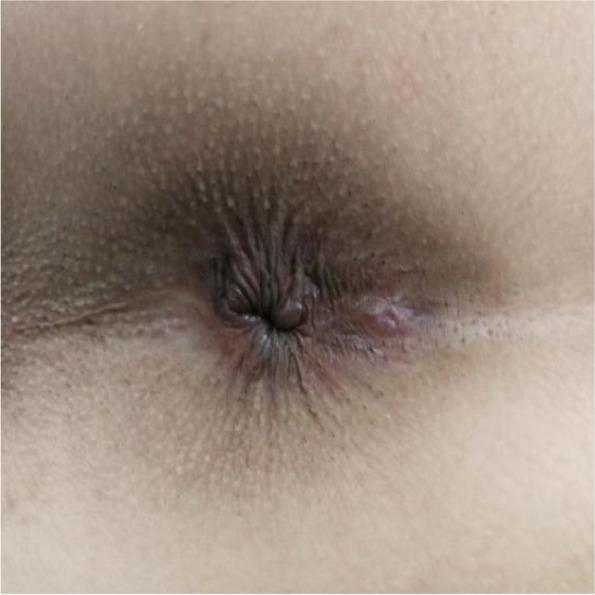
Classification (Parks' System)
(Bailey & Love, p. 1457)
The primary track's relationship to the external sphincter defines the type:
| Type | Description | Frequency |
|---|---|---|
| Intersphincteric | Track between internal and external sphincter, exits perianally | ~70% — most common |
| Transsphincteric | Track crosses external sphincter | ~25% |
| Suprasphincteric | Track goes above puborectalis | ~5% |
| Extrasphincteric | Track outside both sphincters | ~1% |
Based on the proximity of the external opening to the anal verge in this image, a low intersphincteric fistula is the most likely type.
Goodsall's Rule helps predict the internal opening:
- Posterior external openings → curved track to posterior midline internal opening
- Anterior external openings → straight track to the nearest crypt
Investigations
- Digital rectal exam — palpate the tract and identify internal opening
- Proctoscopy/anoscopy — visualize the internal opening at the dentate line
- MRI pelvis (gold standard) — maps complex tracts, secondary tracks, horseshoe extensions
- Endoanal ultrasound — alternative to MRI for sphincter evaluation
- Rule out Crohn's disease — especially if multiple or recurrent fistulas (AGA guidelines)
Treatment
Simple / Low Fistulas (intersphincteric, low transsphincteric)
Fistulotomy — laying open the tract
- Curative in >90% of low fistulas
- Contraindicated if significant sphincter muscle would be divided (risk of incontinence)
Complex / High Fistulas
| Option | Indication |
|---|---|
| Seton placement | High transsphincteric/suprasphincteric; cutting or draining seton |
| LIFT procedure (ligation of intersphincteric fistula tract) | Transsphincteric fistulas; sphincter-sparing |
| Advancement flap | High fistulas; mucosal/rectal flap covers internal opening |
| Fibrin glue / bioprosthetic plug | Adjuncts; lower success rates |
| Anti-TNF therapy (infliximab/adalimumab) | Crohn's-associated fistulas |
Post-operative Care
- Sitz baths, stool softeners, high-fiber diet
- Regular wound packing until healing by secondary intention
- Surveillance for recurrence
Key point: Complete surgical cure requires identifying and closing the internal opening at the dentate line. Failure to do so leads to recurrence. MRI is recommended before operating on any complex or recurrent fistula.
⚠️ This analysis is for educational/clinical decision support purposes. Definitive management requires examination under anesthesia by a colorectal surgeon.
This is a shared conversation. Sign in to Orris to start your own chat.