
Open haemorridodectomy
Reading File
Open haemorrhoidectomy is a surgical procedure for removing haemorrhoids where the excision wounds are left open (not sutured). The most classic technique is the Milligan-Morgan procedure. Let me pull up the detailed textbook content.
Searching sources...
Finding Sources
Finding Sources
Reading File
Reading File
Reading File
Loading Image
Now let me fetch the surgical step images for the open technique:
Finding Sources
Reading File
Reading File
Now let me get the surgical step figures from Bailey & Love's to show the operative steps visually:
Reading File
I now have comprehensive content from multiple major surgical textbooks. Here is the complete answer:
Open Haemorrhoidectomy (Milligan-Morgan Operation)
Definition and Background
Open haemorrhoidectomy - most commonly known as the Milligan-Morgan operation - is the standard surgical technique for haemorrhoid excision in the UK and Europe. It involves ligation and excision of haemorrhoids with the wounds left open to heal by secondary intention (unlike the closed/Ferguson technique where wounds are sutured). It was described by Milligan, Morgan, and colleagues at St Mark's Hospital, London.
- Bailey and Love's Short Practice of Surgery 28th Edition, p. 1453
- Current Surgical Therapy 14e, p. 334
Indications
-
Large, prolapsing (grade III-IV) haemorrhoids with an extensive external component
-
Symptomatic haemorrhoids failing conservative/office-based treatments (injection sclerotherapy, rubber band ligation)
-
Symptomatic haemorrhoids causing significant bleeding leading to anaemia
-
If there is doubt about the diagnosis, examination under anaesthesia and/or endoscopic visualisation are needed first
-
Bailey and Love's, p. 1453
Preoperative Preparation
- Stool softeners in the days before surgery
- Preoperative enema to empty the rectum
- General or regional anaesthesia
- Patient positioned in lithotomy or prone jack-knife position
Operative Technique (Step-by-Step)
1. Infiltration
The anoderm and subcutaneous tissues between the haemorrhoids are injected with dilute adrenaline (1:300,000 dilution) to:
- Reduce bleeding
- Aid preservation of skin bridges
2. Grasping and Traction
Artery forceps are applied to the skin-covered external components of the haemorrhoids and traction exerted to reveal the internal components. The three haemorrhoids are removed in order:
- Posterior
- Left lateral
- Right anterior
3. V-Shaped Incision
A V-shaped cut is made through the skin lateral to the haemorrhoid using scissors or cutting diathermy.
4. Dissection
- Traction by both operator and assistant, combined with careful dissection, exposes the lower border of the internal sphincter
- Dissection proceeds up the anal canal
- Sides of the mucosal dissection converge towards the pile apex
- The internal sphincter is kept visible and separate from the dissected pile throughout
5. Transfixion Ligation
A transfixion ligature of strong Vicryl (polyglactin) is applied to the pedicle at the level of the apex. The pile is excised well distal to the ligature, and after ensuring haemostasis the ligature is cut long.
6. Secondary Haemorrhoids
If significant secondary haemorrhoids are present under the mucocutaneous bridges, they can be excised by submucosal dissection (Parks technique).
7. Mucocutaneous Bridges (CRITICAL)
After excising each haemorrhoid, it is essential to preserve adequate mucocutaneous bridges between the wounds. At the end of the operation there will be three pear-shaped anal wounds. Failure to preserve these bridges risks anal stenosis.
8. Haemostasis and Dressing
-
Careful haemostasis is mandatory
-
A soft absorbable anal dressing is inserted
-
The wound is covered with moist gauze; no drains are necessary
-
Bailey and Love's, p. 1453
-
Pye's Surgical Handicraft 22nd Ed, p. 311
Surgical Illustration
The figure below (from Bailey & Love's) shows the instruments used and the anatomy of rubber band ligation for context; the operative steps for the open haemorrhoidectomy follow the same anatomical landmarks:
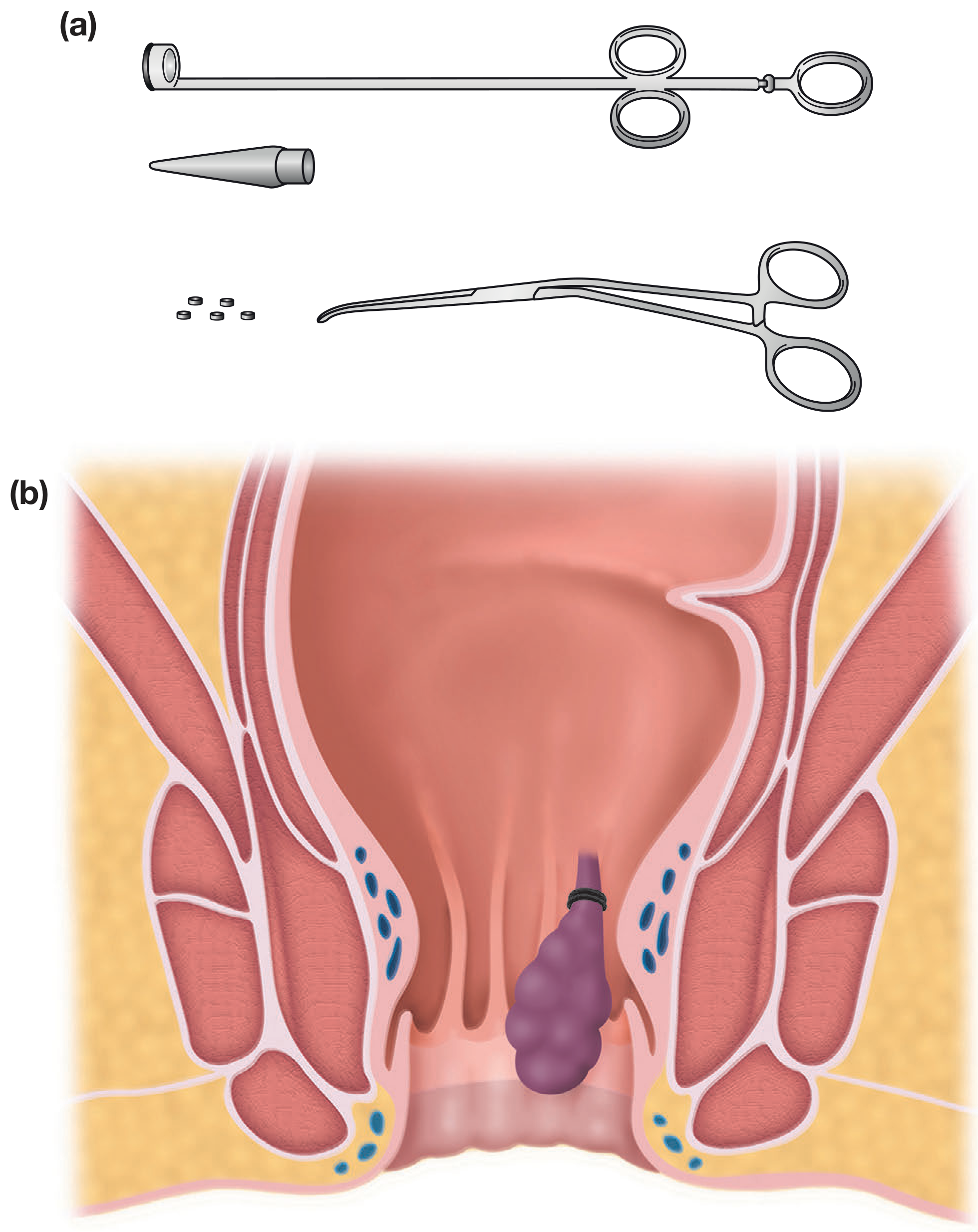
Figure: (a) Barron's banding apparatus. (b) Appearance of a typical banded haemorrhoid showing the anatomical landmarks used in open haemorrhoidectomy.
Open vs. Closed Technique: Key Differences
| Feature | Open (Milligan-Morgan) | Closed (Ferguson) |
|---|---|---|
| Wound closure | Left open - heals by secondary intention | Sutured with continuous absorbable suture |
| Geography | UK/Europe standard | USA standard |
| Wound healing | Longer | Faster |
| Postoperative pain | More | Slightly less |
| Outcomes/durability | Similar | Similar |
- Schwartz's Principles of Surgery 11th Ed, p. 1339
- Current Surgical Therapy 14e, p. 334
Complications
Early
- Pain (most common; major disadvantage of open technique)
- Acute urinary retention
- Reactionary haemorrhage (primary)
Late
-
Secondary haemorrhage (~5% of cases; typically at day 7-10 when the slough separates)
-
Anal stricture (if mucocutaneous bridges not preserved)
-
Anal fissure
-
Faecal incontinence (if internal sphincter damaged during dissection)
-
Bailey and Love's, p. 1454
-
Pye's Surgical Handicraft 22nd Ed, p. 311
Whitehead's Haemorrhoidectomy (Historical Note)
A variant - circumferential excision of all haemorrhoidal cushions just proximal to the dentate line, with the rectal mucosa advanced and sutured down. Now largely abandoned due to the risk of mucosal ectropion (Whitehead's deformity/ectropion) - a disabling complication.
- Schwartz's Principles of Surgery 11th Ed
Comparison with Other Surgical Modalities
| Procedure | Best For | Key Advantage |
|---|---|---|
| Open haemorrhoidectomy (Milligan-Morgan) | Grades III-IV with large external component | Most durable; lowest recurrence |
| Stapled haemorrhoidopexy (PPH) | Grades II-III circumferential, no bulky external component | Less pain, quicker recovery - but higher recurrence |
| HAL (Haemorrhoidal Artery Ligation) | Grade II-III | Less pain than open surgery; lower recurrence than rubber banding |
- Bailey and Love's, p. 1454-1455
- Harrison's Principles of Internal Medicine 22nd Ed
Key takeaway: Open haemorrhoidectomy remains the gold standard for definitive surgical management of large symptomatic haemorrhoids. The critical technical points are: preserving the internal sphincter during dissection, maintaining adequate mucocutaneous bridges between wounds, achieving secure transfixion ligation of the pedicle, and meticulous haemostasis.
This is a shared conversation. Sign in to Orris to start your own chat.