
Umblical hernia treatment options surgery bailey and love referance
Reading File
Finding Sources
Finding Sources
I found content in Schwartz's, Mulholland & Greenfield's, and Sabiston. The user specifically asked for Bailey & Love. Let me search for Bailey & Love and also read the most relevant sections.
Finding Sources
Reading File
Reading File
Bailey & Love is not in the library. Let me read the Schwartz's section and the Sabiston section for comprehensive content, and also read more of Mulholland to get the full picture on surgical treatment.
Reading File
Reading File
Now let me fetch the Mayo repair diagram and also read the full adult umbilical hernia section from Mulholland to get repair techniques.
Loading Image
Reading File
I now have comprehensive information. Bailey & Love is not available in the library, but I have excellent content from Schwartz's, Mulholland & Greenfield's, and Sabiston — all authoritative surgical textbooks. Let me compile the full answer.
Umbilical Hernia — Treatment Options & Surgery
Note: Bailey & Love's Short Practice of Surgery is not available in this textbook library. The information below is drawn from equivalent authoritative surgical references: Schwartz's Principles of Surgery (11e), Mulholland & Greenfield's Surgery (7e), and Sabiston Textbook of Surgery — all of which cover umbilical hernia in the same standard manner taught in Bailey & Love.
Anatomy & Pathogenesis
The umbilical ring normally closes after birth, reinforced by:
- Paired lateral umbilical ligaments (obliterated umbilical arteries)
- Round ligament (obliterated umbilical vein)
- Urachal remnant
- Transversalis fascia
Failure of the ring to close creates a central defect in the linea alba, covered by normal umbilical skin and subcutaneous tissue, allowing protrusion of abdominal contents.
— Mulholland & Greenfield's Surgery, p. 5458
Clinical Features
- Most common abdominal wall defect in infants/children
- Incidence: 25–50% in Black infants; 4–9% in white infants in first months of life
- Generally reducible and asymptomatic
- Incarceration is rare (~1:1,500 cases); more common with smaller defects (≤1 cm)
- Incarceration presents with: abdominal pain, bilious vomiting, tender hard umbilical mass → surgical emergency
Treatment
Conservative (Non-Operative)
| Scenario | Management |
|---|---|
| Children < 2 years, small defect | Observation — ~80% close spontaneously by age 2–3 years |
| Defect < 1 cm at birth | Likely to close by age 4–5 years; defer repair |
| Asymptomatic, no enlargement | Watchful waiting until age 5 years |
Indications to intervene earlier:
- Skin ulceration
- Episode of incarceration
- Defect enlarging or > 2 cm (risk of large skin proboscis if left untreated)
- Significant cosmetic concern to child/family
- Symptomatic hernia in any age
— Schwartz's Principles of Surgery, p. [block 19]; Sabiston Textbook of Surgery, p. [block 28]
In children, prosthetic mesh is never used — primary repair is always achievable.
Surgical Repair Options
1. Primary Open Repair (Standard / Mayo Repair)
The classic technique, suitable for defects < 3 cm:
- Incision: Subumbilical "smile" (semilunar) incision in the skin crease
- Dissection: Hernia sac dissected free circumferentially from overlying skin
- Sac: Excised or reduced
- Fascial closure: Mayo "waistcoat" (vest-over-pants) technique — the superior fascial edge is overlapped over the inferior edge with interrupted non-absorbable or long-acting absorbable sutures in a transverse plane
- Skin: Umbilical skin preserved and sutured to fascial closure for cosmesis; subcuticular skin closure
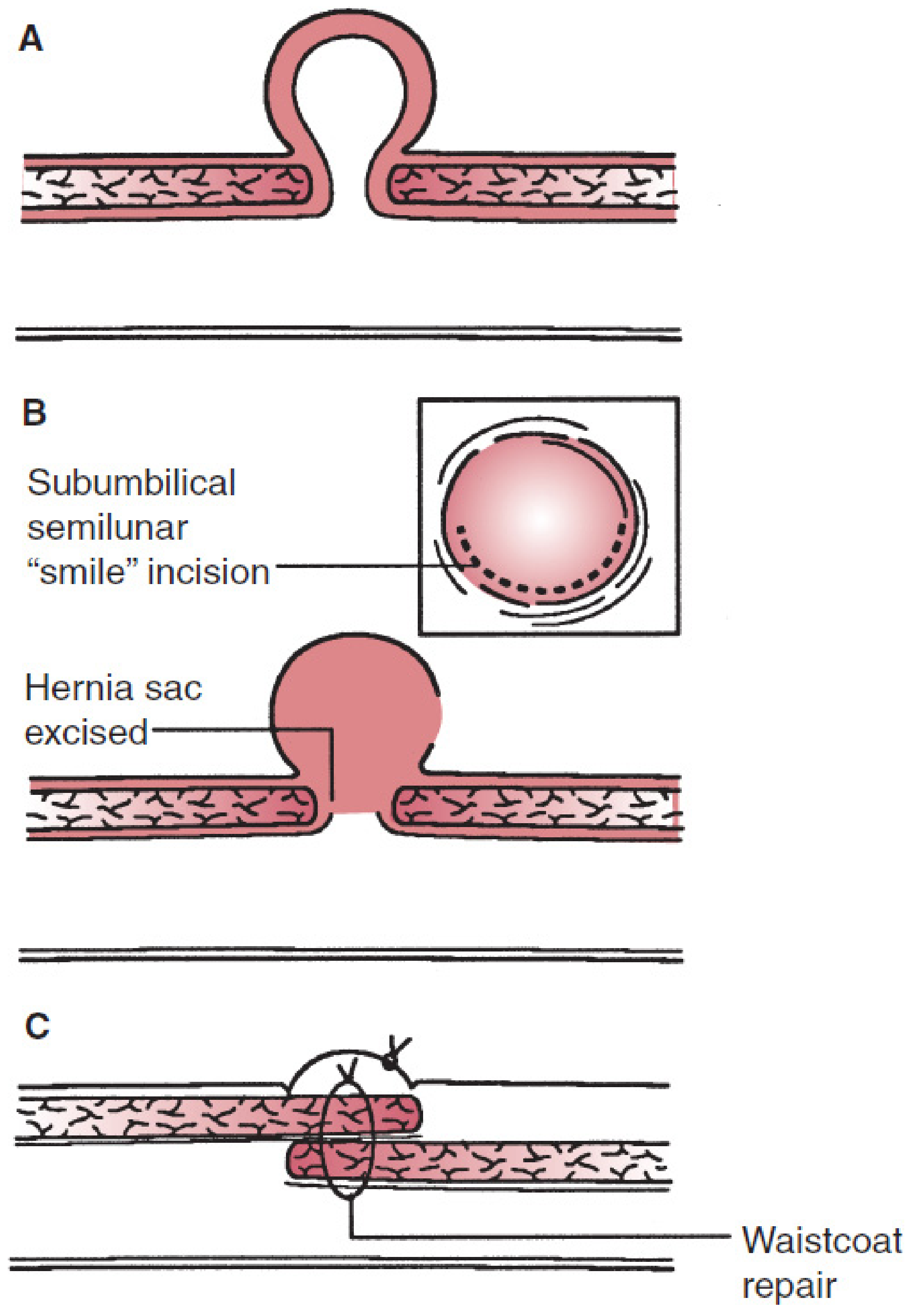
Figure: Mayo repair of an umbilical hernia — Mulholland & Greenfield's Surgery (7e)
Anaesthesia: General anaesthesia, outpatient/day-case procedure
Recurrence: Low; higher in patients with elevated intra-abdominal pressure (e.g., ventriculoperitoneal shunt, ascites)
2. Mesh Repair (Open Preperitoneal / Onlay)
Used for larger defects (> 2–3 cm) in adults:
- Preperitoneal mesh: The peritoneum is bluntly dissected from the undersurface of the posterior rectus sheath; mesh placed in the preperitoneal space, then fascial edges closed over it
- Intraperitoneal mesh: Barrier-coated (composite) mesh placed intraperitoneally — used when preperitoneal dissection is difficult or when defect is small; however, evidence suggests higher complication rates vs. preperitoneal placement
- Falciform and median umbilical ligament fat must be dissected to ensure mesh seats flush against the abdominal wall and prevent fat reherniation
A multicenter RCT showed higher complication rates for intraperitoneal vs. preperitoneal mesh — preperitoneal placement is preferred when feasible.
— Mulholland & Greenfield's Surgery, p. 3724–3725
3. Laparoscopic / Robotic Repair
Indications: Recurrent hernias, defects > 3 cm, or surgeon/patient preference
- Technique mirrors laparoscopic incisional hernia repair
- Options: TAPP (transabdominal preperitoneal) approach — increasingly performed robotically
- Robotic-assisted TAPP is gaining popularity as it facilitates more reliable defect closure
- Potential benefits: decreased operative time, faster return to activity
- Concurrent umbilical hernia repair is a convenient adjunct during TAPP inguinal hernia repair when umbilical access is used
Special Situations
Umbilical Hernia with Ascites / Cirrhosis
- High operative morbidity and mortality — repair undertaken with caution
- Liver transplant candidates: repair at time of transplantation (pre-transplant repair has high morbidity/mortality)
- Patients with incarcerated hernia, thinning or ruptured overlying skin → earlier repair required
- Topical fibrin sealant has been used for leaking umbilical hernias in ascitic patients as a temporizing measure
— Schwartz's Principles of Surgery; Sleisenger & Fordtran's GI & Liver Disease
Summary Table
| Feature | Children | Adults |
|---|---|---|
| Spontaneous closure | ~80% by age 2–3 y | Does not occur |
| Preferred repair | Primary suture (Mayo) | Primary suture or mesh (≥ 2–3 cm) |
| Mesh use | Never | Yes for larger/recurrent defects |
| Approach | Open | Open or laparoscopic/robotic |
| Anesthesia | General (day case) | General (day case) |
| Incarceration risk | Rare (1:1,500) | Slightly higher |
Sources: Schwartz's Principles of Surgery 11e | Mulholland & Greenfield's Surgery 7e | Sabiston Textbook of Surgery
This is a shared conversation. Sign in to Orris to start your own chat.