
PCOD
Reading File
Finding Sources
Finding Sources
Good — the best dedicated PCOS section is in Goldman-Cecil Medicine and Harrison's, alongside Berek & Novak's Gynecology. Let me read the core clinical content from the most comprehensive sources in parallel.
Reading File
Reading File
Reading File
Reading File
Searching Images
polycystic ovary syndrome PCOS ultrasound pathology
Reading File
I now have comprehensive content. Here's a thorough overview of PCOS/PCOD:
Polycystic Ovary Syndrome (PCOS / PCOD)
PCOD (Polycystic Ovarian Disease) is an older, synonymous term for PCOS (Polycystic Ovary Syndrome) — now the preferred clinical designation.
Definition & Epidemiology
PCOS is the most common endocrine disorder in women of reproductive age, affecting 5–10% of women worldwide. It is the leading cause of:
- Hyperandrogenism (HA)
- Hirsutism
- Anovulatory infertility
First described in 1935 by Stein and Leventhal as a triad of amenorrhea, bilateral polycystic ovaries, and obesity. It is a complex, polygenic/multifactorial disorder with significant reproductive, metabolic, and cardiovascular consequences.
— Berek & Novak's Gynecology, p. 1919
Diagnostic Criteria
Rotterdam Criteria (2003) — 2 out of 3 required (after exclusion of other causes):
| Criterion | Description |
|---|---|
| 1. Oligo/anovulation | Irregular or absent menstrual cycles |
| 2. Hyperandrogenism | Clinical (hirsutism, acne, alopecia) and/or biochemical (elevated androgens) |
| 3. Polycystic ovary morphology | ≥12 follicles 2–9 mm diameter, or ovarian volume >10 mL on ultrasound |
Diagnosis requires exclusion of: congenital adrenal hyperplasia (CAH), androgen-secreting tumors, Cushing syndrome, hyperprolactinemia, thyroid disease.
4 Rotterdam Phenotypes:
- HA + ovarian dysfunction + PCO morphology
- HA + ovarian dysfunction
- HA + PCO morphology
- Ovarian dysfunction + PCO morphology
— Berek & Novak's Gynecology, p. 1919–1920
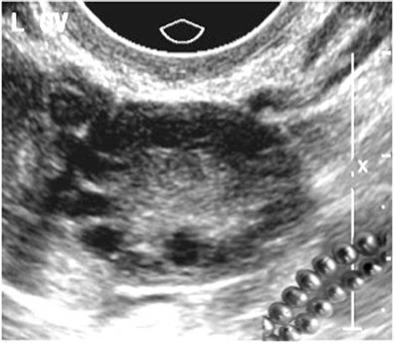
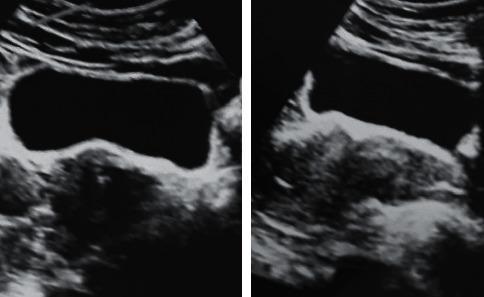
Ultrasound: "String of Pearls" Sign
The classic sonographic finding — multiple small follicles arranged peripherally around an echogenic stroma:
Pathophysiology
Hormonal Abnormalities
- ↑ LH pulse frequency (due to increased GnRH pulse frequency) → elevated LH : FSH ratio
- FSH remains normal/low due to negative feedback from elevated estrogen and inhibin
- Elevated androgens (testosterone, DHEA-S): from both ovarian theca cells and adrenal cortex
- Mild hyperprolactinemia in ~25% of cases
Insulin Resistance (IR)
- A key pathophysiological mechanism in most women with PCOS
- Compensatory hyperinsulinemia stimulates ovarian androgen production
- IR is present even in lean women with PCOS
Steroidogenesis Defect
- Theca cells show intrinsic upregulation of CYP11A, CYP17, 3β-HSD genes → excess testosterone, 17-OH progesterone, and progesterone
— Berek & Novak's Gynecology, p. 1926
Clinical Features
| Feature | Details |
|---|---|
| Menstrual irregularities | Oligomenorrhea, amenorrhea, or irregular cycles from menarche |
| Hirsutism | Most common sign of HA; male-pattern hair growth |
| Acne & oily skin | Androgen-driven |
| Alopecia | Androgenic pattern |
| Obesity | Present in many; worsens phenotype |
| Infertility | Anovulatory; most common cause in developed countries |
| Acanthosis nigricans | Marker of IR |
Associated Long-Term Risks
| System | Risk |
|---|---|
| Metabolic | Type 2 diabetes, impaired glucose tolerance, dyslipidemia, metabolic syndrome |
| Cardiovascular | Hypertension, atherosclerosis (due to hypercholesterolemia + IR) |
| Reproductive | Miscarriage, gestational diabetes, preeclampsia, preterm birth |
| Oncologic | Endometrial cancer (due to unopposed estrogen from anovulation) |
| Psychological | Depression, anxiety |
Management
Lifestyle (First-line for all overweight/obese women)
- Weight loss of 5–10% restores ovulation, reduces androgens, improves insulin sensitivity
- Reduced-calorie diet (<30% fat), ↑ fiber, low glycemic index foods
- Structured exercise >30 min/day
Not Seeking Pregnancy
| Goal | Treatment |
|---|---|
| Menstrual regulation & HA | Combined oral contraceptive pill (COCP) — lowers androgens via ↑ SHBG; first-line |
| Inadequate response to COCP (>6 months) | Add antiandrogens: spironolactone or flutamide |
| Endometrial protection | Progestins (medroxyprogesterone 10 mg, or progesterone 200 mg × 10–14 days, every ≥3 months) or levonorgestrel IUD |
| Cardiometabolic risk | Metformin (especially in overweight/obese) |
Seeking Pregnancy (Ovulation Induction)
- Letrozole (aromatase inhibitor) — first-line
- Clomiphene citrate (± metformin)
- Injectable gonadotropins — under specialist supervision (risk of ovarian hyperstimulation syndrome)
- Laparoscopic ovarian drilling — surgical option for clomiphene-resistant cases
Metformin alone is not recommended for endometrial protection, hyperandrogenism, infertility, or prevention of gestational diabetes.
— Harrison's Principles of Internal Medicine 22E, p. 3179; Berek & Novak's Gynecology, p. 1930
Screening at Diagnosis
- Obesity / BMI
- Blood pressure
- Fasting glucose / HbA1c / oral glucose tolerance test
- Fasting lipid profile (if overweight)
- Depression and anxiety screening
Summary
PCOS is a heterogeneous syndrome — not every woman presents the same way. The Rotterdam criteria allow for 4 phenotypes. Management must be tailored to the patient's primary concern: menstrual regulation, hyperandrogenism, fertility, or metabolic risk.
This is a shared conversation. Sign in to Orris to start your own chat.