
All blades with image, identification points and specific use
Which type of blades are you asking about?
surgical scalpel blade numbers identification uses images medical
https://wpiinc.com/blogs/all/how-to-choose-a-scalpel-blade-f…
laryngoscope blade types Macintosh Miller Wisconsin Wis-Hipple identification uses images
surgical bone saw blade types oscillating sagittal reciprocating identification uses orthopedic
https://valleymed.ca/types-of-laryngoscope-blades-choosing-t…
All Medical Blades: Images, Identification & Specific Uses
PART 1 - SCALPEL BLADES
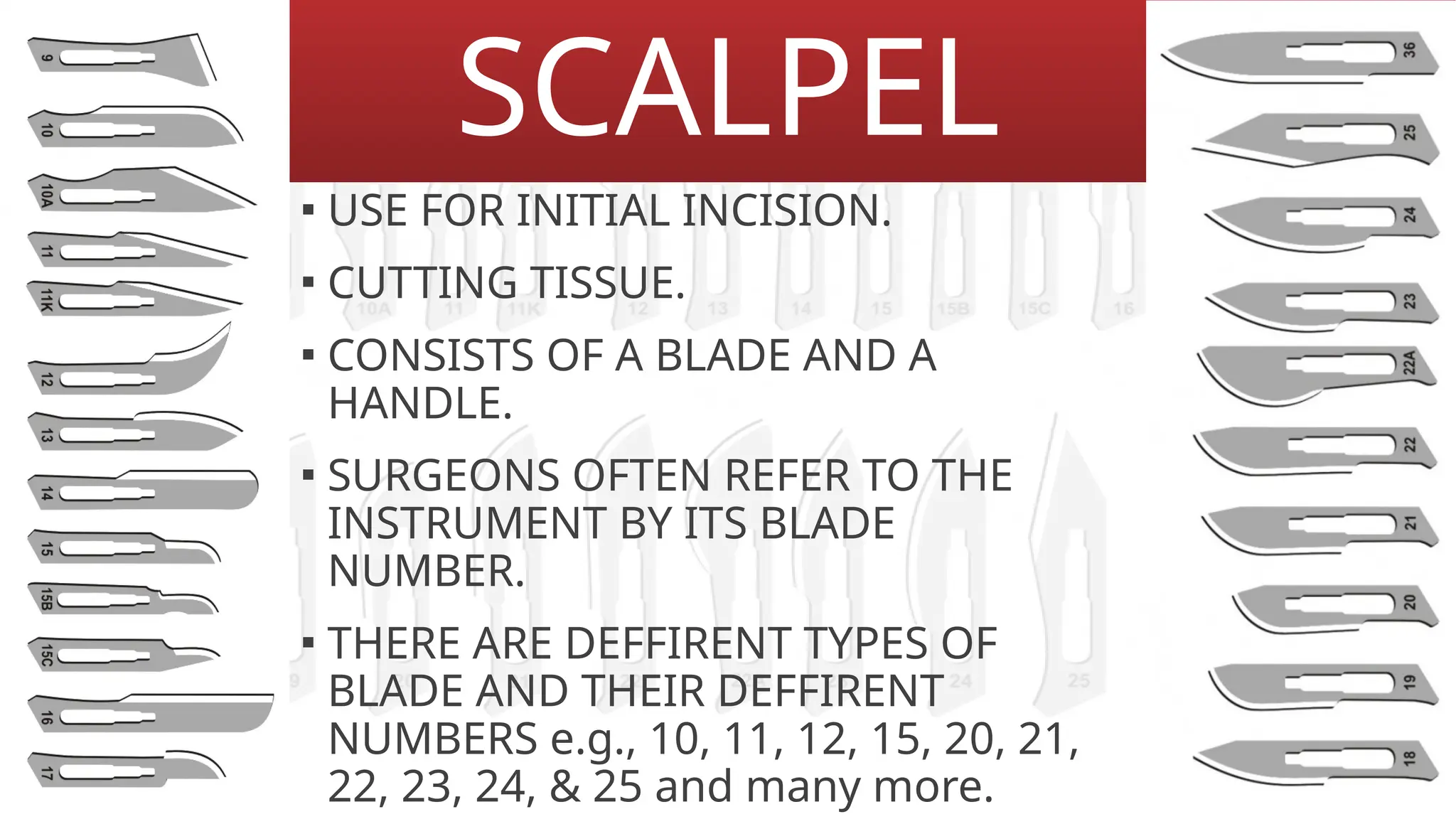

Blade No. 9
- Shape: Small curved blade with a rounded tip, similar to No. 10 but smaller
- Identification: Short, small curved profile
- Use: Fine incisions in restricted areas, ophthalmic and ENT surgery
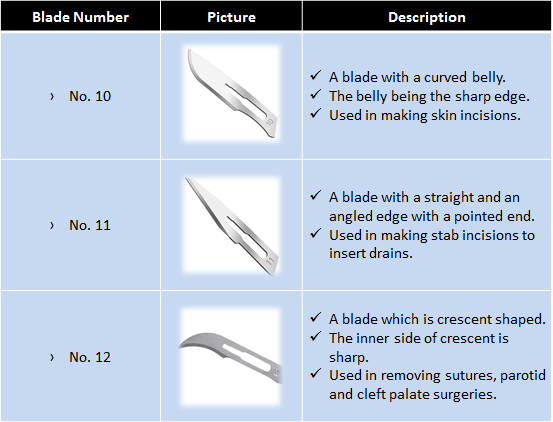
Blade No. 10
- Shape: Large, broad curved blade with a prominent belly; the classic general-purpose blade
- Identification: Wide curved edge, largest of the small-handle curved blades
- Handle: No. 3
- Use: Large skin incisions, subcutaneous tissue dissection, general surgery opening cuts
Blade No. 10A
- Shape: Similar to No. 10 but with a slightly modified curve; narrower body
- Identification: Looks like No. 10 with a less pronounced belly
- Use: Incisions in slightly tighter spaces than No. 10 allows
Blade No. 11
- Shape: Triangular, straight-edged with a sharply pointed tip ("stabbing blade")
- Identification: Straight top edge + angled lower edge meeting at a fine sharp point
- Handle: No. 3
- Use: Stab incisions, inserting chest tubes/drains, incising abscesses, vascular catheter entry, laparoscopic port incisions, Bartholin's cyst drainage
Blade No. 11K
- Shape: Similar to No. 11 but the cutting edge is on the back (concave side)
- Identification: Reverse-edge pointed blade
- Use: Used where a normal No. 11 would cut unintended structures; vascular and ophthalmic procedures
Blade No. 12
- Shape: Crescent/sickle-shaped, hook-curved blade with the cutting edge on the inside (concave side)
- Identification: Distinctive crescent moon shape; unique among scalpel blades
- Handle: No. 3
- Use: Suture removal, posterior pharyngeal incisions, parotid/cleft palate surgery, cutting in tight curved areas, transantral orbital decompression (as noted in Cummings Otolaryngology)
Blade No. 13
- Shape: Small, narrow-pointed blade similar to a scaled-down No. 11
- Identification: Pointed tip, smaller than No. 11, narrow body
- Use: Fine stab incisions, ophthalmic surgery, microsurgery
Blade No. 14
- Shape: Small curved blade with a narrow body and shallow belly
- Identification: Small curved profile, sits between No. 12 and No. 15 in size
- Use: ENT surgery, fine dissection in confined areas
Blade No. 15
- Shape: Small curved blade, the smallest of the "belly" blades; closely resembles No. 10 in shape but much smaller
- Identification: Short, small curved profile; most commonly used fine blade
- Handle: No. 3
- Use: Short, precise incisions; dermatological excisions; skin lesion removal; organ biopsies; neurological and plastic surgery; scraping burrows in scabies diagnosis; histological sectioning - the workhorse of dermatology (Andrews' Diseases of the Skin)
Blade No. 15B / 15C
- Shape: Variants of the No. 15 with slightly modified geometry (wider or differently proportioned belly)
- Identification: Resemble No. 15 but with subtle shape differences at the back of the blade
- Use: Fine dermatologic and plastic surgical procedures
Blade No. 16
- Shape: Narrow, elongated curved blade with a pointed tip
- Identification: Long narrow profile with a pointed end
- Use: Fine dissection in deep or narrow surgical fields
Blade No. 17
- Shape: Narrow with a curved tip
- Identification: Slender blade, moderate curve
- Use: Specialized ophthalmic and microsurgical procedures
Blade No. 18
- Shape: Wide, reverse-angled cutting edge; curved back
- Identification: Large blade with an unusual reverse curvature
- Use: Cartilage cutting, rhinoplasty, ENT surgery
Blade No. 19
- Shape: Larger variant similar to No. 22 family
- Identification: Medium-large curved belly
- Use: General dissection, gross anatomy
Blade No. 20
- Shape: Large curved belly blade, roughly a bigger version of No. 10
- Identification: Larger, broader version of No. 10
- Handle: No. 4
- Use: Larger incisions through thick tissues, large animal surgery, deeper soft tissue dissection
Blade No. 21
- Shape: Large curved blade, longer than No. 20
- Identification: Very large curved belly, longer body than No. 20
- Handle: No. 4
- Use: Deep tissue dissection, large incisions in dense tissue, thoracotomy, laparotomy
Blade No. 22
- Shape: Large broad curved belly blade; "big brother" of No. 10
- Identification: Very wide, rounded belly - the largest of the general curved blades
- Handle: No. 4
- Use: Large skin incisions, gross anatomy dissection, thoracotomy, laparotomy, veterinary surgery
Blade No. 22A
- Shape: Modified No. 22 with a slightly altered tip angle
- Identification: Looks like No. 22 with a shallower tip
- Use: Similar to No. 22; large incisions
Blade No. 23
- Shape: Curved blade with a pronounced belly, similar to No. 22 but with a more pointed tip
- Identification: Large curved blade, pointed at the tip unlike No. 22's rounder end
- Handle: No. 4
- Use: Large incisions, abdominal surgery, general surgical procedures
Blade No. 24
- Shape: Large curved blade, rounded belly
- Identification: Similar to No. 22/23 family; broad cutting surface
- Handle: No. 4
- Use: Large tissue dissection, orthopedic soft tissue work
Blade No. 25
- Shape: Narrow, pointed straight blade
- Identification: Small, pointed and relatively straight - resembles a miniature No. 11
- Handle: No. 4
- Use: Precise stab incisions when a larger handle is preferred; used in some ENT and thoracic procedures
Blade No. 36
- Shape: Large spear-point/lance-point shaped blade
- Identification: Very wide base, tapers to a spear point
- Use: Amputations, large orthopedic soft tissue cuts
Handles: No. 3 handle takes blades 9-17; No. 4 handle takes blades 18-36. The No. 7 handle (long and thin) also accepts No. 10-15 blades for use in deep or confined spaces.
PART 2 - LARYNGOSCOPE BLADES
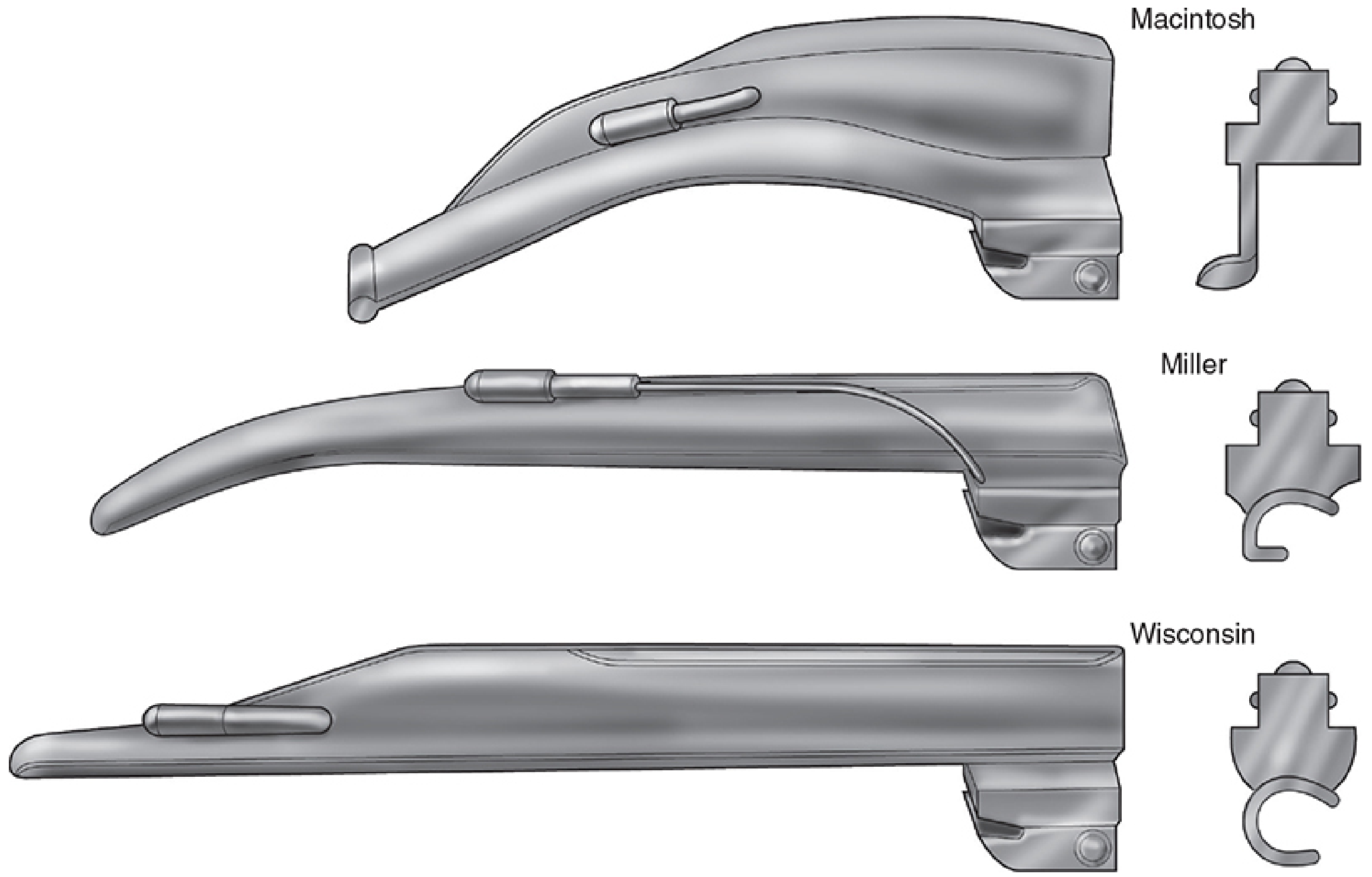
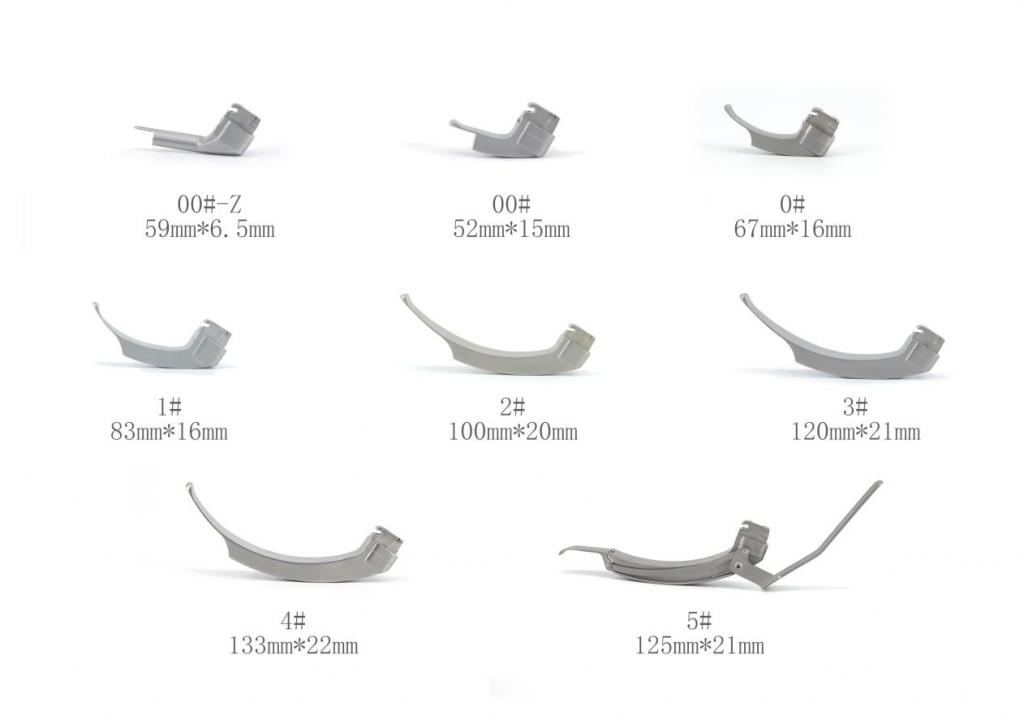
1. Macintosh Blade (Curved)
- Shape: Broad, curved (C-shaped) blade with a wide flange; rounded tip
- Identification: Larger cross-section at the base, obvious curve that sweeps from handle to tip; the cross-section is roughly trapezoidal
- Sizes: 0 (neonate) through 5 (large adult); sizes 3 and 4 are most commonly used in adults
- Technique: Tip is placed in the vallecula (the space between the base of tongue and epiglottis), indirectly lifting the epiglottis via the hyoepiglottic ligament
- Use: Standard adult intubation; uncomplicated airways; keeps tongue retracted; provides more room for tube passage through oropharynx; preferred when prominent upper teeth are present; less risk of laryngospasm than straight blades
- Source: Roberts and Hedges' Clinical Procedures in Emergency Medicine; Morgan and Mikhail's Clinical Anesthesiology
2. Miller Blade (Straight)
- Shape: Straight, narrow blade with a slight upward curve at the tip; narrow cross-section
- Identification: Flat, long straight profile; narrower at the tip; cross-section is a narrow C-shape
- Sizes: 00 (preterm infant) through 4 (large adult); size 2 most common in adults
- Technique: Tip placed directly under the epiglottis, which is then directly lifted upward
- Use: Pediatric patients (preferred in infants and neonates); patients with anterior larynx; patients with a long floppy epiglottis; airways fixed by scar tissue; anterior-positioned glottis
- Cautions: Less effective with prominent upper teeth; higher risk of laryngospasm (stimulates superior laryngeal nerve on underside of epiglottis); may inadvertently enter esophagus; lightbulb at tip may slightly obstruct view
- Source: Roberts and Hedges' Clinical Procedures in Emergency Medicine; Barash Clinical Anesthesia
3. Wisconsin Blade (Straight - Pediatric)
- Shape: Straight, flat blade with a slight curve at the tip; cross-section is a nearly flat C
- Identification: The flattest/most rectangular cross-section of the three classic blades; very flat profile compared to Miller
- Sizes: Mainly pediatric sizes (0-2)
- Technique: Direct epiglottis lift (like Miller)
- Use: Pediatric patients; patients with limited mouth opening; neonates and infants when the Miller is unavailable; preferred in some centers for very small airways
4. Wis-Hipple Blade (Straight - Pediatric variant)
- Shape: Straight, with a short wide body and flat cross-section; combines features of Wisconsin and straight blades
- Identification: Broader, chunkier than Miller for same length; used primarily in infant sizes
- Use: Young children (especially 2-10 years); provides precise visualization of pediatric airway
5. D-Blade / Hyperangulated Blade (Video Laryngoscopy)
- Shape: Acutely angled blade (up to 60-90 degrees); used with video laryngoscopes (GlideScope, McGrath, etc.)
- Identification: Sharply bent geometry; requires a pre-shaped stylet; cannot be used for direct laryngoscopy
- Use: Difficult and failed airways; cervical spine immobility; morbid obesity; cannot-intubate scenarios; provides improved glottic visualization via video chip at the blade tip
Laryngoscope Blade Size Guide
| Size | Blade | Patient Group |
|---|---|---|
| 00 | Miller | Preterm infant (<1500 g) |
| 0 | Miller | Full-term neonate / premature |
| 1 | Miller or Mac | Infant (1-6 months) / toddler |
| 2 | Miller or Mac | Child (2-10 years) |
| 3 | Macintosh | Adolescent / average adult (most common) |
| 4 | Macintosh | Large adult |
| 5 | Macintosh | Very large adult / obese |
PART 3 - SURGICAL SAW BLADES (Orthopedic/Bone Cutting)
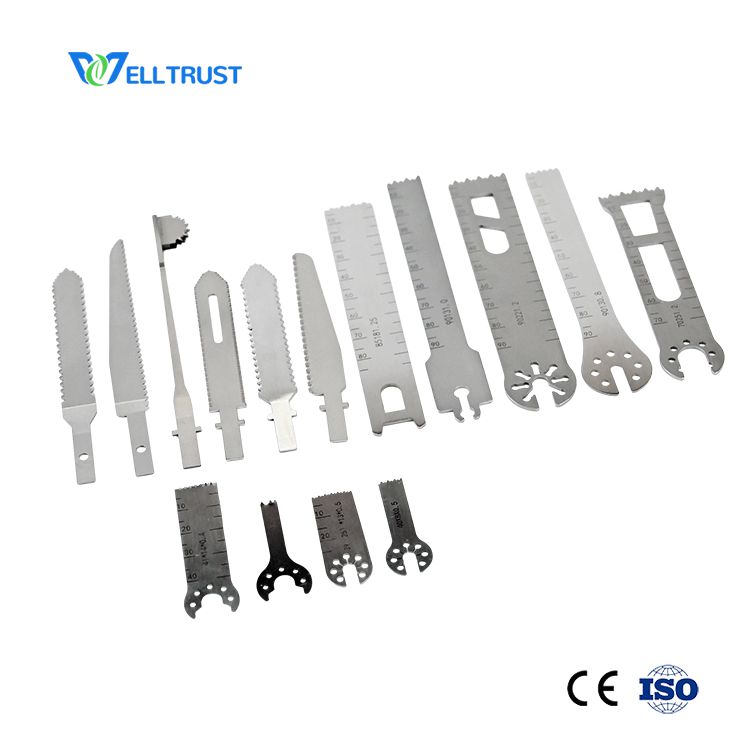
1. Sagittal Saw Blade
- Shape: Flat rectangular blade with serrated teeth on one end; oscillates in the sagittal (back-and-forth) plane through a small arc (3-5 degrees)
- Identification: Broad rectangular body; teeth only on the cutting end; mounts perpendicular to the saw body
- Use: Precise bone cuts in total joint arthroplasty (hip, knee replacement); wedge osteotomies; tibial and femoral cuts in arthroplasty; minimizes bone damage due to small oscillation arc
2. Oscillating Saw Blade
- Shape: Flat blade that moves side-to-side (oscillating in the frontal plane); teeth on the cutting edge
- Identification: Blade oscillates perpendicular to its long axis; comes in various widths and tooth configurations; the most versatile shape
- Use: Curved and straight osteotomies; orthopedic, oral/maxillofacial, and podiatric surgery; bone contouring; cast removal; removing bone fixation hardware
3. Reciprocating Saw Blade
- Shape: Long, narrow blade that moves in a straight in-and-out (reciprocating) motion along its long axis; teeth along one edge
- Identification: Longer, narrower blade compared to oscillating; moves like a jigsaw; serrated edge on one side
- Use: Transverse osteotomies; amputations; bone cuts in deep or narrow spaces where oscillating blades cannot reach; orthopedic, oral/maxillofacial, and podiatric surgery
4. Gigli Saw (Wire Saw)
- Shape: Flexible stainless steel wire with twisted strands creating serrated cutting surfaces; comes as a loop of wire
- Identification: Looks like a braided wire, not a flat blade; used with handles at each end
- Use: Craniotomy (cutting the skull); amputations; cutting bones in tight spaces where power saws cannot go; obstetric destructive operations
5. Amputation Saw
- Shape: Large flat straight blade with coarse teeth; similar to a carpenter's handsaw
- Identification: Large size, coarse serrations, straight profile
- Use: Limb amputations; large bone cutting in emergency or resource-limited settings
Key Differences Summary - Bone Saw Blades
| Blade Type | Motion | Best For |
|---|---|---|
| Sagittal | Back-and-forth arc | Joint replacement, precise flat cuts |
| Oscillating | Side-to-side | Osteotomies, contouring, cast removal |
| Reciprocating | In-and-out | Deep/narrow cuts, transverse osteotomies, amputations |
| Gigli (wire) | Pull-pull | Craniotomy, amputations |
- Roberts and Hedges' Clinical Procedures in Emergency Medicine, 6th ed. - laryngoscope blades section
- Morgan and Mikhail's Clinical Anesthesiology, 7th ed. - laryngoscope blade comparison
- Barash, Cullen & Stoelting's Clinical Anesthesia, 9th ed. - airway management
- Andrews' Diseases of the Skin - scalpel blade No. 15 for cutaneous surgery
- Cummings Otolaryngology Head and Neck Surgery - blade No. 12 application
- WPI Scalpel Blade Guide - blade geometry and uses
Create a quick reference PDF card with blade identification photos
mkdir -p /tmp/workspace/blade-ref-card/images && ls /tmp/workspace/
cd /tmp/workspace/blade-ref-card/images && \ curl -sL "https://medicalscalpel.com/wp-content/uploads/2022/08/scalpel-blog-img-1.png" -o scalpel_shapes.png && \ curl -sL "https://epomedicine.com/wp-content/uploads/2020/07/blade-2.png" -o scalpel_detail.png && \ curl -sL "https://cdn.orris.care/cdss_images/ed1d94de5efbeaf813773cf985df0e8961e944b90a3616d413ec172540ea8fe3.png" -o laryngoscope_blades.png && \ curl -sL "https://www.laryngoscopemole.com/wp-content/uploads/2024/01/%E5%9B%BE%E7%89%8713-1024x724.png" -o laryngoscope_sizes.png && \ curl -sL "https://www.trustorthopedic.com/Uploads/products/2024-01-31/en-orthopedic-saw-blade.jpg" -o bone_saw_blades.jpg && \ curl -sL "https://image.slidesharecdn.com/surgicalbladesizeanduses-241003175425-cd4b5935/75/ALL-TYPES-SURGICAL-BLADES-SIZE-AND-USES-2-2048.jpg" -o scalpel_all.jpg && \ ls -lh