
femoral, umbilical and paraumbilical hernias
Reading File
Now let me search the library for these hernia topics in parallel:
Finding Sources
Finding Sources
Finding Sources
Reading File
Reading File
Finding Sources
Reading File
Reading File
Finding Sources
Reading File
Reading File
Reading File
Loading Image
Loading Image
I now have comprehensive information from the textbooks. Let me compile the full answer.
Femoral, Umbilical, and Paraumbilical Hernias
FEMORAL HERNIA
Anatomy of the Femoral Canal
A femoral hernia is a protrusion of extraperitoneal tissue, peritoneum, and sometimes abdominal contents through the femoral canal. The boundaries of the femoral canal are:
| Boundary | Structure |
|---|---|
| Anterior/superior | Inguinal ligament |
| Posterior/inferior | Pubic ramus and pectineus muscle (Cooper's/iliopectineal ligament) |
| Medial | Lacunar (Gimbernat's) ligament — sharp, unyielding edge |
| Lateral | Femoral vein |
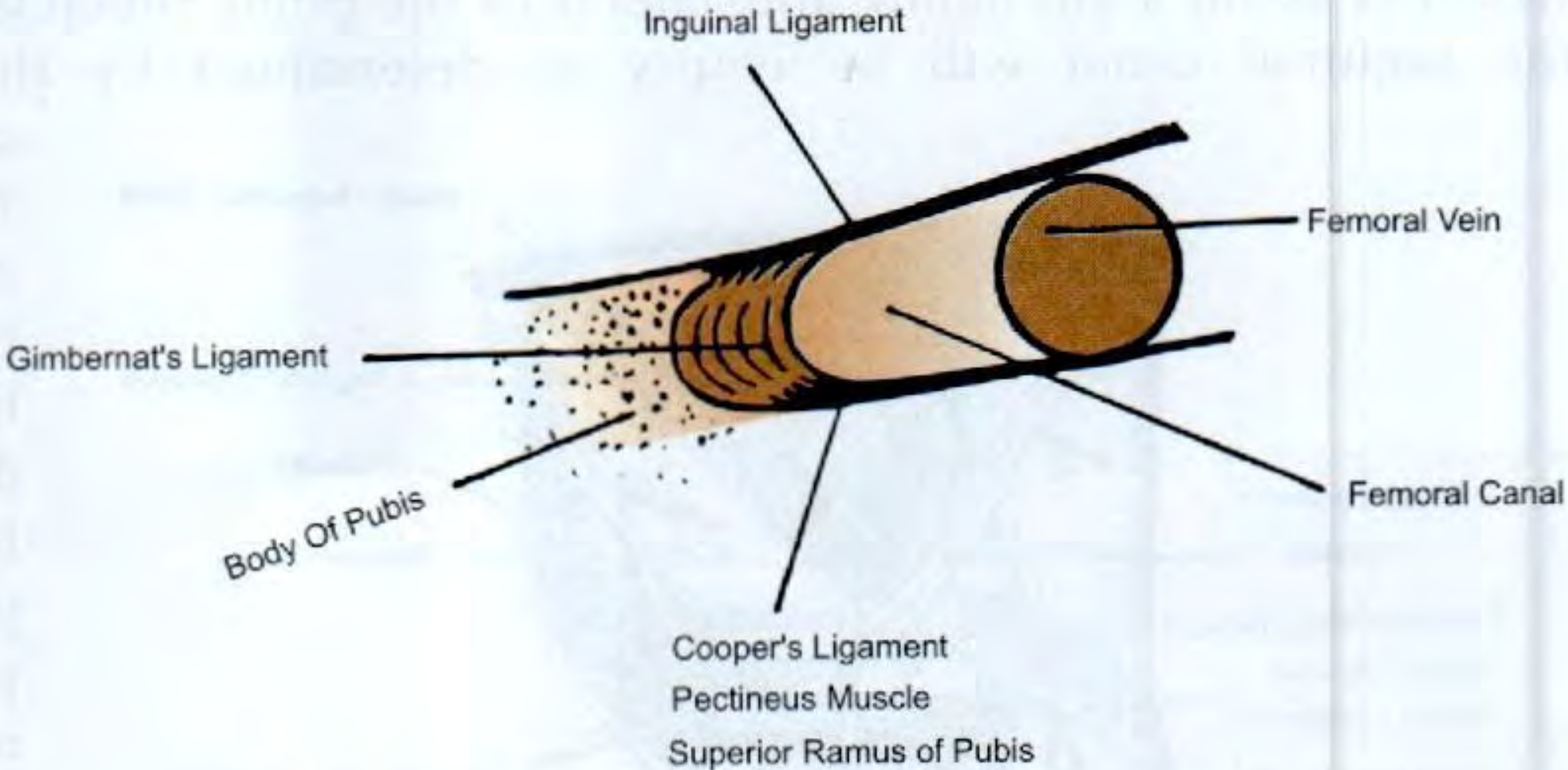
The hernia exits superficially through the saphenous opening (~4 cm below and lateral to the pubic tubercle). Once through this opening, it expands into loose areolar tissue and can curve upward above the inguinal ligament — giving it the classic retort shape.
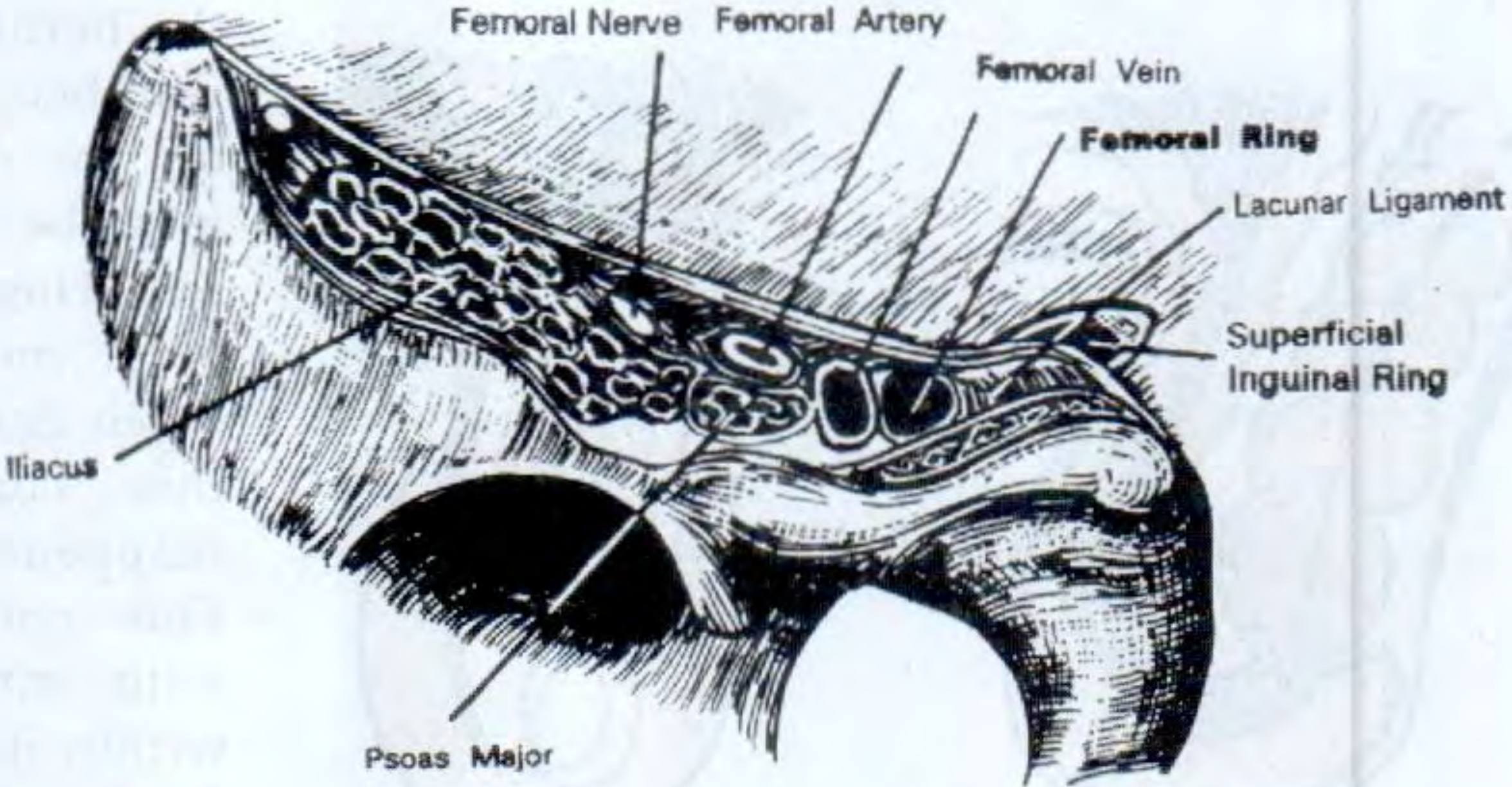
Epidemiology
- Rare before age 20; peak incidence >50 years
- More common in women (2:1), but inguinal hernia remains the commonest groin hernia even in women
- Right > left (2:1); bilateral in ~20%
- The female pelvis is wider, enlarging the femoral canal
- Because the canal is a rigid opening, strangulation is very common — ~50% present as emergencies
Clinical Features & Diagnosis
- Swelling below and lateral to the pubic tubercle, below the inguinal ligament
- May extend superiorly and be confused with a direct inguinal hernia
- Often rapidly becomes irreducible and loses cough impulse (tight neck)
- Can be as small as 1–2 cm and mistaken for a lymph node
- The inguinal canal is empty on invagination test
Key distinguishing points from inguinal hernia:
- Femoral: below and lateral to pubic tubercle; cough impulse at saphenous opening
- Inguinal: above the inguinal ligament and medial to pubic tubercle
- Occluding the deep inguinal ring stops an indirect inguinal hernia but not a femoral hernia
Differential Diagnosis
- Saphena varix — disappears on lying flat; fluid thrill on Schwartz's test (percussion of varicosities transmits upward impulse)
- Enlarged lymph nodes — including Cloquet's node in the femoral canal; search for a distal focus of infection
- Psoas abscess — lateral to femoral vessels; cold fluctuant swelling, reducible, associated with Pott's disease
- Femoral artery aneurysm — pulsatile, expansile
Treatment — Surgery is Mandatory (no alternative)
Three open approaches:
| Approach | Description | Best for |
|---|---|---|
| Low (Lockwood) | Transverse incision over hernia; reduce contents and sac; non-absorbable sutures between inguinal and pectineal ligaments | Elective; suitable for local anaesthesia |
| Inguinal (Lotheissen) | Same incision as Bassini/Lichtenstein; transversalis fascia opened; hernia reduced from above; neck closed with sutures or mesh plug | Elective |
| High (McEvedy/Nyhus) | Transverse incision above inguinal canal; preperitoneal approach; allows bowel inspection and resection | Emergency — risk of strangulation; requires GA/RA |
Laparoscopic repair (TEP/TAPP) is also appropriate for selected cases.
UMBILICAL HERNIA
Classification (S Das)
Four varieties of hernia related to the umbilicus:
- Exomphalos — abdominal contents protrude into umbilical cord, covered by transparent membrane; congenital
- Congenital umbilical hernia — protrudes through the centre of a congenital weak umbilical scar; common in African infants; wide neck → low strangulation risk; ~90% resolve spontaneously within 5 years
- Acquired umbilical hernia — protrudes through the umbilical scar in adult life due to raised intra-abdominal pressure (pregnancy, ascites, ovarian cyst, bowel distension)
- Para-umbilical hernia — see below (commonest acquired type)
Umbilical Hernia in Children
- Occurs in up to 10% of infants (higher in premature and Black infants)
- Appears within weeks of birth; classic conical shape that enlarges on crying
- Obstruction/strangulation extremely uncommon before age 3
- Treatment: conservative under age 2 — 95% resolve spontaneously; surgical repair if persists beyond 2 years
Surgery (children): Small curved infra-umbilical incision; sac opened, contents reduced, sac closed, linea alba defect closed with interrupted slowly absorbable sutures.
Umbilical Hernia in Adults
- Predisposing conditions: obesity, pregnancy, liver cirrhosis with ascites
- Small hernias contain extraperitoneal fat or omentum; larger ones contain bowel
- Narrow neck relative to sac → prone to irreducibility, obstruction, strangulation
- Bulge typically slightly to one side of the umbilical depression → crescent-shaped appearance
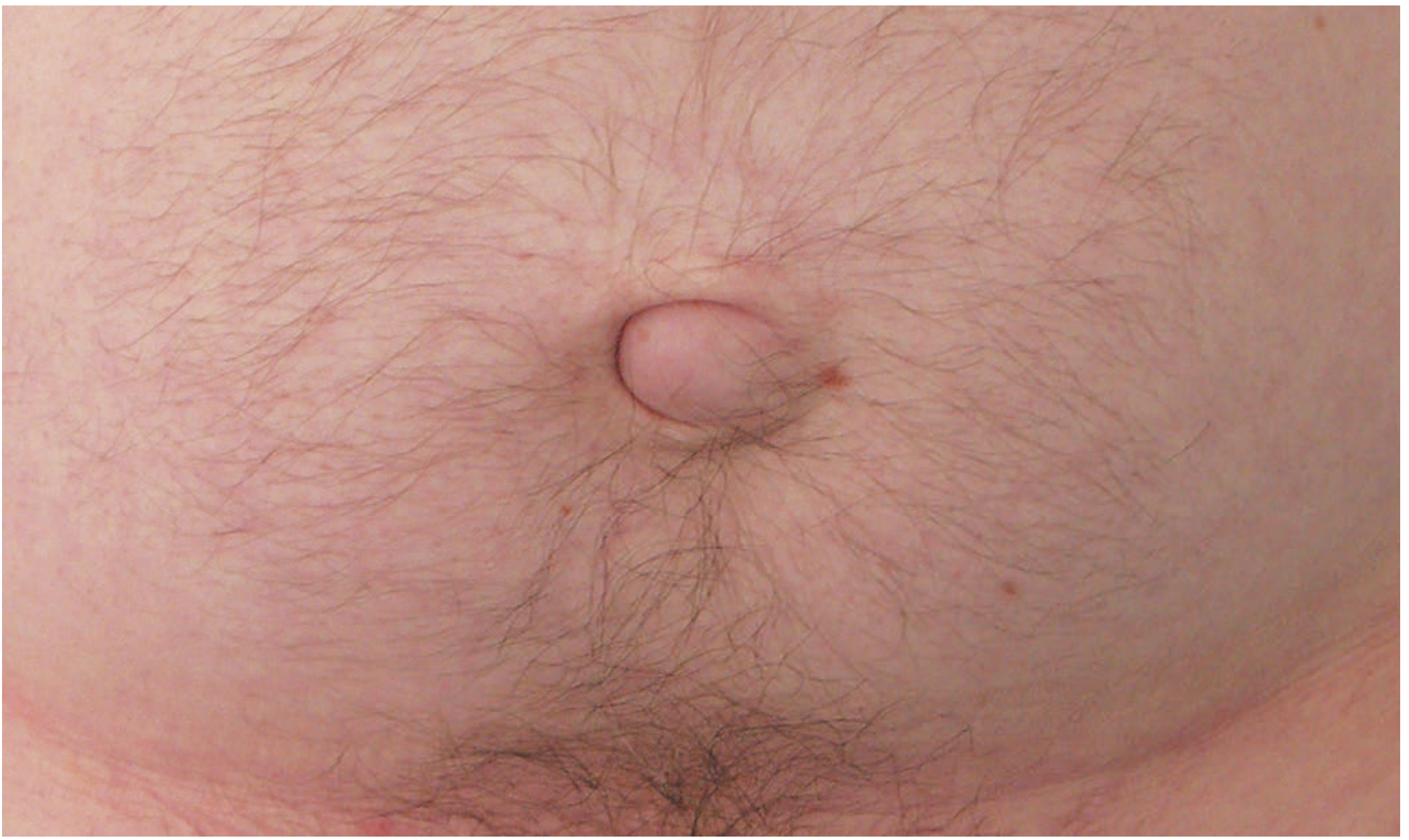
Treatment: Surgery advised when hernia contains bowel; small asymptomatic hernias may be observed.
Open repair:
- Defects <1 cm: simple suture or darn technique
- Defects up to 2 cm: Mayo repair — transverse incision, reduce contents, close peritoneum, extend defect transversally, overlap fascial edges ("waistcoat over trousers" fashion) with non-absorbable sutures
- Defects >2 cm: mesh repair strongly recommended (lower recurrence)
Special considerations:
- Pregnancy-related: encourage weight loss and core strengthening postpartum; avoid surgery during pregnancy
- Liver cirrhosis (Child's B/C): very high surgical mortality; requires hepatology support; continuous sutures to minimise ascites leak
PARAUMBILICAL HERNIA
A paraumbilical hernia protrudes not through the umbilicus itself but through a defect in the linea alba adjacent to it — most commonly just above the umbilicus between the two rectus muscles. The lower half of the sac is often covered by the umbilicus itself.
Note: Under current guidelines (Bailey & Love, 28th Ed.), any hernia in the immediate vicinity of the umbilicus can be classified as "umbilical." The term "paraumbilical" is still widely used clinically.
Features
| Feature | Detail |
|---|---|
| Commonest acquired umbilical hernia | Most frequent type in adults |
| Demographics | Middle/old age; obese women predominantly affected |
| Symptoms | Pain and swelling (if small, pain/discomfort dominate) |
| Consistency | Firm if omentum; soft and resonant if bowel |
| Neck | Firm fibrous edge of linea alba defect (felt on reduction) |
| Reducibility | Many become irreducible — contents adhere to sac or narrow neck |
| Strangulation | Less common than obstruction, but defect does not enlarge proportionately → intermittent abdominal pain |
Treatment
Same principles as adult umbilical hernia:
- Surgical repair with Mayo technique (overlap) or mesh repair
- Laparoscopic/robotic preperitoneal repair is increasingly used for midline paraumbilical hernias
- Mesh recommended for all defects >2 cm
Key Comparisons at a Glance
| Feature | Femoral | Umbilical (adult) | Paraumbilical |
|---|---|---|---|
| Location | Below/lateral to pubic tubercle | Through umbilical ring | Adjacent to (usually above) umbilicus |
| Sex predominance | Women > men | Women > men | Obese middle-aged women |
| Strangulation risk | Very high (rigid canal) | High (narrow neck) | Moderate (less common) |
| Spontaneous resolution | Never | Only in children | Never |
| Emergency rate | ~50% | Significant | Less frequent |
| Repair | Lockwood / Lotheissen / McEvedy / Laparoscopic | Mayo / mesh / laparoscopic | Mayo / mesh / laparoscopic |
Sources: Bailey and Love's Short Practice of Surgery, 28th Ed., Ch. 64; S Das A Manual on Clinical Surgery, 13th Ed., Ch. 38
This is a shared conversation. Sign in to Orris to start your own chat.