
CA oral cavity classification. T3N1M0 CA tongue management according to standard ENT textbook in simplified manner
I'll look this up in the medical library for you. Let me read the skill file first.
Reading File
Now let me search the medical library for oral cavity cancer classification and tongue management simultaneously.
Finding Sources
Finding Sources
Finding Sources
Finding Sources
Good results. Now let me read the relevant sections from KJ Lee's and Cummings simultaneously.
Reading File
Reading File
Excellent content retrieved. Let me now read the management sections and N staging from KJ Lee's.
Reading File
Reading File
Reading File
Reading File
I now have all the key information. Let me also fetch the staging diagram image and lymph node drainage image to include in the answer.
Loading Image
Loading Image
I now have all the information needed to provide a complete, well-organized answer. Here it is:
CA Oral Cavity - Classification & T3N1M0 CA Tongue Management
(Based on AJCC 8th Edition - KJ Lee's Essential Otolaryngology & Cummings Otolaryngology)
PART 1: TNM CLASSIFICATION OF ORAL CAVITY CA
Primary Tumor (T) - ORAL CAVITY SPECIFIC
(Key 8th edition update: Depth of Invasion (DOI) is now incorporated)
| Stage | Criteria |
|---|---|
| Tis | Carcinoma in situ |
| T1 | Tumor ≤2 cm AND DOI ≤5 mm |
| T2 | Tumor <2 cm + DOI >5 mm and ≤10 mm; OR tumor 2-4 cm + DOI <10 mm |
| T3 | Tumor >4 cm OR DOI >10 mm |
| T4a | Invades adjacent structures: cortical bone, inferior alveolar nerve, floor of mouth, skin of face, or deep (extrinsic) muscles of tongue |
| T4b | Invades masticator space, pterygoid plates, skull base, or encases carotid artery |
Note: For intraoral tumors, superficial erosion of bone/tooth socket alone does NOT qualify as T4.
Regional Lymph Nodes (N) - Clinical Staging (Oral Cavity / HPV- Oropharynx / Hypopharynx)
| Stage | Criteria |
|---|---|
| N0 | No regional lymph node metastasis |
| N1 | Single ipsilateral node, <3 cm |
| N2a | Single ipsilateral node, 3-6 cm |
| N2b | Multiple ipsilateral nodes, none >6 cm |
| N2c | Bilateral or contralateral nodes, none >6 cm |
| N3a | Any node >6 cm (without ENE) |
| N3b | Single ipsilateral node >3 cm with ENE; or multiple nodes with any ENE |
ENE = Extra-Nodal Extension - incorporated in AJCC 8th edition pN staging
Distant Metastasis (M)
| Stage | Criteria |
|---|---|
| M0 | No distant metastasis |
| M1 | Distant metastasis present |
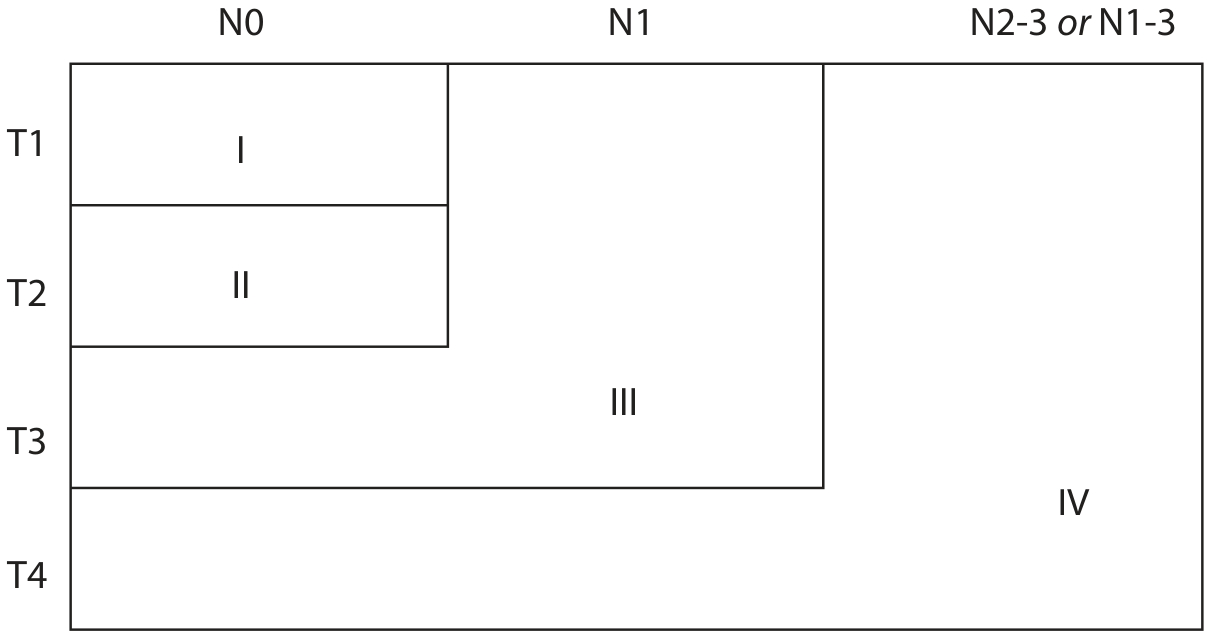
Overall Stage Grouping
| TNM Combination | Overall Stage |
|---|---|
| T1, N0, M0 | Stage I |
| T2, N0, M0 | Stage II |
| T3, N0, M0 OR T1-T3, N1, M0 | Stage III |
| T4a or N2 | Stage IVA |
| T4b or N3 | Stage IVB |
| Any T, Any N, M1 | Stage IVC |
PART 2: T3N1M0 CA TONGUE = STAGE III
This patient has:
- T3: Tumor >4 cm OR depth of invasion >10 mm
- N1: Single ipsilateral node <3 cm
- M0: No distant metastasis
- Overall: Stage III
PART 3: MANAGEMENT OF T3N1M0 CA TONGUE
Step 1 - Workup Before Treatment
- Full head and neck examination + panendoscopy
- CT neck with contrast / MRI (to assess DOI, bone, and nodal disease)
- CT chest / PET-CT (to rule out distant metastasis)
- Biopsy confirmation (SCC in most cases)
- Multidisciplinary team (MDT) discussion
Step 2 - Primary Tumor Treatment
T3 = Extensive local disease → Surgery is the mainstay
| Option | Details |
|---|---|
| Hemiglossectomy / Partial glossectomy | For lateralized T3 tumors |
| Near-total or total glossectomy | For larger/midline T3 involvement |
| Reconstruction | Free flap (radial forearm, anterolateral thigh) to restore form and function |
| If total glossectomy | May require total laryngectomy to prevent chronic aspiration (though some selected patients can avoid it) |
For bone involvement (mandible):
- Periosteal involvement → Marginal mandibulectomy
- Medullary space invasion → Segmental mandibulectomy
Step 3 - Neck Management (N1 disease)
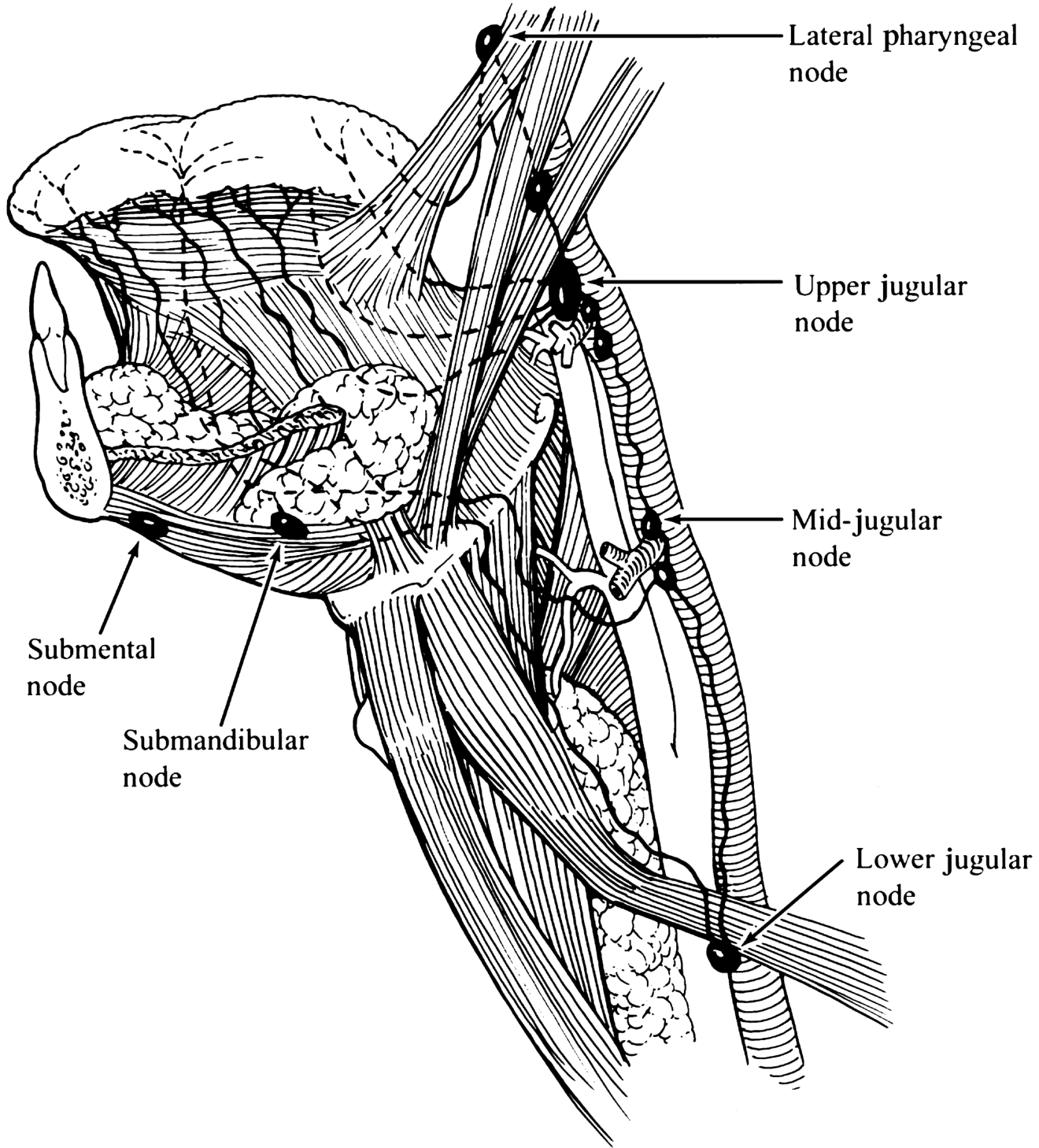
Primary nodal drainage: Upper jugular (73%) > Submandibular (18%) > Mid-jugular (18%) > Submental (9%)
Since this patient is N1 (clinically node-positive ipsilateral neck):
- Modified Radical Neck Dissection (MRND) or Selective Neck Dissection Levels I-IV on the ipsilateral side
- Minimum: Selective neck dissection including levels I-III (supraomohyoid)
- For midline/ventral tongue tumors: bilateral neck dissections
Step 4 - Adjuvant Treatment (Post-Surgery)
After surgery + neck dissection, pathological assessment drives adjuvant therapy:
| Pathological Finding | Recommendation |
|---|---|
| Clear margins, N1 without ENE | Adjuvant radiotherapy (RT) |
| Positive margins or >1 node | Adjuvant chemoradiotherapy (CRT) |
| ENE (Extra-nodal extension) | Adjuvant CRT - cisplatin-based |
| Perineural/vascular invasion | Consider adjuvant RT |
Adjuvant RT dose: typically 60-66 Gy to primary site; 50-54 Gy to elective nodal areas.
Step 5 - Alternative: Non-Surgical Approach
If patient is medically unfit for surgery or refuses surgery:
- Definitive concurrent chemoradiation (cisplatin + RT) is an acceptable alternative
- For T4 with bone involvement: surgery usually still required
Summary Flow for T3N1M0 CA Tongue
T3N1M0 CA Tongue (Stage III)
          ↓
Surgical candidate?
     YES → Hemi/Partial or Near-total Glossectomy
            + Ipsilateral MRND/Selective ND (Levels I-IV)
            ± Contralateral Neck ND (if midline tumor)
            ↓
        Pathology Assessment
            ↓
        Adverse features? (ENE, +ve margins, multiple nodes)
            YES → Adjuvant CRT (Cisplatin + RT)
            NO  → Adjuvant RT alone

     NO  → Definitive concurrent CRT (if no bone invasion)
Prognosis (Stage III/IV)
- 5-year survival: 25-40%
- Extra-nodal extension significantly worsens prognosis:
- pN- (node negative): 88% disease-specific survival
- pN+/ENE-: 65% disease-specific survival
- pN+/ENE+: 48% disease-specific survival
Sources: KJ Lee's Essential Otolaryngology (p. 839-848); Cummings Otolaryngology Head and Neck Surgery (Chapter 91, AJCC 8th edition staging table)
This is a shared conversation. Sign in to Orris to start your own chat.