
Upper and lower eyelid swelling and bluish eye
Reading File
The query describes periorbital swelling with bluish/ecchymotic discoloration — this is a classic clinical sign (e.g., "raccoon eyes" / periorbital ecchymosis) or could be orbital/periorbital conditions. Let me search across multiple angles simultaneously.
Finding Sources
Finding Sources
Finding Sources
Finding Sources
Finding Sources
Finding Sources
Reading File
Reading File
Searching Images
periorbital ecchymosis eyelid swelling bluish discoloration
I now have rich clinical content. Let me fetch the most relevant images to display.
Loading Image
Loading Image
Loading Image
Here is a structured clinical overview of upper and lower eyelid swelling with bluish/ecchymotic discoloration.
Periorbital Swelling with Bluish Discoloration (Periorbital Ecchymosis)
Key Clinical Images
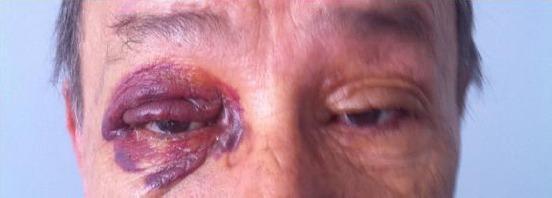
Periorbital ecchymosis — upper and lower lids (purple-blue, raccoon sign):
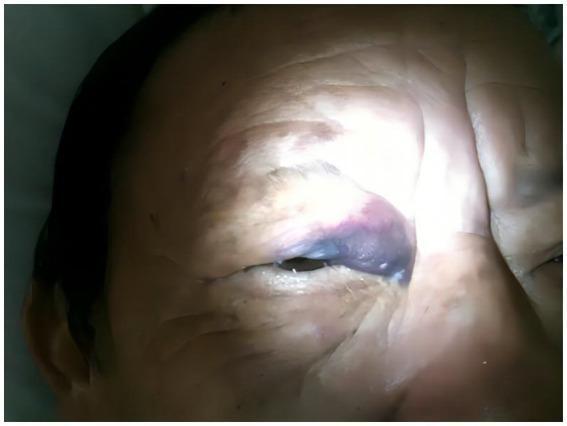
Acute eyelid hematoma — deep purple-blue discoloration with tense edema:
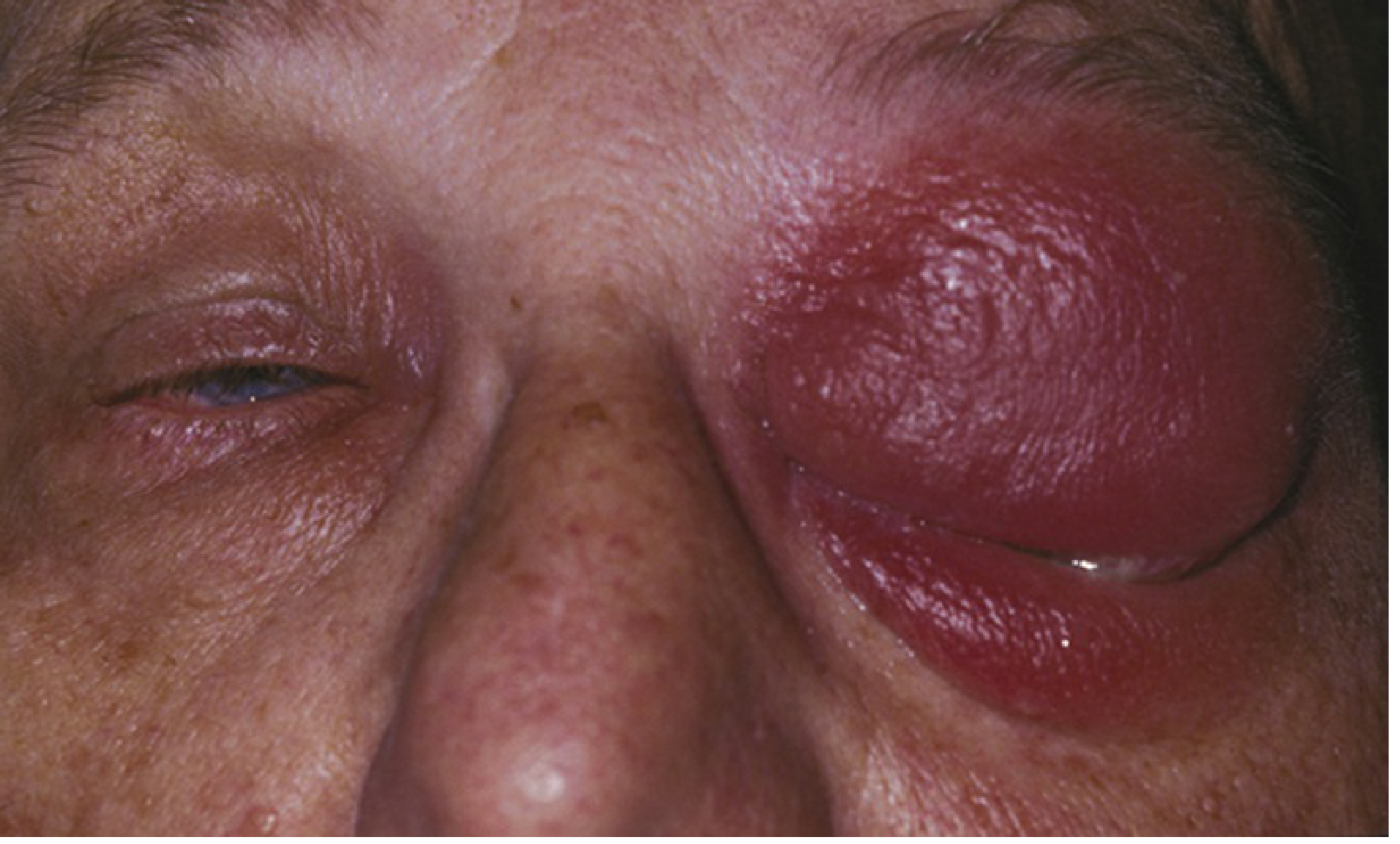
Preseptal (periorbital) cellulitis — erythema, swelling, eyelid closure:
Differential Diagnosis
The combination of both upper and lower eyelid swelling + bluish discoloration narrows the differential considerably:
1. Trauma / Orbital Fracture (Most Common)
- Direct blunt injury → periorbital hematoma
- Blow-out fracture: periorbital ecchymosis + eyelid swelling, diplopia, infraorbital nerve hypoesthesia (cheek numbness), restricted eye movements (muscle entrapment), enophthalmos
- Requires CT orbits to assess bony injury and muscle entrapment
- Harriet Lane Handbook: "Key physical exam findings include eyelid swelling, ecchymosis, exophthalmos, ptosis, diplopia, anesthesia of the cheek (involvement of infraorbital nerve), and restricted extraocular eye movements (intraocular muscle entrapment)"
2. Raccoon Eyes (Periorbital Ecchymosis) — Basal Skull Fracture
- Bilateral periorbital ecchymosis without direct trauma to the orbit
- Ecchymosis tracking along the anterior cranial fossa floor
- Usually appears 12–48 hours after injury
- Associated: Battle's sign (mastoid ecchymosis), CSF rhinorrhea/otorrhea, cranial nerve deficits
- ⚠️ Emergency: requires urgent neurosurgical evaluation + CT head/skull base
3. Preseptal (Periorbital) Cellulitis
- Infection anterior to the orbital septum
- Signs: eyelid erythema/warmth/tenderness, tense edema, possible eye unable to open
- No proptosis, no pain with eye movement, no restricted motility — distinguishes from orbital cellulitis
- Bluish hue may occur with venous congestion or bruising from inflammation
- Causes: skin trauma, insect bite, hordeolum, sinusitis
- Wills Eye Manual: "No proptosis, no optic neuropathy, no extraocular motility restriction... Visual changes such as blurred vision or monocular diplopia attributed to swollen eyelids"
- Treatment: oral antibiotics (amoxicillin-clavulanate); IV if severe or child <1yr
4. Orbital Cellulitis (Postseptal)
- Infection posterior to the orbital septum — more dangerous
- Signs: eyelid edema + erythema + proptosis + pain with eye movement + restricted motility
- Risk: optic nerve compromise (APD, dyschromatopsia), cavernous sinus thrombosis
- Usually secondary to ethmoid sinusitis
- Treatment: IV antibiotics, CT orbits with contrast, possible surgical drainage
- Wills Eye Manual: "Eyelid edema, erythema, warmth, and tenderness. Conjunctival chemosis and injection, proptosis, and restricted extraocular motility with pain on attempted eye movement"
5. Hematoma (Post-procedural or Spontaneous)
- Following procedures (Botox, blepharoplasty, periorbital injections), anticoagulant use, or coagulopathy
- Purple-blue tense edema of both lids
- Usually resolves with conservative care; rarely needs drainage
6. Systemic/Oncologic Causes
- AL Amyloidosis: periorbital purpura ("raccoon eyes" without trauma) — pathognomonic; caused by capillary fragility from amyloid deposition
- Neuroblastoma (children): periorbital ecchymosis + proptosis ("raccoon eyes" + "panda eyes") — orbital metastasis from adrenal/retroperitoneal primary
- Multiple myeloma / lymphoma: orbital infiltration
7. Necrotizing Fasciitis
- Rapidly progressive; gray-to-purple/blue discoloration with overlying hyesthesia
- Patients appear septic; may have skin necrosis
- Surgical emergency — requires emergent debridement + IV antibiotics
Key Differentiating Features
| Feature | Preseptal Cellulitis | Orbital Cellulitis | Trauma/Fracture | Amyloidosis | Skull Base Fracture |
|---|---|---|---|---|---|
| Pain with eye movement | ✗ | ✓ | Variable | ✗ | ✗ |
| Proptosis | ✗ | ✓ | ✗/enophthalmos | ✗ | ✗ |
| Restricted motility | ✗ | ✓ | ✓ (entrapment) | ✗ | ✗ |
| Bilateral | Rare | Rare | Common (skull fx) | Common | ✓ |
| Fever/systemic signs | Mild | ✓ | ✗ | ✗ | Variable |
| History of trauma | ✗ | ✗ | ✓ | ✗ | ✓ |
Urgent Red Flags — Seek Immediate Evaluation
- Bilateral ecchymosis without direct trauma → think basal skull fracture or systemic disease
- Proptosis + restricted eye movement → orbital cellulitis or blow-out with entrapment
- Vision loss or relative afferent pupillary defect (RAPD) → optic nerve compression
- Rapidly expanding ecchymosis in a sick patient → necrotizing fasciitis
- Pulsatile proptosis + bruit → carotid-cavernous fistula
Sources: Wills Eye Manual (6th ed.), Harriet Lane Handbook (23rd ed.), Goldman-Cecil Medicine, Rosen's Emergency Medicine, Textbook of Family Medicine (9th ed.)
This is a shared conversation. Sign in to Orris to start your own chat.