
DRESS syndrome
Reading File
Finding Sources
Finding Sources
Searching PubMed
"DRESS syndrome" drug reaction eosinophilia systemic symptoms
Reading File
Reading File
Reading File
Finding Sources
Finding Sources
Loading Image
Reading File
I now have comprehensive data. Let me compile the full answer.
DRESS Syndrome (Drug Reaction with Eosinophilia and Systemic Symptoms)
Also termed Drug-Induced Hypersensitivity Syndrome (DIHS), DRESS is one of the most severe cutaneous adverse drug reactions (SCARs), carrying a mortality of up to 10%.
Definition
DRESS is a severe, immune-mediated adverse drug reaction characterized by the triad of:
- Fever + extensive skin rash
- Hematologic abnormalities (eosinophilia, atypical lymphocytes)
- Internal organ involvement
- Rosen's Emergency Medicine, p. 1899; Tintinalli's Emergency Medicine, p. 1669
Epidemiology & Timing
- Onset typically 2-8 weeks after starting the culprit drug (longer latency than most drug reactions)
- Genetic predisposition plays a role - family members should be counseled when a case is diagnosed
- Incidence varies widely by drug class
- Tintinalli's Emergency Medicine, p. 1668
Causative Drugs
Most common culprits:
| Drug Class | Examples |
|---|---|
| Aromatic anticonvulsants | Phenytoin, phenobarbital, carbamazepine, lamotrigine |
| Anti-gout | Allopurinol |
| Sulfonamides | TMP-SMX |
| Antibiotics (other) | Minocycline, vancomycin, dapsone |
| Antiretrovirals | Nevirapine, abacavir |
| NSAIDs | - |
| ACE inhibitors | - |
| Calcium channel blockers | - |
| Antipsychotics | Clozapine, quetiapine |
| Anti-TB drugs | Rifampicin, isoniazid |
Higher-risk drugs (>3% of treated patients): aminopenicillins, allopurinol, sulfonamides, anticonvulsants.
- Tintinalli's EM, p. 1668; Dermatology 2-Volume Set 5e
Pathogenesis
DRESS is now understood as a multistep immune process:
- Reactive drug metabolites disturb the balance between cytotoxic and regulatory immune responses
- CD4+ and CD8+ T cells strongly expressing perforin and granzyme are recruited - cytotoxic activity kills keratinocytes
- Viral reactivation - particularly HHV-6 and HHV-7, but also CMV and EBV, is implicated in pathogenesis
- Drug-related immunosuppression (or induction of viral replication) leads to viral reactivation, which stimulates a cellular immune response
- HHV-6 transmits to skin-infiltrating CD4+ T cells, amplifying the reaction
- Drug-specific T cells have been isolated from blood and skin in lamotrigine- and carbamazepine-induced cases
- Dermatology 5e, blocks 5 and 18
Clinical Features
Skin
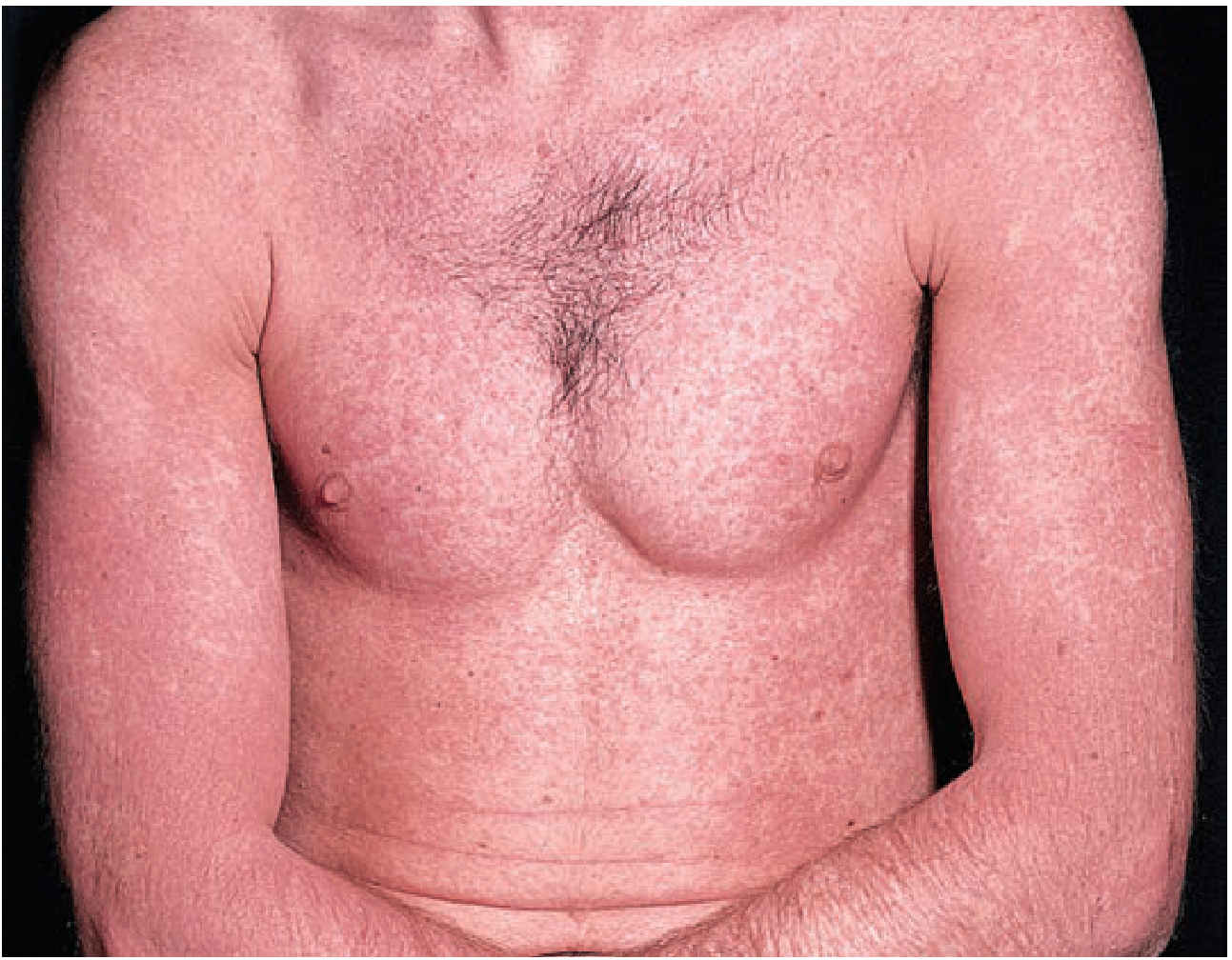
DRESS syndrome caused by phenytoin (Tintinalli's Emergency Medicine)
| Feature | Frequency |
|---|---|
| Maculopapular rash | 60-100% |
| Rash >50% BSA | 45-80% |
| Facial edema | 40-85% |
| Mucosal involvement (mouth/throat/lips) | 50% |
| Purpura | 10-30% |
| Pustules | 15-30% |
| Eye involvement | 10-15% |
The rash morphology is variable - ranges from morbilliform/maculopapular to exfoliative dermatitis or even bullous/SJS-like eruption.
Systemic Features
- Fever (high)
- Lymphadenopathy (at least 2 sites, nodes >1 cm)
- Liver - most commonly affected visceral organ; hepatitis/hepatocellular injury
- Kidney - interstitial nephritis
- Lung - pneumonitis
- Heart - myocarditis (rare but serious)
- Endocrine - thyroid dysfunction (may occur weeks to months after resolution)
- Neurologic, GI involvement also reported
Hematologic Abnormalities
| Finding | Frequency |
|---|---|
| Eosinophilia | 30-95% (notably absent in ~30%) |
| Atypical lymphocytes | 30-65% |
| Lymphocytosis / lymphopenia | variable |
| Thrombocytopenia | occasional |
- Dermatology 5e (frequency table); Rosen's EM, p. 1899
Diagnosis - RegiSCAR Scoring System
The European Registry of Severe Cutaneous Adverse Reactions (RegiSCAR) validated scoring system:
| Criterion | No | Yes | Unknown |
|---|---|---|---|
| Fever ≥38.5°C | -1 | 0 | -1 |
| Lymphadenopathy (≥2 sites; >1 cm) | 0 | +1 | 0 |
| Circulating atypical lymphocytes | 0 | +1 | 0 |
| Peripheral hypereosinophilia | (see subgroups) | +1 or +2 | 0 |
| Skin involvement (extent, morphology, biopsy suggesting DRESS) | variable | +1 or +2 | 0 |
| Organ involvement (liver, kidney, lung, muscle/heart) | 0 | +1 per organ, max +2 | 0 |
| Resolution >15 days | -1 | 0 | 0 |
| Exclusion of other causes (ANA, blood cultures, serology) | -1 | +1 | 0 |
Score interpretation:
- <2 = No DRESS
- 2-3 = Possible DRESS
- 4-5 = Probable DRESS
-
5 = Definite DRESS
- Dermatology 5e, RegiSCAR table, block 5
Key Warning Signs of a Severe Cutaneous Adverse Reaction (SCAR)
Cutaneous: Skin pain, confluent erythema, facial edema, blisters/epidermal detachment, mucosal erosions, necrosis, palpable purpura
Systemic: High fever, lymphadenopathy, arthralgia, dyspnea/wheezing, hypotension, visceral involvement
Labs: Marked eosinophilia, lymphocytosis with atypical lymphocytes, leukopenia, abnormal LFTs/renal function, thrombocytopenia
- Dermatology 5e, eTable 21.3
Differential Diagnosis
- Stevens-Johnson Syndrome / Toxic Epidermal Necrolysis (look for mucosal erosions, skin detachment)
- Drug-induced pseudolymphoma / angioimmunoblastic T-cell lymphoma
- Infectious mononucleosis (EBV)
- Viral exanthem
- Serum sickness-like reaction
Management
- Immediate discontinuation of the suspected culprit drug - single most important step
- Systemic corticosteroids in severe cases (hepatitis, pneumonitis, extensive exfoliative dermatitis) - prednisolone 1-2 mg/kg/day with slow taper
- Supportive care - antipyretics, antihistamines/antipruritic agents, fluid management, wound care
- Hospital admission in all confirmed/probable cases
- Monitor for relapse - DRESS can flare weeks after drug cessation, especially if steroids are tapered too quickly
- Monitor for late sequelae - autoimmune thyroid disease, type 1 diabetes, and other autoimmune diseases can emerge months after acute DRESS
- Family counseling - discuss genetic risk with relatives of the patient
- Tintinalli's EM, p. 1669; Rosen's EM, p. 1899
Prognosis
- Mortality: up to 10% (primarily from fulminant hepatitis or myocarditis)
- Resolution is typically slow (>15 days after drug cessation is characteristic)
- Long-term autoimmune complications (thyroiditis, type 1 DM) may develop months to years later
- The condition can be misdiagnosed early due to its variable presentation and the delayed onset after drug initiation
Recent Evidence
A 2025 EAACI position paper (PMID 40589376) published a systematic review specifically on DRESS diagnosis and management in children, confirming that the RegiSCAR criteria require pediatric adaptation. A 2023 review (PMID 37575981) highlights the expanding list of culprit drugs and the importance of HHV-6 serology in workup.
This is a shared conversation. Sign in to Orris to start your own chat.