
Intra aortic balloon pump and anaesthetic implication
Reading File
The IABP is a mechanical circulatory support device that augments diastolic pressure and reduces afterload. From an anaesthetic standpoint, the key concerns revolve around haemodynamic management, timing of counterpulsation, and perioperative care of the patient with the device in situ.
Searching sources...
Finding Sources
Finding Sources
Searching PubMed
"intra-aortic balloon pump" AND anesthesia
Now let me read the key textbook sections, focusing on Miller's Anesthesia and the dedicated IABP sections:
Reading File
Reading File
Finding Sources
Now let me search Miller's Anesthesia specifically for IABP and anaesthetic implications, and also search Braunwald's section:
Finding Sources
Finding Sources
Excellent - Miller's Anesthesia has a dedicated section. Let me read it along with Braunwald's and Barash's relevant sections:
Reading File
Reading File
Now let me read more of Braunwald's for timing, indications, and weaning, plus search Barash specifically for perioperative/anaesthetic aspects:
Reading File
Finding Sources
Now let me get Braunwald's continuation on IABP and also get the Mulholland section on timing/waveforms, and also Miller's SpO2 issue section:
Reading File
Reading File
Reading File
Now let me get the IABP waveform image and also check Mulholland for the timing/waveform text:
Loading Image
Reading File
I now have comprehensive information from multiple authoritative textbooks. Let me compile the complete answer.
Intra-Aortic Balloon Pump (IABP): Mechanism, Principles & Anaesthetic Implications
1. Overview and History
The IABP was first described by Harken in 1958 and remains the most widely used mechanical circulatory support (MCS) device. It consists of a cylindrical polyurethane balloon (25-50 mL) mounted on a 7.5-8.0 French double-lumen catheter, connected to an external pneumatic console. Helium gas is used to inflate the balloon because its low viscosity enables rapid transfer in and out, and if the balloon ruptures, helium is absorbed rapidly into blood - significantly reducing the risk of gas embolism.
- Braunwald's Heart Disease, 15e - Fischer's Mastery of Surgery, 8e
2. Positioning
The balloon sits in the descending thoracic aorta, approximately 1-2 cm (about an inch) distal to the left subclavian artery, extending to just above the level of the renal arteries. It is typically inserted percutaneously via the left or right femoral artery under fluoroscopic or ultrasound guidance. In patients with severe peripheral arterial disease or when femoral access is unavailable, it can be placed via the left axillary artery (increasingly used as a bridge to transplant in ambulatory patients).
3. Mechanism of Action: Counterpulsation
The core principle is diastolic augmentation + systolic unloading (afterload reduction):
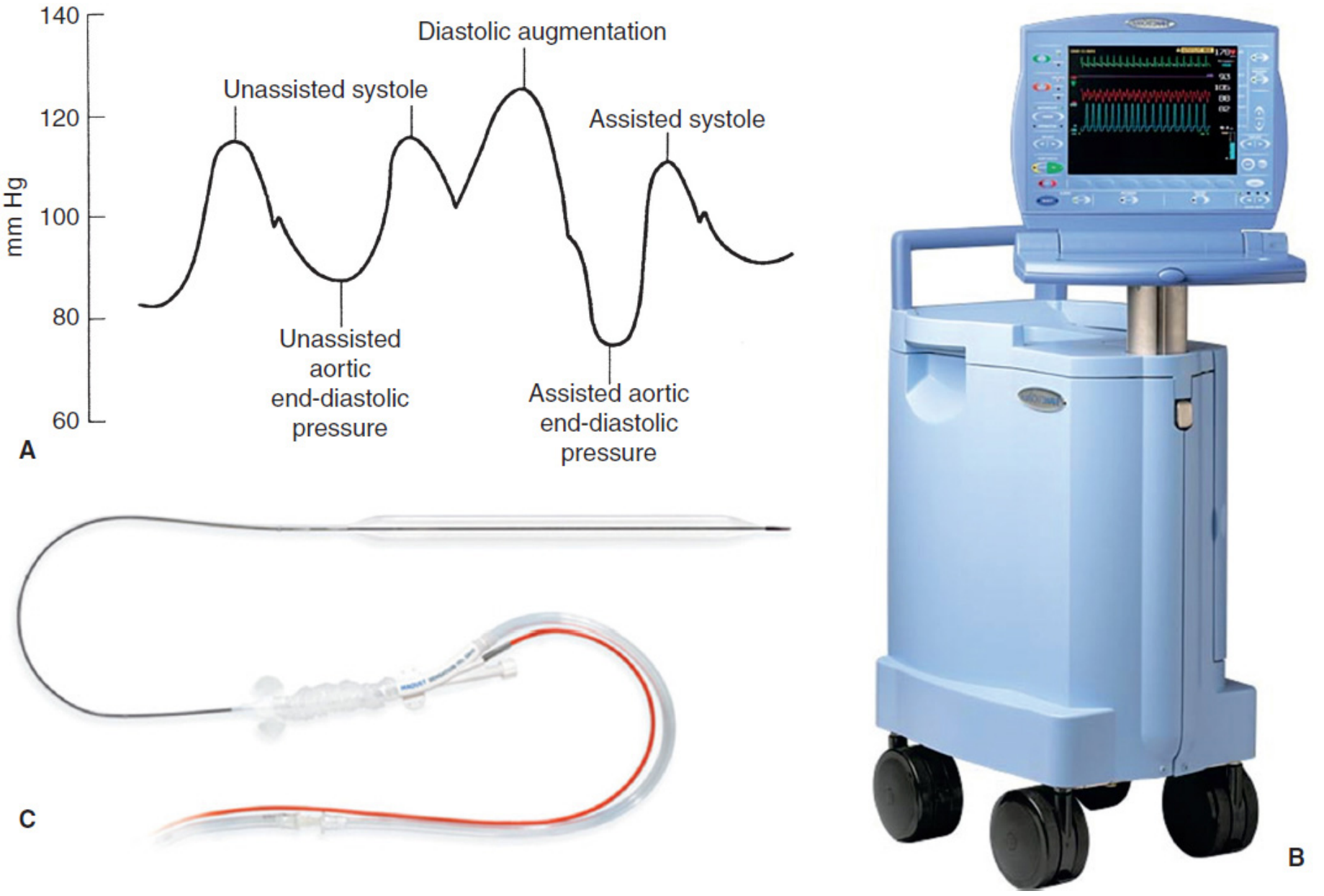
| Phase | Balloon Action | Effect |
|---|---|---|
| Diastole | Inflates (triggered by dicrotic notch / middle of T-wave on ECG) | Increases aortic diastolic pressure -> augments coronary and cerebral perfusion |
| Systole | Deflates rapidly (triggered by R-wave peak) | Creates a vacuum effect -> reduces LV afterload, reduces wall stress, decreases myocardial O2 consumption |
Net haemodynamic effects:
-
Increased diastolic blood pressure (coronary augmentation)
-
Decreased systolic pressure and end-diastolic pressure (afterload reduction)
-
Modest increase in cardiac output (~0.5-1.0 L/min)
-
Reduced myocardial oxygen consumption
-
Requires the patient to have some residual LV function - the IABP amplifies, not replaces, LV work
-
Braunwald's Heart Disease | Tintinalli's Emergency Medicine
4. Triggering Modes
The IABP console can be triggered by:
- ECG trigger - Inflation timed to middle of T-wave (dicrotic notch equivalent); deflation timed to R-wave peak
- Arterial pressure waveform trigger - Inflation just after the dicrotic notch; deflation just before the next systolic upstroke
- Pacer mode - When the patient is paced; uses pacer spike rather than R-wave
- Internal (asynchronous) trigger - Used in cardiac arrest, used at a fixed rate
Timing errors are critical:
-
Early inflation - Balloon inflates before aortic valve closes -> increases afterload (dangerous)
-
Late inflation - Diastolic augmentation reduced
-
Early deflation - Loses afterload reduction benefit
-
Late deflation - Balloon still inflated when LV ejects -> increased afterload
-
Fuster & Hurst's The Heart, 15e
5. Indications
| Category | Examples |
|---|---|
| Cardiogenic shock | Post-AMI cardiogenic shock, mechanical complications (papillary muscle rupture, VSD) |
| Preoperative stabilisation | High-risk PCI, pre-CABG in critical left main CAD |
| Intraoperative support | Failure to wean from cardiopulmonary bypass |
| Postoperative support | Post-CABG low cardiac output syndrome |
| Bridge therapy | Bridge to transplantation, bridge to durable LVAD |
| Refractory unstable angina | Unresponsive to maximal medical therapy |
The SHOCK II trial found no mortality benefit of IABP in AMI-complicated cardiogenic shock when early revascularisation was planned (30-day mortality: 39.7% vs 41.3%, p=0.69). IABP is therefore no longer recommended routinely in this context per current ESC guidelines.
- Braunwald's Heart Disease | Washington Manual of Medical Therapeutics
6. Contraindications
| Absolute | Relative |
|---|---|
| Severe aortic regurgitation (inflation worsens AR) | Aortic aneurysm |
| Aortic dissection | Significant coagulopathy |
| Severe peripheral arterial disease at insertion site | |
| Uncontrolled sepsis | |
| Bilateral femoral bypass grafts |
- Fischer's Mastery of Surgery, 8e
7. Anaesthetic Implications
7.1 Preoperative Considerations
- Identify the presence of IABP before any anaesthetic - review trigger mode, support ratio (1:1, 1:2, 1:3), console alarms
- Patients presenting for CABG or cardiac surgery with critical left main CAD or unstable angina should have IABP placed for stabilisation before induction of anaesthesia, to prevent haemodynamic collapse at induction
- Understand the underlying indication - the degree of LV impairment guides induction agent selection, monitoring strategy, and vasoactive drug planning
- Check anticoagulation status - IABP requires systemic anticoagulation (usually heparin); this impacts neuraxial anaesthesia, invasive line placement, and surgical bleeding
- Washington Manual of Medical Therapeutics | Sabiston Textbook of Surgery, 20e
7.2 Intraoperative Monitoring
- Invasive arterial monitoring is mandatory - the arterial waveform is used to assess IABP timing and effects; it also demonstrates the augmented diastolic waveform (diastolic pressure > systolic on assisted beats at 1:2)
- Central venous access - for vasoactive drugs; PAC may be used in complex cases
- Pulse oximetry: SpO2 accuracy is reduced in the presence of IABP - accuracy depends on the brand of pulse oximeter and the support ratio, with accuracy generally reduced at higher support ratios (1:1). In patients with continuous-flow VADs, pulse oximetry may be entirely unreliable due to non-pulsatile flow; cerebral oximetry is then advocated
- Echocardiography (TOE/TEE) - essential to assess LV function, valvular pathology (especially AR), check balloon position, and guide haemodynamic management
- ECG monitoring must be high quality - artefact from IABP can interfere with the trigger signal
- Miller's Anesthesia, 10e
7.3 Induction and Maintenance
- Avoid tachycardia - at high heart rates (>120-130 bpm), diastole shortens and the IABP loses effectiveness; there is inadequate time for diastolic augmentation
- Avoid bradycardia/arrhythmias - atrial fibrillation and frequent ectopics cause irregular triggering and poor counterpulsation; an irregular rhythm impairs IABP efficacy significantly
- Induction agents - choose those with minimal myocardial depression; high-dose opioid-based induction (fentanyl/sufentanil) is commonly used in cardiac cases; ketamine may be considered to maintain SVR, but may increase myocardial O2 demand
- Avoid large increases in SVR - while the IABP reduces afterload, addition of vasoconstrictors that markedly increase SVR can negate this benefit
- IABP should ideally remain ON during induction - particularly in haemodynamically unstable patients; do not pause without a clear indication
- The placement of IABP is usually performed under conscious sedation, but the anaesthesiologist is often involved when the patient is compromised haemodynamically or from a respiratory standpoint
- Miller's Anesthesia, 10e | Barash's Clinical Anesthesia, 9e
7.4 Specific Intraoperative Scenarios
During cardiac surgery on cardiopulmonary bypass (CPB):
- IABP is paused during CPB (aortic cross-clamp) - no cardiac cycle to trigger
- Restart in asynchronous mode when coming off CPB, then switch to synchronised mode once cardiac rhythm is established
- Particularly useful for failure to wean from CPB - significant low cardiac output state post-CABG/valve surgery
During non-cardiac surgery in a patient with pre-existing IABP:
- IABP must remain functional throughout - ensure the console is available in the operating room and that biomedical/perfusion staff are present
- Patient positioning is limited - femoral insertion restricts hip flexion; axillary insertion restricts arm positioning
- Surgical field prep must avoid the insertion site
- Radiolucency matters - fluoroscopy may be needed intraoperatively to check position
Arrhythmia management:
- Frequent PVCs cause alternating trigger signals
- AF requires switching to pressure trigger mode
- In VF/pulseless VT, switch to internal trigger mode
- During defibrillation - the IABP console should be capable of withstanding defibrillation shock, but confirm with the device manufacturer
7.5 Postoperative and ICU Management
- Weaning the IABP: reduce the counterpulsation ratio progressively: 1:1 -> 1:2 -> 1:3, while monitoring haemodynamic parameters (cardiac output, MAP, heart rate, urine output). Do not wean too early in haemodynamically unstable patients
- Haemodynamic targets during IABP support: maintain adequate preload; the IABP does not replace volume; avoid vasodilators that may excessively drop diastolic pressure and negate diastolic augmentation
- Immobility: patients with femoral IABP must remain immobilised with the affected limb straight - neuraxial anaesthesia, epidural management, and physiotherapy are constrained
- Postoperative pain management: consider that morphine and opioids may cause bradycardia which can impair IABP triggering
- Limb ischaemia monitoring: hourly checks of the limb distal to insertion; document neurovascular observations
- Fischer's Mastery of Surgery, 8e
8. Complications
| Complication | Notes |
|---|---|
| Limb ischaemia (most common) | Major in ~2.6%, any complication 8.1% (Benchmark Registry) |
| Aortic dissection | Catastrophic; immediate removal |
| Stroke | From embolism or displacement obstructing subclavian/carotid |
| Renal/mesenteric ischaemia | From downward migration occluding renal/coeliac vessels |
| Thrombocytopaenia | Platelet activation on balloon surface |
| Balloon rupture | Helium embolism - low risk due to rapid absorption |
| Infection/bacteraemia | Especially with prolonged use |
| Bleeding at insertion site | Especially in anticoagulated patients |
For axillary artery IABP: unique complications include balloon kinking/folding within the aorta and left arm ischaemia. Serial chest X-rays are essential to confirm position as kinking may occur without triggering console alarms.
- Fischer's Mastery of Surgery, 8e | Braunwald's Heart Disease
9. Comparison with Other MCS Devices (Anaesthetic Perspective)
| Device | CO Support | Pulsatility | SpO2 Reliability | Anaesthetic Complexity |
|---|---|---|---|---|
| IABP | ~0.5-1 L/min | Yes (augmented) | Reduced at high support ratios | Moderate |
| Impella 2.5/CP | 2.5-4.3 L/min | Minimal | May be unreliable | High |
| TandemHeart | 2-4 L/min | None | Unreliable | High |
| VA-ECMO | 4-6 L/min | None | Unreliable (cerebral oximetry needed) | Very high |
- Miller's Anesthesia, 10e
Key Anaesthetic Summary Points
- Always identify IABP before starting any anaesthetic - trigger mode, ratio, console availability, anticoagulation status
- Maintain regular cardiac rhythm - arrhythmias severely impair IABP efficacy
- Avoid tachycardia - shortens diastolic augmentation time
- Invasive arterial line is mandatory - enables real-time assessment of IABP timing and haemodynamic effect
- SpO2 accuracy is reduced with IABP - validate with ABG
- ECG trigger artefact is common - use pressure trigger as alternative
- IABP does not replace volume - adequate preload must be maintained
- Aortic regurgitation is an absolute contraindication - inflation worsens AR
- Keep the device running during induction in haemodynamically unstable patients
- Wean gradually after stabilisation - not before haemodynamic goals are met
This is a shared conversation. Sign in to Orris to start your own chat.