
Prompt- Create a super aesthetic, handwritten-style revision note page for the topic: Diabetes Mellitus, Refer “Essentials of Medicine for Dental Students” by Anil K Tripathi. • Make it look like neat exam notes written on a page (top view, clean layout, colorful headings, underlines, boxes). • Keep it crisp, high-yield, and exam-oriented. • Use clear headings and organize content like this (modify if needed for topic): ○ Definition ○ Etiology ○ Pathogenesis (flow/arrow style) ○ Clinical features ○ Radiographic features (if applicable) ○ Histopathology (if applicable) ○ Key features ○ Differential diagnosis ○ Management ○ Complications ○ Key points / last-minute revision box • Add simple diagrams or labeled sketches wherever helpful. • Highlight important keywords. • Include one memory trick / one-line summary
A super aesthetic handwritten-style medical revision note page for "Diabetes Mellitus" — dental student exam notes, top-view, clean white lined paper look, colorful headings in different ink colors, underlines, boxes, arrows, and small sketches. The notes are dense, neat, high-yield, and exam-oriented. Layout includes: TOP HEADER: Large colorful title "DIABETES MELLITUS" in bold blue with yellow highlighter, subtitle "Essentials of Medicine for Dental Students | Tripathi" in small cursive. SECTION 1 - DEFINITION (red heading with underline): "Metabolic disorder characterized by chronic hyperglycemia due to defective insulin secretion, action, or both → affecting carbohydrate, fat & protein metabolism." SECTION 2 - CLASSIFICATION (purple heading with box): T-shaped table: Type 1 (Insulin-dependent, autoimmune, <30yrs, HLA-DR3/DR4, lean) | Type 2 (Non-insulin-dependent, insulin resistance, >40yrs, obese) | GDM | Others (MODY, secondary) SECTION 3 - ETIOLOGY (orange heading): Two columns with arrows: TYPE 1: Genetic (HLA-DR3/DR4) + Environmental trigger → Autoimmune beta cell destruction → Absolute insulin deficiency. TYPE 2: Genetic + Obesity/Sedentary lifestyle → Insulin Resistance → Relative insulin deficiency SECTION 4 - PATHOGENESIS (green heading, arrow flowchart style): T1: "Autoimmune → CD4/CD8 T cells attack beta cells → Insulitis → Beta cell loss → Absolute insulin def. → Hyperglycemia" T2: "Insulin Resistance → Beta cell compensates (hyperinsulinemia) → Beta cell exhaustion → Amyloid deposition → Relative insulin def." Mechanisms of end-organ damage: AGEs (bind RAGE) | Polyol pathway | PKC activation | Oxidative stress SECTION 5 - CLINICAL FEATURES (teal heading): Classic 3 Ps highlighted: POLYURIA, POLYDIPSIA, POLYPHAGIA + Weight loss | Fatigue | Blurred vision | Recurrent infections | Poor wound healing. Small stick figure with arrows pointing to symptoms. SECTION 6 - ORAL/DENTAL MANIFESTATIONS (coral/pink heading, boxed): • Xerostomia (dry mouth) • Burning sensation • Periodontitis (5th complication) • Candidiasis • Delayed wound healing • Parotid enlargement • Taste disturbance • Denture stomatitis SECTION 7 - DIAGNOSIS (blue heading, small table): FPG ≥ 126 mg/dL | 2hr OGTT ≥ 200 mg/dL | Random glucose ≥ 200 + symptoms | HbA1c ≥ 6.5%. Prediabetes: FPG 100-125 | HbA1c 5.7-6.4% SECTION 8 - MANAGEMENT (dark green heading): Non-pharmacological: Diet + Exercise + Weight loss. Pharmacological: T1 → Insulin only. T2 → Metformin (1st line) → Add SUs/DPP4i/GLP1-RA/SGLT2i → Insulin. Dental consideration: Check blood glucose before procedure, avoid morning appointments. SECTION 9 - COMPLICATIONS (red box, two columns): ACUTE: DKA (T1), HONK/HHS (T2), Hypoglycemia. CHRONIC: Micro (Retinopathy, Nephropathy, Neuropathy) → Macro (Atherosclerosis, MI, Stroke, PVD). Small diagram showing eye/kidney/nerve/heart icons with dotted lines. SECTION 10 - HISTOPATHOLOGY (brown heading): T1: Insulitis - lymphocytic infiltrate, reduced beta cells. T2: Islet amyloid (amyloid deposition >90%), fibrosis, reduced beta cell mass. Kimmelstiel-Wilson nodules (glomerulosclerosis). BOTTOM - MEMORY BOX (yellow sticky-note style): "MNEMONIC: 3Ps + 1W = Classic DM" "T1 = Thin, Teens, Total insulin deficiency | T2 = Tubby, Forty, Two treatments". One-line summary: "DM = Hyperglycemia due to insulin deficiency/resistance → damages all vessels → oral sign = periodontitis + xerostomia". Small reminder stars and doodles around margins. Overall style: notebook paper texture, neat handwriting fonts, multiple pen colors (blue, red, green, purple, orange, teal), highlighter streaks on keywords, small arrows connecting sections, tiny margin doodles of a pancreas and tooth, professional dental student aesthetic.
Create a super aesthetic, handwritten-style revision note page for the topic: Diabetes Mellitus, Refer “Essentials of Medicine for Dental Students” by Anil K Tripathi. • Make it look like neat exam notes written on a page (top view, clean layout, colorful headings, underlines, boxes). For KUHS Thirrd Year BDS General Medicine Examination. • Keep it crisp, high-yield, and exam-oriented. • Use clear headings and organize content like this (modify if needed for topic): ○ Definition ○ Etiology ○ Pathogenesis (flow/arrow style) ○ Clinical features ○ Radiographic features (if applicable) ○ Histopathology (if applicable) ○ Key features ○ Differential diagnosis ○ Management ○ Complications ○ Key points / last-minute revision box • Add simple diagrams or labeled sketches wherever helpful. • Highlight important keywords. • Include one memory trick / one-line summary
A super aesthetic, handwritten-style medical revision note page for "DIABETES MELLITUS" — KUHS Third Year BDS General Medicine exam notes. The image looks like a real student's notebook paper viewed from the top — white lined paper with blue horizontal lines, slightly warm background, clean and neat. Multiple colored pens/inks used throughout. The layout is dense, organized, high-yield. TOP SECTION: - Large bold title "DIABETES MELLITUS" written in dark navy blue ink, thick letters, with a bright yellow highlighter streak underneath - Subtitle in small purple cursive: "Essentials of Medicine for Dental Students — Anil K Tripathi | KUHS 3rd Year BDS" - A small hand-drawn pancreas sketch to the right of the title with an arrow labeled "islets of Langerhans" SECTION 1 — DEFINITION (coral/red heading, double underlined): Written in neat blue handwriting: "Metabolic disorder characterized by CHRONIC HYPERGLYCEMIA (highlighted in yellow) resulting from defects in insulin secretion, insulin action, or BOTH — affecting CHO, fat & protein metabolism." "Normal fasting glucose: 70–100 mg/dL" SECTION 2 — CLASSIFICATION (purple heading, underlined with purple pen): A neat hand-drawn 2-column table: Left column header "TYPE 1 (IDDM)" | Right column "TYPE 2 (NIDDM)" Row 1: "Autoimmune" | "Insulin resistance" Row 2: "<30 yrs, lean" | ">40 yrs, obese" Row 3: "HLA-DR3/DR4 assoc." | "Strong family history" Row 4: "Absolute insulin deficiency" | "Relative insulin deficiency" Below the table in small writing: "Others: GDM | MODY | Secondary (drugs, pancreatitis)" SECTION 3 — ETIOLOGY (orange heading): Two neat sub-columns: "TYPE 1: Genetic susceptibility (HLA-DR3/DR4) + Environmental trigger (virus) → Autoimmune β-cell destruction" "TYPE 2: Genetic + Obesity/Sedentary + Ageing → Insulin Resistance + β-cell dysfunction" Small labels: "RISK FACTORS: Obesity ★ Family Hx ★ Hypertension ★ Dyslipidaemia ★ GDM history" SECTION 4 — PATHOGENESIS (green heading, with small arrow flowchart): Two neat flow diagrams side by side drawn with arrows (→): Left box labeled "T1DM": "Genetic predisposition → CD4+/CD8+ T-cell activation → Insulitis → β-cell destruction (>90% loss) → Absolute insulin ↓ → Hyperglycemia + DKA" Right box labeled "T2DM": "Obesity/IR → Compensatory hyperinsulinemia → β-cell exhaustion → Amyloid deposition in islets → Relative insulin ↓ → Hyperglycemia + HHS" Below, a smaller box labeled "Mechanisms of End-Organ Damage (4 key)": "① AGEs (bind RAGE) ② Polyol pathway ↑ ③ PKC activation ④ Hexosamine pathway overload" SECTION 5 — CLINICAL FEATURES (teal/dark cyan heading): Left sub-column "CLASSIC (highlighted pink): 3 Ps ★" "• POLYURIA (osmotic diuresis)" "• POLYDIPSIA (dehydration)" "• POLYPHAGIA (cellular starvation)" "• Weight loss, Fatigue, Blurred vision" "• Recurrent infections (UTI, skin, fungal)" "• Poor wound healing" Right sub-column with small stick figure diagram with arrows pointing to: eye (blurred vision), mouth (xerostomia), kidney (polyuria), foot (neuropathy), wound (healing) SECTION 6 — ORAL/DENTAL MANIFESTATIONS (bright pink heading, box around entire section): "⭐ KUHS FAVOURITE ⭐" In two neat columns: "• Xerostomia (dry mouth) — due to dehydration" "• Periodontitis ★ (5th complication of DM)" "• Oral candidiasis (Candida albicans)" "• Burning mouth sensation" "• Delayed wound healing / post-extraction" "• Parotid gland enlargement (sialosis)" "• Taste disturbance (dysgeusia)" "• Denture stomatitis" "• Increased caries risk" Small tooth doodle with arrow: "DM → ↓ saliva + ↑ glucose in saliva → ↑ caries + candida" SECTION 7 — DIAGNOSIS (dark blue heading, small table): "ADA Diagnostic Criteria (highlighted yellow):" Neat table 2 columns: "FPG ≥ 126 mg/dL | (fasting ≥8 hrs)" "2hr OGTT ≥ 200 mg/dL | (75g glucose load)" "Random glucose ≥ 200 mg/dL | + symptoms" "HbA1c ≥ 6.5% | (reflects 3-month avg)" Below: "Prediabetes: FPG 100–125 | HbA1c 5.7–6.4%" "HbA1c target in treatment: <7% (highlighted)" SECTION 8 — HISTOPATHOLOGY (brown/maroon heading): "TYPE 1: Insulitis — lymphocytic infiltrate, ↓ β-cell mass, islet atrophy" "TYPE 2: ★ Amyloid deposition in islets (>90% cases) ★, fibrosis, ↓ β cells, β-cell hypertrophy early" "KIDNEY: Kimmelstiel-Wilson nodules (nodular glomerulosclerosis) — PAS +ve (highlighted)" "VESSEL: Basement membrane thickening, hyaline arteriolosclerosis" SECTION 9 — MANAGEMENT (green heading with small algorithm arrows): "NON-PHARMACOLOGICAL: Diet (low glycaemic index) + Exercise + Weight reduction" Small flow algorithm: "T1DM → INSULIN ONLY (highlighted) [no oral agents]" "T2DM → Metformin (1st line ★) → Add: SU / DPP4i / GLP-1 RA / SGLT2i → Insulin (if uncontrolled)" "Dental Consideration (boxed in red dashes): Check blood glucose before procedure | Avoid long fasting | Morning appointments preferred | Antibiotic prophylaxis for major procedures" SECTION 10 — COMPLICATIONS (red heading, 2 clear columns): Left: "ACUTE" "• DKA (Type 1 ★) — Kussmaul breathing, fruity breath, anion gap acidosis" "• HHS/HONK (Type 2) — very high glucose >600, no ketones" "• Hypoglycaemia — sweating, tremor, confusion" Right: "CHRONIC" "MICROVASCULAR (highlighted yellow): • Retinopathy (leading cause of blindness) • Nephropathy (Kimmelstiel-Wilson) • Neuropathy (glove-stocking distribution)" "MACROVASCULAR: • Atherosclerosis → MI, Stroke, PVD" Small mnemonic: "Micro RNN — Retina, Nephron, Nerve" BOTTOM SECTION — LAST MINUTE REVISION BOX (bright yellow sticky-note style box, slightly tilted, with a small star): "★ MEMORY TRICK: 3Ps = Polyuria + Polydipsia + Polyphagia" "T1 = Thin, Teen, Total insulin loss, T-cell mediated" "T2 = Two = Tubby + Forty = Twice the prevalence" "★ ONE-LINE SUMMARY: DM = Chronic hyperglycemia due to ↓ insulin or ↑ resistance → damages micro & macro vessels → oral sign = PERIODONTITIS (5th complication) + Xerostomia ★" "★ HbA1c = 3-month glycaemic memory | Target <7%" "★ Kimmelstiel-Wilson = pathognomonic of diabetic nephropathy" Overall aesthetic: warm notebook paper, neat consistent handwriting in multiple ink colors (navy blue main text, red for headings/stars, purple/teal for subheadings, orange for etiology, green for management), yellow and pink highlighter streaks on key phrases, small doodles of a pancreas, tooth, kidney, eye in margins, small arrows and boxes connecting ideas, very clean and professional student note aesthetic. A4 portrait orientation.
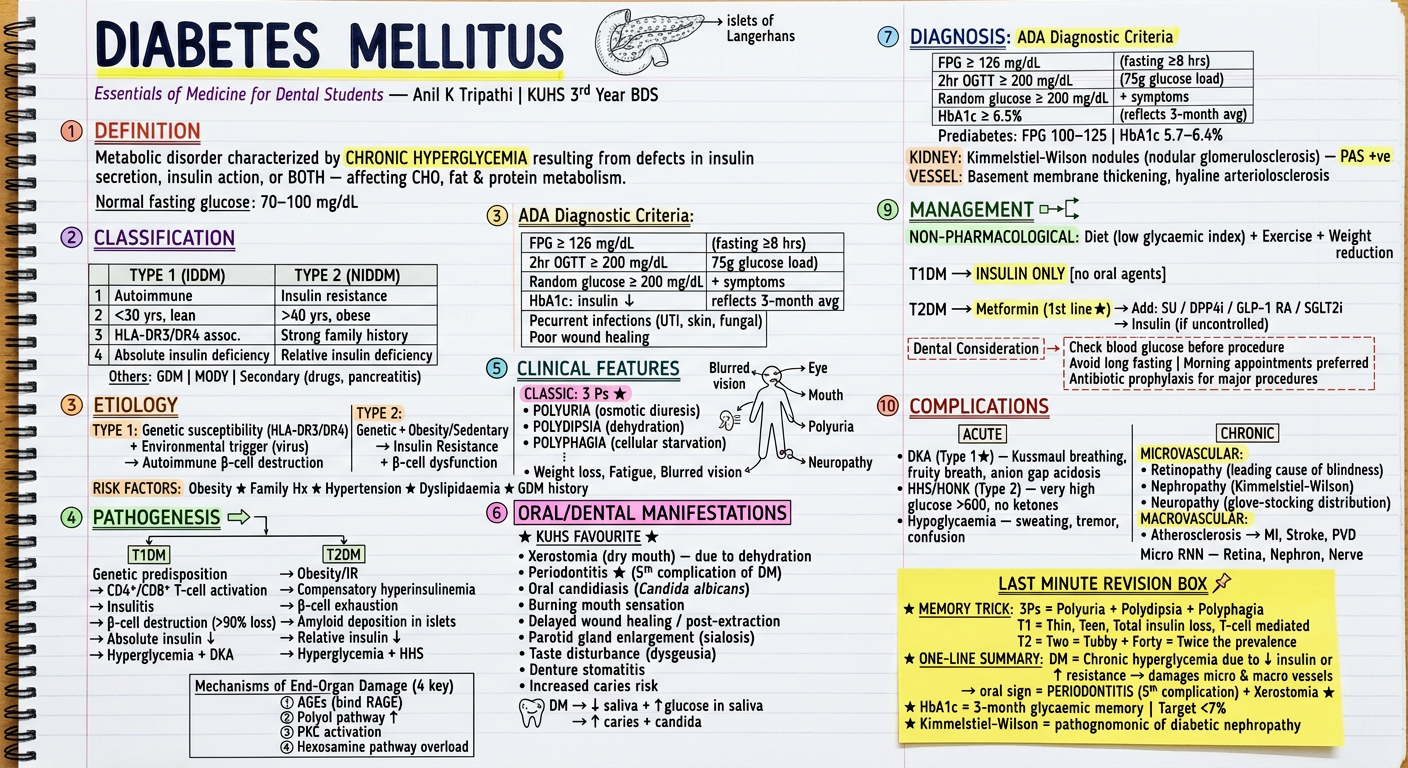
| Section | Key Exam Points |
|---|---|
| Definition | Chronic hyperglycemia due to ↓ insulin secretion/action/both |
| Classification | T1 vs T2 table, + GDM, MODY, Secondary |
| Etiology | HLA-DR3/DR4 (T1) vs Obesity/IR (T2) |
| Pathogenesis | T-cell mediated β-cell destruction (T1) vs β-cell exhaustion + amyloid (T2); 4 mechanisms: AGEs, Polyol, PKC, Hexosamine |
| Clinical Features | Classic 3Ps + poor wound healing, recurrent infections |
| Oral Manifestations ⭐ | Periodontitis (5th complication), Xerostomia, Candidiasis, Delayed healing — KUHS favourite! |
| Diagnosis | ADA criteria: FPG ≥126, OGTT ≥200, HbA1c ≥6.5% |
| Histopathology | Insulitis (T1), Islet amyloid (T2), Kimmelstiel-Wilson nodules |
| Management | T1 → Insulin only; T2 → Metformin → add-ons → Insulin; Dental precautions |
| Complications | Acute: DKA/HHS/Hypoglycemia; Chronic Micro (RNN) + Macro |
| Memory Trick | 3Ps, T1=Thin/Teen, T2=Tubby/Forty, Micro=RNN |
Create a super aesthetic, handwritten-style revision note page for the topic: Heart Failure, Refer “Essentials of Medicine for Dental Students” by Anil K Tripathi. • Make it look like neat exam notes written on a page (top view, clean layout, colorful headings, underlines, boxes). For KUHS Thirrd Year BDS General Medicine Examination. • Keep it crisp, high-yield, and exam-oriented. • Use clear headings and organize content like this (modify if needed for topic): ○ Definition ○ Etiology ○ Pathogenesis (flow/arrow style) ○ Clinical features ○ Radiographic features (if applicable) ○ Histopathology (if applicable) ○ Key features ○ Differential diagnosis ○ Management ○ Complications ○ Key points / last-minute revision box • Add simple diagrams or labeled sketches wherever helpful. • Highlight important keywords. • Include one memory trick / one-line summary
A super aesthetic, handwritten-style A4 portrait medical revision note page for "HEART FAILURE" — KUHS Third Year BDS General Medicine exam notes. Looks like a real student's notebook viewed from the top: white paper with faint blue horizontal lines, warm slightly cream background, multiple colored ink pens. Extremely neat, dense, organized, exam-oriented layout. TOP HEADER: - Large bold title "HEART FAILURE" in thick dark navy blue ink, underlined twice, bright yellow highlighter streak underneath - Subtitle in small purple cursive handwriting: "Essentials of Medicine for Dental Students — Anil K Tripathi | KUHS 3rd Year BDS General Medicine" - Small hand-drawn heart sketch to the right with a downward arrow labeled "↓ Cardiac Output" SECTION 1 — DEFINITION (coral-red heading, double underlined): Neat blue handwriting: "Inability of the heart to pump blood sufficient to meet the METABOLIC DEMANDS (highlighted yellow) of the body at NORMAL FILLING PRESSURES — OR — can only do so at the expense of elevated filling pressures." Small note: "HFrEF = EF <45% (systolic) | HFpEF = EF >50% (diastolic)" SECTION 2 — ETIOLOGY (orange heading, underlined): Two neat columns: Left — "COMMON CAUSES:" "• Ischaemic Heart Disease / MI ★ (MC cause)" "• Systemic Hypertension ★" "• Dilated Cardiomyopathy" "• Valvular Heart Disease (AS, MR, AR)" "• Diabetes mellitus" Right — "OTHER CAUSES:" "• Anaemia / Thyrotoxicosis" "• Arrhythmias (AF)" "• Myocarditis" "• Congenital heart disease" "• Alcohol, drugs" Small label box: "PRECIPITATING FACTORS: Infection ★ | Non-compliance | Arrhythmia | PE | Pregnancy" SECTION 3 — PATHOGENESIS (green heading, arrow flowchart boxes): Main flow diagram with neat arrows: "Myocardial damage / Pressure/Volume overload → ↓ Cardiac Output → Baroreceptor activation → Neurohormonal activation (RAAS + SNS) → ↑ Angiotensin II + ↑ Aldosterone + ↑ Norepinephrine → Na⁺ & H₂O retention + Vasoconstriction → ↑ Preload + ↑ Afterload → LV Remodelling + Dilatation → Further ↓ EF → Worsening Heart Failure" Side note: "Compensatory mechanisms: Frank-Starling ★ | Cardiac hypertrophy | Tachycardia | RAAS activation" Small box: "BNP/NT-proBNP ↑ = released by ventricles under stretch (highlighted pink)" SECTION 4 — CLASSIFICATION (purple heading, neat table): Two small tables side by side: Table 1 header "NYHA FUNCTIONAL CLASS": "Class I — No symptoms on ordinary activity" "Class II — Slight limitation, comfortable at rest" "Class III — Marked limitation, comfortable only at rest" "Class IV — Symptoms at REST ★ (highlighted)" Table 2 header "ACC/AHA STAGES": "Stage A — At risk, no symptoms" "Stage B — Structural disease, no symptoms" "Stage C — Structural disease + symptoms" "Stage D — Refractory HF at rest ★" SECTION 5 — CLINICAL FEATURES (teal heading, two columns): Left column — "LEFT HEART FAILURE (highlighted pink):" "• Dyspnoea on exertion ★" "• Orthopnoea (pillows to sleep)" "• Paroxysmal nocturnal dyspnoea (PND) ★" "• Cardiac asthma" "• Fine basal crepitations (crackles)" "• S3 gallop rhythm ★" "• Pulsus alternans" "• Fatigue, ↓ exercise tolerance" Right column — "RIGHT HEART FAILURE (highlighted yellow):" "• Bilateral pitting pedal oedema ★" "• Raised JVP ★" "• Hepatomegaly (tender)" "• Ascites" "• Pleural effusion" "• Anorexia, nausea" Small stick figure drawing at bottom of column with arrows pointing to: neck (↑JVP), abdomen (hepatomegaly), ankles (oedema), lungs (crepitations) SECTION 6 — RADIOGRAPHIC FEATURES (dark blue heading, boxed): "CHEST X-RAY FINDINGS: (★ KUHS FAVOURITE ★)" In neat listed format: "① Cardiomegaly (CTR >50%) ★ (highlighted yellow)" "② Upper lobe venous diversion" "③ Kerley B lines ★ (horizontal lines at bases = interstitial oedema)" "④ Bat-wing / Butterfly pulmonary oedema" "⑤ Pleural effusion (bilateral/right>left)" "⑥ Hilar haze / Fluffy shadows" Small simple sketch of a chest X-ray outline showing enlarged heart silhouette, Kerley B lines at bases, and hilar shadows labeled SECTION 7 — INVESTIGATIONS (brown heading): "ECG: LVH, AF, bundle branch block, ST changes" "ECHO: ★ Gold standard — measures EF, wall motion, valves" "BNP: >100 pg/mL = HF likely ★ (highlighted)" "CXR: as above" "Bloods: FBC, U&E, LFTs, TFTs, glucose, lipids" SECTION 8 — DENTAL / ORAL RELEVANCE (bright pink heading, dashed box around it): "⭐ FOR BDS — IMPORTANT ⭐" "• Xerostomia — due to diuretics (furosemide ★) + ACE inhibitors" "• Lichenoid drug reactions — from antihypertensives" "• Gingival hyperplasia — amlodipine / CCBs" "• Bleeding tendency — if on warfarin / anticoagulants" "• Angioedema — ACE inhibitor side effect ★" "• Supine position intolerance (orthopnoea) — position patient upright in dental chair" "• Avoid NSAIDs — worsen HF by Na⁺ retention" "• Avoid GA / heavy sedation — risk of decompensation" Small tooth icon with warning triangle SECTION 9 — MANAGEMENT (green heading, stepwise format): "NON-PHARMACOLOGICAL:" "• Fluid restriction (<1.5 L/day) | Salt restriction | Daily weight monitoring" "• Smoking cessation | Alcohol restriction | Exercise rehab" "PHARMACOLOGICAL — HFrEF (EF<40%):" Small algorithm with arrows: "① Diuretics (Furosemide ★) — symptomatic relief, ↓ oedema" "② ACE inhibitor (Enalapril/Ramipril) ★ — ↓ mortality 15-20%" "③ Beta-blocker (Carvedilol/Bisoprolol) ★ — ↓ mortality, reverse remodelling" "④ Aldosterone antagonist (Spironolactone) — ↓ mortality in class III-IV" "⑤ Digoxin — ↓ symptoms, AF control (NOT mortality benefit)" "⑥ SGLT2 inhibitors (Dapagliflozin) — new addition ★" "DEVICE THERAPY: ICD (↓ sudden death) | CRT (biventricular pacing if QRS >130ms)" "SURGICAL: Heart transplant (last resort)" SECTION 10 — COMPLICATIONS (red heading, two columns): Left: "CARDIAC:" "• Arrhythmias (AF most common)" "• Sudden cardiac death ★" "• Cardiogenic shock" Right: "SYSTEMIC:" "• Pulmonary oedema (acute)" "• Hepatic failure (cardiac cirrhosis)" "• Renal failure (cardiorenal syndrome)" "• DVT / PE" "• Cachexia" BOTTOM — LAST MINUTE REVISION BOX (bright yellow sticky note style, slightly tilted, star decorations): "★ MEMORY TRICK: LEFT fails → LUNGS fill (dyspnoea, PND, crackles)" "RIGHT fails → REST of body fills (JVP, oedema, hepatomegaly)" "★ DRUG MNEMONIC: ABC-D of HF = ACE inhibitor + Beta-blocker + (C) Spironolactone + Diuretic" "★ Kerley B lines = Horizontal lines at lung bases on CXR = interstitial oedema" "★ S3 gallop = pathognomonic of HF (ventricular filling sound)" "★ BNP >100 = Heart Failure | BNP <35 = HF unlikely" "★ ONE-LINE SUMMARY: HF = ↓CO → RAAS/SNS activation → LV remodelling → SOB (L) + Oedema (R) | Rx: ACEI + BB + Spiro + Diuretic" Overall aesthetic: warm cream notebook paper, blue horizontal ruled lines, neat consistent handwriting in multiple ink colours (navy blue main text, red for starred points/headings, purple for subheadings/classification, orange for etiology, green for management, teal for clinical features), bright yellow and pink highlighter streaks on key terms, small hand-drawn doodles in margins: heart with arrow, simple CXR sketch, stick figure with edema arrows, tiny stethoscope, clean professional student note aesthetic, A4 portrait orientation, all text fits neatly on one page
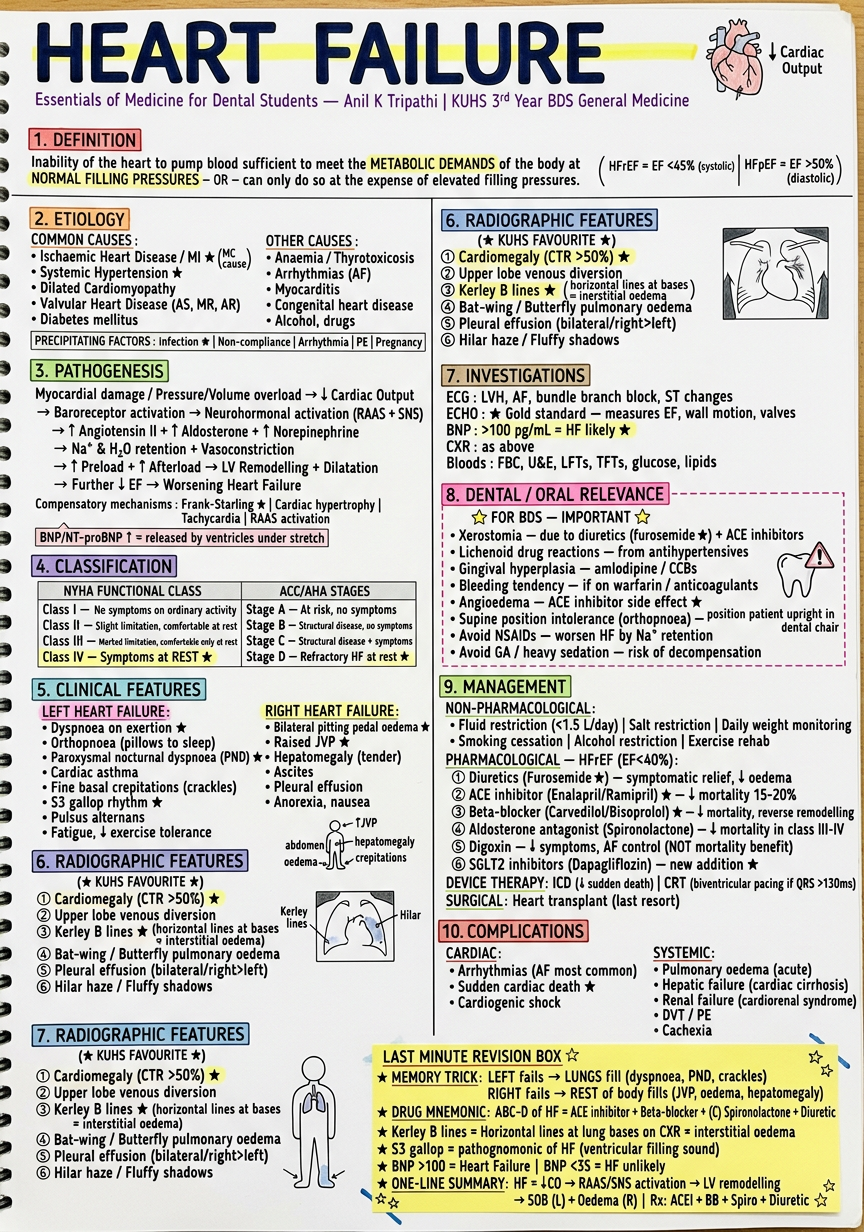
| Section | High-Yield Exam Points |
|---|---|
| Definition | Inability to meet metabolic demands at normal filling pressures; HFrEF (EF <45%) vs HFpEF (EF >50%) |
| Etiology | IHD/MI (MC cause ★), Hypertension, Cardiomyopathy, Valvular disease |
| Pathogenesis | ↓CO → RAAS + SNS activation → LV remodelling → worsening failure (Frank-Starling, BNP) |
| NYHA Classification | Class I-IV; ACC/AHA Stages A-D |
| Left HF Features | Dyspnoea, PND ★, Orthopnoea, S3 gallop, Crackles |
| Right HF Features | Pitting oedema ★, ↑JVP ★, Hepatomegaly, Ascites |
| CXR ★ KUHS Favourite | Cardiomegaly (CTR >50%), Kerley B lines ★, Bat-wing oedema, Pleural effusion |
| Dental Relevance ★ | Xerostomia (diuretics), Gingival hyperplasia (CCBs), Angioedema (ACEi), Avoid NSAIDs, Upright chair position |
| Management | Furosemide + ACEi + Beta-blocker + Spironolactone + Digoxin; SGLT2i (new) |
| Memory Trick | LEFT fails → LUNGS fill; RIGHT fails → REST of body fills |
Create a super aesthetic, handwritten-style revision note page for the topic: Hypothyroidism, Refer “Essentials of Medicine for Dental Students” by Anil K Tripathi. • Make it look like neat exam notes written on a page (top view, clean layout, colorful headings, underlines, boxes). For KUHS Thirrd Year BDS General Medicine Examination. • Keep it crisp, high-yield, and exam-oriented. • Use clear headings and organize content like this (modify if needed for topic): ○ Definition ○ Etiology ○ Pathogenesis (flow/arrow style) ○ Clinical features ○ Radiographic features (if applicable) ○ Histopathology (if applicable) ○ Key features ○ Differential diagnosis ○ Management ○ Complications ○ Key points / last-minute revision box • Add simple diagrams or labeled sketches wherever helpful. • Highlight important keywords. • Include one memory trick / one-line summary
A super aesthetic, handwritten-style A4 portrait medical revision note page for "HYPOTHYROIDISM" — KUHS Third Year BDS General Medicine exam notes. Looks exactly like a real student's ruled notebook paper viewed from the top: white paper with faint blue horizontal lines, warm cream background, multiple coloured ink pens, neat and dense but very organized. Professional student exam note aesthetic. TOP HEADER: - Large bold title "HYPOTHYROIDISM" in thick dark navy blue ink, underlined twice, bright yellow highlighter streak underneath it - Subtitle in small purple cursive: "Essentials of Medicine for Dental Students — Anil K Tripathi | KUHS 3rd Year BDS General Medicine" - Small hand-drawn butterfly thyroid gland sketch to the right, with a downward arrow labeled "↓ T3/T4" SECTION 1 — DEFINITION (coral-red heading, double underlined): Neat blue handwriting: "A HYPOMETABOLIC STATE (yellow highlight) resulting from insufficient circulating THYROID HORMONE (yellow highlight) to meet the body's metabolic requirements." "TSH >10 mIU/L (primary) | Normal/low TSH (secondary/central)" Two types noted: "Primary — thyroid gland failure | Secondary — pituitary failure | Tertiary — hypothalamic failure" SECTION 2 — ETIOLOGY (orange heading, underlined): Two neat columns: Left — "PRIMARY (MC = Hashimoto ★):" "• Hashimoto thyroiditis (CAT) ★ — MC cause in developed world (highlighted pink)" "• Iodine deficiency ★ — MC cause worldwide (highlighted yellow)" "• Post-thyroidectomy / Post-131I therapy" "• Antithyroid drugs (PTU, carbimazole)" "• Congenital (cretinism)" "• Subacute thyroiditis (transient)" Right — "SECONDARY/TERTIARY:" "• Pituitary failure (↓TSH)" "• Hypothalamic failure (↓TRH)" "• Drugs: lithium, amiodarone, interferon" Small note box: "RISK FACTORS: Female ★ | Age >40 | Family Hx | Other autoimmune disease (DM, vitiligo)" SECTION 3 — PATHOGENESIS (green heading, neat arrow flowchart): Main flow boxes connected with arrows: Box 1: "Autoimmune (Hashimoto) / Iodine ↓ / Surgery / Drugs" Arrow down to: Box 2: "Destruction/dysfunction of thyroid follicular cells → ↓ T3 and ↓ T4 synthesis" Arrow down to: Box 3: "↓ Negative feedback on pituitary → ↑ TSH (primary) → Thyroid stimulation → GOITRE (highlighted)" Arrow down to: Box 4: "↓ Thyroid hormones → ↓ Basal metabolic rate → HYPOMETABOLIC STATE" Side branch box: "Hashimoto mechanism: TPO-Ab + Tg-Ab → Lymphocytic infiltration → Progressive fibrosis → ↓ T4 production" Small label: "T3 = active form | T4 = storage form (converted peripherally)" SECTION 4 — CLINICAL FEATURES (teal heading, organized two columns): Header label: "SLOW DOWN everything! (highlighted pink)" Left column — "GENERAL / METABOLIC:" "• Weight gain (↓ BMR) ★" "• Cold intolerance ★" "• Fatigue, lethargy, weakness" "• Constipation" "• Bradycardia ★" "• Hypotension" "• Menorrhagia / infertility" "• Galactorrhoea (↑ prolactin)" Right column — "SKIN / FACE / NEUROLOGY:" "• Dry, coarse skin ★" "• Coarse, brittle hair + loss of outer 1/3 eyebrow ★ (highlighted yellow)" "• Periorbital/facial puffiness (myxoedema) ★" "• Hoarse voice ★" "• Slow speech, slow reflexes ★" "• Carpal tunnel syndrome" "• Memory impairment, depression" "• Non-pitting oedema (myxoedema)" "• Peaches-and-cream complexion" Small face sketch with labels: puffiness, thinning lateral eyebrow, coarse skin, goitre at neck SECTION 5 — ORAL / DENTAL MANIFESTATIONS (bright pink heading, dashed box around it): "⭐ BDS EXAM FAVOURITE ⭐" "• MACROGLOSSIA ★ (enlarged tongue — thick/scalloped edges) (highlighted yellow)" "• Hoarse voice / slow speech" "• Delayed tooth eruption (in children/cretinism)" "• Delayed wound healing" "• Dry mouth (xerostomia)" "• Thickened lips / perioral puffiness" "• Malocclusion in congenital hypothyroidism" "• Anaemia → pallor of oral mucosa" "• Drug interactions: avoid CNS depressants, NSAIDs (can worsen hypothyroid state)" "• Dental chair position: supine acceptable; ensure warm environment" Small tooth/tongue doodle with arrow to "MACROGLOSSIA ★" SECTION 6 — INVESTIGATIONS / DIAGNOSIS (dark blue heading): Neat small table: "TSH ↑↑ (>10 mIU/L) | PRIMARY hypothyroid — BEST SCREENING TEST ★ (highlighted)" "Free T4 ↓ | Confirms hypothyroid" "Free T3 ↓ (or normal) | Often reduced" "TPO Antibodies ↑ | Hashimoto's ★" "Thyroglobulin Ab ↑ | Hashimoto's" "Cholesterol ↑, LDL ↑, HDL ↓ | Atherogenic lipid profile" "Prolactin ↑ | ↓ T4 → ↑ TRH → ↑ Prolactin" "Normochromic normocytic anaemia" "ECG: Bradycardia, low voltage complexes, flat T-waves" "USG thyroid: ↓ echogenicity, inhomogeneity in Hashimoto" SECTION 7 — HISTOPATHOLOGY (brown/maroon heading): "HASHIMOTO THYROIDITIS:" "• Dense lymphocytic infiltrate + germinal centre formation ★" "• Hürthle cell (oxyphilic) change of follicular epithelium ★ (highlighted yellow)" "• Progressive fibrosis of thyroid stroma" "• Atrophied follicles with scant colloid" "PRIMARY ATROPHIC HYPOTHYROIDISM: Fibrotic replacement, few follicles" SECTION 8 — DIFFERENTIAL DIAGNOSIS (purple heading): "• Hypothyroidism vs Depression (both: lethargy, slow, weight gain — TSH normal in depression)" "• Nephrotic syndrome (oedema — but proteinuria +, thyroid normal)" "• Cushing's syndrome (weight gain — but central obesity, purple striae, ↑cortisol)" "• Anaemia alone (fatigue — TSH normal)" "• Euthyroid sick syndrome (low T3/T4 but normal TSH in systemic illness)" SECTION 9 — MANAGEMENT (green heading, clean stepwise): "PHARMACOLOGICAL:" "① L-THYROXINE (Levothyroxine) ★★ — DRUG OF CHOICE (highlighted yellow)" " Dose: 1.6 μg/kg/day | Start low (12.5–25 μg/day) in elderly + cardiac patients" " Monitor: TSH (4–6 weekly initially, then annually)" " Target TSH: 0.5–2.5 mIU/L" "② T4 + T3 combination — if T4-resistant (controversial)" "MYXOEDEMA COMA (emergency ★):" "• IV T3 (liothyronine) + IV hydrocortisone + Supportive care (warmth, O2, IV fluids)" "SUBCLINICAL HYPOTHYROIDISM (TSH 4–10, normal T4):" "• Treat if: symptoms + TPO-Ab+ + TSH >10 + pregnant" "CONGENITAL (Cretinism): Start L-thyroxine ASAP after birth ★" SECTION 10 — COMPLICATIONS (red heading, two neat columns): Left: "ACUTE:" "• Myxoedema coma ★ (hypothermia, bradycardia, ↓ consciousness, hypoventilation)" "• Precipitated by: infection, cold, trauma, sedatives" Right: "CHRONIC:" "• Ischaemic heart disease (↑ cholesterol) ★" "• Pericardial effusion" "• Infertility / menstrual irregularity" "• Hyperlipidaemia → Atherosclerosis" "• Goitre" "• Psychosis (myxoedema madness)" "• Cretinism (if congenital untreated) — mental retardation, short stature ★" BOTTOM — LAST MINUTE REVISION BOX (bright yellow sticky-note style, slightly tilted, with small stars): "★ MEMORY TRICK: SLOW is the theme — Slow HR, Slow reflexes, Slow bowel, Slow speech, Slow BMR → everything SLOWS DOWN" "★ Loss of outer 1/3 of eyebrow = PATHOGNOMONIC of hypothyroidism ★ (highlighted)" "★ Hürthle cell change = Hashimoto histology marker" "★ Drug of choice = L-THYROXINE (T4) — 1.6 μg/kg/day" "★ TPO-Ab = most sensitive marker of Hashimoto's" "★ Macroglossia = most important oral sign for BDS ★" "★ ONE-LINE SUMMARY: Hypothyroidism = ↓T3/T4 → SLOWED metabolism → weight gain + cold intolerance + bradycardia + myxoedema | Oral: MACROGLOSSIA ★ | Rx: L-Thyroxine" Overall aesthetic: warm cream ruled notebook paper, multiple ink colours (navy blue main text, red for starred/important points, purple for subheadings, orange for etiology, green for management, teal for clinical features, brown for histopathology), yellow + pink highlighter streaks on KEY terms, small hand-drawn butterfly thyroid doodle, face sketch showing myxoedema features, small tablet/pill doodle near treatment, neat arrow connectors, very clean professional dental student note style, A4 portrait layout
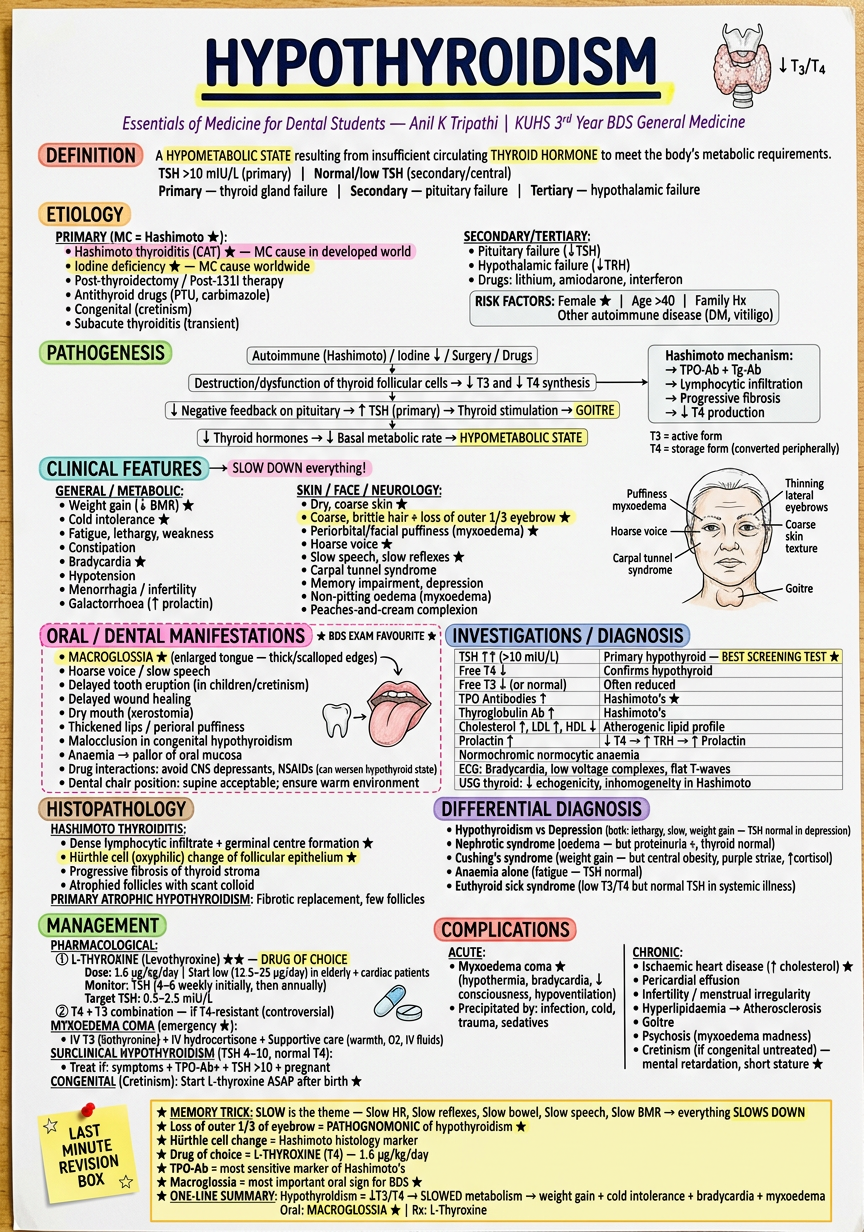
| Section | High-Yield Exam Points |
|---|---|
| Definition | Hypometabolic state from ↓ T3/T4; Primary (TSH ↑) vs Secondary (TSH normal/↓) |
| Etiology | Hashimoto's (MC in developed world ★) / Iodine deficiency (MC worldwide ★) |
| Pathogenesis | TPO-Ab → lymphocytic infiltration → fibrosis → ↓T4 → ↑TSH (feedback) → Goitre |
| Clinical Features | Everything SLOWS - bradycardia, constipation, cold intolerance, slow reflexes, weight gain |
| Classic Signs | Myxoedema face ★, Loss of outer 1/3 eyebrow ★, Hoarse voice, Non-pitting oedema |
| Oral Signs ★ BDS | MACROGLOSSIA ★ (most important), Delayed tooth eruption, Xerostomia, Hoarse speech |
| Diagnosis | TSH ↑ = best screening test ★; ↓FT4 confirms; TPO-Ab = Hashimoto's marker |
| Histopathology | Lymphocytic infiltrate + Hurthle cell change ★ + Progressive fibrosis |
| Management | L-Thyroxine 1.6 μg/kg/day ★ (Drug of Choice); IV T3 + hydrocortisone for myxoedema coma |
| Complications | Myxoedema coma (acute ★); IHD, pericardial effusion, cretinism (chronic) |
| Memory Trick | SLOW everything |
Create a super aesthetic, handwritten-style revision note page for the topic: Iron Deficiency Anemia, Refer “Essentials of Medicine for Dental Students” by Anil K Tripathi. • Make it look like neat exam notes written on a page (top view, clean layout, colorful headings, underlines, boxes). For KUHS Thirrd Year BDS General Medicine Examination. • Keep it crisp, high-yield, and exam-oriented. • Use clear headings and organize content like this (modify if needed for topic): ○ Definition ○ Etiology ○ Pathogenesis (flow/arrow style) ○ Clinical features ○ Radiographic features (if applicable) ○ Histopathology (if applicable) ○ Key features ○ Differential diagnosis ○ Management ○ Complications ○ Key points / last-minute revision box • Add simple diagrams or labeled sketches wherever helpful. • Highlight important keywords. • Include one memory trick / one-line summary
A super aesthetic, handwritten-style A4 portrait medical revision note page for "IRON DEFICIENCY ANAEMIA (IDA)" — KUHS Third Year BDS General Medicine exam notes. Looks exactly like a real student's ruled notebook page viewed from the top: white paper with faint blue horizontal lines, warm cream background, multiple coloured ink pens used, neat dense and organized layout. Professional dental student exam note aesthetic. TOP HEADER: - Large bold title "IRON DEFICIENCY ANAEMIA" in thick dark navy blue ink, underlined twice, bright yellow highlighter streak underneath - Below title: "IDA" in a red bubble/box - Subtitle in small purple cursive: "Essentials of Medicine for Dental Students — Anil K Tripathi | KUHS 3rd Year BDS General Medicine" - Small hand-drawn red blood cell (biconcave disc) sketch to the right, with a pale centre labelled "hypochromic" and another smaller cell labelled "microcytic" SECTION 1 — DEFINITION (coral-red heading, double underlined): Neat blue handwriting: "Anaemia resulting from INADEQUATE IRON (yellow highlight) for normal haemoglobin synthesis — the MOST COMMON NUTRITIONAL DEFICIENCY (yellow highlight) and MOST COMMON ANAEMIA worldwide." "Normal Hb: Males >13 g/dL | Females >12 g/dL | Children >11 g/dL" "MC type of anaemia = MICROCYTIC HYPOCHROMIC (highlighted pink)" SECTION 2 — ETIOLOGY (orange heading, underlined): Four neat sub-groups: "① BLOOD LOSS (MC cause in developed world ★):" " • GI: peptic ulcer ★, colon cancer, haemorrhoids, hookworm" " • Gynaecological: Menorrhagia ★, metrorrhagia" " • Other: epistaxis, haematuria, haemoptysis" "② INADEQUATE INTAKE:" " • Vegetarian/vegan diet (↓ haem iron)" " • Poverty / food insecurity" " • Infants fed exclusively milk" "③ INCREASED DEMAND (highlighted pink):" " • Pregnancy ★ | Infancy | Adolescence" "④ MALABSORPTION:" " • Coeliac disease ★ | Gastritis | Post-gastrectomy | Roux-en-Y bypass" " • Duodenum = site of iron absorption" SECTION 3 — PATHOGENESIS (green heading, neat sequential arrow flowchart): Flow boxes connected by downward arrows: Box 1: "Cause (blood loss / ↓ intake / ↑ demand / malabsorption)" ↓ Arrow: Box 2: "STAGE 1 — Depletion of iron STORES ↓ Serum Ferritin ↓ | Bone marrow iron absent" ↓ Arrow: Box 3: "STAGE 2 — ↓ Serum Iron + ↑ TIBC (Transferrin) + ↓ Transferrin Saturation <15%" ↓ Arrow: Box 4: "STAGE 3 — ↓ Hb synthesis → MICROCYTIC HYPOCHROMIC ANAEMIA (highlighted yellow)" Side note box: "Hepcidin role: ↑ Hepcidin (inflammation) → ↓ ferroportin → ↓ iron absorption (Anaemia of Chronic Disease)" Small iron absorption diagram: "Dietary Fe³⁺ → reduced to Fe²⁺ (duodenum) → DMT1 transporter → enterocyte → ferroportin → plasma → binds Transferrin" SECTION 4 — CLINICAL FEATURES (teal heading, two neat columns): Left column — "GENERAL ANAEMIA SYMPTOMS:" "• Fatigue / weakness / lethargy ★" "• Pallor (skin, conjunctiva, nails, palms) ★" "• Dyspnoea on exertion" "• Palpitations / tachycardia" "• Headache, poor concentration" "• Dizziness / syncope" Right column — "SPECIFIC TO IDA (highlighted yellow):" "• Koilonychia (spoon-shaped nails) ★★" "• PICA (craving non-food — dirt, clay, ice) ★" "• Brittle hair and nails" "• Angular stomatitis / cheilitis ★" "• Atrophic glossitis (smooth, sore tongue) ★" "• Post-cricoid dysphagia (Plummer-Vinson) ★" "• Blue sclerae (in chronic IDA)" "• Oesophageal web (Patterson-Kelly)" Small finger sketch labelled "Koilonychia" showing spoon-shaped nail SECTION 5 — ORAL / DENTAL MANIFESTATIONS (bright pink heading, dashed box around it): "⭐ BDS EXAM FAVOURITE — HIGH YIELD ⭐" "• ATROPHIC GLOSSITIS ★★ — smooth, beefy red, depapillated tongue (highlighted yellow)" "• ANGULAR CHEILITIS / STOMATITIS ★ — cracking at corners of mouth" "• Pallor of oral mucosa ★" "• Aphthous ulcers (recurrent)" "• PLUMMER-VINSON SYNDROME ★★: Triad = IDA + dysphagia + oesophageal web → pre-malignant (highlighted pink)" "• Burning mouth sensation" "• Oral candidiasis (due to compromised immunity)" "• ↑ Susceptibility to oral infections" "• Post-extraction bleeding may be prolonged (severe anaemia)" Small tongue sketch labelled: "Smooth depapillated surface = Atrophic Glossitis" with dotted line to "Glossitis = IDA ★" SECTION 6 — INVESTIGATIONS / DIAGNOSIS (dark blue heading): Neat table with 3 columns — TEST | IDA | ANAEMIA OF CHRONIC DISEASE: "Hb | ↓ | ↓" "MCV | ↓ <80 fL (microcytic ★) | ↓ or normal" "MCH | ↓ <27 pg (hypochromic ★) | ↓ or normal" "Serum Iron | ↓↓ | ↓" "TIBC | ↑↑ (highlighted) | ↓ or normal" "Transferrin Sat | ↓ <15% ★ | ↓" "Serum Ferritin | ↓↓ <15 ng/mL ★★ (highlighted yellow) | ↑ or normal" "Serum Ferritin <15 ng/mL = most specific test for IDA ★" Below: "PERIPHERAL SMEAR ★: Microcytic hypochromic RBCs + Anisocytosis + Poikilocytosis + Pencil cells ★ + Target cells" "BONE MARROW: Absent stainable iron (Prussian blue -ve)" "Platelets: often ↑ (reactive thrombocytosis)" SECTION 7 — HISTOPATHOLOGY / PERIPHERAL SMEAR (brown heading): "Peripheral blood film features:" "• ↓ Cell size (microcytic) ★" "• ↑ Central pallor (hypochromic) — pallor >1/3 of cell diameter ★" "• Pencil (cigar-shaped) cells ★ (highlighted)" "• Elliptocytes, target cells" "• Anisocytosis + Poikilocytosis" "• RDW ↑ (increased variation in size)" Small sketch of RBC on smear showing large central pallor area labelled "Hypochromic microcytic cell" SECTION 8 — DIFFERENTIAL DIAGNOSIS (purple heading): Three-row comparison mini-table: "IDA: ↓Fe, ↑TIBC, ↓Ferritin, microcytic hypochromic" "Thalassaemia: normal Fe, normal TIBC, ↑Ferritin, microcytic BUT normochromic, target cells ★" "Anaemia of Chronic Disease: ↓Fe, ↓TIBC, ↑Ferritin (key difference ★)" "Sideroblastic: ↑Fe, ↑Ferritin, ring sideroblasts in marrow" SECTION 9 — MANAGEMENT (green heading, stepwise): "STEP 1 — IDENTIFY AND TREAT UNDERLYING CAUSE ★ (highlighted pink)" "STEP 2 — ORAL IRON SUPPLEMENTATION (first line ★):" " • Ferrous sulphate 200 mg TDS (elemental Fe 65 mg/tablet)" " • Take with Vitamin C (ascorbic acid) — ↑ absorption ★" " • Avoid with tea, coffee, antacids — ↓ absorption" " • Continue 3–6 months after Hb normalises (replenish stores) ★" " • Side effects: constipation, dark stools, nausea" "STEP 3 — PARENTERAL IRON (IV/IM) if:" " • Malabsorption | Intolerance to oral | Non-compliance | Rapid correction needed" " • IV iron sucrose / ferric carboxymaltose (preferred)" "STEP 4 — BLOOD TRANSFUSION: Only if severe symptomatic anaemia / haemodynamic compromise" "DIETARY: Red meat, legumes, leafy greens, fortified cereals" SECTION 10 — COMPLICATIONS (red heading, two columns): Left: "IF UNTREATED:" "• Severe anaemia → cardiac failure (high-output failure)" "• Plummer-Vinson → oesophageal carcinoma ★" "• Impaired immune function → recurrent infections" "• Poor cognitive development (children)" "• Intrauterine growth retardation (pregnancy)" Right: "TREATMENT COMPLICATIONS:" "• GI side effects of oral iron" "• Haemosiderosis (over-supplementation)" "• Anaphylaxis (IV iron — rare)" BOTTOM — LAST MINUTE REVISION BOX (bright yellow sticky note, slightly tilted, star decorations): "★ MEMORY TRICK: PACKING a KOILA = Pallor + Angular cheilitis + Koilonychia + IDA → also causes PICA + Atrophic glossitis" "★ PLUMMER-VINSON TRIAD = IDA + Dysphagia + Oesophageal web ★ → pre-malignant (SCC oesophagus)" "★ BEST TEST = Serum Ferritin <15 ng/mL (↓ = IDA; ↑ = chronic disease)" "★ Ferritin is acute phase reactant — can be falsely normal in IDA + inflammation" "★ Peripheral smear: PENCIL CELLS ★ = pathognomonic of IDA" "★ Key Oral Sign = ATROPHIC GLOSSITIS (smooth red tongue) ★" "★ ONE-LINE SUMMARY: IDA = ↓ iron → ↓ Hb → microcytic hypochromic anaemia | Oral signs = Glossitis + Angular cheilitis + Plummer-Vinson ★ | Rx: Ferrous sulphate + treat cause" Overall aesthetic: warm cream ruled notebook paper, multiple ink colours (navy blue main text, red for starred highlights, orange for etiology, green for management, teal for clinical features, brown/maroon for histopathology, purple for differential), yellow + pink highlighter streaks on critical terms, small hand-drawn doodles: biconcave RBC, koilonychia nail, tongue sketch, small iron tablet, neat connecting arrows, professional dental student note style, A4 portrait layout
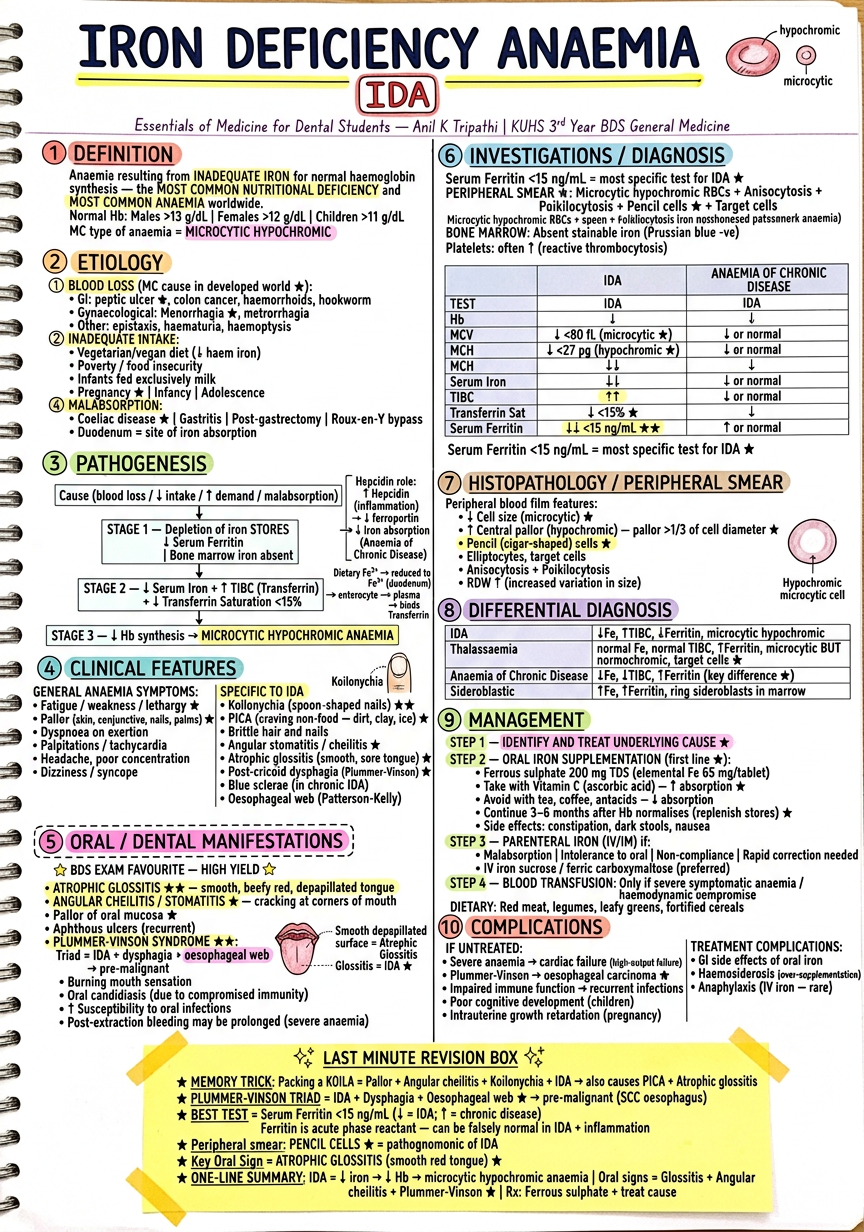
| Section | High-Yield Exam Points |
|---|---|
| Definition | MC nutritional deficiency + MC anaemia worldwide; microcytic hypochromic |
| Etiology | Blood loss (MC in developed world: GI ★ / Menorrhagia ★); Malabsorption (Coeliac ★); Increased demand (Pregnancy ★) |
| Pathogenesis | 3 Stages: ↓Ferritin → ↓Fe/↑TIBC → ↓Hb synthesis |
| Specific Features | Koilonychia ★★, PICA ★, Angular cheilitis, Atrophic glossitis |
| Oral Signs ★ BDS | Atrophic Glossitis ★★ (smooth red tongue), Angular Cheilitis ★, Plummer-Vinson Syndrome ★★ |
| Plummer-Vinson ★★ | IDA + Dysphagia + Oesophageal web = pre-malignant (→ SCC oesophagus) |
| Best Diagnostic Test | Serum Ferritin <15 ng/mL ★★ |
| Peripheral Smear | Microcytic hypochromic + Pencil cells ★ + Anisocytosis |
| IDA vs ACD | IDA: ↑TIBC + ↓Ferritin vs Chronic Disease: ↓TIBC + ↑Ferritin |
| Management | Ferrous sulphate TDS + Vitamin C ★; continue 3-6 months after Hb normalises |
| Memory Trick | PACKING a KOILA: Pallor + Angular cheilitis + Koilonychia + IDA + Glossitis + Atrophic |
Create a super aesthetic, handwritten-style revision note page for the topic: Mitral Regurgitaion, Refer “Essentials of Medicine for Dental Students” by Anil K Tripathi. • Make it look like neat exam notes written on a page (top view, clean layout, colorful headings, underlines, boxes). For KUHS Thirrd Year BDS General Medicine Examination. • Keep it crisp, high-yield, and exam-oriented. • Use clear headings and organize content like this (modify if needed for topic): ○ Definition ○ Etiology ○ Pathogenesis (flow/arrow style) ○ Clinical features ○ Radiographic features (if applicable) ○ Histopathology (if applicable) ○ Key features ○ Differential diagnosis ○ Management ○ Complications ○ Key points / last-minute revision box • Add simple diagrams or labeled sketches wherever helpful. • Highlight important keywords. • Include one memory trick / one-line summary
A super aesthetic, handwritten-style A4 portrait medical revision note page for "MITRAL REGURGITATION (MR)" — KUHS Third Year BDS General Medicine exam notes. Looks exactly like a real student's ruled notebook page viewed from the top: white paper with faint blue horizontal lines, warm cream background, multiple coloured ink pens used, neat and organized. Professional dental student exam note aesthetic. TOP HEADER: - Large bold title "MITRAL REGURGITATION" in thick dark navy blue ink, underlined twice, bright yellow highlighter underneath - "MR" in a bright red circle/badge next to the title - Subtitle in small purple cursive: "Essentials of Medicine for Dental Students — Anil K Tripathi | KUHS 3rd Year BDS General Medicine" - Small hand-drawn heart sketch to the right with arrows showing backflow from LV into LA through mitral valve, labelled "Regurgitant flow ★" SECTION 1 — DEFINITION (coral-red heading, double underlined): Neat blue handwriting: "Incompetence of the MITRAL VALVE (highlighted yellow) allowing RETROGRADE FLOW of blood from the LEFT VENTRICLE into the LEFT ATRIUM (highlighted yellow) during systole — causing VOLUME OVERLOAD (highlighted pink) of the LV and LA." "MV components: 2 leaflets (anterior ★ larger + posterior), chordae tendineae, papillary muscles, mitral annulus" SECTION 2 — ETIOLOGY (orange heading, underlined): Two neat columns: Left — "CHRONIC MR (MC):" "• Mitral Valve Prolapse (MVP) ★ — MC cause in developed world (myxomatous degeneration) (highlighted pink)" "• Rheumatic Heart Disease ★ — MC cause in developing countries" "• Infective Endocarditis" "• Dilated cardiomyopathy (functional MR)" "• Mitral annular calcification (elderly)" "• Connective tissue disorders (Marfan's, Ehlers-Danlos)" Right — "ACUTE MR (Emergency ★):" "• Rupture of chordae tendineae ★" "• Papillary muscle rupture (post-MI) ★" "• Infective endocarditis (leaflet perforation)" "• Trauma" Small note box: "Mitral Valve = MOST COMMONLY AFFECTED valve in rheumatic fever ★" SECTION 3 — PATHOGENESIS (green heading, neat 3-phase flowchart boxes with arrows): Title label: "3 PHASES OF MR:" Left column Phase 1 — small box "ACUTE MR:" "Sudden ↑ regurgitant volume → ↑ LA pressure (sudden) → Pulmonary oedema + ↓ Forward CO → Haemodynamic emergency" Middle column Phase 2 — "CHRONIC COMPENSATED MR:" "LV dilates (eccentric hypertrophy) → ↑ EDV + ↑ total stroke volume → LA enlarges to accommodate volume → Asymptomatic (may last years)" Right column Phase 3 — "CHRONIC DECOMPENSATED MR:" "LV contractile dysfunction → ↑ ESV → ↓ EF → ↑ LA pressure → Pulmonary hypertension → Heart failure symptoms" Bottom note: "Volume overload → Frank-Starling mechanism (initially compensates) → Eventually overwhelmed → LV dysfunction ★" SECTION 4 — CLINICAL FEATURES (teal heading, two neat columns): Left column — "SYMPTOMS:" "• Asymptomatic for years (chronic compensated) ★" "• Dyspnoea on exertion ★" "• Orthopnoea / PND" "• Fatigue / reduced exercise tolerance" "• Palpitations (AF common) ★" "• Haemoptysis (if pulmonary HTN)" Right column — "SIGNS (highlighted yellow):" "• PANSYSTOLIC MURMUR ★★ at APEX (highlighted)" "• Radiates to LEFT AXILLA ★ (pathognomonic)" "• Best heard: left lateral decubitus + expiration" "• ↓ S1 (soft) ★" "• S3 gallop (severe MR) ★" "• Laterally displaced apex beat (LV enlargement)" "• Thrusting / heaving apex" "• Atrial fibrillation (common) ★" "• Signs of pulmonary HTN: loud P2, RV heave" Small heart auscultation sketch: chest outline with "PSM" marked at apex area, arrow pointing to left axilla labelled "Radiation ★" SECTION 5 — RADIOGRAPHIC FEATURES (dark blue heading, boxed): "CHEST X-RAY FINDINGS:" "• Cardiomegaly (LV + LA enlargement) ★ (highlighted yellow)" "• Prominent left heart border (LA enlargement)" "• Double shadow at right heart border (LA enlargement) ★" "• Upper lobe venous diversion / pulmonary oedema (decompensated)" "• Splaying of carina >70° (LA enlargement) ★" "ECG:" "• P mitrale (broad notched P wave in V1) = LA enlargement ★ (highlighted)" "• LVH (tall R waves in V5/V6)" "• Atrial fibrillation (absent P waves) — common" "• Left axis deviation" "ECHOCARDIOGRAPHY (Gold Standard ★):" "• Colour-flow Doppler — shows regurgitant jet into LA ★" "• LV/LA dimensions + EF measured" "• Identifies leaflet pathology (prolapse, vegetation, ruptured chordae)" "• 3D echo: aids in surgical planning" SECTION 6 — DENTAL / ORAL RELEVANCE (bright pink heading, dashed box): "⭐ BDS EXAM — HIGH YIELD ⭐" "• Antibiotic prophylaxis: Previously recommended; now ONLY for HIGH-RISK patients ★" " High risk = Prosthetic valve | Previous IE | Cyanotic CHD" " Routine MR alone = NOT an indication for antibiotic prophylaxis (AHA 2007 guidelines ★) (highlighted yellow)" "• INFECTIVE ENDOCARDITIS RISK ★ — especially if MVP with regurgitation" "• Xerostomia — from diuretics/antihypertensives used in management" "• Anticoagulation (if in AF) — ↑ bleeding risk during dental procedures ★" " Check INR before procedures | Target INR 2–3" "• Digoxin toxicity → oral symptoms (nausea, yellow vision — inform dentist)" "• Dental chair: Avoid fully supine if in heart failure (prop up 45°)" "• Emergency procedures only if MR is decompensated" Small tooth icon with warning: "Check AF + anticoagulation before extractions ★" SECTION 7 — DIFFERENTIAL DIAGNOSIS (purple heading): Neat comparison: "Aortic Stenosis: Ejection systolic murmur (NOT pansystolic), radiates to carotids, loudest at aortic area" "Tricuspid Regurgitation: Pansystolic BUT at left sternal border, increases with inspiration (Carvallo's sign)" "VSD: Pansystolic BUT harsh, loudest at left sternal edge" "Mitral Stenosis: Mid-diastolic rumble (NOT systolic), opening snap, loud S1" Key box: "MR murmur = PANSYSTOLIC + APEX + LEFT AXILLA radiation ★★" SECTION 8 — INVESTIGATIONS (brown heading): "Echo (TOE if needed): ★ GOLD STANDARD" "CXR: cardiomegaly, LA enlargement" "ECG: P mitrale, LVH, AF" "Cardiac MRI: accurate regurgitant volume quantification" "Cardiac catheterisation: coronary artery assessment pre-surgery" "BNP: ↑ in decompensated MR" SECTION 9 — MANAGEMENT (green heading, stepwise): "MEDICAL MANAGEMENT (Symptomatic relief):" "• ACE inhibitors / ARBs — ↓ afterload ★" "• Diuretics — ↓ pulmonary congestion" "• Beta-blockers — rate control if AF" "• Anticoagulation (warfarin) — if AF (INR 2–3)" "• Digoxin — rate control in AF" "• NO long-term vasodilators in asymptomatic chronic MR with normal EF (highlighted)" "SURGICAL MANAGEMENT (Definitive ★):" "• MITRAL VALVE REPAIR ★★ — PREFERRED (better outcomes, no lifelong anticoagulation) (highlighted yellow)" " → Annuloplasty ring + leaflet reconstruction" "• MITRAL VALVE REPLACEMENT — if repair not feasible" " → Mechanical (lifelong warfarin) OR Bioprosthetic (no anticoag, but less durable)" "INDICATIONS FOR SURGERY:" "• Symptomatic severe MR ★" "• Asymptomatic severe MR + EF 30–60% OR LVESD >40mm" "• New onset AF / Pulmonary HTN" "PERCUTANEOUS: MitraClip (edge-to-edge repair) — high surgical risk patients" SECTION 10 — COMPLICATIONS (red heading): Two columns: Left: "CARDIAC:" "• Atrial Fibrillation (MC complication ★) (highlighted)" "• LV dysfunction / Heart failure" "• Pulmonary hypertension → RV failure" "• Infective Endocarditis ★" Right: "SYSTEMIC:" "• Systemic emboli (if AF + no anticoag)" "• Stroke ★" "• Pulmonary oedema (acute MR)" "• Sudden cardiac death (rare)" BOTTOM — LAST MINUTE REVISION BOX (bright yellow sticky note, slightly tilted, stars): "★ MEMORY TRICK: MR = MAPS — Murmur (Pansystolic) + Apex + Propagates to axilla + Soft S1" "★ MR murmur = PANSYSTOLIC ★ | Apex → Left Axilla ★ | ↓ S1 + S3" "★ MC cause: MVP (developed) | Rheumatic (developing) ★" "★ Echo = Gold Standard | P mitrale on ECG = LA enlargement" "★ Valve repair > Valve replacement ★" "★ Antibiotic prophylaxis NOT routinely needed for MR alone (AHA 2007) ★" "★ ONE-LINE SUMMARY: MR = incompetent mitral valve → systolic backflow LV→LA → Volume overload → LV/LA dilation → PSM at apex radiating to axilla | Complications: AF ★, HF, IE | Rx: Repair > Replace" Overall aesthetic: warm cream notebook paper with blue ruled lines, multiple ink colours (navy blue main text, coral-red for headings, orange for etiology, green for management/pathogenesis, teal for clinical features, dark blue for investigations/CXR, brown for histopathology/investigations, purple for differentials), yellow and pink highlighter streaks on KEY phrases, small hand-drawn heart with backflow arrows, chest auscultation sketch, neat connecting boxes and arrows, professional dental student note style, A4 portrait layout
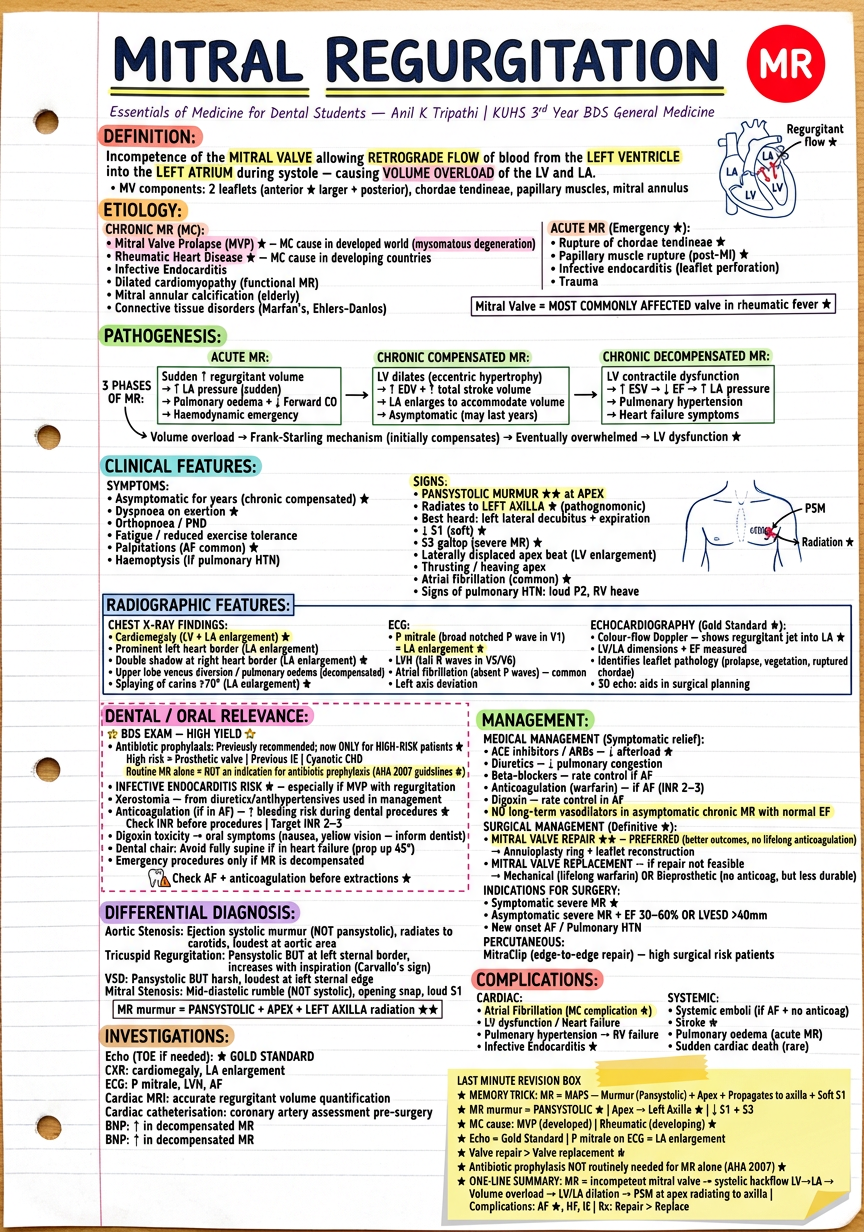
| Section | High-Yield Exam Points |
|---|---|
| Definition | Retrograde flow LV → LA during systole → volume overload of LV + LA |
| Etiology | MVP ★ (MC in developed world) / Rheumatic ★ (MC in developing) / Acute: Ruptured chordae + Post-MI papillary muscle rupture |
| 3 Phases | Acute (emergency) → Chronic Compensated (asymptomatic) → Chronic Decompensated (HF) |
| Murmur ★★ | PANSYSTOLIC at APEX radiating to LEFT AXILLA + Soft S1 + S3 |
| ECG | P mitrale (broad notched P) = LA enlargement ★; LVH; AF |
| CXR | Cardiomegaly + LA enlargement (double shadow right border + splayed carina >70°) ★ |
| Echo | Gold standard - colour Doppler shows regurgitant jet ★ |
| Dental ★★ BDS | Antibiotic prophylaxis NOT routine for MR alone (AHA 2007) ★; Check INR if on warfarin; AF = ↑ bleeding risk |
| Management | Medical: ACEi + Diuretics + AF control; Surgery: Repair > Replace ★★ |
| Complications | AF (MC ★), Heart failure, IE, Stroke (if AF) |
| Memory Trick | MAPS = Murmur (Pansystolic) + Apex + Propagates to axilla + Soft S1 |
Create a super aesthetic, handwritten-style revision note page for the topic: Liver Cirrhosis, Refer “Essentials of Medicine for Dental Students” by Anil K Tripathi. • Make it look like neat exam notes written on a page (top view, clean layout, colorful headings, underlines, boxes). For KUHS Thirrd Year BDS General Medicine Examination. • Keep it crisp, high-yield, and exam-oriented. • Use clear headings and organize content like this (modify if needed for topic): ○ Definition ○ Etiology ○ Pathogenesis (flow/arrow style) ○ Clinical features ○ Radiographic features (if applicable) ○ Histopathology (if applicable) ○ Key features ○ Differential diagnosis ○ Management ○ Complications ○ Key points / last-minute revision box • Add simple diagrams or labeled sketches wherever helpful. • Highlight important keywords. • Include one memory trick / one-line summary
A super aesthetic, handwritten-style A4 portrait medical revision note page for "LIVER CIRRHOSIS" — KUHS Third Year BDS General Medicine exam notes. Looks exactly like a real student's ruled notebook page viewed from the top: white paper with faint blue horizontal lines, warm cream background, multiple coloured ink pens, neat and organized. Dense, exam-oriented, professional dental student aesthetic. TOP HEADER: - Large bold title "LIVER CIRRHOSIS" in thick dark navy blue ink, underlined twice, bright yellow highlighter streak underneath - Subtitle in small purple cursive: "Essentials of Medicine for Dental Students — Anil K Tripathi | KUHS 3rd Year BDS General Medicine" - Small hand-drawn liver sketch to the right with nodular bumpy surface labelled "Regenerative nodules ★" and a downward arrow "→ Portal HTN" SECTION 1 — DEFINITION (coral-red heading, double underlined): Neat blue handwriting: "END-STAGE CHRONIC LIVER DISEASE (highlighted yellow) characterized by DIFFUSE HEPATIC FIBROSIS (highlighted yellow) + REGENERATIVE NODULES (highlighted yellow) → disruption of normal hepatic architecture → liver dysfunction + portal hypertension." "Two stages: COMPENSATED (asymptomatic) | DECOMPENSATED ★ (ascites, varices, encephalopathy, jaundice)" SECTION 2 — ETIOLOGY (orange heading, underlined): Two neat columns: Left — "COMMON CAUSES:" "• Alcoholic liver disease ★ (MC in Western world)" "• Viral hepatitis B ★ (MC worldwide)" "• Viral hepatitis C ★" "• Non-alcoholic fatty liver disease (NAFLD) ★" Right — "OTHER CAUSES:" "• Autoimmune hepatitis" "• Primary biliary cirrhosis (PBC)" "• Primary sclerosing cholangitis (PSC)" "• Haemochromatosis ★ (iron overload)" "• Wilson's disease ★ (copper overload)" "• Alpha-1 antitrypsin deficiency" "• Budd-Chiari syndrome (hepatic vein thrombosis)" "• Drugs/toxins (methotrexate, amiodarone)" "• Cardiac: Right heart failure (cardiac cirrhosis)" Small note box: "CRYPTOGENIC = no identifiable cause (~10%)" SECTION 3 — PATHOGENESIS (green heading, neat flowchart with arrows): "CHRONIC LIVER INJURY (any cause)" "↓" "Hepatocyte necrosis/apoptosis → Inflammation" "↓" "ACTIVATION OF HEPATIC STELLATE CELLS (Ito cells) ★ (highlighted pink)" "↓" "Stellate cells → lose Vit A → become myofibroblasts → secrete COLLAGEN (Type I & III) ★" "↓" "DIFFUSE FIBROSIS + REGENERATIVE NODULES → Disrupted lobular architecture" "↓" "Two major consequences (highlighted yellow):" Box 1: "PORTAL HYPERTENSION ★ → Varices, Ascites, Splenomegaly" Box 2: "LIVER INSUFFICIENCY ★ → Jaundice, Coagulopathy, Encephalopathy" Side note: "Capillarisation of sinusoids — loss of fenestrae → ↓ exchange between plasma and hepatocytes" SECTION 4 — CLINICAL FEATURES (teal heading, two neat columns): Left column — "SYMPTOMS:" "• Fatigue, anorexia, weight loss" "• Abdominal distension (ascites) ★" "• Leg swelling" "• Haematemesis (variceal bleed) ★" "• Jaundice ★" "• Confusion (encephalopathy)" "• Easy bruising / bleeding ★" Right column — "SIGNS — organized by system:" "HANDS: Leukonychia (white nails), Clubbing, Dupuytren's contracture, Palmar erythema ★, Flapping tremor (asterixis ★)" "FACE: Jaundice, Parotid enlargement, Fetor hepaticus (sweet-musty breath) ★" "CHEST: Spider naevi (>5 = significant) ★★, Gynaecomastia ★, Loss of body hair" "ABDOMEN: Hepatomegaly (early) / Small liver (late ★), Splenomegaly, Ascites (shifting dullness/fluid thrill), Caput medusae ★ (dilated periumbilical veins)" "LEGS: Pitting oedema" Small body sketch: stick figure outline with labels — spider naevi on chest, caput medusae at umbilicus, ascites, splenomegaly, palmar erythema on hands SECTION 5 — HISTOPATHOLOGY (brown/maroon heading): "GROSS: Shrunken, nodular, firm liver — Orange-tawny colour ★" "MICROSCOPIC (highlighted yellow):" "• Diffuse FIBROSIS ★★ (collagen Type I + III)" "• REGENERATIVE NODULES ★★ (surrounded by fibrous bands)" "• Micronodular (<3mm): alcoholic cirrhosis ★ (highlighted)" "• Macronodular (>3mm): viral hepatitis ★ (highlighted)" "• Mixed nodular pattern" "• Stellate cell activation + myofibroblast transformation" "• Disrupted lobular architecture — loss of central vein/portal triad relationships" "• Inflammatory infiltrate (lymphocytes)" "Stains: Masson's Trichrome ★ (highlights fibrosis — blue) | Reticulin stain" SECTION 6 — INVESTIGATIONS / IMAGING (dark blue heading): "BLOOD TESTS:" "• LFTs: ↑ Bilirubin, ↓ Albumin ★, ↑ ALP, ↑ AST/ALT" "• Coagulation: ↑ PT/INR ★ (↓ clotting factors)" "• FBC: Pancytopenia (hypersplenism) ★" "• Serum albumin ↓ = best marker of synthetic function ★ (highlighted)" "• AFP ↑ → suspect HCC" "IMAGING:" "• USG abdomen: ★ First-line — coarse liver echotexture, nodularity, splenomegaly, ascites" "• CT abdomen: nodular liver, portal hypertension features" "• Fibroscan (elastography): liver stiffness — non-invasive fibrosis assessment" "• OGD (endoscopy): oesophageal varices ★" "SCORING SYSTEMS: Child-Pugh score ★ (Bilirubin, Albumin, PT, Ascites, Encephalopathy) | MELD score (for transplant listing)" SECTION 7 — DENTAL / ORAL RELEVANCE (bright pink heading, dashed box): "⭐ BDS EXAM — VERY IMPORTANT ⭐" "• BLEEDING TENDENCY ★★ — ↓ clotting factors (liver unable to synthesise) + thrombocytopenia (hypersplenism) (highlighted yellow)" " → Check PT/INR before dental procedures ★" " → Avoid extractions if INR >2.5 without haematology advice" "• JAUNDICE — yellowing of sclera + oral mucosa ★" "• PAROTID ENLARGEMENT (bilateral sialosis) ★ — seen in alcoholic cirrhosis" "• FETOR HEPATICUS — sweet/musty breath from mercaptans ★" "• DRUG METABOLISM IMPAIRED — avoid hepatotoxic drugs (paracetamol ★, NSAIDs, certain antibiotics)" "• ORAL INFECTIONS ↑ — compromised immunity" "• Anaemia → pallor of oral mucosa" "• Xerostomia possible (especially with diuretic therapy)" "• Avoid GA in decompensated cirrhosis" Small tooth icon with warning: "Always check INR + Platelet count before dental surgery ★★" SECTION 8 — DIFFERENTIAL DIAGNOSIS (purple heading): "Chronic hepatitis (no regenerative nodules yet — early stage)" "Cardiac failure / congestive hepatopathy (raised JVP + right HF signs)" "Malignancy — hepatocellular carcinoma (AFP ↑, mass on imaging)" "Primary biliary cholangitis (AMA +ve, pruritus, females)" "Wilson's disease (young patient, Kayser-Fleischer rings ★)" "Haemochromatosis (diabetes + skin pigmentation + cirrhosis = 'bronze diabetes' ★)" SECTION 9 — MANAGEMENT (green heading, stepwise): "GENERAL:" "• Treat underlying cause (abstinence from alcohol ★, antivirals for HBV/HCV)" "• Nutrition: high protein (unless encephalopathy), vitamin supplements" "• Avoid hepatotoxic drugs ★" "ASCITES:" "• Na restriction (2000 mg/day) + Diuretics: Spironolactone 100 mg ★ (first-line) + Furosemide 40 mg" "• Therapeutic paracentesis + albumin infusion (large volume)" "• TIPS (transjugular intrahepatic portosystemic shunt) — refractory ascites" "VARICES:" "• Non-selective beta-blockers (propranolol) — prophylaxis ★" "• Endoscopic band ligation (EBL) — acute bleed treatment ★" "• Terlipressin (vasoconstrictor) — acute variceal bleed" "ENCEPHALOPATHY:" "• Lactulose ★ (↓ NH3 production) | Rifaximin (antibiotic)" "• Low protein diet (acute episodes)" "SBP: IV Ceftriaxone/Cefotaxime + Albumin infusion ★" "HEPATOCELLULAR CARCINOMA SURVEILLANCE: 6-monthly AFP + USG ★" "LIVER TRANSPLANT: Definitive treatment for end-stage disease ★ (highlighted yellow)" SECTION 10 — COMPLICATIONS (red heading): Two columns: Left: "FROM PORTAL HYPERTENSION:" "• Oesophageal/gastric varices → HAEMATEMESIS ★★" "• Ascites ★" "• Spontaneous Bacterial Peritonitis (SBP) ★" "• Hepatorenal syndrome ★ (functional renal failure)" "• Splenomegaly → hypersplenism → pancytopenia" Right: "FROM LIVER INSUFFICIENCY:" "• Jaundice ★" "• Coagulopathy → bleeding ★" "• Hepatic Encephalopathy ★ (flapping tremor, confusion)" "• Hypoalbuminaemia → oedema" "• Hepatocellular Carcinoma (HCC) ★ (5-10% per year)" "• Hepatopulmonary syndrome" BOTTOM — LAST MINUTE REVISION BOX (bright yellow sticky note, slightly tilted, small stars): "★ MEMORY TRICK: SAFe JE = Stellate cell Activation → Fibrosis → portal hypertension → (J)aundice + (E)ncephalopathy + varices + Ascites" "★ MACRO vs MICRO nodules: Macro = Viral ★ | Micro = Alcohol ★" "★ Child-Pugh = BAT PE: Bilirubin, Albumin, Time (PT), ascites (Peritoneal), Encephalopathy" "★ Serum albumin ↓ = BEST marker of liver synthetic function ★" "★ Spider naevi >5 = clinically significant" "★ Fetor hepaticus = sweet musty breath ★ (UNIQUE to liver disease)" "★ KEY ORAL SIGN: Parotid enlargement (alcoholic cirrhosis) + Bleeding tendency (↓ PT) ★★" "★ ONE-LINE SUMMARY: Cirrhosis = chronic liver injury → stellate cell activation → fibrosis + regenerative nodules → portal HTN (varices, ascites) + liver failure (jaundice, coagulopathy, encephalopathy) | Oral: Bleeding ★★ + Parotid enlargement" Overall aesthetic: warm cream notebook paper with blue ruled lines, multiple ink colours (navy blue main text, coral-red for headings, orange for etiology, green for management/pathogenesis, teal for clinical features, dark blue for investigations, brown for histopathology, purple for differentials), bright yellow and pink highlighter streaks on key terms, small hand-drawn liver with nodules, stick figure with labelled signs, neat connecting arrows and boxes, professional dental student note style, A4 portrait layout, all content fits neatly on one page
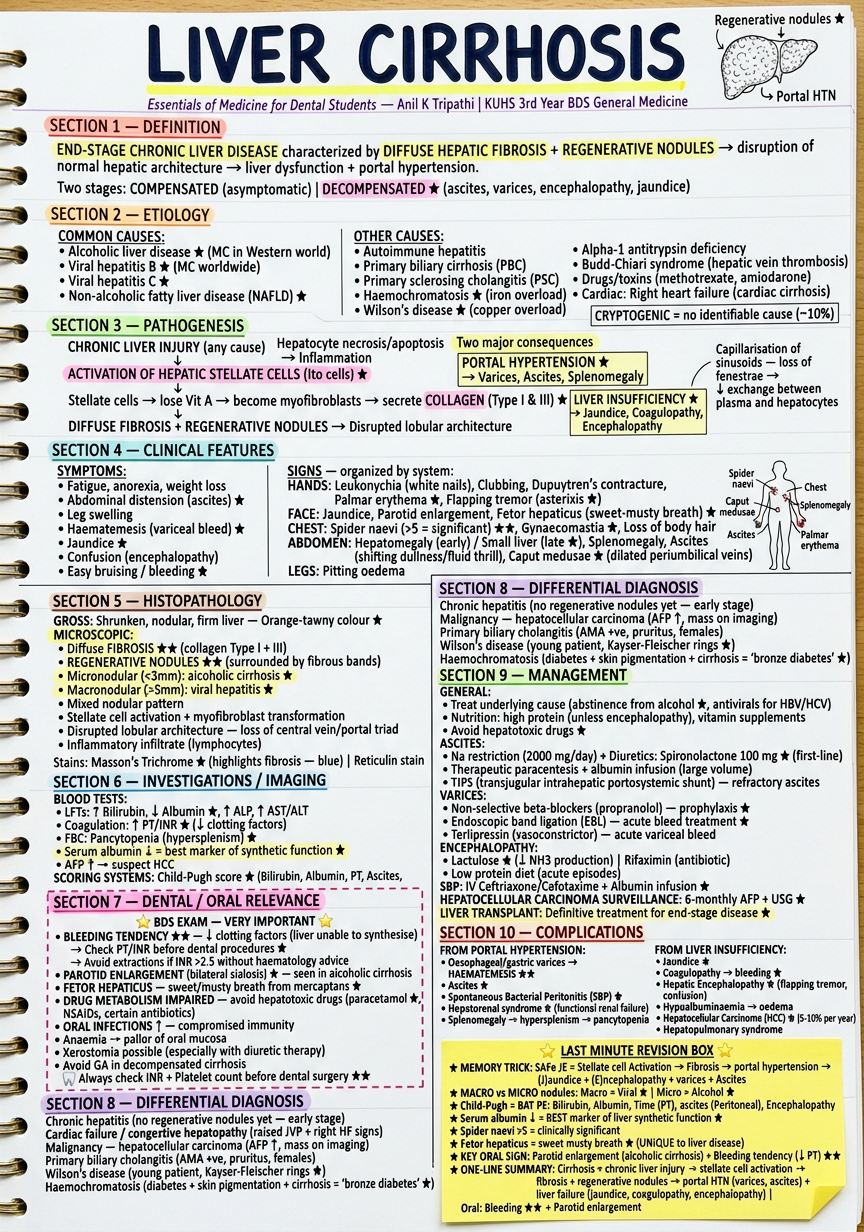
| Section | High-Yield Exam Points |
|---|---|
| Definition | End-stage liver disease = diffuse fibrosis + regenerative nodules; Compensated vs Decompensated ★ |
| Etiology | Alcohol (MC Western ★) / HBV (MC worldwide ★) / NAFLD / Wilson's / Haemochromatosis |
| Pathogenesis | Hepatocyte injury → Stellate cell (Ito cell) activation → Collagen (Type I+III) → Fibrosis + Nodules |
| Key Signs | Spider naevi ★★, Palmar erythema, Caput medusae ★, Asterixis (flapping tremor), Fetor hepaticus ★ |
| Histopathology | Micronodular = Alcohol ★ |
| Best Synthetic Function Test | Serum Albumin ↓ ★ + PT/INR ↑ |
| Dental ★★ BDS | Bleeding tendency (↓ clotting factors + thrombocytopenia) ★★ - check INR before any procedure; Parotid enlargement (alcohol); Fetor hepaticus; Avoid hepatotoxic drugs |
| Complications | Variceal bleed ★, Ascites, SBP, Hepatorenal syndrome, Hepatic encephalopathy, HCC |
| Management | Spironolactone (ascites) ★; Beta-blockers + EBL (varices) ★; Lactulose (encephalopathy) ★; Liver transplant (definitive) |
| Memory Trick | SAFe JE: Stellate cell Activation → Fibrosis → portal HTN → Jaundice + Encephalopathy |
Create a super aesthetic, handwritten-style revision note page for the topic: Myocardial Infarction, Refer “Essentials of Medicine for Dental Students” by Anil K Tripathi. • Make it look like neat exam notes written on a page (top view, clean layout, colorful headings, underlines, boxes). For KUHS Thirrd Year BDS General Medicine Examination. • Keep it crisp, high-yield, and exam-oriented. • Use clear headings and organize content like this (modify if needed for topic): ○ Definition ○ Etiology ○ Pathogenesis (flow/arrow style) ○ Clinical features ○ Radiographic features (if applicable) ○ Histopathology (if applicable) ○ Key features ○ Differential diagnosis ○ Management ○ Complications ○ Key points / last-minute revision box • Add simple diagrams or labeled sketches wherever helpful. • Highlight important keywords. • Include one memory trick / one-line summary
A super aesthetic, handwritten-style A4 portrait medical revision note page for "MYOCARDIAL INFARCTION (MI)" — KUHS Third Year BDS General Medicine exam notes. Looks exactly like a real student's ruled notebook page viewed from the top: white paper with faint blue horizontal lines, warm cream background, multiple coloured ink pens, neat and organized. Dense, high-yield, professional dental student exam aesthetic. TOP HEADER: - Large bold title "MYOCARDIAL INFARCTION" in thick dark navy blue ink, double underlined, bright yellow highlighter streak underneath - "MI = HEART ATTACK" in a bright red badge/box next to the title - Subtitle in small purple cursive: "Essentials of Medicine for Dental Students — Anil K Tripathi | KUHS 3rd Year BDS General Medicine" - Small hand-drawn heart sketch to the right with a dark patch on the left ventricular wall labelled "Infarcted zone ★" and a blocked artery labelled "Thrombus" SECTION 1 — DEFINITION (coral-red heading, double underlined): Neat blue handwriting: "NECROSIS OF CARDIAC MUSCLE (highlighted yellow) due to PROLONGED ISCHAEMIA (>20-40 min) (highlighted yellow) caused by acute CORONARY ARTERY OCCLUSION — characterized by abnormal CARDIAC BIOMARKERS + evidence of acute myocardial ischaemia." "STEMI = ST Elevation MI (transmural, full thickness) ★" "NSTEMI = Non-ST Elevation MI (subendocardial) ★" SECTION 2 — ETIOLOGY / RISK FACTORS (orange heading, underlined): Two neat columns: Left — "MODIFIABLE RISK FACTORS ★:" "• Hypertension ★" "• Diabetes mellitus ★" "• Hyperlipidaemia (↑LDL) ★" "• Smoking ★★ (highlighted pink)" "• Obesity / Physical inactivity" "• Stress" Right — "NON-MODIFIABLE:" "• Age (Males >45 | Females >55)" "• Male sex ★" "• Family history of IHD" "• Post-menopausal women (↓ oestrogen)" Small note box: "MC cause = ATHEROSCLEROSIS + acute plaque rupture → THROMBOSIS ★ | ~10% MIs without atherosclerosis: vasospasm, embolism" SECTION 3 — PATHOGENESIS (green heading, neat 5-step sequential flowchart with arrows): Step-by-step boxes: "① Atherosclerotic plaque in coronary artery (lipid core + fibrous cap)" "↓" "② Plaque EROSION / RUPTURE ★ → subendothelial collagen + lipid exposed" "↓" "③ Platelet adhesion + aggregation → release TXA₂, ADP, serotonin → Vasospasm ★" "↓" "④ Coagulation cascade activation → OCCLUSIVE THROMBUS ★★ (highlighted yellow)" "↓" "⑤ Complete coronary occlusion → cessation of O₂ supply" "↓" "⑥ Aerobic metabolism stops (seconds) → ↓ATP → Loss of contractility (minutes) → IRREVERSIBLE CELL DEATH at 20-40 min ★ (highlighted)" "↓" "⑦ COAGULATIVE NECROSIS → inflammatory response → fibrosis → SCAR" Side note: "Subendocardium = most vulnerable ★ (highest O₂ demand, lowest perfusion)" "LAD occlusion (40-50%) → Anterior wall MI ★ | RCA (30-40%) → Inferior MI | LCX (15-20%) → Lateral MI" SECTION 4 — CLINICAL FEATURES (teal heading, two neat columns): Left column — "SYMPTOMS:" "• Severe CRUSHING/SQUEEZING chest pain ★★ (highlighted yellow)" "• Radiates to: LEFT ARM ★ + jaw + neck + back" "• SUDDEN ONSET, at rest or on exertion" "• NOT relieved by nitrates ★ (unlike angina)" "• Duration >30 minutes ★" "• Sweating (diaphoresis) ★" "• Nausea, vomiting" "• Dyspnoea" "• Anxiety, sense of impending doom ★" Right column — "SIGNS:" "• Pallor + sweating" "• Tachycardia (or bradycardia in inferior MI) ★" "• Hypotension (cardiogenic shock)" "• S3 gallop / S4 sound" "• Fine basal crepitations (pulmonary oedema)" "• Raised JVP (in RV infarct)" "• Pericardial friction rub (if Dressler's)" "SILENT MI ★: Common in diabetics + elderly — no chest pain (highlighted pink)" SECTION 5 — ECG CHANGES (dark blue heading, neat timeline table): "12-LEAD ECG ★ — MOST IMPORTANT IMMEDIATE INVESTIGATION" Timeline table with arrows: "Minutes–Hours: Hyperacute TALL T WAVES ★ | ST ELEVATION (STEMI) ★★ (highlighted yellow) in affected leads | Reciprocal ST depression in opposite leads" "Hours–Days: PATHOLOGICAL Q WAVES ★★ = marker of full-thickness necrosis (highlighted)" "Days–Weeks: T-wave inversion | Persistent Q waves" "NSTEMI/Unstable Angina: ST depression + T inversion (NO Q waves) (highlighted pink)" "Lead localisation: V1-V4 = anterior (LAD) | II, III, aVF = inferior (RCA) | I, aVL, V5-V6 = lateral (LCX)" Small simple ECG strip sketch showing: flat line → peaked T → ST elevation → Q wave formation, labelled chronologically SECTION 6 — INVESTIGATIONS / DIAGNOSIS (dark blue sub-section): "CARDIAC BIOMARKERS (highlighted yellow):" Neat table: "Troponin I/T ★★ = MOST SPECIFIC + SENSITIVE | Rises 3-6h | Peaks 12-24h | Lasts 7-10 days" "CK-MB ★ = Rises 4-6h | Peaks 12-24h | Returns normal 72h | Used to detect reinfarction" "Myoglobin = Earliest rise (2h) | NOT specific ★" "LDH = Late rise (days) — rarely used now" "OTHER TESTS: CXR (cardiomegaly, pulmonary oedema) | Echo (wall motion abnormality ★, EF) | Coronary angiography (Gold standard for anatomy)" SECTION 7 — HISTOPATHOLOGY (brown/maroon heading): "TEMPORAL SEQUENCE OF CHANGES ★★ (highlighted yellow) — KUHS FAVOURITE:" Neat timeline table: "0-12 hrs: No gross change | Microscopically: Early coagulation necrosis, wavy fibres, eosinophilic hypereosinophilic cells ★" "12-24 hrs: Yellow/pale softening (gross) | Neutrophil infiltration begins ★" "1-3 days: Pale yellow infarct | MAX neutrophil infiltration ★" "3-7 days: Hyperaemia border | Macrophages + phagocytosis ★" "1-2 weeks: Soft yellow-tan (vulnerable to rupture ★) | Granulation tissue begins" "2-4 weeks: Pale grey-white scar begins | Fibroblasts + collagen ★" ">4 weeks: DENSE COLLAGEN SCAR (white) ★★ — completed (highlighted)" Small mnemonic tag: "No neutrophil yet → Neutrophils (1-3d) → Macrophages (3-7d) → Granulation → Scar ★" SECTION 8 — DENTAL / ORAL RELEVANCE (bright pink heading, dashed box): "⭐ BDS EXAM — HIGH YIELD ⭐" "• REFERRED JAW PAIN ★ — MI can present as jaw/tooth pain without chest pain (highlight in yellow)" " → Always take cardiac history before dental procedures" "• ANTIPLATELET THERAPY (Aspirin + Clopidogrel) ★ → ↑ bleeding during dental surgery" " → Do NOT stop antiplatelet without cardiology advice ★" "• β-BLOCKERS (Atenolol): bradycardia + hypotension during stress" "• STATINS: potential drug interactions" "• AVOID EPINEPHRINE/ADRENALINE in local anaesthesia ★ within 6 months post-MI" "• Dental procedures: POSTPONE elective treatment for 6 months post-MI ★ (highlighted)" "• Stress/anxiety → ↑ catecholamines → risk of re-infarction ★" "• Use LA with minimum vasoconstrictor (1:200,000 max) after 6 months" "• Ensure emergency oxygen + GTN spray available in dental clinic ★" Small tooth icon: "Defer elective dentistry 6 months post-MI ★" SECTION 9 — DIFFERENTIAL DIAGNOSIS (purple heading): "Unstable Angina: chest pain at rest BUT troponin NEGATIVE, no ECG Q waves" "Aortic Dissection: tearing pain radiating to back, pulse differential, wide mediastinum on CXR" "Pulmonary Embolism: pleuritic chest pain, dyspnoea, RV strain on ECG" "Oesophageal spasm: retrosternal pain, relieved by GTN (mimics angina)" "Pericarditis: sharp pleuritic pain, saddle-shaped ST elevation (all leads) ★, pericardial rub" SECTION 10 — MANAGEMENT (green heading, stepwise — MONA + reperfusion): "IMMEDIATE — MONA + Reperfusion (Time = Myocardium ★) (highlighted yellow):" "M — Morphine ★ (analgesia + reduces anxiety)" "O — Oxygen (if SpO₂ <94%) ★" "N — Nitrates (GTN sublingual/IV — pain relief)" "A — Aspirin 300 mg STAT ★★ + Clopidogrel 300-600 mg loading" "REPERFUSION THERAPY ★★:" "• Primary PCI (angioplasty + stent) ★★ — GOLD STANDARD if within 12 hours (highlighted)" "• Thrombolysis (streptokinase/tPA) — if PCI not available within 120 mins ★" "ANTI-COAGULATION: Heparin (UFH/LMWH) during PCI" "LONG-TERM (Post-MI — ABCDS) ★:" "A — Aspirin + ACE inhibitor (↓ remodelling)" "B — Beta-blocker ★ (↓ mortality, ↓ re-infarction)" "C — Clopidogrel + Cholesterol (statin ★)" "D — Diabetes control + Diet" "S — Smoking cessation ★" SECTION 11 — COMPLICATIONS (red heading, two columns): Left: "EARLY (<48 hrs):" "• Arrhythmias — VF ★ (MC cause of EARLY death) (highlighted red)" "• Cardiogenic shock ★" "• Acute LV failure / Pulmonary oedema" "• Heart block (inferior MI → AV block)" "• Cardiac tamponade (free wall rupture)" Right: "LATE (Days–Weeks):" "• Dressler's syndrome ★ (pericarditis 2-10 wks post-MI — autoimmune)" "• Mitral regurgitation (papillary muscle rupture) ★" "• LV aneurysm" "• Mural thrombus → stroke ★" "• Cardiac failure (chronic)" "• VSD (septal rupture)" BOTTOM — LAST MINUTE REVISION BOX (bright yellow sticky note, slightly tilted): "★ MEMORY TRICK: MONA = Morphine + Oxygen + Nitrate + Aspirin (immediate management)" "★ 20-40 min = POINT OF NO RETURN for myocyte necrosis ★" "★ Troponin = BEST biomarker | Rises 3-6h, lasts 10 days ★★" "★ Pathological Q waves = TRANSMURAL infarction ★ (full thickness)" "★ MC early death = Ventricular Fibrillation ★ | MC late complication = LV failure" "★ VF (arrhythmia) = MC cause of death in MI ★★" "★ DENTAL: Defer 6 months post-MI ★ | Avoid epinephrine | Jaw pain can be the ONLY symptom ★" "★ ONE-LINE SUMMARY: MI = plaque rupture → thrombus → coronary occlusion → coagulative necrosis → MONA + PCI | Key oral: referred jaw pain + defer dental Rx 6 months ★" Overall aesthetic: warm cream notebook paper with blue ruled lines, multiple ink colours (navy blue main text, coral-red for headings, orange for risk factors, green for pathogenesis/management, teal for clinical features, dark blue for ECG/investigations, brown for histopathology, purple for differentials), yellow and pink highlighter streaks on key terms, small hand-drawn heart with blocked vessel, simple ECG trace, neat connecting arrows, professional dental student note style, A4 portrait layout
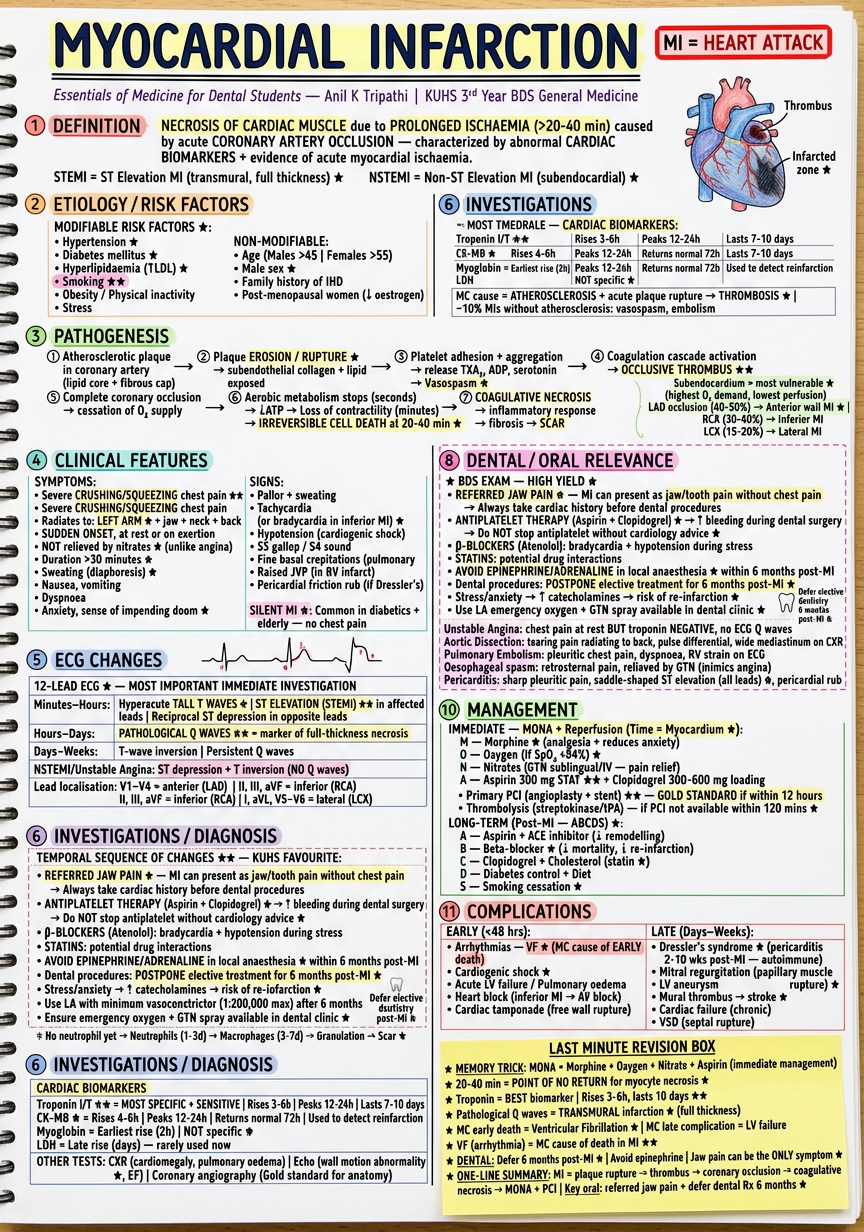
| Section | High-Yield Exam Points |
|---|---|
| Definition | Necrosis of cardiac muscle from ischaemia >20-40 min; STEMI (transmural) vs NSTEMI (subendocardial) |
| Pathogenesis | Plaque rupture → platelet aggregation → TXA₂/ADP → occlusive thrombus → ischaemia → coagulative necrosis |
| Vessels | LAD (40-50%) = Anterior MI ★ |
| Key Symptom | Crushing chest pain + radiation to left arm/jaw ★★, NOT relieved by nitrates, >30 min |
| ECG ★★ | Tall T → ST elevation → Pathological Q waves (transmural) ★ |
| Best Biomarker | Troponin I/T ★★ (rises 3-6h, lasts 10 days); CK-MB for reinfarction |
| Histopathology ★★ | 0-12h: wavy fibres → 1-3d: neutrophils ★ → 3-7d: macrophages → 2-4wks: granulation → >4wks: white scar |
| Management | MONA + Primary PCI (Gold Standard ★★) within 12h; Long-term: ABCDS |
| Early Complication ★ | VF = MC cause of early death ★★ |
| Late Complication | Dressler's syndrome ★ (2-10 wks), LV aneurysm, MR (papillary muscle rupture) |
| Dental ★★ BDS | Jaw pain as ONLY MI symptom ★; Defer elective dentistry 6 months ★; Avoid epinephrine; Don't stop antiplatelet drugs |
| Memory Trick | MONA = Morphine + Oxygen + Nitrate + Aspirin |
Create a super aesthetic, handwritten-style revision note page for the topic: Falciparum Malaria, Refer “Essentials of Medicine for Dental Students” by Anil K Tripathi. • Make it look like neat exam notes written on a page (top view, clean layout, colorful headings, underlines, boxes). For KUHS Thirrd Year BDS General Medicine Examination. • Keep it crisp, high-yield, and exam-oriented. • Use clear headings and organize content like this (modify if needed for topic): ○ Definition ○ Etiology ○ Pathogenesis (flow/arrow style) ○ Clinical features ○ Radiographic features (if applicable) ○ Histopathology (if applicable) ○ Key features ○ Differential diagnosis ○ Management ○ Complications ○ Key points / last-minute revision box • Add simple diagrams or labeled sketches wherever helpful. • Highlight important keywords. • Include one memory trick / one-line summary
A super aesthetic, handwritten-style A4 portrait medical revision note page for "FALCIPARUM MALARIA" — KUHS Third Year BDS General Medicine exam notes. Looks exactly like a real student's ruled notebook page viewed from the top: white paper with faint blue horizontal lines, warm cream background, multiple coloured ink pens, neat and organized. Dense, high-yield, professional dental student exam aesthetic. TOP HEADER: - Large bold title "FALCIPARUM MALARIA" in thick dark navy blue ink, double underlined, bright yellow highlighter streak underneath - "P. falciparum = MOST DANGEROUS ★★" in a bright red badge/box - Subtitle in small purple cursive: "Essentials of Medicine for Dental Students — Anil K Tripathi | KUHS 3rd Year BDS General Medicine" - Small hand-drawn mosquito sketch to the right with an arrow labelled "Female Anopheles ★" and a small red blood cell with "ring form" labelled SECTION 1 — DEFINITION (coral-red heading, double underlined): Neat blue handwriting: "Malaria caused by PLASMODIUM FALCIPARUM (highlighted yellow) — the MOST SEVERE and POTENTIALLY FATAL (highlighted yellow) form of malaria, transmitted by the bite of an INFECTED FEMALE ANOPHELES MOSQUITO ★." "Mortality <0.1% if uncomplicated | Rises steeply if >2% RBCs infected ★" "4 species: P. falciparum ★★ | P. vivax | P. ovale | P. malariae" SECTION 2 — LIFE CYCLE / ETIOLOGY (orange heading, underlined): Neat circular flow diagram: "MOSQUITO (definitive host) → sporozoites injected during bite ★" "↓" "LIVER PHASE (exoerythrocytic) — sporozoites → hepatocytes → SCHIZOGONY → merozoites released ★" "↓" "ERYTHROCYTIC PHASE ★ — merozoites invade RBCs → ring stage → trophozoite → schizont → RBC ruptures → MORE merozoites (+ fever spike)" "↓" "Some merozoites → GAMETOCYTES (male + female) → taken up by mosquito during blood meal" "↓" "MOSQUITO — sexual cycle → oocyst → sporozoites → salivary glands" Small note boxes: "P. falciparum — IRREGULAR fever, invades ALL age RBCs ★ (all stages)" "P. vivax — 48h tertian fever, hypnozoites in liver ★ | P. malariae — 72h quartan fever" "NO hypnozoite (dormant liver stage) in P. falciparum ★ (unlike P. vivax)" SECTION 3 — PATHOGENESIS (green heading, neat arrow flowchart): "Merozoites invade RBCs → RBC deformation + rigidity" "↓" "CYTOADHERENCE ★★ — infected RBCs express PfEMP1 (highlighted pink) on surface → adhere to vascular endothelium" "↓" "SEQUESTRATION ★ — infected RBCs stuck in deep microvasculature (brain, kidney, lung, placenta)" "↓" "Microvascular obstruction → TISSUE HYPOXIA + ISCHAEMIA (highlighted yellow)" "↓" "ROSETTING — infected RBCs bind uninfected RBCs → further microvascular blockage" "↓" "Inflammatory cytokines (TNF-α, IL-1, IL-6) → Fever + organ damage" "Key features unique to P. falciparum:" "① ALL stages of RBC infected (not just young/old) → HIGH parasitaemia ★" "② RBCs become RIGID + STICKY → can't pass through spleen → splenomegaly" "③ Haemolysis → Haemoglobinuria (Blackwater fever ★)" SECTION 4 — CLINICAL FEATURES (teal heading, two neat columns): Left column — "UNCOMPLICATED MALARIA:" "• FEVER ★★ — irregular/remittent (NO regular periodicity unlike P. vivax)" "• Classic MALARIAL PAROXYSM (cold → hot → sweating) ★ — occurs when RBCs rupture" "• Cold stage: shivering, rigors (1hr)" "• Hot stage: fever 39-41°C, headache (2-6 hrs)" "• Sweating stage: profuse sweating, temp drops (2-4 hrs)" "• Headache, myalgia, arthralgia" "• Nausea, vomiting" "• Splenomegaly (tender) ★" "• Mild jaundice (haemolysis)" "• Anaemia ★" Right column — "SEVERE FALCIPARUM (★★ EMERGENCY):" "• CEREBRAL MALARIA ★★ — coma, seizures, GCS <11 (highlighted red)" "• BLACKWATER FEVER ★ — haemoglobinuria (dark/black urine) + intravascular haemolysis (highlighted)" "• Severe normocytic normochromic ANAEMIA ★" "• Hypoglycaemia ★ (parasites consume glucose + quinine → ↑ insulin)" "• Lactic acidosis / metabolic acidosis" "• Acute renal failure (acute tubular necrosis)" "• Non-cardiogenic pulmonary oedema ★" "• Thrombocytopenia + DIC" "• Jaundice (haemolysis + hepatic dysfunction)" "• Splenic rupture (rare)" Small sketch: stick figure with arrows — head (cerebral), kidney (renal failure), dark urine bottle (blackwater fever), RBCs being destroyed (haemolysis), spleen SECTION 5 — DIAGNOSIS / INVESTIGATIONS (dark blue heading): "GOLD STANDARD ★★ — PERIPHERAL BLOOD SMEAR (highlighted yellow):" "• THICK FILM ★ — detection of parasites (more sensitive, used for screening)" "• THIN FILM ★ — species identification (morphology) (more specific)" "P. falciparum features on smear:" "• RING (trophozoite) FORMS ★★ — multiple rings per RBC (highlighted)" "• Appliqué/Accolé forms (rings at RBC periphery) ★" "• MAURER'S CLEFTS (red clefts in RBC cytoplasm) ★" "• GAMETOCYTES = CRESCENT/BANANA shaped ★★ (PATHOGNOMONIC of P. falciparum) (highlighted pink)" "• No enlarged RBCs (unlike P. vivax/P. ovale)" "• High parasitaemia (>2%) possible" "RAPID DIAGNOSTIC TEST (RDT) ★ — HRP2 antigen detection (PfHRP2)" "PCR — for species confirmation in low parasitaemia" "BLOOD TESTS: Anaemia, thrombocytopenia ↓, ↑ LDH, ↑ bilirubin, ↑ creatinine (severe)" SECTION 6 — DENTAL / ORAL RELEVANCE (bright pink heading, dashed box): "⭐ BDS EXAM — HIGH YIELD ⭐" "• BLEEDING TENDENCY ★★ — thrombocytopenia + DIC in severe malaria → ↑ bleeding during dental procedures" "• ORAL ULCERS — immunosuppression during acute malaria" "• JAUNDICE — yellowing of oral mucosa/sclera in haemolytic malaria" "• DRUG INTERACTIONS ★ — QUININE: can prolong QT interval, interact with drugs" "• ARTEMISININ — generally safe, but check for interactions" "• FEVER + DEHYDRATION → xerostomia" "• HALOFANTRINE + MEFLOQUINE — can cause QT prolongation" "• DEFER elective dental procedures during acute malaria ★" "• Check platelet count before surgery in post-malaria patients ★" Small tooth icon with warning: "Check platelets + coagulation before dental surgery in malaria ★" SECTION 7 — DIFFERENTIAL DIAGNOSIS (purple heading): "Typhoid fever (Salmonella): step-ladder fever, rose spots, positive Widal test, no malaria smear" "Dengue: thrombocytopenia + rash + negative malaria smear + NS1 antigen +" "Viral hepatitis: jaundice + elevated ALT/AST + HBsAg/anti-HCV positive" "Meningitis: neck stiffness + photophobia + CSF changes (in cerebral malaria: no meningism)" "Leptospirosis: Weil's disease, conjunctival haemorrhage, exposure to water" "Key differentiator: PERIPHERAL SMEAR + RDT ★" SECTION 8 — MANAGEMENT (green heading, stepwise): "UNCOMPLICATED FALCIPARUM (oral therapy):" "① ACT — Artemisinin Combination Therapy ★★ = FIRST LINE (highlighted yellow)" " • Artemether + Lumefantrine (Coartem) OR" " • Artesunate + Sulfadoxine-Pyrimethamine (ACT-SP) — India protocol" " Artesunate 4 mg/kg/day × 3 days + SP Day 1" "② Primaquine 0.75 mg/kg single dose Day 2 ★ (gametocytocidal — prevents transmission)" "NOTE: Chloroquine resistance in P. falciparum = widespread ★ → DO NOT use chloroquine" "SEVERE FALCIPARUM (IV/IM therapy — EMERGENCY ★★):" "• IV ARTESUNATE ★★ = DRUG OF CHOICE for severe malaria (highlighted yellow)" " Dose: 2.4 mg/kg IV at 0, 12, 24h then daily" "• If artesunate unavailable: IV Quinine dihydrochloride" "• IM Artemether — if IV access unavailable" "SUPPORTIVE CARE (severe malaria):" "• Antipyretics (paracetamol)" "• IV dextrose (hypoglycaemia ★)" "• Blood transfusion (severe anaemia Hb <7g/dL)" "• Anticonvulsants (cerebral malaria)" "• Mechanical ventilation (pulmonary oedema)" "• Dialysis (renal failure)" SECTION 9 — COMPLICATIONS (red heading, two neat columns): Left: "SPECIFIC TO P. FALCIPARUM ★:" "• Cerebral malaria ★★ (coma, seizures)" "• Blackwater fever ★ (haemoglobinuria)" "• ARDS / Pulmonary oedema" "• Acute renal failure ★" "• Hypoglycaemia ★" "• DIC / Coagulopathy" Right: "OTHER COMPLICATIONS:" "• Algid malaria (Gram-negative septicaemia)" "• Malarial hepatitis" "• Splenic rupture" "• Severe anaemia" "• Lactic acidosis" "• Hyperparasitaemia (>5% RBCs)" SECTION 10 — PREVENTION (small teal note): "PROPHYLAXIS: Mefloquine / Doxycycline / Atovaquone-Proguanil ★ (for travellers)" "VECTOR CONTROL: Insecticide-treated bed nets (ITNs) ★ | Indoor residual spraying | Larviciding" "VACCINE: RTS,S (Mosquirix) — partial protection, recently WHO approved" BOTTOM — LAST MINUTE REVISION BOX (bright yellow sticky note, slightly tilted, stars): "★ MEMORY TRICK: FALCIPARUM = FATAL — Fever (irregular) + ALL RBCs invaded + Lactic acidosis + Cerebral malaria + Invades deep vasculature + Prolonged if untreated + Artesunate = treatment + Ring forms multiple + Urinary haemoglobin (blackwater) + Mortality high" "★ BANANA/CRESCENT GAMETOCYTES ★★ = PATHOGNOMONIC of P. falciparum (highlighted)" "★ Multiple ring forms per RBC ★★ = P. falciparum" "★ NO liver dormancy (no hypnozoite) in P. falciparum ★" "★ Treatment: IV ARTESUNATE (severe) ★★ | ACT-SP (uncomplicated)" "★ Cerebral malaria = diffuse symmetric encephalopathy ★" "★ ONE-LINE SUMMARY: P. falciparum = cytoadherence + sequestration → cerebral malaria + blackwater fever | Dx: banana gametocytes on smear ★★ | Rx: Artesunate ★" Overall aesthetic: warm cream notebook paper with blue ruled lines, multiple ink colours (navy blue main text, coral-red for headings, orange for life cycle/etiology, green for pathogenesis/management, teal for clinical features, dark blue for investigations, brown for additional notes, purple for differentials), yellow and pink highlighter streaks on key terms, small hand-drawn mosquito, life cycle arrows, crescent/banana gametocyte sketch, ring form RBC, neat connecting arrows, professional dental student note style, A4 portrait layout, all content fits neatly on one page
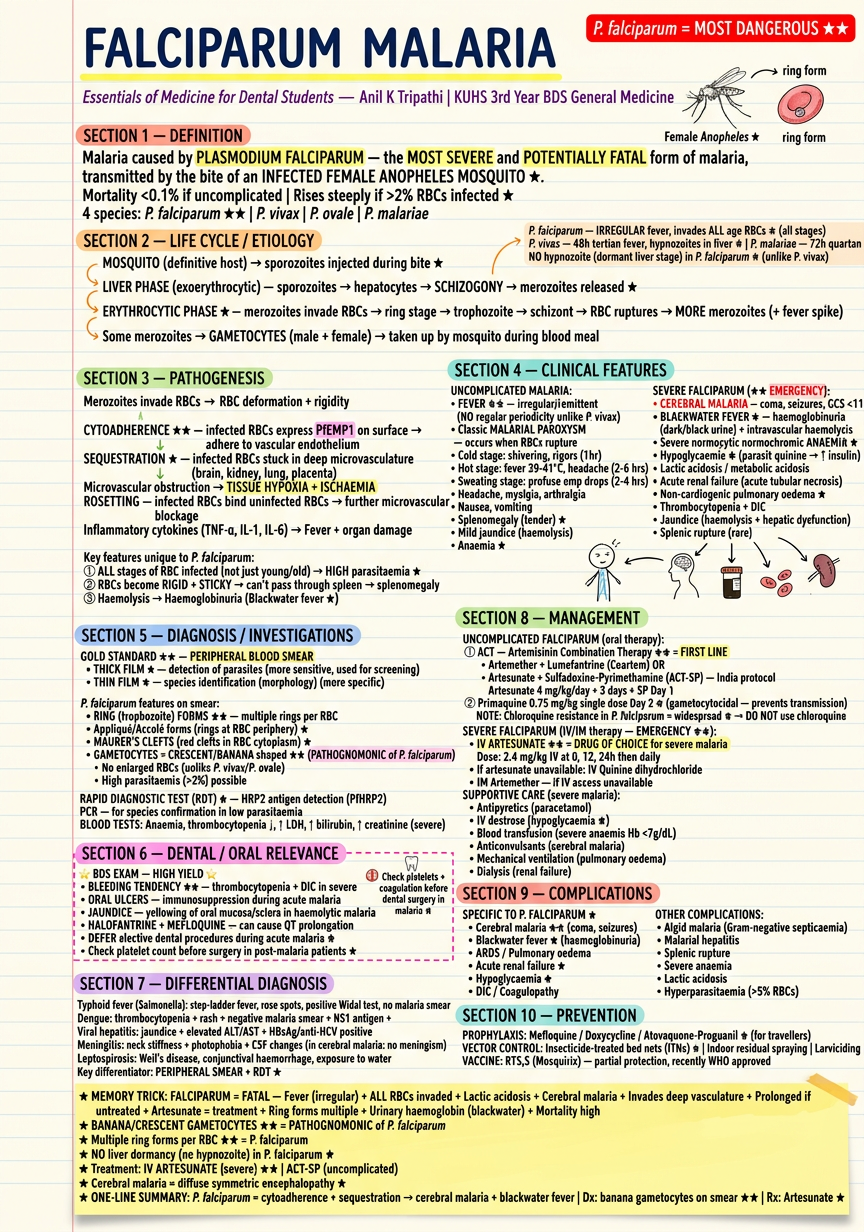
| Section | High-Yield Exam Points |
|---|---|
| Definition | P. falciparum = most severe malaria; transmitted by female Anopheles mosquito |
| Life Cycle | Sporozoite → Liver → Merozoites → RBCs → Gametocytes (crescent) → Mosquito |
| Key Mechanism | Cytoadherence (PfEMP1) + Sequestration ★ → microvascular obstruction → organ damage |
| Fever Pattern | IRREGULAR (not periodic like P. vivax) — all RBC stages present simultaneously |
| Blood Smear ★★ | Multiple ring forms per RBC ★★ + Crescent/Banana gametocytes ★★ (pathognomonic) + Maurer's clefts |
| Severe Complications | Cerebral malaria ★★ (coma/seizures), Blackwater fever ★ (haemoglobinuria), ARDS, AKF, Hypoglycaemia |
| Diagnosis | Thick + thin peripheral smear ★★; RDT (PfHRP2 antigen); >2% parasitaemia = severe |
| Treatment | IV Artesunate ★★ (severe); ACT-SP oral (uncomplicated); Primaquine (gametocytocidal) |
| Dental ★ BDS | Thrombocytopenia → bleeding risk; Defer elective dentistry; Quinine prolongs QT interval |
| Memory Trick | FALCIPARUM = FATAL acronym; Banana gametocytes = P. falciparum only ★★ |
| Key Differentiator | No hypnozoite (no liver dormancy) in P. falciparum ★ (unlike P. vivax/ovale) |
Create a super aesthetic, handwritten-style revision note page for the topic: Bronchial Asthma, Refer “Essentials of Medicine for Dental Students” by Anil K Tripathi. • Make it look like neat exam notes written on a page (top view, clean layout, colorful headings, underlines, boxes). For KUHS Thirrd Year BDS General Medicine Examination. • Keep it crisp, high-yield, and exam-oriented. • Use clear headings and organize content like this (modify if needed for topic): ○ Definition ○ Etiology ○ Pathogenesis (flow/arrow style) ○ Clinical features ○ Radiographic features (if applicable) ○ Histopathology (if applicable) ○ Key features ○ Differential diagnosis ○ Management ○ Complications ○ Key points / last-minute revision box • Add simple diagrams or labeled sketches wherever helpful. • Highlight important keywords. • Include one memory trick / one-line summary
A super aesthetic, handwritten-style A4 portrait medical revision note page for "BRONCHIAL ASTHMA" — KUHS Third Year BDS General Medicine exam notes. Looks exactly like a real student's ruled notebook page viewed from the top: white paper with faint blue horizontal lines, warm cream background, multiple coloured ink pens, neat and organized. Dense, high-yield, professional dental student exam aesthetic. TOP HEADER: - Large bold title "BRONCHIAL ASTHMA" in thick dark navy blue ink, double underlined, bright yellow highlighter streak underneath - Subtitle in small purple cursive: "Essentials of Medicine for Dental Students — Anil K Tripathi | KUHS 3rd Year BDS General Medicine" - Small hand-drawn bronchial tree sketch to the right: a Y-shaped airway with narrowed lower branches, labelled "Bronchoconstriction ★" and "Mucus plug" SECTION 1 — DEFINITION (coral-red heading, double underlined): Neat blue handwriting: "CHRONIC INFLAMMATORY DISORDER (highlighted yellow) of the airways characterized by:" "① Airway HYPERRESPONSIVENESS (highlighted yellow) to various stimuli" "② REVERSIBLE airway obstruction ★ (key feature — distinguishes from COPD)" "③ Recurrent episodes of WHEEZE, breathlessness, chest tightness, cough" "Obstruction = bronchospasm + mucosal oedema + mucus hypersecretion" "REVERSIBILITY: FEV₁ improves ≥12% (and ≥200 mL) after bronchodilator ★" SECTION 2 — ETIOLOGY / TRIGGERS (orange heading, underlined): Two neat columns: Left — "PREDISPOSING FACTORS:" "• ATOPY ★ — genetic tendency to produce IgE (MC predisposing factor)" "• Family history of asthma/eczema/allergic rhinitis" "• Male sex (childhood) | Female (adult)" "• Low birth weight" Right — "TRIGGERS (precipitants) ★:" "• ALLERGENS ★ — house dust mite ★★, pollen, animal dander, mould" "• RESPIRATORY INFECTIONS ★ (viral — RSV, rhinovirus)" "• ASPIRIN / NSAIDs ★ (Samter's triad: Asthma + Nasal polyps + Aspirin sensitivity)" "• Exercise ★ (exercise-induced bronchoconstriction)" "• Cold air | Smoke | Pollution" "• Emotional stress | Laughing" "• Occupational sensitisers" "• Beta-blockers ★ (drug trigger — IMPORTANT for dental students)" Small note box: "TYPES: Extrinsic (allergic, IgE-mediated, atopic) ★ | Intrinsic (non-allergic, no IgE)" SECTION 3 — PATHOGENESIS (green heading, neat two-phase arrow flowchart): "PHASE 1 — EARLY PHASE (within 10-20 mins of allergen exposure):" "Allergen → IgE on MAST CELLS ★ → degranulation → release of:" "Histamine + PGD₂ + LTC₄/D₄/E₄ (leukotrienes) + Tryptase" "↓" "→ Bronchoconstriction + Mucus secretion + Vasodilatation (IMMEDIATE response) ★" "PHASE 2 — LATE PHASE (4-8 hours later) ★:" "Recruitment of EOSINOPHILS ★★ + Th2 lymphocytes + Basophils" "↓" "ECP (Eosinophil Cationic Protein) + MBP (Major Basic Protein) → Epithelial damage" "↓" "IL-4, IL-5, IL-13 ★ → sustained inflammation" "↓" "AIRWAY REMODELLING (chronic) ★:" "Goblet cell hyperplasia ★ + Smooth muscle hypertrophy ★ + Subepithelial fibrosis + ↑ BM thickness" Side key box: "KEY CELLS: Mast cells ★ (early) | Eosinophils ★★ (late + pathognomonic) | Th2 cells | Dendritic cells" SECTION 4 — CLINICAL FEATURES (teal heading, two neat columns): Left column — "SYMPTOMS (triad ★):" "• WHEEZE ★★ (expiratory, polyphonic) — hallmark symptom (highlighted yellow)" "• DYSPNOEA (breathlessness) ★ — worse at night / early morning" "• COUGH ★ (dry/productive, worse at night)" "• Chest TIGHTNESS ★" "• Symptoms vary and are reversible ★" "• Nocturnal symptoms ★ — classic (wakes from sleep)" Right column — "SIGNS:" "• Tachypnoea + tachycardia" "• Use of accessory muscles ★" "• Hyperinflated chest (barrel chest in chronic)" "• Hyperresonance on percussion" "• EXPIRATORY WHEEZE ★★ on auscultation (highlighted)" "• Prolonged expiration ★" "ACUTE SEVERE ASTHMA / STATUS ASTHMATICUS ★ (highlighted red box):" "• Inability to complete sentences" "• Peak flow <33% predicted" "• SpO₂ <92%, silent chest ★ (no wheeze = very severe), cyanosis" "• PaCO₂ NORMAL/RAISED = impending respiratory failure ★" Small lung sketch with narrow airways, trapped air bubbles, and mucus plugs labelled, plus "Expiratory wheeze" with a wiggly line SECTION 5 — RADIOGRAPHIC FEATURES (dark blue heading, boxed): "CHEST X-RAY (CXR):" "• Usually NORMAL between attacks ★" "• During acute attack: HYPERINFLATION ★ (highlighted yellow)" " → Increased AP diameter | Low flat diaphragm | Horizontal ribs | ↑ Intercostal spaces" "• Peribronchial thickening (tram-track opacities)" "• Rule out complications: Pneumothorax ★ | Consolidation | Atelectasis (mucus plug)" "• CXR in children: may show transient segmental collapse" "SPIROMETRY / PFT ★ (Gold Standard for diagnosis):" "• FEV₁ ↓ | FVC normal/↓ | FEV₁/FVC RATIO ↓ (<0.7) = OBSTRUCTIVE pattern ★★ (highlighted)" "• REVERSIBILITY TEST ★: FEV₁ ↑ ≥12% + ≥200 mL after salbutamol = diagnostic" "• PEFR (Peak Expiratory Flow Rate): ↓ during attack, ↑ after bronchodilator" "• FeNO (exhaled nitric oxide): ↑ in eosinophilic asthma" SECTION 6 — HISTOPATHOLOGY (brown/maroon heading): "AIRWAYS IN ASTHMA (microscopy):" "• MUCUS PLUGGING of airways ★★ — tenacious eosinophilic mucus (highlighted yellow)" "• CURSCHMANN'S SPIRALS ★ — spiral-shaped mucus casts in sputum" "• CHARCOT-LEYDEN CRYSTALS ★★ — from eosinophil membrane phospholipase (highlighted)" "• CREOLA BODIES — shed bronchial epithelial cells" "• Goblet cell HYPERPLASIA ★ — excess mucus production" "• Smooth muscle HYPERTROPHY + HYPERPLASIA ★" "• Thickened BASEMENT MEMBRANE ★ (subepithelial fibrosis)" "• Dense EOSINOPHILIC INFILTRATE ★★ in submucosa" "• Mast cell degranulation" "Sputum: eosinophilia ★ + Charcot-Leyden crystals" SECTION 7 — DENTAL / ORAL RELEVANCE (bright pink heading, dashed box): "⭐ BDS EXAM — VERY HIGH YIELD ⭐" "• ASPIRIN / NSAIDs ★★ — CONTRAINDICATED in aspirin-sensitive asthma (Samter's triad) → can trigger fatal bronchospasm (highlighted yellow)" "• BETA-BLOCKERS ★★ (e.g., used in LA with adrenaline) — propranolol used to control anxiety can PRECIPITATE asthma ★" " → Use cardioselective β₁-blockers only if essential" "• ANXIETY + STRESS → hyperventilation → asthma trigger ★" " → Reassure patient + use relative analgesia/anxiolytics carefully" "• LOCAL ANAESTHETICS: Avoid preparations containing SULPHITES/metabisulphite (preservative in some LA) ★ → can trigger bronchoconstriction" "• XEROSTOMIA ★ — from salbutamol inhalers (beta-2 agonist side effect) → ↑ caries risk" "• INHALED STEROIDS (ICS) — ORAL CANDIDIASIS ★★ — MOST COMMON side effect (highlighted)" " → Advise patients to rinse mouth after using ICS ★" "• DENTAL CHAIR: Avoid fully supine in acute/severe asthma → upright/semi-reclined" "• ENSURE: Bronchodilator inhaler (salbutamol) available in dental clinic ★" "• PARACETAMOL: safe analgesic in asthma patients ★" "• CODEINE: use cautiously — can cause histamine release → bronchospasm" Small tooth icon: "ICS → Oral Candidiasis ★ | Aspirin → AVOID ★★ | Salbutamol → Xerostomia ★" SECTION 8 — DIFFERENTIAL DIAGNOSIS (purple heading): "COPD: >40yrs, smoker, IRREVERSIBLE obstruction, no atopy, no wheeze improvement with BD" "Cardiac Asthma: (left heart failure) — orthopnoea, PND, S3, fine crackles, no wheeze" "Vocal cord dysfunction: inspiratory stridor, normal spirometry, resolves with speech therapy" "Pulmonary embolism: sudden dyspnoea + pleuritic pain + D-dimer ↑" "GORD-associated cough: chronic cough + heartburn + no wheeze" "Key: Reversibility test + FeNO + allergy tests ★" SECTION 9 — MANAGEMENT (green heading, GINA stepwise): "ACUTE ATTACK:" "① Sit upright + Oxygen (target SpO₂ 94-98%) ★" "② SALBUTAMOL ★★ (SABA) — nebulised/MDI — every 20 mins (highlighted yellow)" "③ Ipratropium bromide (anticholinergic) — add in moderate/severe" "④ Systemic CORTICOSTEROIDS ★ — oral prednisolone 40-50 mg (or IV hydrocortisone 100 mg)" "⑤ IV Magnesium sulphate ★ (severe — bronchodilator, single dose 1.2-2g IV)" "⑥ ICU / Intubation — life-threatening" "CHRONIC MANAGEMENT — GINA STEPWISE ★ (highlighted):" "Step 1: SABA PRN (salbutamol as needed)" "Step 2: LOW-DOSE ICS ★ (beclomethasone/budesonide) + SABA PRN" "Step 3: Low-dose ICS + LABA (salmeterol) ★" "Step 4: Medium/High ICS + LABA ± LAMA" "Step 5: Add-on biologics (Omalizumab — anti-IgE ★, Mepolizumab — anti-IL5)" "AVOID: Aspirin/NSAIDs ★★ | Non-selective beta-blockers ★ | Sulphite-containing foods/drugs" "PATIENT EDUCATION: Inhaler technique ★ | PEFR monitoring | Written Asthma Action Plan" SECTION 10 — COMPLICATIONS (red heading, two columns): Left: "ACUTE:" "• Status asthmaticus ★ (prolonged severe attack, >24hrs)" "• Pneumothorax ★ (due to air trapping)" "• Respiratory failure" "• Atelectasis (mucus plugging)" Right: "CHRONIC:" "• Airway remodelling → IRREVERSIBLE obstruction" "• Cor pulmonale (in very severe chronic asthma)" "• Growth retardation (children on high-dose steroids)" "• Oral candidiasis (ICS side effect ★)" "• Pneumonia" BOTTOM — LAST MINUTE REVISION BOX (bright yellow sticky note, slightly tilted, stars): "★ MEMORY TRICK: ASTHMA = Airway hyperreactivity + Smooth muscle spasm + Th2/IgE mediated + Hyperinflation on CXR + Mucus plugging + Atopy" "★ PATHOGNOMONIC histology: Charcot-Leyden crystals ★★ + Curschmann's spirals + Eosinophils" "★ KEY ORAL: ICS → Oral Candidiasis ★★ (rinse mouth!) | ASPIRIN CONTRAINDICATED ★★" "★ Silent chest = very severe = EMERGENCY ★ (no wheeze means no airflow)" "★ PaCO₂ NORMAL in acute attack = DANGER SIGN (should be low due to hyperventilation) ★" "★ REVERSIBILITY: FEV₁ ↑ ≥12% + ≥200 mL post-bronchodilator = diagnostic ★" "★ ONE-LINE SUMMARY: Asthma = chronic airway inflammation (mast cells + eosinophils) → reversible bronchoconstriction → wheeze + dyspnoea + cough | Rx: SABA + ICS ★ | Oral: Candidiasis (ICS) + Avoid Aspirin ★★" Overall aesthetic: warm cream notebook paper with blue ruled lines, multiple ink colours (navy blue main text, coral-red for headings, orange for triggers/etiology, green for pathogenesis/management, teal for clinical features, dark blue for investigations/CXR, brown for histopathology, purple for differentials), yellow and pink highlighter streaks on key terms, small hand-drawn bronchial tree with narrowed airways, lung with hyperinflation, neat connecting arrows and boxes, professional dental student note style, A4 portrait layout, all content neat and organized
Create a super aesthetic, handwritten-style revision note page for the topic: Bronchial Asthma, Refer “Essentials of Medicine for Dental Students” by Anil K Tripathi. • Make it look like neat exam notes written on a page (top view, clean layout, colorful headings, underlines, boxes). For KUHS Thirrd Year BDS General Medicine Examination. • Keep it crisp, high-yield, and exam-oriented. • Use clear headings and organize content like this (modify if needed for topic): ○ Definition ○ Etiology ○ Pathogenesis (flow/arrow style) ○ Clinical features ○ Radiographic features (if applicable) ○ Histopathology (if applicable) ○ Key features ○ Differential diagnosis ○ Management ○ Complications ○ Key points / last-minute revision box • Add simple diagrams or labeled sketches wherever helpful. • Highlight important keywords. • Include one memory trick / one-line summary
A super aesthetic, handwritten-style A4 portrait medical revision note page for "BRONCHIAL ASTHMA" — KUHS Third Year BDS General Medicine exam notes. Looks exactly like a real student's ruled notebook page viewed from top: white paper with faint blue horizontal lines, warm cream background, multiple coloured ink pens, neat and very organized. Dense, high-yield, professional dental student exam aesthetic. TOP HEADER: - Large bold title "BRONCHIAL ASTHMA" in thick dark navy blue ink, double underlined, bright yellow highlighter streak underneath - Subtitle in small purple cursive: "Essentials of Medicine for Dental Students — Anil K Tripathi | KUHS 3rd Year BDS" - Two small hand-drawn airway cross-sections side by side: Left labelled "NORMAL" (open lumen), Right labelled "ASTHMA" (narrow lumen, thickened wall, mucus inside) with arrows showing bronchospasm, mucosal oedema, mucus plug SECTION 1 — DEFINITION (coral-red heading, double underlined): "CHRONIC INFLAMMATORY DISORDER of the AIRWAYS (highlighted yellow) characterized by:" "① Airway HYPERRESPONSIVENESS (highlighted yellow) to various stimuli" "② REVERSIBLE airway obstruction ★ — bronchospasm + mucosal oedema + mucus hypersecretion" "③ Episodic WHEEZE, DYSPNOEA, COUGH, CHEST TIGHTNESS" "Key: REVERSIBILITY = FEV₁ ↑ ≥12% + ≥200 mL post-bronchodilator ★ (highlighted pink)" SECTION 2 — ETIOLOGY / TRIGGERS (orange heading, underlined): Two neat columns: Left — "PREDISPOSING:" "• ATOPY ★ (MC predisposing) — genetic IgE tendency" "• Family history" "• Allergic rhinitis, eczema (atopic triad)" Right — "TRIGGERS ★:" "• Allergens: house dust mite ★★, pollen, animal dander" "• Respiratory infections (viral ★)" "• ASPIRIN / NSAIDs ★★ — Samter's triad (Asthma + Nasal polyps + Aspirin sensitivity)" "• Exercise-induced ★" "• Cold air, smoke, pollution" "• Emotional stress, laughing" "• BETA-BLOCKERS ★ (drug trigger — key for dental students)" "• Occupational sensitisers" Small box: "EXTRINSIC (allergic, IgE, atopic) ★ | INTRINSIC (non-allergic, no IgE)" SECTION 3 — PATHOGENESIS (green heading, two-phase arrow flowchart): "PHASE 1 — EARLY RESPONSE (0-30 mins after trigger) ★:" "Allergen → IgE on MAST CELLS ★ → degranulation → release of Histamine, PGD₂, LTC₄/D₄/E₄ (leukotrienes), Tryptase" "↓ → Bronchoconstriction + Mucus secretion + Vascular dilatation (IMMEDIATE)" "PHASE 2 — LATE RESPONSE (4-8 hours) ★:" "Recruitment of EOSINOPHILS ★★ + Th2 lymphocytes + Basophils" "IL-4, IL-5, IL-13 → sustained inflammation" "↓ → Epithelial damage, airway oedema, prolonged bronchoconstriction" "AIRWAY REMODELLING (chronic, untreated) ★:" "Goblet cell hyperplasia ★ | Smooth muscle hypertrophy ★ | Subepithelial fibrosis | ↑ BM thickness → progressive obstruction" Key cell box: "MAST CELLS ★ (early) | EOSINOPHILS ★★ (late, pathognomonic) | Th2 cells | IgE ★" SECTION 4 — CLINICAL FEATURES (teal heading, two neat columns): Left — "SYMPTOMS (Classic Triad ★):" "• WHEEZE ★★ — expiratory, polyphonic (hallmark — highlighted yellow)" "• DYSPNOEA ★ — worse at night/early morning" "• DRY COUGH ★ — worse at night" "• CHEST TIGHTNESS" "• Nocturnal symptoms ★ (wakes from sleep)" "• Symptoms REVERSIBLE ★" Right — "SIGNS:" "• Tachypnoea + tachycardia" "• Accessory muscle use ★" "• Hyperinflated chest" "• Hyperresonance on percussion" "• Prolonged EXPIRATION ★" "• EXPIRATORY WHEEZE on auscultation ★" "ACUTE SEVERE ASTHMA (boxed in red):" "• Cannot complete sentences | PEFR <33% | SpO₂ <92%" "• SILENT CHEST ★★ = very severe (no wheeze = no airflow — highlighted red)" "• PaCO₂ normal/↑ = DANGER SIGN ★ (should be ↓ in hyperventilation)" SECTION 5 — RADIOGRAPHIC FEATURES (dark blue heading, boxed): "CXR: Usually NORMAL between attacks ★" "During acute attack: HYPERINFLATION ★ (highlighted yellow)" "→ Flat, low diaphragm | Horizontal ribs | ↑ AP diameter | Wide intercostal spaces" "Complications on CXR: Pneumothorax ★ | Atelectasis (mucus plug) | Consolidation" "SPIROMETRY/PFT ★ (GOLD STANDARD):" "• OBSTRUCTIVE pattern: FEV₁ ↓ | FEV₁/FVC ↓ <0.7 ★★ (highlighted)" "• REVERSIBILITY: FEV₁ ↑ ≥12% after salbutamol = DIAGNOSTIC ★" "• PEFR: ↓ in attack, ↑ with bronchodilator | Diurnal variation >20% = asthma" "• FeNO (exhaled NO): ↑ = eosinophilic airway inflammation" SECTION 6 — HISTOPATHOLOGY (brown/maroon heading): "AIRWAYS IN ASTHMA — microscopy ★★ (KUHS FAVOURITE):" "• MUCUS PLUGGING ★★ — tenacious eosinophilic mucus (highlighted yellow)" "• CURSCHMANN'S SPIRALS ★ — spiral mucus casts in sputum" "• CHARCOT-LEYDEN CRYSTALS ★★ — from eosinophil membranes (highlighted pink)" "• CREOLA BODIES — shed bronchial epithelial cells" "• Goblet cell HYPERPLASIA ★" "• Smooth muscle HYPERTROPHY ★" "• Thickened BASEMENT MEMBRANE ★" "• Dense EOSINOPHILIC INFILTRATE ★★" "• Mast cell degranulation" "Sputum: eosinophilia + Charcot-Leyden crystals ★" SECTION 7 — DENTAL / ORAL RELEVANCE (bright pink heading, dashed box): "⭐ BDS EXAM — VERY HIGH YIELD ⭐" "• ASPIRIN / NSAIDs ★★ CONTRAINDICATED in aspirin-sensitive asthma → fatal bronchospasm (highlighted red)" " → Samter's triad: Asthma + Nasal polyps + Aspirin sensitivity ★" "• BETA-BLOCKERS ★ (including eye drops) → precipitate bronchospasm in asthma patients" " → Avoid non-selective beta-blockers ★" "• INHALED CORTICOSTEROIDS (ICS) → OROPHARYNGEAL CANDIDIASIS ★★ (highlighted yellow)" " → Advise rinse mouth with water after every puff ★" "• ICS → Dysphonia/hoarseness (local effect)" "• SALBUTAMOL (SABA) → XEROSTOMIA ★ → ↑ caries risk" "• LOCAL ANAESTHETIC with SULPHITES (metabisulphite preservative) → can trigger bronchospasm ★" " → Use plain LA without preservatives if possible" "• ANXIETY/STRESS in dental chair → hyperventilation → asthma trigger ★" "• SUPINE POSITION may worsen breathing — prefer upright/semi-reclined ★" "• CODEINE → histamine release → bronchospasm (use paracetamol instead ★)" "• ENSURE: Salbutamol MDI available in dental clinic ★" Small tooth icon: "ICS → Candidiasis ★★ | Aspirin → AVOID ★★ | Salbutamol → Xerostomia" SECTION 8 — DIFFERENTIAL DIAGNOSIS (purple heading): "COPD: >40yr, smoker, IRREVERSIBLE, no atopy, no reversibility" "Cardiac asthma (LVF): fine crackles, S3, JVP ↑, no wheeze, responds to diuretics" "Vocal cord dysfunction: inspiratory stridor, normal spirometry" "GORD: chronic cough, heartburn, worse lying down" "Pulmonary embolism: sudden dyspnoea, pleuritic pain, D-dimer ↑" "Key: Reversibility test ★" SECTION 9 — MANAGEMENT (green heading, GINA stepwise): "ACUTE ATTACK ★:" "① Sit upright + O₂ (SpO₂ 94-98%) ★" "② SALBUTAMOL ★★ (SABA) nebulised — every 20 mins (highlighted yellow)" "③ Ipratropium bromide (anticholinergic) — add in moderate/severe" "④ Systemic CORTICOSTEROIDS ★ — oral prednisolone 40 mg or IV hydrocortisone 100 mg" "⑤ IV MAGNESIUM SULPHATE ★ — 1.2-2g single dose (severe)" "⑥ ICU / Intubation (life-threatening)" "CHRONIC MANAGEMENT — GINA STEPS:" "Step 1: SABA PRN (salbutamol — reliever)" "Step 2: LOW-DOSE ICS ★ (beclomethasone) + SABA PRN (highlighted)" "Step 3: Low-dose ICS + LABA (salmeterol) ★" "Step 4: Medium/High ICS + LABA ± LAMA (tiotropium)" "Step 5: Add biologics — Omalizumab (anti-IgE ★) | Mepolizumab (anti-IL5)" "AVOID: Aspirin ★★ | Non-selective beta-blockers ★ | Sulphite-containing drugs" "Spacer device with MDI ★ (reduces oral deposition/candidiasis)" SECTION 10 — COMPLICATIONS (red heading, two columns): Left: "ACUTE:" "• Status asthmaticus ★ (>24hr severe attack)" "• Pneumothorax ★ (air trapping)" "• Respiratory failure + hypoxia" "• Atelectasis (mucus plug)" Right: "CHRONIC:" "• Airway remodelling → permanent obstruction" "• Cor pulmonale (severe chronic)" "• Oral candidiasis (ICS ★)" "• Growth retardation (children)" "• Pneumonia" BOTTOM — LAST MINUTE REVISION BOX (bright yellow sticky note, slightly tilted, stars): "★ MEMORY TRICK: ASTHMA = Airway inflammation + Smooth muscle spasm + Th2/IgE + Hyperinflation + Mucus plugging + Atopy" "★ HISTOLOGY HALLMARK: Charcot-Leyden crystals ★★ + Curschmann's spirals + Eosinophils" "★ SILENT CHEST ★★ = MOST SEVERE (no air movement, emergency!)" "★ ICS side effect = ORAL CANDIDIASIS ★★ → rinse mouth after use" "★ ASPIRIN CONTRAINDICATED ★★ in aspirin-sensitive asthma (Samter's triad)" "★ REVERSIBILITY: FEV₁ ↑ ≥12% post-BD = diagnostic ★" "★ PaCO₂ NORMAL in acute attack = DANGER (should be ↓ due to hyperventilation)" "★ ONE-LINE SUMMARY: Asthma = chronic airway inflammation (mast cells + eosinophils) → reversible bronchoconstriction + wheeze | Oral: ICS→Candidiasis ★★, AVOID Aspirin ★★ | Rx: SABA + ICS stepwise" Warm cream notebook paper with blue ruled lines, multiple ink colours — navy blue text, coral-red headings, orange etiology, green pathogenesis/management, teal clinical features, dark blue investigations, brown histopathology, purple differentials. Yellow and pink highlighter on keywords. Small hand-drawn bronchial tree sketches, normal vs asthmatic airway cross-section comparison, simple CXR outline showing hyperinflation, neat arrows and boxes. A4 portrait, all content neat and organized on one page.
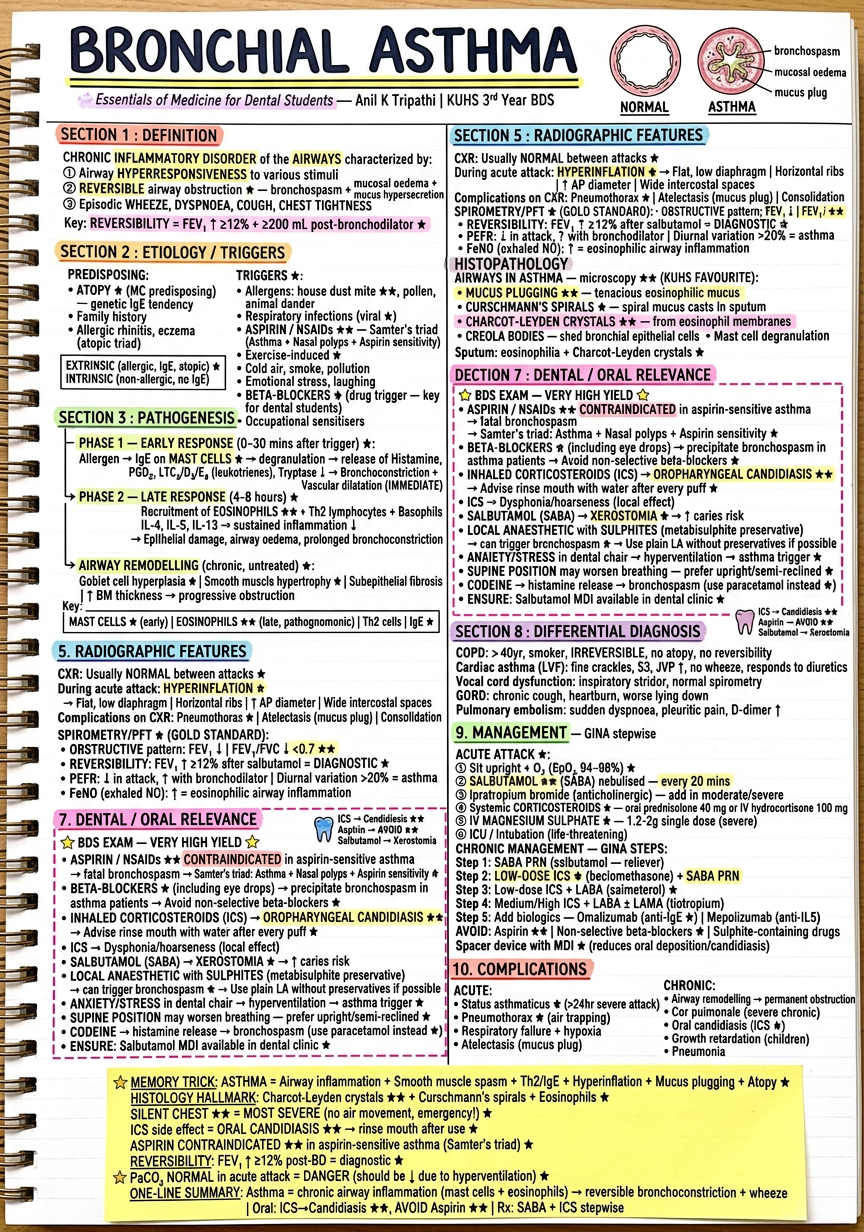
| Section | High-Yield Exam Points |
|---|---|
| Definition | Chronic airway inflammation + REVERSIBLE obstruction ★ — distinguishes from COPD |
| Etiology | Atopy (MC predisposing) ★; Triggers: HDM ★★, Aspirin ★★, Exercise, Beta-blockers ★ |
| Pathogenesis | Early: Mast cell → histamine/LTs → bronchospasm |
| Classic Triad | Wheeze ★★ + Dyspnoea + Cough (worse at night) |
| Silent Chest ★★ | No wheeze = no airflow = MOST severe = emergency |
| CXR | Usually normal; acute = hyperinflation (flat diaphragm, horizontal ribs) |
| Spirometry | Obstructive: FEV₁/FVC <0.7 + Reversible: FEV₁ ↑ ≥12% post-BD ★ |
| Histopathology ★★ | Charcot-Leyden crystals ★★ + Curschmann's spirals + Eosinophilic infiltrate + Mucus plug |
| Dental ★★ BDS | ICS → Oral Candidiasis ★★ (rinse mouth!) |
| Management | Acute: O₂ + Salbutamol ★★ + Steroids + IV MgSO₄; Chronic: ICS ★ (Step 2+) + SABA PRN |
| Complications | Status asthmaticus ★, Pneumothorax ★, Oral candidiasis (ICS) |
| Memory Trick | ASTHMA = Airway inflammation + Smooth muscle spasm + Th2/IgE + Hyperinflation + Mucus + Atopy |
Create a super aesthetic, handwritten-style revision note page for the topic: Acute Severe Asthma, Refer “Essentials of Medicine for Dental Students” by Anil K Tripathi. • Make it look like neat exam notes written on a page (top view, clean layout, colorful headings, underlines, boxes). For KUHS Thirrd Year BDS General Medicine Examination. • Keep it crisp, high-yield, and exam-oriented. • Use clear headings and organize content like this (modify if needed for topic): ○ Definition ○ Etiology ○ Pathogenesis (flow/arrow style) ○ Clinical features ○ Radiographic features (if applicable) ○ Histopathology (if applicable) ○ Key features ○ Differential diagnosis ○ Management ○ Complications ○ Key points / last-minute revision box • Add simple diagrams or labeled sketches wherever helpful. • Highlight important keywords. • Include one memory trick / one-line summary
A super aesthetic, handwritten-style A4 portrait medical revision note page for "ACUTE SEVERE ASTHMA (Status Asthmaticus)" — KUHS Third Year BDS General Medicine exam notes. Looks exactly like a real student's ruled notebook page viewed from the top: white paper with faint blue horizontal lines, warm cream background, multiple coloured ink pens, neat and very organized. Dense, high-yield, professional dental student exam aesthetic. Emergency topic — urgent red accents throughout. TOP HEADER: - Large bold title "ACUTE SEVERE ASTHMA" in thick dark navy blue ink, double underlined, bright yellow highlighter streak underneath - "= STATUS ASTHMATICUS ★ EMERGENCY ★" in a bright red box/badge - Subtitle in small purple cursive: "Essentials of Medicine for Dental Students — Anil K Tripathi | KUHS 3rd Year BDS General Medicine" - Small hand-drawn alert clock/alarm with a small lung sketch beside it labelled "TIME-CRITICAL ★" SECTION 1 — DEFINITION (coral-red heading, double underlined): Neat blue handwriting: "ACUTE SEVERE ASTHMA (Status Asthmaticus) = An acute asthma attack that is SEVERE and FAILS TO RESPOND (highlighted yellow) to usual doses of inhaled bronchodilators and corticosteroids — a MEDICAL EMERGENCY ★ with risk of death." "Formerly called STATUS ASTHMATICUS ★" "Can occur in any asthmatic patient, even those with previously mild disease ★" "Worsening usually occurs over HOURS TO DAYS before the event ★" SECTION 2 — PRECIPITATING FACTORS / ETIOLOGY (orange heading, underlined): Two neat columns: Left — "COMMON TRIGGERS:" "• Respiratory INFECTIONS (viral ★★ — MC trigger of acute attacks)" "• Non-compliance with controller medications ★" "• Allergen exposure (HDM, pollen, mould) ★" "• Exercise ★" "• Cold air / air pollution" "• Emotional stress / anxiety ★" Right — "DRUG-RELATED TRIGGERS ★:" "• ASPIRIN / NSAIDs ★★ (Samter's triad)" "• BETA-BLOCKERS ★★ (oral or even eye drops)" "• ACE inhibitors (cough → bronchoconstriction)" "• NSAIDs in aspirin-sensitive patients" "• Stopping inhaled steroids abruptly ★" Small note box: "DENTAL RELEVANCE: Aspirin ★★ + Beta-blockers ★★ are KEY triggers to avoid" SECTION 3 — PATHOGENESIS (green heading, neat arrow flowchart): "TRIGGER (infection / allergen / drug)" "↓" "Massive mast cell degranulation + Eosinophil infiltration" "↓" "↑↑ Histamine, Leukotrienes (LTC₄/D₄/E₄), PGD₂ → SEVERE BRONCHOCONSTRICTION ★" "↓" "Airway lumen narrowed → ↑↑ Airway resistance → Expiratory flow obstruction ★" "↓" "Air TRAPPING + Dynamic HYPERINFLATION ★ (Auto-PEEP) → ↑↑ Work of breathing" "↓" "Ventilation-Perfusion (V/Q) mismatch → HYPOXAEMIA ★★ (PaO₂ ↓)" "↓" "Initially: Hyperventilation → PaCO₂ ↓ (respiratory alkalosis)" "↓ (if untreated)" "RESPIRATORY MUSCLE FATIGUE → PaCO₂ RISES ★★ (DANGER SIGN = impending respiratory failure)" "↓" "Respiratory FAILURE + Cardiopulmonary ARREST ★" Key box: "RISING PaCO₂ in acute asthma = EMERGENCY — patient tiring out ★★ (highlighted red)" SECTION 4 — SEVERITY GRADING (dark blue heading, neat table): "GINA/BTS CLASSIFICATION OF ACUTE ASTHMA EXACERBATIONS ★★ (KUHS FAVOURITE):" Neat 4-row table: "MILD: PEFR >80% | Speaks in sentences | SpO₂ >95% | No tachycardia" "MODERATE: PEFR 60-80% | Speaks phrases only | SpO₂ 92-95% | HR >100 | Accessory muscles" "SEVERE ★: PEFR 33-60% | Single words only | SpO₂ <92% | HR >120 | RR >25" "LIFE-THREATENING ★★ (highlighted red): PEFR <33% | Cannot speak | SpO₂ <92% | Silent chest ★★ | Bradycardia | Hypotension | Confusion | Cyanosis" Small mnemonic: "LIFE-THREATENING = Can't speak + Silent chest + Confusion + Cyanosis + Bradycardia ★" SECTION 5 — CLINICAL FEATURES (teal heading, two neat columns): Left column — "SYMPTOMS:" "• Severe breathlessness / DYSPNOEA ★★" "• Cannot complete sentences ★" "• Chest tightness / pain" "• Wheeze (may be absent in severe!) ★" "• Cough" "• Sense of IMPENDING DOOM ★ (prodromal)" "• Prodrome: itching under chin, discomfort between scapulae ★" Right column — "SIGNS:" "• Tachypnoea (RR >25/min) ★" "• Tachycardia (HR >120/min) ★" "• ACCESSORY MUSCLE USE ★★ (highlighted yellow)" "• PULSUS PARADOXUS ★ (BP drops >10 mmHg on inspiration)" "• Chest HYPERINFLATION ★" "• Prolonged expiration" "• SILENT CHEST ★★ = most dangerous sign (highlighted red)" " (No wheeze = no airflow = near-fatal)" "• Cyanosis (central) — late, dangerous ★" "• Confusion/agitation = impending respiratory failure ★" "ABG in severe: ↓ PaO₂ (<60 mmHg) | Initially ↓ PaCO₂ → RISING PaCO₂ = DANGER ★★" SECTION 6 — INVESTIGATIONS (dark blue heading): "PEFR (Peak Expiratory Flow Rate) ★ — bedside, essential, serial monitoring" " <33% = life-threatening | 33-50% = severe | 50-75% = moderate" "PULSE OXIMETRY ★ — continuous, SpO₂ <92% = severe" "ABG ★★ — MOST IMPORTANT in severe asthma:" " Rising PaCO₂ (normocapnia or hypercapnia) = respiratory failure imminent ★★ (highlighted)" " ↓ PaO₂ <60 mmHg | Metabolic acidosis (lactic acid from respiratory work)" "ECG: Tachycardia, right heart strain (S1Q3T3), arrhythmias" "CXR: ★" " • Hyperinflation (flat diaphragm, horizontal ribs, ↑ AP diameter)" " • RULE OUT: Pneumothorax ★ | Consolidation | Pneumomediastinum" " (Not routinely done unless suspecting complication)" "FBC: ↑ Eosinophils (if allergic), WBC ↑ (infection), Hb (anaemia worsens hypoxia)" "U&E: Hypokalaemia (salbutamol + steroids → ↓ K⁺) ★" SECTION 7 — DENTAL / ORAL RELEVANCE (bright pink heading, dashed box): "⭐ BDS EXAM — EMERGENCY SCENARIO ★ ⭐" "• ACUTE ATTACK IN DENTAL CHAIR — HOW TO MANAGE ★★:" " ① STOP dental procedure immediately ★" " ② Sit patient UPRIGHT ★ (not supine)" " ③ Give patient their own SALBUTAMOL MDI (reliever inhaler) 2-4 puffs ★" " ④ Administer HIGH-FLOW O₂ by face mask ★" " ⑤ If no improvement in 5-10 min → CALL 999/AMBULANCE ★" " ⑥ Repeat salbutamol every 5-10 min while waiting" " ⑦ Do NOT give SEDATIVES / anxiolytics ★ (worsen ventilation)" " ⑧ AVOID ASPIRIN / NSAIDS ★★ — absolute contraindication in asthma" "• ASPIRIN / NSAIDS ★★ = fatal bronchoconstriction in sensitive patients" "• BETA-BLOCKERS (even in eye drops) ★ — avoid in asthmatic patients" "• LA containing SULPHITES ★ — can trigger bronchospasm" "• CODEINE ★ — causes histamine release → bronchospasm" "• NEVER give MORPHINE/SEDATIVES in acute asthma ★" Small tooth icon with red alert: "STOP procedure → UPRIGHT → Salbutamol → O₂ → 999 ★★" SECTION 8 — DIFFERENTIAL DIAGNOSIS (purple heading): "COPD exacerbation: older, smoker, fixed obstruction, no reversibility, pursed-lip breathing" "Acute Pulmonary Oedema (Cardiac Asthma): bilateral crackles, S3, JVP ↑, pink frothy sputum, CXR hilar bat-wing" "Anaphylaxis: urticaria, angioedema, hypotension, laryngeal oedema, sudden onset after allergen ★" "Pulmonary Embolism: pleuritic pain, haemoptysis, DVT signs, D-dimer ↑" "Foreign body: sudden onset, unilateral wheeze, no prior asthma history" "Vocal cord dysfunction: inspiratory stridor, normal SpO₂, normal ABG" "Key: History + PEFR reversibility + ABG + CXR ★" SECTION 9 — MANAGEMENT (green heading, step-by-step emergency protocol): "IMMEDIATE — ABC approach ★★:" "A — Airway: ensure patent, position upright ★" "B — Breathing: HIGH-FLOW O₂ (40-60% via face mask) ★ → target SpO₂ 94-98%" "C — Circulation: IV access, monitor BP/ECG/SpO₂ continuously" "PHARMACOLOGICAL (in order) ★★:" "① SALBUTAMOL (SABA) ★★ — FIRST LINE (highlighted yellow)" " Nebulised 2.5-5 mg every 15-20 min (O₂-driven) | or pMDI 4-8 puffs with spacer" "② IPRATROPIUM BROMIDE ★ (anticholinergic) — add for moderate/severe" " Nebulised 0.5 mg — additional bronchodilation" "③ SYSTEMIC CORTICOSTEROIDS ★ — give EARLY" " Oral Prednisolone 40-50 mg/day ★ OR IV Hydrocortisone 100 mg QDS" " Continue at least 5 days" "④ IV MAGNESIUM SULPHATE ★★ — life-threatening asthma / poor response to above" " 1.2-2g IV over 20-30 min — bronchodilator, reduces need for ICU ★" "⑤ IV SALBUTAMOL — if inhaled therapy cannot be used reliably" "⑥ IV AMINOPHYLLINE — if inadequate response (monitor levels, narrow TI) ★" "⑦ HELIOX (helium/oxygen mix) — reduces turbulent airflow in severe obstruction" "ICU INDICATIONS ★★ (intubation + mechanical ventilation):" "• Deteriorating PEFR | Rising PaCO₂ ★ | PaO₂ <60 | Exhaustion | Confusion | Cyanosis | Bradycardia" "DISCHARGE CRITERIA ★:" "PEFR >75% | SpO₂ >94% | No accessory muscle use | Able to walk | Stable on PRN SABA only" "NEVER: Sedatives ★ | Morphine ★ | Empirical antibiotics (unless confirmed infection) ★" SECTION 10 — COMPLICATIONS (red heading, two columns): Left: "IMMEDIATE:" "• RESPIRATORY FAILURE ★★" "• Cardiopulmonary arrest ★" "• PNEUMOTHORAX ★ (air trapping → rupture)" "• Pneumomediastinum" "• Hypoxic brain injury" Right: "FROM TREATMENT:" "• Hypokalaemia ★ (salbutamol + steroids) → arrhythmias" "• Tachyarrhythmias (salbutamol)" "• Hyperglycaemia (steroids)" "• Fluid overload" "• Barotrauma (mechanical ventilation)" BOTTOM — LAST MINUTE REVISION BOX (bright yellow sticky note, slightly tilted, red and gold stars): "★ MEMORY TRICK — LIFE-THREATENING Signs = CAN'T COPE:" "C — Can't speak | A — Absent wheeze (Silent chest) ★★ | N — No response to bronchodilators | T — Tachycardia + Bradycardia | C — Confusion/cyanosis | O — O₂ <92% | P — PEFR <33% | E — Exhaustion" "★ RISING PaCO₂ = DANGER ★★ — patient is tiring out, impending arrest" "★ SILENT CHEST ★★ = most ominous sign = near-fatal asthma (no wheeze = no airflow)" "★ PULSUS PARADOXUS >10 mmHg = severe asthma ★" "★ IV MAGNESIUM SULPHATE ★★ = single-dose life-saver in severe/life-threatening" "★ DENTAL EMERGENCY: STOP → UPRIGHT → SALBUTAMOL → O₂ → CALL 999 ★★" "★ NEVER: Sedatives / Morphine / Empirical antibiotics (unless infection confirmed)" "★ ONE-LINE SUMMARY: Acute severe asthma = status asthmaticus → severe irreversible bronchospasm → hypoxia + rising PaCO₂ = emergency | Rx: O₂ + Salbutamol + Steroids + IV MgSO₄ ★★ | Dental: STOP + UPRIGHT + SALBUTAMOL ★" Overall aesthetic: warm cream notebook paper, blue ruled lines, multiple ink colours (navy blue main text, bright coral-red for headings + emergency highlights, orange for triggers, green for management, teal for clinical features, dark blue for investigations, purple for differentials), yellow and red highlighter streaks on key terms, small hand-drawn alarm clock, lung diagram, severity table, emergency protocol arrows, neat boxes, professional dental student note style, A4 portrait layout
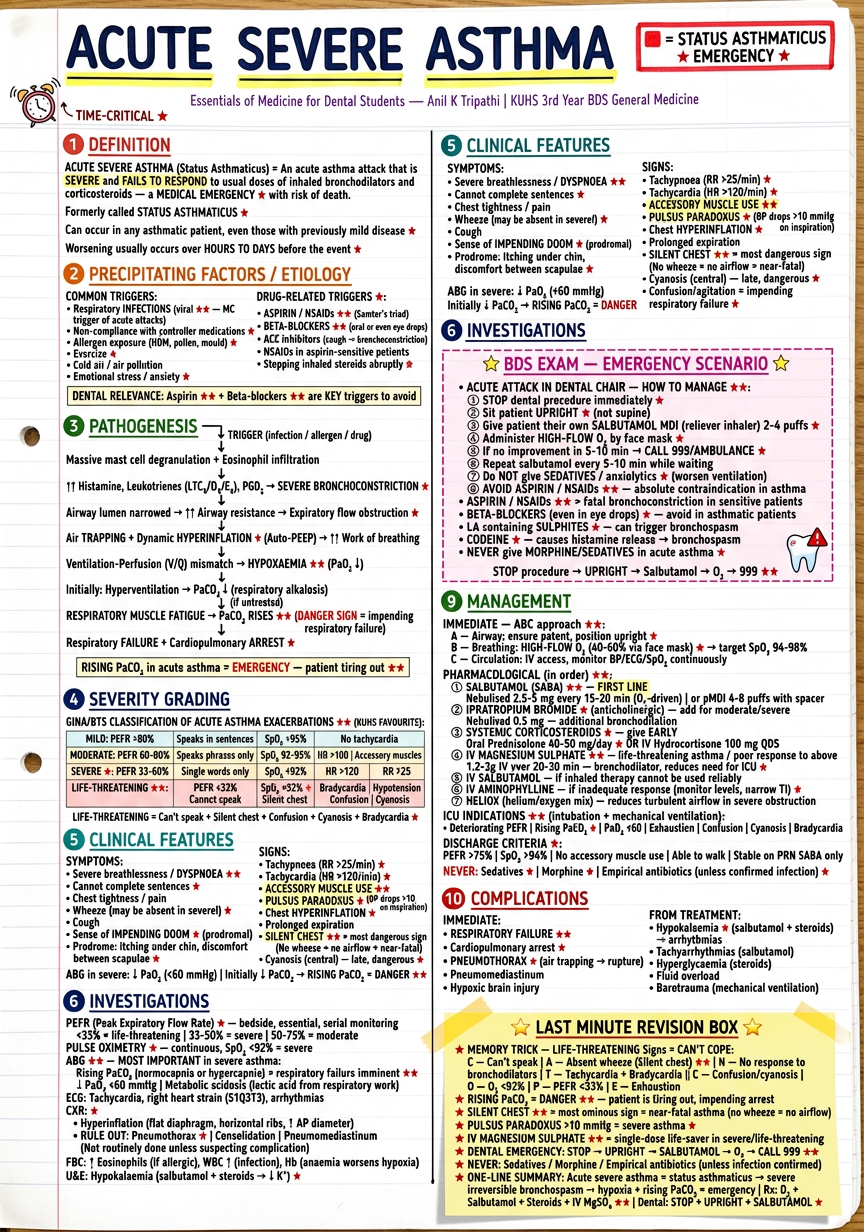
| Section | Key Exam Points |
|---|---|
| Definition | Asthma attack unresponsive to usual bronchodilators + steroids = medical emergency |
| MC Trigger | Viral respiratory infection ★★ |
| Drug triggers | Aspirin ★★, Beta-blockers ★★, ACE inhibitors |
| Life-Threatening Signs | Silent chest ★★ + PEFR <33% + SpO₂ <92% + Confusion + Bradycardia + Cyanosis |
| KEY DANGER SIGN | Rising PaCO₂ = patient tiring = impending respiratory arrest ★★ |
| Pulsus Paradoxus | SBP drops >10 mmHg on inspiration = severe asthma ★ |
| Management Order | O₂ → Salbutamol ★★ → Ipratropium → IV Steroids → IV MgSO₄ ★★ → ICU |
| IV MgSO₄ | 1.2-2g IV over 20-30 min — give in severe/life-threatening, single dose ★ |
| ICU Trigger | Rising PaCO₂ + Confusion + Exhaustion + PEFR deteriorating |
| Dental Emergency ★★ | STOP → Sit UPRIGHT → Salbutamol MDI → High-flow O₂ → Call 999 |
| NEVER Give | Sedatives / Morphine / Empirical antibiotics ★ |
| Complication | Hypokalaemia from Salbutamol + Steroids → monitor K⁺ ★ |
Generate a comprehensive KUHS BDS revision guide PDF compiling all topics (Diabetes, Heart Failure, Hypothyroidism, IDA, Mitral Regurgitation, Liver Cirrhosis, MI, Malaria, Asthma, Acute Severe Asthma)
mkdir -p /home/daytona/workspace/kuhs-bds-revision && ls /home/daytona/workspace/kuhs-bds-revision/
cd /home/daytona/workspace/kuhs-bds-revision && curl -s -o 01_diabetes.png "https://cdn.orris.care/image-gen/57a68653f51c4e9fb03af2584f62c7b8.png" && echo "DM done" & curl -s -o 02_heart_failure.png "https://cdn.orris.care/image-gen/41d8ca348b0648cd93d1735e31940c34.png" && echo "HF done" & curl -s -o 03_hypothyroidism.png "https://cdn.orris.care/image-gen/90aed496604b4162b6687d5b5c0367e3.png" && echo "Hypo done" & curl -s -o 04_IDA.png "https://cdn.orris.care/image-gen/c84248ebdcf84a9087194c08336b7f1c.png" && echo "IDA done" & curl -s -o 05_mitral_regurgitation.png "https://cdn.orris.care/image-gen/a91342dc138c44959226b7ab057e39ee.png" && echo "MR done" & wait && echo "ALL BATCH 1 DONE"
cd /home/daytona/workspace/kuhs-bds-revision && curl -s -o 01_diabetes.png "https://cdn.orris.care/image-gen/57a68653f51c4e9fb03af2584f62c7b8.png" && echo "DM done"
cd /home/daytona/workspace/kuhs-bds-revision && curl -s -o 02_heart_failure.png "https://cdn.orris.care/image-gen/41d8ca348b0648cd93d1735e31940c34.png" && echo "HF done" && curl -s -o 03_hypothyroidism.png "https://cdn.orris.care/image-gen/90aed496604b4162b6687d5b5c0367e3.png" && echo "Hypo done" && curl -s -o 04_IDA.png "https://cdn.orris.care/image-gen/c84248ebdcf84a9087194c08336b7f1c.png" && echo "IDA done"
cd /home/daytona/workspace/kuhs-bds-revision && curl -s -o 05_mitral_regurgitation.png "https://cdn.orris.care/image-gen/a91342dc138c44959226b7ab057e39ee.png" && echo "MR done" && curl -s -o 06_liver_cirrhosis.png "https://cdn.orris.care/image-gen/9e2b99c2761b47d4b9099fe60600c1b3.png" && echo "Cirrhosis done" && curl -s -o 07_myocardial_infarction.png "https://cdn.orris.care/image-gen/61aa04bfd09b4e54b603d8d378b19905.png" && echo "MI done"
cd /home/daytona/workspace/kuhs-bds-revision && curl -s -o 08_malaria.png "https://cdn.orris.care/image-gen/713b463364a249f7bdb1a030f187b952.png" && echo "Malaria done" && curl -s -o 09_bronchial_asthma.png "https://cdn.orris.care/image-gen/90bc76727c2d4c28bb30b20a929d9ebd.png" && echo "Asthma done" && curl -s -o 10_acute_severe_asthma.png "https://cdn.orris.care/image-gen/6d215e6fc2ae47baa485a0fecc1b3a08.png" && echo "ASA done"
ls -lh /home/daytona/workspace/kuhs-bds-revision/*.png
~/kuhs-bds-revision/build_pdf.py
#!/usr/bin/env python3
"""
KUHS BDS General Medicine Revision Guide - PDF Builder
Compiles all 10 handwritten-style revision note images into a single PDF
with cover page, table of contents, topic dividers, and page numbers.
"""

from reportlab.lib.pagesizes import A4
from reportlab.lib import colors
from reportlab.lib.units import cm, mm
from reportlab.platypus import (
    SimpleDocTemplate, Image, Paragraph, Spacer, PageBreak,
    Table, TableStyle, HRFlowable
)
from reportlab.lib.styles import getSampleStyleSheet, ParagraphStyle
from reportlab.lib.enums import TA_CENTER, TA_LEFT, TA_RIGHT
from reportlab.pdfgen import canvas
from reportlab.platypus import BaseDocTemplate, Frame, PageTemplate
from PIL import Image as PILImage
import os

OUTPUT_DIR = "/home/daytona/workspace/kuhs-bds-revision"
OUTPUT_PDF = os.path.join(OUTPUT_DIR, "KUHS_BDS_General_Medicine_Revision_Guide.pdf")

# Topic data: (filename, topic title, short description)
TOPICS = [
    ("01_diabetes.png",           "Diabetes Mellitus",          "Type 1 & Type 2 DM — Diagnosis, Complications, Insulin, Oral Hypoglycaemics, Dental Relevance"),
    ("02_heart_failure.png",      "Heart Failure",               "Systolic & Diastolic HF — NYHA Classification, BNP, ACEi/ARBi, Furosemide, Dental Relevance"),
    ("03_hypothyroidism.png",     "Hypothyroidism",              "Primary vs Secondary — Hashimoto's, Myxoedema Coma, Levothyroxine, Dental Relevance"),
    ("04_IDA.png",                "Iron Deficiency Anaemia",     "Microcytic Hypochromic Anaemia — Ferritin, TIBC, Oral Iron, Angular Cheilitis, Dental Relevance"),
    ("05_mitral_regurgitation.png","Mitral Regurgitation",       "Rheumatic Heart Disease — Pan-systolic Murmur, Echo, Antibiotic Prophylaxis, Dental Relevance"),
    ("06_liver_cirrhosis.png",    "Liver Cirrhosis",             "Portal Hypertension — Child-Pugh Score, Ascites, INR, Bleeding Risk, Dental Relevance"),
    ("07_myocardial_infarction.png","Myocardial Infarction",     "STEMI & NSTEMI — Troponin, MONA, Thrombolytics, Dual Antiplatelet, Dental Relevance"),
    ("08_malaria.png",            "Falciparum Malaria",          "Severe/Complicated Malaria — Artesunate, Blackwater Fever, Cerebral Malaria, Dental Relevance"),
    ("09_bronchial_asthma.png",   "Bronchial Asthma",           "Chronic Airway Inflammation — ICS, SABA, GINA Steps, Oral Candidiasis, Aspirin-sensitive, Dental Relevance"),
    ("10_acute_severe_asthma.png","Acute Severe Asthma",        "Status Asthmaticus — PEFR, Silent Chest, MgSO4, Emergency Protocol, Dental Chair Management"),
]

# Colour palette
NAVY    = colors.HexColor("#1a2744")
CRIMSON = colors.HexColor("#c0392b")
GOLD    = colors.HexColor("#f0c040")
CREAM   = colors.HexColor("#fffdf5")
CORAL   = colors.HexColor("#e8714a")
TEAL    = colors.HexColor("#1a7a7a")
PURPLE  = colors.HexColor("#6c3483")
LIGHT_BLUE = colors.HexColor("#d6eaf8")
LIGHT_GOLD = colors.HexColor("#fef9e7")
MID_GREY = colors.HexColor("#666666")
LIGHT_GREY = colors.HexColor("#f2f2f2")
WHITE   = colors.white
BLACK   = colors.black

PAGE_W, PAGE_H = A4  # 595.27 x 841.89 pts

# ── Number-on-page callback ───────────────────────────────────────────────────
_page_counter = {"n": 0}

def add_page_number(canvas_obj, doc):
    _page_counter["n"] += 1
    n = _page_counter["n"]
    canvas_obj.saveState()
    canvas_obj.setFont("Helvetica", 8)
    canvas_obj.setFillColor(MID_GREY)
    canvas_obj.drawCentredString(PAGE_W / 2, 18, f"— {n} —")
    canvas_obj.drawString(30, 18, "KUHS 3rd Year BDS · General Medicine Revision Guide")
    canvas_obj.drawRightString(PAGE_W - 30, 18, "Ref: Essentials of Medicine for Dental Students")
    canvas_obj.restoreState()


def build_cover(c, doc):
    """Draw a rich cover page directly onto the canvas."""
    w, h = PAGE_W, PAGE_H

    # Background gradient bands
    c.setFillColor(NAVY)
    c.rect(0, 0, w, h, fill=1, stroke=0)

    # Decorative top band
    c.setFillColor(CRIMSON)
    c.rect(0, h - 90, w, 90, fill=1, stroke=0)

    # Gold accent stripe
    c.setFillColor(GOLD)
    c.rect(0, h - 95, w, 5, fill=1, stroke=0)

    # Bottom decorative band
    c.setFillColor(CORAL)
    c.rect(0, 0, w, 60, fill=1, stroke=0)
    c.setFillColor(GOLD)
    c.rect(0, 60, w, 4, fill=1, stroke=0)

    # Watermark circles
    c.setFillColor(colors.HexColor("#ffffff08"))
    c.circle(w * 0.85, h * 0.75, 160, fill=1, stroke=0)
    c.circle(w * 0.15, h * 0.30, 110, fill=1, stroke=0)

    # Top band text
    c.setFillColor(WHITE)
    c.setFont("Helvetica-Bold", 13)
    c.drawCentredString(w / 2, h - 42, "KERALA UNIVERSITY OF HEALTH SCIENCES (KUHS)")
    c.setFont("Helvetica", 11)
    c.drawCentredString(w / 2, h - 62, "Third Year BDS · General Medicine Examination")

    # Main title
    c.setFillColor(GOLD)
    c.setFont("Helvetica-Bold", 36)
    c.drawCentredString(w / 2, h * 0.62, "GENERAL MEDICINE")
    c.setFont("Helvetica-Bold", 28)
    c.drawCentredString(w / 2, h * 0.55, "REVISION GUIDE")

    # Subtitle bar
    c.setFillColor(CRIMSON)
    c.roundRect(60, h * 0.49, w - 120, 34, 8, fill=1, stroke=0)
    c.setFillColor(WHITE)
    c.setFont("Helvetica-Bold", 13)
    c.drawCentredString(w / 2, h * 0.502, "Handwritten-Style High-Yield Exam Notes · 10 Topics")

    # Reference
    c.setFillColor(LIGHT_GOLD)
    c.roundRect(80, h * 0.435, w - 160, 46, 6, fill=1, stroke=0)
    c.setFillColor(NAVY)
    c.setFont("Helvetica-Bold", 10)
    c.drawCentredString(w / 2, h * 0.467, "Reference: Essentials of Medicine for Dental Students")
    c.setFont("Helvetica", 9)
    c.drawCentredString(w / 2, h * 0.449, "Anil K Tripathi  |  Supplemented from Harrison's, Robbins, Lippincott, Fishman's, Tintinalli's")

    # Topics list
    c.setFillColor(colors.HexColor("#ffffff15"))
    c.roundRect(55, h * 0.155, w - 110, h * 0.27, 10, fill=1, stroke=0)

    c.setFillColor(GOLD)
    c.setFont("Helvetica-Bold", 11)
    c.drawCentredString(w / 2, h * 0.415, "TOPICS COVERED")

    topic_names = [t[1] for t in TOPICS]
    cols = [topic_names[:5], topic_names[5:]]
    col_x = [110, w / 2 + 20]
    start_y = h * 0.385

    for ci, col in enumerate(cols):
        for ri, name in enumerate(col):
            y = start_y - ri * 22
            # bullet dot
            c.setFillColor(CORAL)
            c.circle(col_x[ci] - 12, y + 3, 4, fill=1, stroke=0)
            c.setFillColor(WHITE)
            c.setFont("Helvetica", 10)
            label = f"{ci*5 + ri + 1:02d}.  {name}"
            c.drawString(col_x[ci], y, label)

    # Bottom band
    c.setFillColor(WHITE)
    c.setFont("Helvetica-Bold", 10)
    c.drawCentredString(w / 2, 38, "Compiled by Orris AI  ·  For Personal Academic Use Only")
    c.setFont("Helvetica", 9)
    c.drawCentredString(w / 2, 22, "June 2026")


def make_divider_page(c, doc, num, title, description, colour):
    """Draw a styled topic divider page."""
    w, h = PAGE_W, PAGE_H

    # Background
    c.setFillColor(CREAM)
    c.rect(0, 0, w, h, fill=1, stroke=0)

    # Left accent bar
    c.setFillColor(colour)
    c.rect(0, 0, 18, h, fill=1, stroke=0)

    # Top header strip
    c.setFillColor(colour)
    c.rect(0, h - 80, w, 80, fill=1, stroke=0)

    # Number badge
    c.setFillColor(WHITE)
    c.circle(60, h - 40, 28, fill=1, stroke=0)
    c.setFillColor(colour)
    c.setFont("Helvetica-Bold", 22)
    c.drawCentredString(60, h - 47, str(num))

    c.setFillColor(WHITE)
    c.setFont("Helvetica-Bold", 22)
    c.drawString(100, h - 35, title)
    c.setFont("Helvetica", 11)
    c.drawString(100, h - 55, "KUHS 3rd Year BDS · General Medicine")

    # Description card
    c.setFillColor(WHITE)
    c.roundRect(40, h * 0.55, w - 80, 80, 10, fill=1, stroke=0)
    c.setFillColor(colour)
    c.setFont("Helvetica-Bold", 10)
    c.drawString(55, h * 0.61 + 45, "HIGH-YIELD TOPICS:")
    c.setFillColor(MID_GREY)
    c.setFont("Helvetica", 9)
    # Word-wrap the description
    words = description.split("—")
    for wi, part in enumerate(words):
        c.drawString(55, h * 0.61 + 25 - wi * 14, part.strip())

    # "Turn page" hint
    c.setFillColor(colour)
    c.roundRect(w / 2 - 80, h * 0.35, 160, 36, 18, fill=1, stroke=0)
    c.setFillColor(WHITE)
    c.setFont("Helvetica-Bold", 11)
    c.drawCentredString(w / 2, h * 0.366, "Revision Notes →")

    # Decorative bottom
    c.setFillColor(colour)
    c.rect(0, 0, w, 8, fill=1, stroke=0)


def build_pdf():
    from reportlab.platypus import SimpleDocTemplate

    elements = []
    styles = getSampleStyleSheet()

    # ── COVER ────────────────────────────────────────────────────────────────
    # Use a one-page canvas-only cover then switch to flowable doc
    # We'll do everything in a single BaseDocTemplate with on_page callbacks

    # Build with custom page templates
    doc = BaseDocTemplate(
        OUTPUT_PDF,
        pagesize=A4,
        leftMargin=0, rightMargin=0,
        topMargin=0, bottomMargin=0,
        title="KUHS BDS General Medicine Revision Guide",
        author="Orris AI",
        subject="KUHS 3rd Year BDS General Medicine"
    )

    full_frame  = Frame(0, 0, PAGE_W, PAGE_H, leftPadding=0, rightPadding=0,
                        topPadding=0, bottomPadding=0)
    note_frame  = Frame(10, 28, PAGE_W - 20, PAGE_H - 36,
                        leftPadding=0, rightPadding=0,
                        topPadding=0, bottomPadding=0)

    divider_colours = [CRIMSON, TEAL, PURPLE, CORAL, NAVY,
                       TEAL, CRIMSON, colors.HexColor("#1a6b1a"),
                       CORAL, CRIMSON]

    # We'll accumulate page-template callbacks
    page_templates = []

    # Cover template (no footer)
    class CoverTemplate(PageTemplate):
        def beforeDrawPage(self, c, doc):
            build_cover(c, doc)

    # Divider templates (one per topic)
    class DividerTemplate(PageTemplate):
        def __init__(self, tid, num, title, description, colour):
            self._num = num; self._title = title
            self._desc = description; self._colour = colour
            super().__init__(id=tid, frames=[full_frame])
        def beforeDrawPage(self, c, doc):
            make_divider_page(c, doc, self._num, self._title, self._desc, self._colour)
            add_page_number(c, doc)

    # Note page template (with footer)
    class NoteTemplate(PageTemplate):
        def __init__(self, tid):
            super().__init__(id=tid, frames=[note_frame])
        def beforeDrawPage(self, c, doc):
            c.setFillColor(CREAM)
            c.rect(0, 0, PAGE_W, PAGE_H, fill=1, stroke=0)
            add_page_number(c, doc)

    # TOC page template
    class TocTemplate(PageTemplate):
        def __init__(self):
            super().__init__(id="toc", frames=[
                Frame(30, 28, PAGE_W - 60, PAGE_H - 60,
                      leftPadding=10, rightPadding=10,
                      topPadding=10, bottomPadding=10)
            ])
        def beforeDrawPage(self, c, doc):
            c.setFillColor(CREAM)
            c.rect(0, 0, PAGE_W, PAGE_H, fill=1, stroke=0)
            c.setFillColor(NAVY)
            c.rect(0, PAGE_H - 55, PAGE_W, 55, fill=1, stroke=0)
            c.setFillColor(WHITE)
            c.setFont("Helvetica-Bold", 18)
            c.drawCentredString(PAGE_W / 2, PAGE_H - 32, "TABLE OF CONTENTS")
            c.setFont("Helvetica", 10)
            c.drawCentredString(PAGE_W / 2, PAGE_H - 48, "KUHS 3rd Year BDS · General Medicine Revision Guide")
            add_page_number(c, doc)

    cover_tmpl = CoverTemplate(id="cover", frames=[full_frame])
    toc_tmpl   = TocTemplate()
    note_tmpls = {}
    div_tmpls  = {}

    for i, (fname, title, desc) in enumerate(TOPICS):
        tid = f"topic_{i+1}"
        dtid = f"div_{i+1}"
        note_tmpls[tid]  = NoteTemplate(tid)
        div_tmpls[dtid]  = DividerTemplate(dtid, i+1, title, desc, divider_colours[i])

    all_templates = [cover_tmpl, toc_tmpl] + list(div_tmpls.values()) + list(note_tmpls.values())
    doc.addPageTemplates(all_templates)

    # ── FLOWABLE ELEMENTS ────────────────────────────────────────────────────
    from reportlab.platypus import NextPageTemplate, KeepTogether

    # 1. Cover (blank flowable — the template draws it)
    elements.append(NextPageTemplate("cover"))
    elements.append(Spacer(1, PAGE_H))

    # 2. TOC page
    elements.append(NextPageTemplate("toc"))
    elements.append(PageBreak())

    toc_style = ParagraphStyle("toc_entry",
        fontName="Helvetica", fontSize=11,
        leading=20, leftIndent=20, textColor=NAVY)
    toc_num_style = ParagraphStyle("toc_num",
        fontName="Helvetica-Bold", fontSize=11,
        leading=20, textColor=CRIMSON)
    toc_title_style = ParagraphStyle("toc_title",
        fontName="Helvetica-Bold", fontSize=11,
        leading=20, textColor=NAVY)
    toc_desc_style = ParagraphStyle("toc_desc",
        fontName="Helvetica", fontSize=8,
        leading=13, textColor=MID_GREY, leftIndent=30)

    elements.append(Spacer(1, 20))

    page_num_start = 3  # cover=1, toc=2, first topic divider=3
    for i, (fname, title, desc) in enumerate(TOPICS):
        pg = page_num_start + i * 2
        # Row: number + title + page
        row_data = [[
            Paragraph(f"<b>{i+1:02d}</b>", toc_num_style),
            Paragraph(f"<b>{title}</b>", toc_title_style),
            Paragraph(f"p. {pg}", ParagraphStyle("pgn", fontName="Helvetica",
                fontSize=10, textColor=MID_GREY, alignment=TA_RIGHT))
        ]]
        row_style = TableStyle([
            ("BACKGROUND", (0,0), (-1,0), LIGHT_GREY if i%2==0 else WHITE),
            ("ROWBACKGROUNDS", (0,0), (-1,-1), [LIGHT_BLUE, WHITE]),
            ("LEFTPADDING",  (0,0), (-1,-1), 8),
            ("RIGHTPADDING", (0,0), (-1,-1), 8),
            ("TOPPADDING",   (0,0), (-1,-1), 6),
            ("BOTTOMPADDING",(0,0), (-1,-1), 4),
            ("LINEBELOW", (0,0), (-1,0), 0.5, colors.HexColor("#dddddd")),
            ("ROUNDEDCORNERS", [4]),
        ])
        t = Table(row_data, colWidths=[35, 370, 60])
        t.setStyle(row_style)
        elements.append(t)
        elements.append(Paragraph(desc.replace("—", "·"), toc_desc_style))
        elements.append(Spacer(1, 4))

    elements.append(Spacer(1, 12))
    elements.append(HRFlowable(width="100%", thickness=1.5, color=NAVY))
    elements.append(Spacer(1, 6))
    elements.append(Paragraph(
        "<i>All notes are high-yield, exam-oriented, and referenced to Essentials of Medicine for Dental Students (Anil K Tripathi), "
        "supplemented from Harrison's Principles of Internal Medicine, Robbins Pathology, Lippincott Pharmacology, "
        "Fishman's Pulmonary Diseases, and Tintinalli's Emergency Medicine.</i>",
        ParagraphStyle("footer_note", fontName="Helvetica-Oblique", fontSize=8,
                       textColor=MID_GREY, leading=12, alignment=TA_CENTER)
    ))

    # 3. Topic pages (divider + note image)
    for i, (fname, title, desc) in enumerate(TOPICS):
        div_id  = f"div_{i+1}"
        note_id = f"topic_{i+1}"
        img_path = os.path.join(OUTPUT_DIR, fname)

        # Divider page
        elements.append(NextPageTemplate(div_id))
        elements.append(PageBreak())
        elements.append(Spacer(1, PAGE_H))  # template draws everything

        # Note image page — fit image to full A4 minus margins
        elements.append(NextPageTemplate(note_id))
        elements.append(PageBreak())

        pil = PILImage.open(img_path)
        iw, ih = pil.size
        # Scale to fit within note frame (PAGE_W-20 x PAGE_H-64)
        max_w = PAGE_W - 20
        max_h = PAGE_H - 64
        ratio = min(max_w / iw, max_h / ih)
        draw_w = iw * ratio
        draw_h = ih * ratio

        img = Image(img_path, width=draw_w, height=draw_h)
        img.hAlign = "CENTER"
        elements.append(img)

    doc.build(elements)
    print(f"PDF written to: {OUTPUT_PDF}")
    size_mb = os.path.getsize(OUTPUT_PDF) / 1e6
    print(f"File size: {size_mb:.1f} MB")


if __name__ == "__main__":
    build_pdf()