
Explain how to measure QT interval from an ECG and give me the normal reference values
Reading File
Finding Sources
Finding Sources
Searching Images
QT interval measurement ECG diagram
Reading File
Reading File
Finding Sources
Reading File
Loading Image
Loading Image
Here is a comprehensive guide to QT interval measurement and normal reference values, drawn from authoritative cardiology textbooks.
What Is the QT Interval?
The QT interval represents the total duration of ventricular depolarization and repolarization — from the onset of the QRS complex to the end of the T wave. Because the QRS itself contributes a small component, the QT is primarily a measure of ventricular repolarization time.
How to Measure the QT Interval
Step 1 — Choose the correct leads
Measure in leads II, V5, and V6. Report the longest interval found among these three leads, averaged over 3–5 consecutive cycles. If measurement is not possible in these leads, other leads may be used.
Step 2 — Identify the boundaries
- Start: the earliest deflection of the QRS complex (onset of the Q wave, or the R wave if no Q is present)
- End: the point where the T wave returns to the isoelectric (TP) baseline
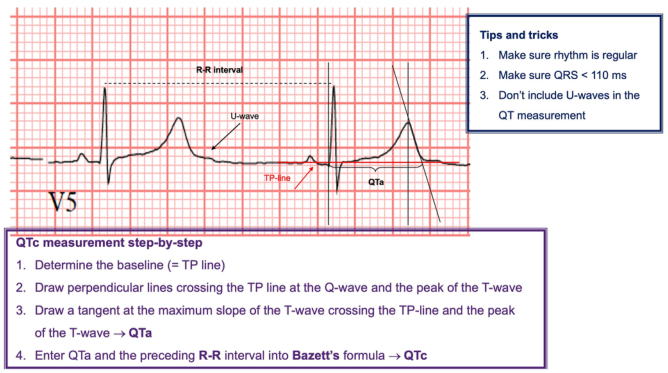
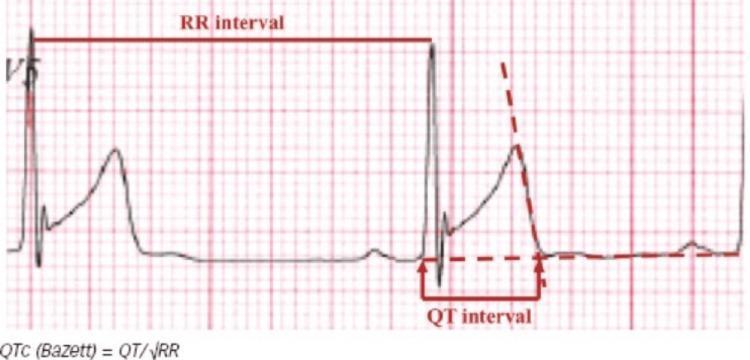
Tangent method (recommended): Draw a tangent line along the steepest descending slope of the T wave. Where this tangent intersects the baseline = the end of the QT interval.
Step 3 — Handle the U wave
The U wave (if present) should not be included in the QT measurement. Extrapolate the slope of the T wave to the baseline to find the true endpoint, ignoring any subsequent U wave deflection.
Rate Correction (QTc)
The QT interval shortens at faster heart rates and lengthens at slower ones, so it must be corrected for heart rate before interpreting as normal or abnormal.
Bazett's Formula (most widely used)
$$QTc = \frac{QT}{\sqrt{RR}}$$
- QT and RR are measured in seconds
- RR = time between two consecutive R waves
Limitation: Bazett's formula overcorrects at high heart rates and undercorrects at low ones. For best accuracy, ensure the rhythm is regular and QRS < 110 ms before applying it.
Fridericia's Formula (alternative)
$$QTc = \frac{QT}{\sqrt[3]{RR}}$$
May be more accurate in atrial fibrillation and better at predicting adverse outcomes, but has not achieved widespread clinical use.
Framingham Formula (Harrison's)
$$QT_{corrected} = QT + 0.154 \times (1000 - RR) \quad \text{(in ms)}$$
Normal Reference Values
| Parameter | Men | Women |
|---|---|---|
| Normal upper QTc limit | ≤ 450 ms | ≤ 460 ms |
| Short QT (concerning) | < 320–340 ms | < 320–340 ms |
Women have slightly longer QTc values than men — this sex difference is most prominent in young and middle-aged adults.
For context on other ECG intervals:
- PR interval: 120–200 ms
- QRS duration: ≤ 100–110 ms
- QT interval (uncorrected, at normal HR ~60–100 bpm): approximately 350–440 ms
Practical Tips
| Tip | Why |
|---|---|
| Confirm regular rhythm before measuring | Irregular rhythm (e.g., AF) makes RR averaging unreliable |
| Ensure QRS < 110 ms | Wide QRS prolongs the QT mechanically; the JT interval (J point to end of T wave) is preferred in bundle branch block — subtract excess QRS (measured QRS − 80 ms) from the QT |
| Average 3–5 beats | Reduces beat-to-beat variability |
| Do not include U waves | Falsely prolongs QT |
| Use the longest QT across leads | Maximizes sensitivity for detecting prolongation |
Clinical Significance
- Prolonged QTc (> 450 ms men / > 460 ms women): risk of torsades de pointes ventricular tachycardia. Causes include drugs (antiarrhythmics, some antibiotics and antipsychotics), hypokalemia, hypomagnesemia, hypothyroidism, congenital long QT syndromes, and CNS events.
- Short QTc (< 320–340 ms): rare; associated with short QT syndrome and risk of malignant ventricular arrhythmias.
— Goldman-Cecil Medicine, QT Interval section; Harrison's Principles of Internal Medicine 22E, Basic ECG Waveforms and Intervals
This is a shared conversation. Sign in to Orris to start your own chat.