
Explain , route of spread , pathophysiology, , sign and symptoms , complications of varicella zoster virus
"Varicella-Zoster Virus"[MeSH Terms]
CDC chickenpox varicella symptoms complications transmission
varicella chickenpox vesicular rash clinical photograph distribution
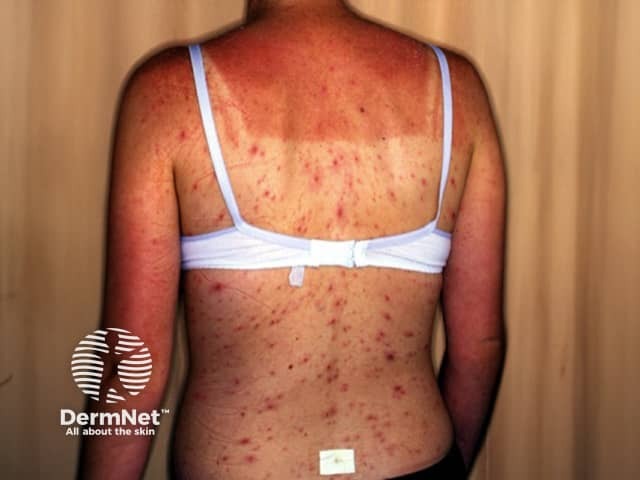
Clinical photography of the patient’s back showing a vesiculo-papular rash consistent with varicella (chickenpox). Modality: clinical dermatology photography; technique: high‑resolution color digital photograph acquired in a clinical setting, posterior/dorsal view of the trunk; lighting: diffuse, even illumination; no contrast. Anatomical context: integumentary system; back (thoracic‑lumbar paraspinal region) with lesions concentrated along the paraspinal and scapular areas. Lesion morphology: crops of small erythematous macules evolving into papules and vesicles, some ruptured with crust formation; surfaces may be dewy and excoriated from scratching; vesicles appear as translucent, fluid‑filled lesions on an inflamed base; color varying from red to pink; distribution: centripetal (trunk > face > limbs) with bilateral symmetry; no mucosal involvement evident in this view; progression stage in this image suggests early-to-mid vesicular phase with healing crusts. Clinical interpretation: rash compatible with varicella infection; differential considerations include disseminated herpes zoster in adults and less likely pityriasis rosea or papular urticaria; diagnostic significance: highly contagious, portal of entry for VZV; clinical correlation: fever, malaise, pruritus; management implications: isolation, antiviral therapy in appropriate populations; educational and research use: dermatology teaching, image-based differential diagnosis, telemedicine consultation. Keywords: varicella, chickenpox, vesicular rash, trunk-dominant eruption, vector contagion, VZV.
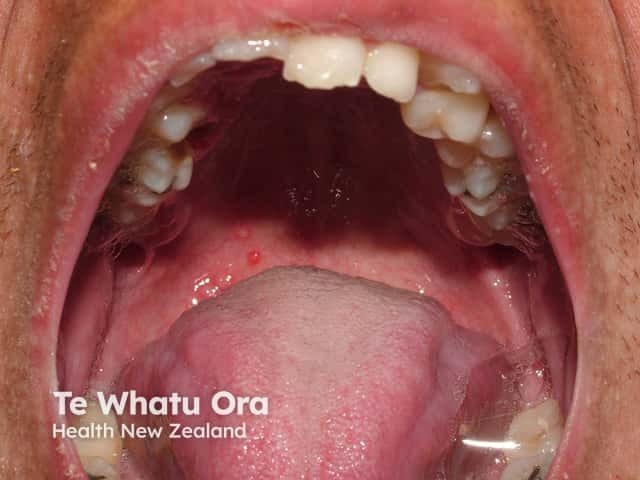
Clinical intraoral photograph depicting mucosal enanthem consistent with varicella (chickenpox) involvement of the oral mucosa. Modality: clinical photography of the oral cavity, frontal intraoral view with the mouth opened to expose the buccal mucosa, tongue, hard palate, and gingival tissues. The image highlights multiple vesicular lesions on oral mucosa with erythematous bases, some vesicles partially ruptured forming shallow erosions and irregular ulcers. The lesions appear discrete yet can coalesce in affected areas, reflecting the characteristic varicella presentation of generalized mucocutaneous involvement. The surrounding mucosa is moist and mildly erythematous, with preserved structural integrity of the teeth and adjacent gingiva. No purulent discharge is evident; there is subtle edema of the labial mucosa. This visualization illustrates an enanthem rather than exanthem limited to the skin, emphasizing mucosal involvement that may accompany the cutaneous rash. In clinical practice this pattern supports a varicella diagnosis when integrated with fever, malaise, pruritic vesicular rash, and compatible epidemiologic context. Differential considerations include herpes simplex stomatitis, aphthous ulcers, or hand, foot, and mouth disease; however, age, distribution, and concurrent skin findings aid differentiation. The image is valuable for medical education, dermatology, infectious disease, dental training, and radiology correlate when assessing vesicular mucositis. Useful for case discussions, exams, and remote review.
https://www.cdc.gov/chickenpox/signs-symptoms/index.html
Varicella-zoster virus (VZV)
- Varicella (chickenpox): the primary infection, usually occurring in children.
- Herpes zoster (shingles): reactivation of the same virus years later from its latent state in sensory nerve ganglia.
Route of spread
Person-to-person transmission
- Airborne respiratory droplets/aerosols from an infected person with chickenpox.
- Direct contact with fluid from varicella vesicles.
- Less commonly, contact with fluid from active shingles lesions can transmit VZV to a nonimmune person. That person develops chickenpox, not shingles.
Vertical transmission
Pathophysiology
Primary VZV infection: chickenpox
-
Entry and initial replication
- VZV is inhaled and infects epithelial cells of the nasopharynx or conjunctiva.
-
Lymphatic spread
- It replicates in nearby lymph nodes.
-
Primary viremia
- Virus enters the bloodstream and travels to reticuloendothelial organs, especially the liver and spleen.
-
Secondary viremia
- After further replication, infected mononuclear cells carry the virus back into the bloodstream.
-
Skin and mucosal infection
- VZV reaches the skin and mucosa through the blood.
- Viral replication in epidermal cells produces ballooning degeneration, cell swelling, and fluid accumulation, resulting in vesicles.
-
Latency
- After recovery, VZV enters sensory neurons and becomes latent in dorsal-root and cranial-nerve ganglia for life.
Reactivation: herpes zoster
- Virus replicates in the ganglion, causing inflammation and neuropathic pain.
- It then travels down the affected sensory nerve to the skin.
- The rash is therefore unilateral and dermatomal, rather than generalized.
Signs and symptoms of varicella
Incubation period
Prodromal symptoms
- Fever
- Malaise
- Fatigue
- Headache
- Loss of appetite
- Sore throat
Characteristic rash
- Starts commonly on the scalp, face, trunk, chest, or back
- Spreads to the limbs, with a centripetal distribution: trunk more affected than extremities
- May involve the mouth, pharynx, eyelids, and genital area
- Appears in repeated crops
Complications of varicella
1. Secondary bacterial infection of the skin
- Usually due to Staphylococcus aureus or Streptococcus pyogenes
- Can cause impetigo, cellulitis, abscess, or rarely invasive group A streptococcal disease, necrotizing fasciitis, or sepsis.
2. Neurologic complications
- Acute cerebellar ataxia: usually develops after the rash; presents with unsteady gait, tremor, and poor coordination. It is often self-limited.
- Encephalitis: headache, altered consciousness, seizures, focal neurologic signs; may cause permanent deficits or death.
- Meningitis, transverse myelitis, stroke due to VZV vasculopathy, and Guillain-Barré syndrome are uncommon.
3. Varicella pneumonia
- More common and more severe in adults, pregnant people, neonates, and immunocompromised patients.
- Presents with cough, dyspnea, tachypnea, hypoxia, and diffuse pulmonary infiltrates.
- It is an important cause of VZV-related mortality. Jawetz, Melnick & Adelberg’s Medical Microbiology, p. 488.
4. Hematologic complications
- Thrombocytopenia
- Purpura
- Hemorrhagic varicella
- Disseminated intravascular coagulation in severe cases
5. Hepatic and systemic disease
- Hepatitis
- Disseminated infection involving the liver, lungs, brain, kidneys, and other organs, especially in immunocompromised people.
6. Pregnancy and neonatal complications
- Congenital varicella syndrome after maternal infection early in pregnancy: limb hypoplasia, cicatricial skin scars, eye disease, neurologic abnormalities, and growth restriction.
- Severe neonatal varicella may occur when maternal rash develops from about 5 days before to 2 days after delivery, before enough protective maternal antibody can reach the newborn.
7. Late complication: shingles
Key distinction
| Feature | Varicella | Herpes zoster |
|---|---|---|
| Cause | Primary VZV infection | Reactivation of latent VZV |
| Distribution | Generalized, centripetal | Unilateral, dermatomal |
| Spread to skin | Viremia | Along sensory nerve |
| Main rash feature | Crops of lesions at different stages | Grouped painful vesicles in one dermatome |
| Typical patient | Nonimmune child or adult | Older adult or immunocompromised person |
Explain VZV diagnosis, treatment, and prevention
"Varicella-Zoster Virus"[MeSH Terms] AND vaccination
CDC varicella diagnosis treatment prevention antiviral vaccination post exposure prophylaxis
https://www.cdc.gov/chickenpox/hcp/vaccine-considerations/in…
VZV diagnosis, treatment, and prevention
1. Diagnosis
Clinical diagnosis
| Condition | Typical diagnostic features |
|---|---|
| Varicella | Fever/malaise followed by a generalized, intensely itchy rash appearing in crops. Macules, papules, vesicles, pustules, and crusts coexist. Distribution is mainly face/scalp and trunk, then limbs. |
| Herpes zoster | Burning, tingling, or pain followed by grouped vesicles on an erythematous base in a unilateral dermatomal pattern, usually not crossing the midline. |
Laboratory confirmation
- VZV PCR from fluid or cells from the base of a vesicle/scab is the preferred confirmatory test. It is rapid and sensitive.
- Direct fluorescent antibody testing can be used where available but is less sensitive than PCR.
- Viral culture is slow and less sensitive, so it is rarely preferred.
- Serology
- VZV IgG indicates prior infection or vaccination and helps determine immunity.
- VZV IgM is less reliable for diagnosing acute infection and should not be used alone to confirm a case.
- For neurologic disease, VZV PCR and/or intrathecal anti-VZV antibody testing may be performed on cerebrospinal fluid.
2. Treatment
A. Uncomplicated varicella in an otherwise healthy child
- Rest and fluids
- Paracetamol/acetaminophen for fever or discomfort
- Cool baths, calamine lotion, oral antihistamines, and short fingernails to reduce itching and excoriation
- Watch for secondary bacterial skin infection
B. Antiviral therapy for varicella
- Adolescents and adults
- Pregnant patients, after obstetric/medical assessment
- People receiving corticosteroids
- People with chronic skin or lung disease
- Household contacts in whom disease is likely to be severe
- Varicella pneumonia
- Encephalitis, meningitis, myelitis, or other CNS disease
- Disseminated or hemorrhagic varicella
- Severe hepatitis or thrombocytopenia
- Severe neonatal varicella
- Immunocompromised patients with suspected or confirmed varicella
C. Treatment of herpes zoster
- Acyclovir
- Valacyclovir
- Famciclovir
- Eye pain, visual symptoms, or rash on the tip/side of the nose: possible ophthalmic zoster
- Ear vesicles, facial weakness, vertigo, or hearing change: possible Ramsay Hunt syndrome
- Altered mental status, severe headache, weakness, or seizures
- Disseminated lesions
- Pregnancy, newborn exposure, or immunocompromise
3. Prevention
A. Varicella vaccine
- First dose: age 12-15 months
- Second dose: age 4-6 years
Important contraindications
- Pregnant people
- People with severe immunosuppression
- People with a history of severe allergic reaction to a vaccine component or prior dose
B. Herpes zoster vaccine
- Adults aged 50 years and above
- Immunocompromised adults aged 19 years and above
C. Post-exposure prophylaxis
- Eligible, nonimmune persons: give varicella vaccine as soon as possible, ideally within 3-5 days. This may prevent infection or reduce disease severity.
- People who cannot receive vaccine and are at high risk, such as susceptible pregnant people, severely immunocompromised individuals, and certain exposed newborns: give varicella-zoster immune globulin (VariZIG) as soon as possible, up to 10 days after exposure. CDC post-exposure guidance
D. Infection control
- Isolate using airborne and contact precautions in healthcare settings.
- Keep the patient away from susceptible people, especially pregnant people, newborns, and immunocompromised individuals.
- Infectious period: from 1-2 days before rash onset until all lesions have crusted.
- For breakthrough varicella without crusting lesions, the person remains infectious until no new lesions have appeared for 24 hours.
- Cover lesions.
- Avoid direct contact with people without immunity to VZV until lesions have crusted.
- Transmission from shingles causes chickenpox in a susceptible exposed person.
Can. Throat pain also occur in varicella
"Varicella"[MeSH Terms] AND pharyngitis
CDC varicella sore throat mouth lesions symptoms
How can painful oral lesions in varicella be managed?
varicella oral lesions management
chickenpox mouth sores management hydration acetaminophen avoid aspirin authoritative guidance
At home
- Fluids first: Offer frequent small sips of cool water, oral rehydration solution, milk, ice chips, ice pops, or cold smoothies. Avoid acidic drinks such as orange juice, and spicy, salty, hot, or rough foods that sting.
- Soft, bland foods: Yogurt, porridge, mashed foods, soup cooled to lukewarm, and ice cream can be easier to tolerate.
- Pain and fever relief: Use paracetamol/acetaminophen as directed for the person's age and weight. Do not give aspirin or aspirin-containing products to children or teenagers with varicella because of the risk of Reye syndrome. CDC treatment advice
- Gentle mouth care: In an older child or adult who can spit reliably, gentle salt-water rinses may reduce discomfort. Do not use rinses in young children who may swallow them.
- Avoid irritating topical products: Do not routinely use numbing gels, mouth sprays, or viscous lidocaine in young children unless a clinician specifically prescribes them. Numbness can impair swallowing and raise choking or aspiration risk.
When antiviral treatment is considered
Seek urgent medical assessment if there is
- Inability or refusal to drink
- Signs of dehydration: very little urine, dry mouth, no tears, marked sleepiness, dizziness
- Drooling, inability to swallow saliva, muffled voice, or breathing difficulty
- Persistent severe throat pain or rapidly worsening mouth lesions
- High or persistent fever, confusion, severe headache, chest symptoms
- Pregnancy, newborn age, or immunocompromise
Role of calamine?
calamine pruritus topical
CDC chickenpox calamine lotion itching treatment
Its role in varicella
- Produces a cooling, soothing effect.
- Acts as a mild astringent/counterirritant, which can reduce pruritus.
- May help dry moist or oozing vesicles slightly.
- By reducing scratching, it may indirectly lower the risk of excoriation and secondary bacterial skin infection.
How to use
- Apply a thin layer to intact external skin as directed on the product.
- Avoid the eyes, mouth, throat, genitals, and other mucosal surfaces.
- Do not apply it inside chickenpox mouth lesions, as it is not intended for oral use.
- Stop use if it causes burning, worsening redness, or an allergic reaction.