
Define sterilization and disinfection autoclave diagram
Reading File
Now let me search the medical library for sterilization and disinfection content, and look for autoclave diagrams in parallel.
Finding Sources
Searching the Web
autoclave diagram labeled parts sterilization
Reading File
Reading File
Loading Image
Now let me get more content on autoclave from the textbook, including how it works:
Finding Sources
Loading Image
Reading File
Reading File
Now let me get the autoclave section from Sherris:
Reading File
Loading Image
I now have all the information needed. Here is a complete answer:
Sterilization and Disinfection
Definitions
Sterilization
Sterilization is an absolute term. It means the complete killing or removal of all living organisms - including bacteria, fungi, viruses, and most importantly bacterial spores - from a material or surface. It can be accomplished by:
- Autoclaving (steam under pressure)
- Incineration / dry heat
- Ionizing or UV radiation
- Certain gases (ethylene oxide, formaldehyde vapor)
- Some liquid chemicals (glutaraldehyde, peracetic acid)
- Filtration
"Sterilization is an absolute term. It means complete killing, or removal, of all living organisms from a particular location or material." - Sherris & Ryan's Medical Microbiology, 8th Ed.
Disinfection
Disinfection is a less precise term. It implies the destruction of most pathogenic microorganisms, but falls short of the criteria for sterilization. Bacterial spores, mycobacteria (waxy coat), and some viruses may resist common disinfectants.
Disinfection is subdivided into three levels:
| Level | Agents | Targets |
|---|---|---|
| High-level | Moist heat, glutaraldehyde, hydrogen peroxide, peracetic acid, chlorine compounds | Most organisms except large numbers of spores |
| Intermediate-level | Alcohols, iodophors, phenolic compounds | Vegetative bacteria, mycobacteria, most viruses/fungi |
| Low-level | Quaternary ammonium compounds | Most vegetative bacteria, some fungi/viruses |
Related terms:
- Antiseptics - disinfecting agents safe for use on body surfaces (skin, mucous membranes); lower toxicity but usually less active
- Pasteurization - a form of disinfection using heat below sterilizing temperature (e.g., 74°C for 3-5 sec for milk); kills vegetative pathogens but NOT spores
- Asepsis - working systems/procedures designed to prevent microorganisms from reaching a protected environment (e.g., operating room technique)
- Sanitization - even less precise; used in housekeeping/food preparation contexts
Medical Microbiology 9e notes: "Disinfection results in the destruction of most organisms, although the more resilient microbes can survive some disinfection procedures."
The Autoclave
Principle
The autoclave uses saturated steam under pressure - the most effective sterilizing agent. Pressure itself does NOT sterilize; it raises the temperature of steam above 100°C, and this elevated temperature denatures microbial proteins and destroys all life forms including spores.
- Standard conditions: 121°C at 15 lbs/sq. inch (1 kg/cm²) for 15-20 minutes
- Flash autoclave (OR use): 134°C for 3 minutes
- Kills ALL forms of life including spores
The autoclave works on the same principle as a domestic pressure cooker. - Park's Textbook of Preventive and Social Medicine
Autoclave Diagram
Detailed cross-section (downward displacement / gravity displacement type):
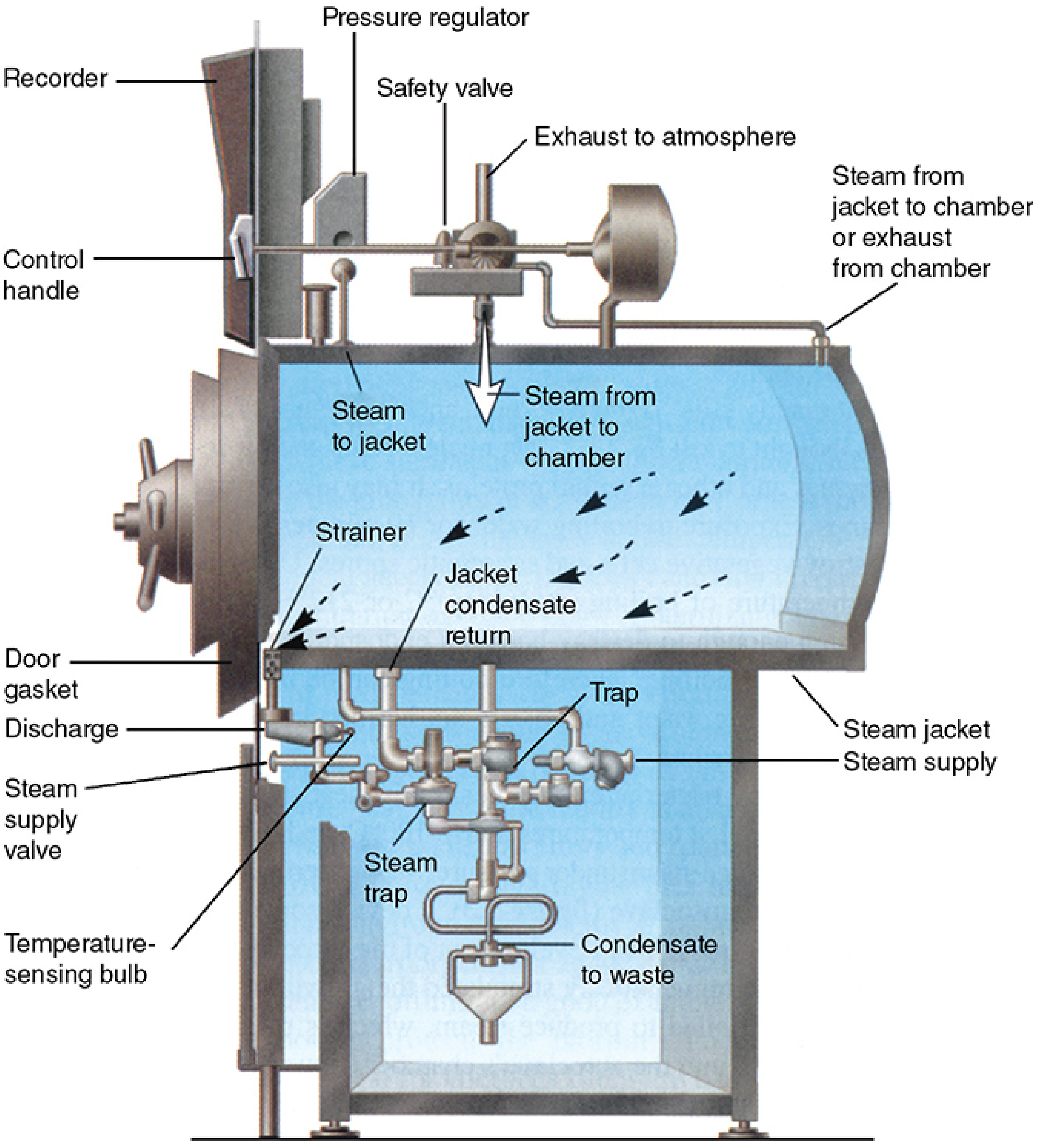
FIGURE: Simple downward displacement autoclave. Key labeled parts: Recorder, Control handle, Door gasket, Discharge, Steam supply valve, Temperature-sensing bulb, Strainer, Pressure regulator, Safety valve, Exhaust to atmosphere, Steam jacket, Steam trap, Condensate to waste. - Sherris & Ryan's Medical Microbiology, 8th Ed., Fig. 3-2
Gravity displacement type - steam/air flow diagram:
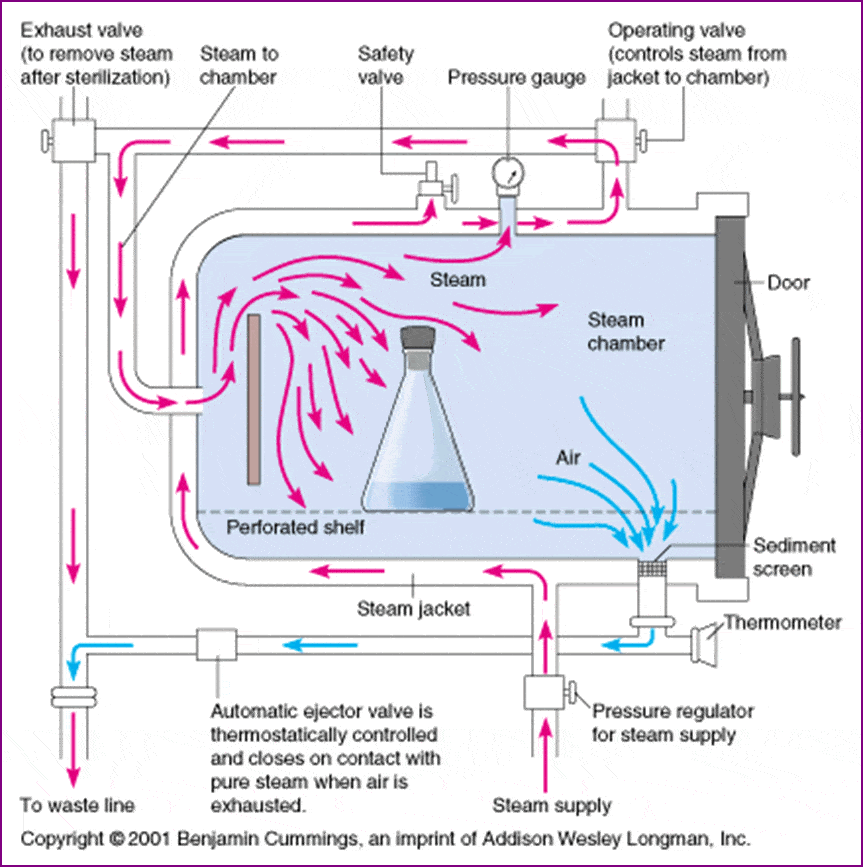
Portable bench-top autoclave (external parts):

Key Components of an Autoclave
| Component | Function |
|---|---|
| Pressure chamber | Double-walled vessel (inner chamber + outer jacket) that holds items to be sterilized |
| Steam jacket | Surrounds the inner chamber; pre-heats the walls to prevent condensation |
| Pressure gauge | Monitors pressure inside the chamber |
| Safety valve | Releases excess pressure to prevent explosion |
| Pressure regulator | Maintains desired steam pressure |
| Temperature-sensing bulb | Monitors temperature to verify sterilizing conditions |
| Exhaust/discharge valve | Removes air and condensate |
| Steam trap | Allows condensate out but not steam |
| Door gasket | Creates an airtight seal |
Types of Autoclaves
- Gravity (Downward) Displacement - Steam enters at top; heavier air is displaced downward through a drain valve; slower but common in labs
- High-speed Pre-vacuum (Flash) - Air mechanically evacuated before steam injection; faster (134°C, 3 min); used in operating rooms
What Cannot Be Autoclaved
- Plastics and rubber that melt at high temperatures
- Sharp instruments (dulled by heat)
- Oils and powders (steam cannot penetrate)
- Heat-sensitive lensed instruments → use ethylene oxide gas instead
Comparison: Sterilization vs. Disinfection
| Feature | Sterilization | Disinfection |
|---|---|---|
| Kills spores | Yes | Usually no |
| Kills all organisms | Yes (absolute) | Most (not all) |
| Method examples | Autoclave, EtO, ionizing radiation | Alcohols, chlorine, phenolics |
| Precision | Absolute | Relative |
| Application | Surgical instruments, culture media | Environmental surfaces, skin prep |
Sources: Sherris & Ryan's Medical Microbiology, 8th Ed. | Medical Microbiology 9e | Park's Textbook of Preventive and Social Medicine
This is a shared conversation. Sign in to Orris to start your own chat.