
Medical code of ethics of medical students with images
Reading File
Now let me search the medical library and web in parallel for medical ethics content relevant to medical students.
Finding Sources
Searching the Web
medical code of ethics for medical students principles with images
Good. Now let me read the most relevant textbook sections in parallel - the Forensic Medicine (CODE OF MEDICAL ETHICS) and the Essentials section, plus search for more specific ethics content.
Reading File
Reading File
Finding Sources
Let me now read the key sections from the Essentials of Forensic Medicine (2026) on medical ethics and bioethics, and also the Declaration of Geneva section and principles section, plus fetch some images.
Reading File
Reading File
Loading Image
Now let me read more content - the Declaration of Geneva text and bioethics principles sections, plus search for more ethical principles content.
Reading File
Reading File
Finding Sources
Excellent! I have a lot of content. Let me now read the Miller's Orthopaedics section which has a diagram of the 4 principles, and also read more of the bioethics section with specific principles.
Reading File
Reading File
Now let me fetch the diagram image from Miller's and also read additional content on informed consent, confidentiality, and duties of medical students.
Loading Image
Finding Sources
Finding Sources
I have very rich content. Let me also read the Charaka oath section, the duties section, and get specific content on medical students' obligations.
Reading File
Reading File
I now have comprehensive content from multiple authoritative textbooks. Let me compile a thorough, well-illustrated answer on the Medical Code of Ethics for Medical Students.
Medical Code of Ethics for Medical Students
Medical ethics is the "moral principles" or "code of conduct" that governs medical professionals' interactions with each other, their patients, and the State. For medical students, understanding and practicing ethical principles is foundational from the very first day of medical school.
1. Historical Origins
| Era | Document/Oath | Significance |
|---|---|---|
| 1750 BCE | Code of Hammurabi (Babylonia) | Earliest documented standards for medical practitioners |
| 1500 BCE | Sushruta's Oath (Sushruta Samhita) | Father of Indian Surgery; foundational ethical standards |
| 200 BCE | Charaka's Oath (Charaka Samhita) | Father of Indian Medicine; in 2022 the NMC introduced the Charaka Oath for white coat ceremonies in India |
| 5th century BCE | Hippocratic Oath | Attributed to Hippocrates (Father of Medicine); established beneficence, non-maleficence, and justice |
| 1803 | Thomas Percival | Wrote first "modern code of medical ethics" and coined the terms "medical ethics" and "medical jurisprudence" |
| 1847 | AMA Code of Ethics | First national code of ethics based on Percival's work |
| 1948 | Declaration of Geneva | Modern version of the Hippocratic Oath; now administered to new MBBS students on first day of admission |
| 1949 | International Code of Medical Ethics (ICME) | WMA delineated physician duties "in general, to the sick, and to colleagues" |
- The Essentials of Forensic Medicine and Toxicology, 36th ed. (2026), p. 40-41
2. The Four Pillars of Medical Ethics
The Beauchamp and Childress model (the most widely taught framework) identifies four core principles:
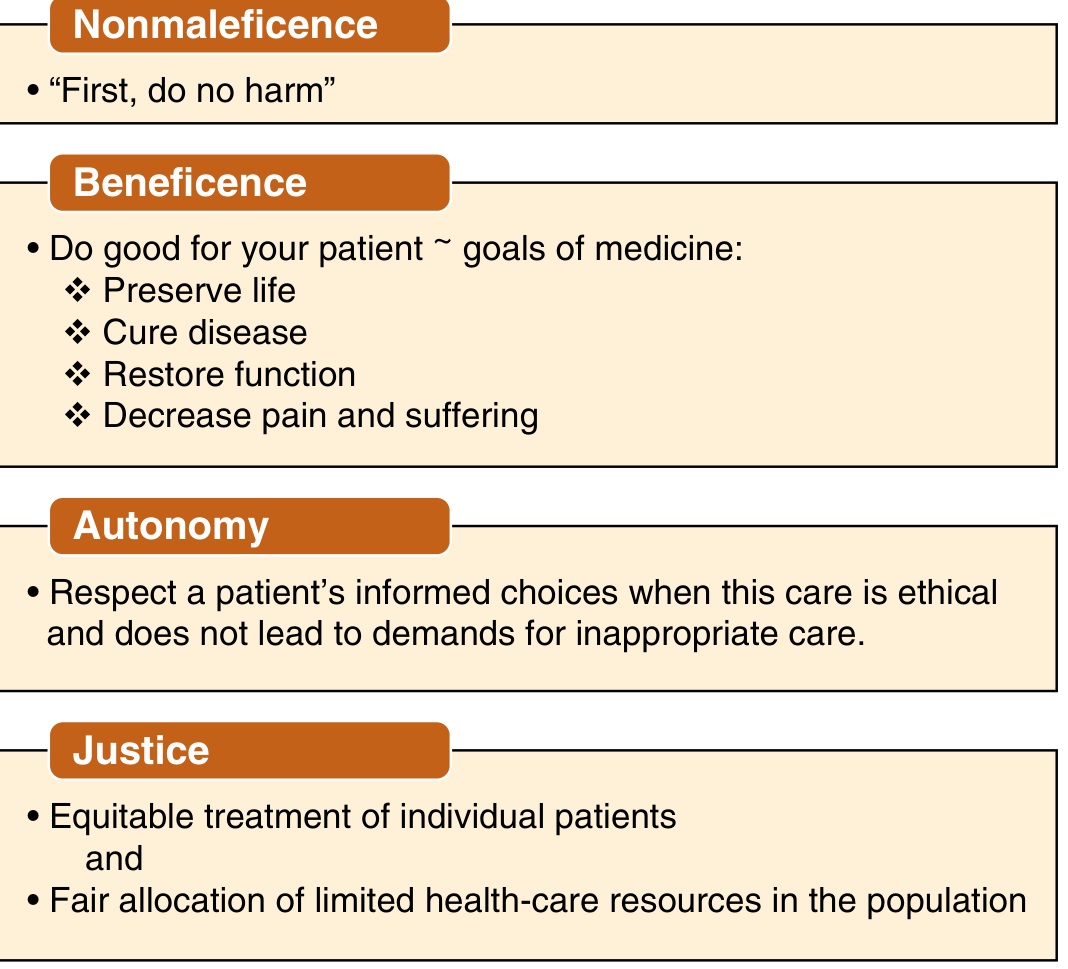
🔴 1. Non-Maleficence - "First, Do No Harm"
A basic obligation not to inflict harm on patients, either intentionally or carelessly. Summarized by Hippocrates as "Primum non nocere."
- Avoid unnecessary investigations, treatments, or procedures that could harm
- Ensure medications prescribed do not cause avoidable adverse effects
- Consider harm not only physical but also psychological, social, and financial
🟢 2. Beneficence - "Do Good"
Acting for the benefit of the patient is the central tenet of medical ethics. Goals of medicine under this principle:
- Preserve life
- Cure disease
- Restore function
- Alleviate pain and suffering
🔵 3. Autonomy - "Respect Patient Choice"
Personal rule of the self, free from controlling interference by others. Key applications:
- Informed consent - patients must receive adequate information before agreeing to treatment
- Truth-telling - patients have a right to truthful information about their diagnosis
- Confidentiality - patients' private information must be protected
"A physician shall respect a patient's right to confidentiality. It is ethical to disclose confidential information when the patient consents to it or when there is a real and imminent threat of harm to the patient or to others." - ICME, amended 2006
⚖️ 4. Justice - "Fair Treatment for All"
Promoting fair and equitable treatment of individuals within populations. Types of justice relevant to medicine:
-
Distributive justice - allocation of limited healthcare resources
-
Compensatory justice - fair compensation for malpractice or workplace injuries
-
Rights-based justice - upholding patient rights
-
Legal justice - obeying the law
-
Miller's Review of Orthopaedics, 9th ed., p. 961

3. The Declaration of Geneva (2017 Version) - The Physician's Pledge
Every medical student, at the time of admission to medical college, shall take this oath. The text as amended by the 68th WMA General Assembly, Chicago, October 2017 reads:
AS A MEMBER OF THE MEDICAL PROFESSION:I SOLEMNLY PLEDGE to dedicate my life to the service of humanity;THE HEALTH AND WELL-BEING OF MY PATIENT will be my first consideration;I WILL RESPECT the autonomy and dignity of my patient;I WILL MAINTAIN the utmost respect for human life;I WILL NOT PERMIT considerations of age, disease or disability, creed, ethnic origin, gender, nationality, political affiliation, race, sexual orientation, social standing or any other factor to intervene between my duty and my patient;I WILL RESPECT the secrets that are confided in me, even after the patient has died;I WILL PRACTISE my profession with conscience and dignity and in accordance with good medical practice;I WILL FOSTER the honor and noble traditions of the medical profession;I WILL GIVE to my teachers, colleagues, and students the respect and gratitude that is their due;I WILL SHARE my medical knowledge for the benefit of the patient and the advancement of healthcare;I WILL ATTEND TO my own health, well-being, and abilities in order to provide care of the highest standard;I WILL NOT USE my medical knowledge to violate human rights and civil liberties, even under threat;I MAKE THESE PROMISES solemnly, freely, and upon my honor.
- Essentials of Forensic Medicine and Toxicology, 36th ed. (2026), pp. 42-43
4. Key WMA Declarations Medical Students Should Know
| Declaration | Year | Topic |
|---|---|---|
| Declaration of Helsinki | 1964 | Ethical principles for human experimentation/research |
| Declaration of Sydney | 1968 | Declaration of death and organ harvesting for transplantation |
| Declaration of Oslo | 1970 | Therapeutic abortion |
| Declaration of Tokyo | 1975 | Prohibition of physician participation in torture |
| Declaration of Lisbon | 1981 | Rights of patients |
| Declaration of Venice | 1983 | Terminal illness |
| Declaration of Madrid | 1983 | Euthanasia is unethical |
| Declaration of Ottawa | 1998 | Child's right to healthcare |
| Declaration of Chicago | 2017 | Quality assurance in the medical profession |
5. Definitions: Ethics vs. Etiquette
| Term | Definition |
|---|---|
| Medical Ethics | Moral principles or code of conduct governing medical professionals' interactions with each other, their patients, and the State |
| Medical Etiquette | Conventional laws and customs of courtesy followed among members of the same profession (e.g., not charging colleagues' families for professional services) |
| Bioethics | Broader field coined by Fritz Jahr (1927) covering ethics in biological and medical research, animal ethics, and environmental ethics |
6. Professional Misconduct (Infamous Conduct)
Acts that constitute professional misconduct (for which a doctor may face penal erasure - removal from the medical register):
- Improper conduct with a patient or maintaining an improper association
- Conviction by a Court of Law for offences involving moral turpitude
- Issuing false, misleading, or improper certificates (sickness benefits, insurance, passport, etc.)
- Contravening provisions of the Drugs Act
- Claiming to be a specialist without the recognized qualification
- Performing or assisting in illegal procedures (e.g., illegal sex-selective abortion)
- Accepting or soliciting gifts or commissions for referrals
Penal erasure - termed "the professional death sentence" - deprives the practitioner of all privileges of a registered practitioner.
7. Specific Ethical Obligations for Medical Students
Based on the AMA's guidance for medical students and the Physician's Charter:
- Respect patient dignity - Treat patients with respect regardless of background, disease, or social standing
- Maintain confidentiality - Never discuss patient information casually; protect records
- Seek informed consent - Even as a student, explain procedures and obtain permission before clinical examinations
- Practice within competence - Do not perform procedures you are not trained for; seek supervision
- Be honest - About your student status, your level of knowledge, and any errors you make
- Respect teachers and colleagues - The Declaration of Geneva explicitly requires giving teachers "the respect and gratitude that is their due"
- Report misconduct - An obligation to report unethical behavior observed in clinical settings
- Self-care - Maintaining your own health and abilities is an ethical obligation ("I will attend to my own health, well-being, and abilities")
8. Principles Summary: Education in Medical Ethics
The Pond Report (1984, UK) reviewed the teaching and implementation of medical ethics in medical schools and made recommendations. In 1993, the General Medical Council (London) recommended integrating ethics and legal issues into medical curricula to ensure doctors are fully aware of their moral and ethical responsibilities in patient care.
In India, the National Medical Commission (NMC) since 2022 introduced the Charaka Oath for the white coat ceremony for entering medical students, connecting ancient Indian medical ethics traditions to modern practice.
Sources:
- The Essentials of Forensic Medicine and Toxicology, 36th edition (2026) - Chapters FM10.1, FM10.16, FM10.22, FM10.23
- P.C. Dikshit's Textbook of Forensic Medicine and Toxicology
- Parikh's Textbook of Medical Jurisprudence, Forensic Medicine and Toxicology
- Miller's Review of Orthopaedics, 9th ed., p. 961
- AMA Code of Medical Ethics - authoritative guidance from the American Medical Association
This is a shared conversation. Sign in to Orris to start your own chat.