Anti anginal drugs I. Pharmacology

Reading File
Finding Sources
Finding Sources
Reading File
Reading File
Reading File
Reading File
Searching Images

antianginal drugs mechanism of action nitrates beta blockers calcium channel blockers

Reading File
Reading File
Loading Image
Loading Image
Excellent — I have both key figures. Now I have all the material needed for a comprehensive response. Let me compile the full pharmacology of anti-anginal drugs.

Anti-Anginal Drugs — Pharmacology

Overview

Angina pectoris results from an imbalance between myocardial oxygen supply and demand. Atherosclerotic coronary disease is the most common underlying cause, though coronary vasospasm (Prinzmetal angina) also reduces perfusion. Anti-anginal drugs restore this balance by either reducing O₂ demand, increasing supply (coronary dilation), or both.

Types of Angina

TypeMechanismKey Features
Stable (Classic)Fixed atherosclerotic obstructionEffort-induced; relieved by rest or nitroglycerin
UnstablePlaque rupture + partial thrombosisRest angina, crescendo pattern; ACS
Prinzmetal (Vasospastic)Coronary artery spasmOccurs at rest; responds to nitrates and CCBs

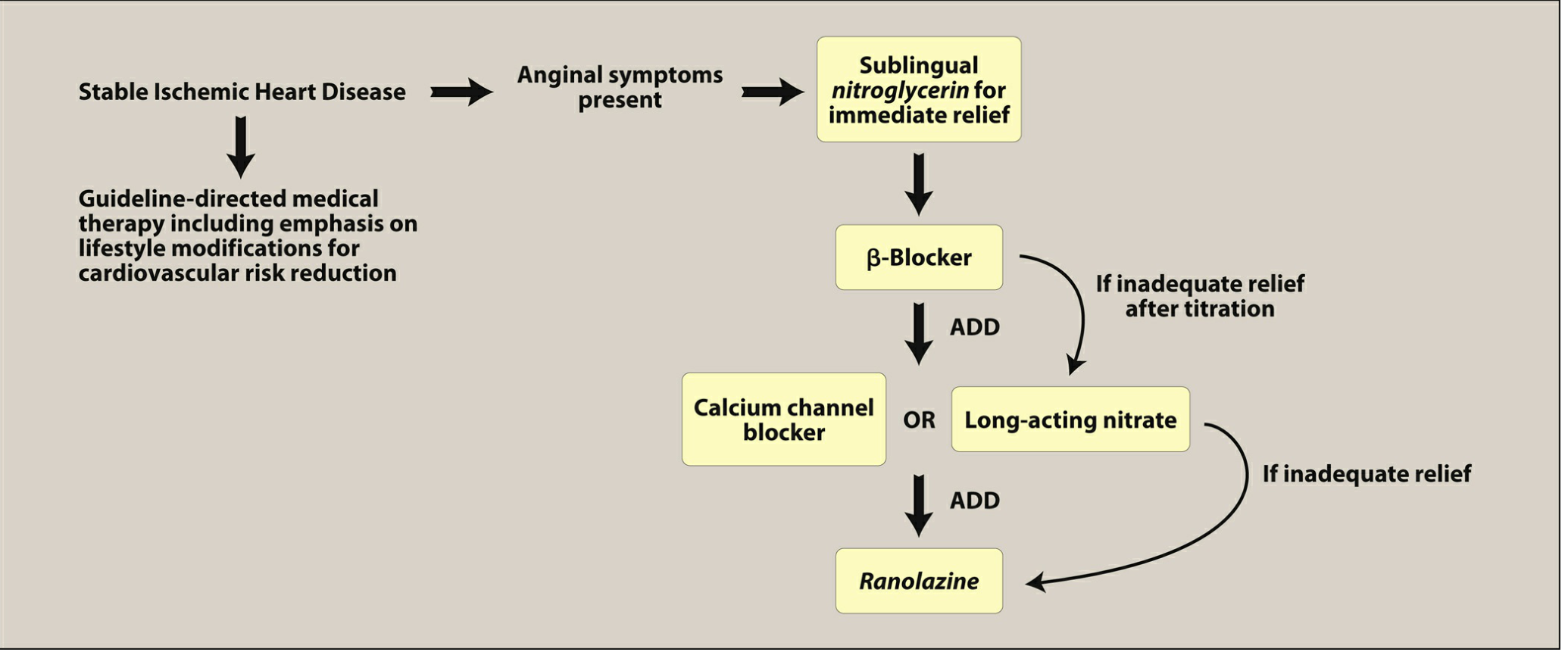
Treatment Algorithm

General treatment algorithm for stable angina
Fig. General treatment algorithm for stable angina — Lippincott Pharmacology, p. 416

Drug Classes

1. Organic Nitrates

Drugs: Nitroglycerin (NTG), Isosorbide dinitrate (ISDN), Isosorbide mononitrate (ISMN)
Mechanism of Action:
  • Nitrates are converted to nitric oxide (NO) in vascular smooth muscle
  • NO activates guanylyl cyclase → ↑ cGMP → activation of cGMP-dependent protein kinase → dephosphorylation of myosin light chain → smooth muscle relaxation
  • Primary effect: venodilation (↓ venous return → ↓ preload → ↓ ventricular wall tension → ↓ O₂ demand)
  • At higher doses: arteriolar dilation (↓ afterload)
  • Also directly dilate coronary arteries, benefiting vasospastic angina and redistributing flow to ischemic subendocardium
Key point from Goodman & Gilman: When NTG is injected directly into the coronary artery, it does not abort angina induced by pacing — confirming that the dominant mechanism is preload reduction, not direct coronary dilation alone.
Preparations & Pharmacokinetics:
FormulationRouteOnsetDurationUse
Nitroglycerin sublingual tablet/spraySL1–3 min30 minAcute attack
Nitroglycerin IVIVImmediateDuring infusionUnstable angina, ACS
Nitroglycerin transdermal patchTransdermalHours24 hProphylaxis
Nitroglycerin buccal/sustained-releaseBuccal/oralHoursProphylaxis
Isosorbide dinitrateOral30 min4–6 hProphylaxis
Isosorbide mononitrateOralSlow6–8 hProphylaxis
  • NTG and ISDN undergo extensive first-pass metabolism; ISMN does not (high oral bioavailability)
  • NTG is highly lipophilic and readily absorbed through skin and mucous membranes
Nitrate Tolerance:
  • Continuous nitrate exposure leads to tolerance (tachyphylaxis)
  • Mechanism: depletion of sulfhydryl (-SH) groups required for NO bioactivation; upregulation of PDE
  • Prevention: nitrate-free interval of 10–12 hours daily (e.g., remove patch at night)
Adverse Effects:
  • Headache (vasodilation of meningeal vessels) — most common
  • Orthostatic hypotension, reflex tachycardia
  • Flushing
  • Methemoglobinemia (high-dose IV NTG)
Contraindications:
  • Concurrent use of PDE-5 inhibitors (sildenafil, tadalafil) — severe, potentially fatal hypotension
  • Hypotension, hypovolemia
  • Right ventricular infarction
  • Hypertrophic obstructive cardiomyopathy (HOCM)

2. β-Adrenergic Blockers

Drugs:
  • Non-selective: Propranolol, Nadolol, Sotalol
  • Cardioselective (β₁): Atenolol, Bisoprolol, Metoprolol, Nebivolol
Mechanism of Action:
  • Block β₁ receptors in the heart → ↓ heart rate (negative chronotropy) + ↓ contractility (negative inotropy) → ↓ myocardial O₂ demand
  • Also reduce blood pressure, further lowering cardiac workload
  • Reduce frequency and severity of angina attacks
  • Increase exercise duration and tolerance in effort-induced angina
Clinical Use:
  • First-line antianginal therapy for stable angina (unless contraindicated)
  • Proven survival benefit after MI (reduce re-infarction and death)
  • Improve mortality in heart failure with reduced ejection fraction (HFrEF)
  • Cardioselective β₁-blockers are preferred to minimize side effects
  • β-Blockers with intrinsic sympathomimetic activity (ISA) should be avoided in angina
Exception — Vasospastic angina: β-Blockers are ineffective and may worsen vasospastic/Prinzmetal angina (unopposed α-mediated vasoconstriction → increased spasm)
Adverse Effects:
  • Bradycardia, AV block
  • Bronchoconstriction (non-selective agents)
  • Fatigue, depression
  • Peripheral vasoconstriction
  • Masked hypoglycemia in diabetics
  • Impotence
Contraindications:
  • Asthma/severe reactive airways disease (non-selective)
  • Decompensated heart failure
  • Significant bradycardia or AV block
  • Vasospastic angina

3. Calcium Channel Blockers (CCBs)

Drugs:
  • Dihydropyridines (DHP): Amlodipine, Nifedipine, Felodipine
  • Non-dihydropyridines (non-DHP): Verapamil, Diltiazem
Mechanism of Action:
  • Block voltage-gated L-type Ca²⁺ channels in vascular smooth muscle and cardiac muscle
  • DHPs: Predominantly peripheral arterial vasodilation → ↓ afterload → ↓ O₂ demand; also dilate coronary arteries
  • Non-DHPs (Verapamil, Diltiazem): Also suppress SA node automaticity and AV conduction (negative chronotropy and dromotropy) + negative inotropy
  • Activity gradient (peripheral to myocardial): Amlodipine > Diltiazem > Verapamil
Clinical Use:
  • All CCBs effective for stable and vasospastic angina
  • First-line for Prinzmetal (vasospastic) angina — most effective
  • DHPs used as add-on to β-blockers in stable angina
  • Verapamil/diltiazem: alternative to β-blockers when β-blockers are contraindicated
Adverse Effects:
  • DHPs: Reflex tachycardia (especially nifedipine), peripheral edema, flushing, headache
  • Verapamil: Constipation, bradycardia, AV block, negative inotropy
  • Diltiazem: Bradycardia, AV block (less than verapamil), less negative inotropy
Contraindications:
  • Non-DHPs contraindicated in HFrEF (negative inotropy worsens function)
  • Non-DHPs should not be combined with β-blockers (risk of severe bradycardia/AV block)
  • Systolic blood pressure <90 mmHg

4. Ranolazine (Sodium Channel Blocker)

Drug: Ranolazine (RANEXA)
Mechanism of Action:
  • Blocks late inward Na⁺ current (late I_Na) in ischemic myocardium
  • Ischemia → ↑ late I_Na → intracellular Na⁺ overload → reversal of Na⁺/Ca²⁺ exchanger → intracellular Ca²⁺ overload → diastolic dysfunction and ischemic injury
  • Blocking late I_Na → ↓ Ca²⁺ overload → improved diastolic relaxation → ↓ wall tension → ↓ O₂ demand
  • Does not affect heart rate or blood pressure — hemodynamically neutral
  • Also has mild anti-arrhythmic properties (decreases AF, SVT, ventricular arrhythmias)
Clinical Use:
  • Used in patients with stable angina who have failed β-blockers, CCBs, or nitrates
  • Can be used in combination with any of the above agents
  • Provides additional antianginal benefit even on top of maximal conventional therapy
Adverse Effects:
  • QT interval prolongation (risk of torsades de pointes)
  • Dizziness, nausea, constipation
  • Less effective in women
Drug Interactions:
  • Strong CYP3A4 inhibitors (ketoconazole, clarithromycin) increase ranolazine levels
  • P-glycoprotein inhibitors also increase levels
  • Numerous interactions — check carefully before prescribing

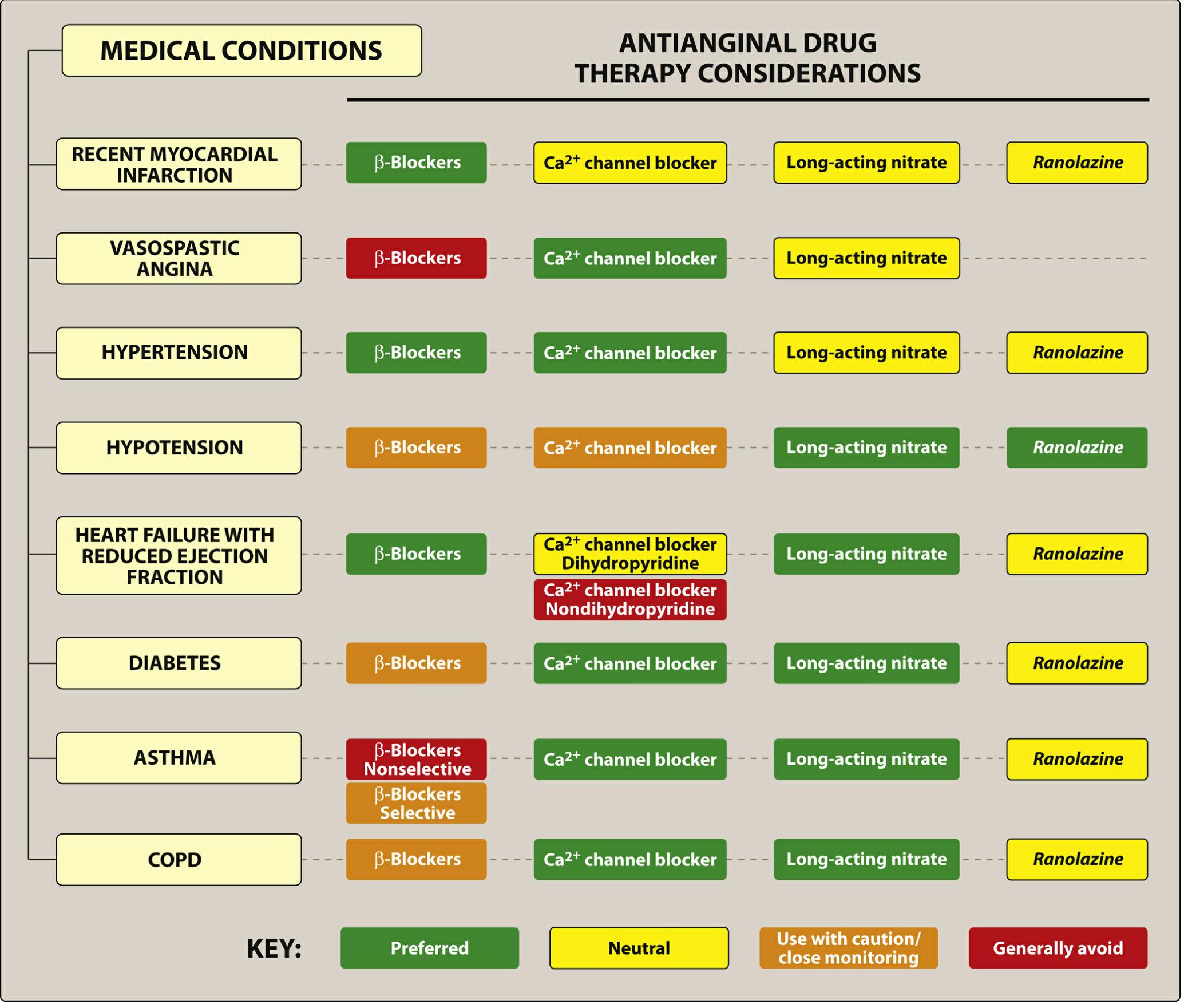
Antianginal Drug Therapy by Comorbidity

Antianginal drug therapy considerations by medical condition
Fig. Antianginal therapy in patients with comorbidities — Lippincott Pharmacology, p. 417

Summary Comparison Table

Drug Class↓ HR↓ Contractility↓ Preload↓ AfterloadVasospastic Angina1st-Line for Stable Angina
Nitrates↑ (reflex)++++Acute relief only
β-Blockers+++++++✗ (contraindicated)✓ (first-line)
CCBs (DHP)↑ (reflex)+++✓✓Add-on
CCBs (non-DHP)++++++✓✓Alternative
RanolazineRefractory cases

Key Clinical Points

  • Sublingual NTG (tablet or spray) must be prescribed to all angina patients for acute attack relief
  • β-Blockers are first-line for stable angina (proven mortality benefit post-MI)
  • CCBs (especially DHPs or diltiazem) are first-line for vasospastic angina; β-blockers are contraindicated in vasospasm
  • Non-DHP CCBs (verapamil, diltiazem) are contraindicated in HFrEF due to negative inotropy
  • Nitrate tolerance is prevented by a 10–12 hour nitrate-free interval daily
  • Nitrates + PDE-5 inhibitors = dangerous — absolutely contraindicated combination
  • Ranolazine is reserved for refractory angina; prolongs QT and has extensive drug interactions
  • Combination therapy (β-blocker + CCB or nitrate) is used when monotherapy is inadequate

Sources: Lippincott Illustrated Reviews: Pharmacology, pp. 411–425 | Goodman & Gilman's The Pharmacological Basis of Therapeutics, pp. 626–690

1. The use of B-ngists as an antianginal agent is contraindicated To the peate phase of myocardial infantion hs the presence of bronchoepnun Wah high blood pressure With stable marina FC 1 With av blockade Tet 2. Name an antianginal drug that improves Ironchial patuney 1. Anaprilin R Nitroglycerine Sustak-mite Isadrin Sustak-Forte 3. The antianginal effed of which drup is associated with a decrense in the contractile fanetion of the myocardium Finoptin Erinne Sustak Nitrang Nitrosorbite Specify an antianginal drug that incresitses myocardial oxygen demand Sustak Isadrim Validol Finoptin Nitrong 5. Indicate a combination of antianginal drugs that is categorically contraindicared in unstable forms of angina pectoris Eufillin + isadrin 2. Finoptin+anaprilin Finoptincordanum Finoptin nitrosorbitol 5. Finoptin + Sustak 6. Why eufillin contraindicated in unstable angina 1. Lowers blood pressure 2. Increases blood pressure 3. Increases myocardial oxygen demand Decreases myocardial oxygen demand Expands the vessels of the brain 7. Specify the drug that causes tachycardia Eufillin 2. Anaprilin Kordanum Nitrong 5. Nitroglycerine 8. What drug merrases OPS 1. Nitroglycerine Nitrosorbite Sustak Eufillin 5. Trazikor/B-blocker/ 9. The mechanism of antianginal action of finoptin is associated 1. With a decrease in myocardial constractility 2. With a decrease in OPS 3 With an increase in OPS With increased afterioad 5. With increasing preload 10. Indicate the drug that is undesirable in the combination of angina pectoris and a-c blockade 1. Sustak-mite 2. Sustak-forte 3. Nitrosorbite 4. propranolol 5. Erinite

These are MCQ-style pharmacology questions. Let me work through each one systematically.

Drug Reference (for context)

Trade NameGeneric NameClass
AnaprilinPropranololNon-selective β-blocker
FinoptinVerapamilNon-DHP CCB
KordanumTalinololCardioselective β-blocker
TrazikorOxprenololβ-blocker with ISA
Sustak-mite / Sustak-forteNitroglycerin (sustained-release oral)Nitrate
NitrongNitroglycerin (sustained-release)Nitrate
NitrosorbiteIsosorbide dinitrateNitrate
ErinitePentaerythritol tetranitrateNitrate
IsadrinIsoprenaline (Isoproterenol)Non-selective β-agonist
EufillinAminophyllinePDE inhibitor / bronchodilator
ValidolMenthol/valerianReflex vasodilator

Answers


Question 1

The use of β-blockers as an antianginal agent is contraindicated in:
4. With AV blockade
Reasoning:
  • β-Blockers slow conduction through the AV node. Pre-existing AV block is a direct contraindication — adding a β-blocker risks complete heart block
  • Bronchospasm is a contraindication only for non-selective β-blockers (cardioselective ones may still be used cautiously)
  • Acute phase of MI — β-blockers are actually indicated (unless hemodynamically unstable)
  • High blood pressure — β-blockers are indicated
  • Stable angina FC I — β-blockers are first-line; not contraindicated

Question 2

Name an antianginal drug that improves bronchial patency:
5. Isadrin (Isoprenaline)
Reasoning:
  • Isoprenaline is a non-selective β-agonist (β₁ + β₂)
  • β₂ stimulation → bronchodilation → improves bronchial patency
  • It also has antianginal effect (vasodilation via β₂), though it is rarely used today due to β₁-mediated tachycardia and increased O₂ demand
  • Nitrates and propranolol do not bronchodilate; propranolol (β-blocker) actually causes bronchospasm

Question 3

The antianginal effect of which drug is associated with a decrease in contractile function of the myocardium:
1. Finoptin (Verapamil)
Reasoning:
  • Verapamil is a non-DHP CCB with pronounced negative inotropic effect — it directly reduces myocardial contractility (↓ Ca²⁺ entry into cardiomyocytes)
  • This decreases O₂ demand, contributing to its antianginal effect
  • Nitrates (Sustak, Nitrong, Nitrosorbite) work primarily by reducing preload/afterload — they do not reduce contractility
  • Erinite (pentaerythritol nitrate) is also a nitrate — no negative inotropy

Question 4

Specify an antianginal drug that increases myocardial oxygen demand:
2. Isadrin (Isoprenaline)
Reasoning:
  • Isoprenaline (β₁ + β₂ agonist) → ↑ heart rate + ↑ contractility → markedly ↑ myocardial O₂ demand
  • This is why non-selective β-agonists are not standard antianginals and are actually harmful in most angina patients
  • Sustak and Nitrong (nitrates) O₂ demand (↓ preload)
  • Validol has no significant hemodynamic effect on myocardial demand
  • Finoptin O₂ demand

Question 5

Indicate a combination of antianginal drugs that is categorically contraindicated in unstable forms of angina pectoris:
1. Eufillin + Isadrin
Reasoning:
  • Both aminophylline and isoprenaline increase myocardial O₂ demand:
    • Aminophylline → PDE inhibition → ↑ cAMP → tachycardia, ↑ contractility
    • Isoprenaline → β₁/β₂ agonism → tachycardia, ↑ contractility
  • Together, this combination dramatically increases ischemic burden — catastrophic in unstable angina
  • Finoptin + Anaprilin (Q5-2) is dangerous (severe bradycardia/AV block) but the question specifies "unstable angina" where demand-increasing drugs are the most dangerous
  • Finoptin + nitrates is acceptable; β-blocker + CCB (non-DHP) is contraindicated in bradycardia but the most categorically harmful in unstable angina is the demand-increasing pair

Question 6

Why is Eufillin (aminophylline) contraindicated in unstable angina:
3. Increases myocardial oxygen demand
Reasoning:
  • Aminophylline inhibits phosphodiesterase → ↑ cAMP → positive chronotropy and inotropy → ↑ heart rate and contractility↑ myocardial O₂ demand
  • It also causes systemic vasodilation (↓ peripheral resistance) but the dominant harmful effect in unstable angina is the demand increase
  • In a setting of already-compromised coronary perfusion, increasing demand worsens ischemia

Question 7

Specify the drug that causes tachycardia:
1. Eufillin (Aminophylline)
Reasoning:
  • Aminophylline → PDE inhibition → ↑ cAMP in the SA node → tachycardia
  • Anaprilin (propranolol) causes bradycardia (β-blocker)
  • Kordanum (talinolol) causes bradycardia (β-blocker)
  • Nitrong — may cause reflex tachycardia, but eufillin is the most direct chronotropic agent in the list
  • Nitroglycerin can also cause reflex tachycardia, but aminophylline's tachycardia is direct and more pronounced
(Note: Nitroglycerin [option 5] also causes reflex tachycardia via baroreceptor activation, but eufillin causes direct, more severe tachycardia)

Question 8

What drug increases Total Peripheral Resistance (TPR/OPS):
5. Trazikor (Oxprenolol — β-blocker with ISA)
Reasoning:
  • β-Blockers → block β₂-mediated vasodilation in peripheral vessels → ↑ peripheral vascular resistance (OPS)
  • This is one reason β-blockers are cautiously used in peripheral vascular disease
  • Nitroglycerin, nitrosorbite, and Sustak all decrease OPS (vasodilators)
  • Eufillin decreases OPS (vasodilation via PDE inhibition)
  • Among the options, the β-blocker (Trazikor) is the one that raises OPS

Question 9

The mechanism of antianginal action of Finoptin (Verapamil) is associated with:
1. A decrease in myocardial contractility
Reasoning:
  • Verapamil blocks L-type Ca²⁺ channels in the myocardium → ↓ contractility (negative inotropy) → ↓ O₂ demand
  • It also decreases heart rate (negative chronotropy) and reduces afterload to some extent
  • Options 2 (↓ OPS) describes DHP-CCBs like nifedipine, not verapamil primarily
  • Options 4 and 5 (increased after/preload) would worsen angina — incorrect
  • The primary antianginal mechanism of verapamil is negative inotropy + chronotropy, not peripheral vasodilation

Question 10

Indicate the drug that is undesirable in the combination of angina pectoris + AV blockade:
4. Propranolol (Anaprilin)
Reasoning:
  • Propranolol (non-selective β-blocker) slows AV conduction
  • In a patient with pre-existing AV block, adding propranolol risks progression to complete heart block
  • Nitrates (Sustak-mite, Sustak-forte, Nitrosorbite, Erinite) do not affect AV conduction — they are safe in AV block
  • Propranolol is categorically contraindicated when significant AV block is present

Quick Answer Summary

QAnswerKey Principle
1AV blockadeβ-blockers slow AV conduction
2Isadrin (isoprenaline)β₂ → bronchodilation
3Finoptin (verapamil)Negative inotropy
4Isadrin (isoprenaline)β₁ → ↑ HR + contractility → ↑ O₂ demand
5Eufillin + IsadrinBoth ↑ O₂ demand — catastrophic in unstable angina
6Increases myocardial O₂ demandPDE inhibition → ↑ cAMP → ↑ HR/contractility
7EufillinDirect chronotropic via PDE inhibition
8Trazikor (β-blocker)Blocks β₂ vasodilation → ↑ OPS
9↓ myocardial contractilityCa²⁺ channel block in myocardium
10PropranololSlows AV conduction → risk of complete block

Acute appendicitis

Reading File
Finding Sources
Finding Sources
Reading File
Reading File
Reading File
Your credits are exhausted. Your daily credits reset tomorrow, or you can purchase a top-up for more.
This is a shared conversation. Sign in to Orris to start your own chat.