
Anatomy of nose and para nasal sinus according to ent standard textbook
Reading File
Now let me search the ENT textbooks for nose and paranasal sinus anatomy sections.
Finding Sources
Finding Sources
Excellent! Found key ENT textbooks. Now let me search for the detailed anatomy sections in parallel:
Finding Sources
Finding Sources
Finding Sources
Finding Sources
Now let me read the key ENT textbook sections in parallel - Cummings, KJ Lee, and Scott-Brown:
Reading File
Reading File
Reading File
Excellent content found. Now let me read more from Cummings anatomy section and KJ Lee paranasal sinus section:
Reading File
Reading File
Great content. Let me read the Cummings anatomy section further (nose structure) and KJ Lee for maxillary/frontal/sphenoid sinus details:
Reading File
Reading File
Reading File
Finding Sources
Reading File
Finding Sources
Finding Sources
Reading File
Reading File
Reading File
I now have comprehensive content from multiple ENT textbooks. Let me also fetch a key anatomical image and read the KJ Lee section on nasal blood supply/nerves:
Reading File
Loading Image
I now have comprehensive content from Cummings Otolaryngology, KJ Lee's Essential Otolaryngology, and Scott-Brown's. Let me also fetch the sphenoid anatomy image and read the nerve supply section:
Loading Image
Reading File
I now have all the content I need from multiple ENT standard textbooks. Let me compile a comprehensive response.
Anatomy of the Nose and Paranasal Sinuses
Sources: Cummings Otolaryngology Head and Neck Surgery; K.J. Lee's Essential Otolaryngology; Scott-Brown's Otorhinolaryngology Head & Neck Surgery
PART I: ANATOMY OF THE NOSE
1. External Nose - Structural Framework
The external nose is divided into three vertical thirds:
- Upper third: nasal bones
- Middle third: upper lateral cartilages (ULC) and nasal septum
- Lower third: lower lateral cartilages (LLC) and septum
Key cartilages:
- Upper lateral cartilages (ULC)
- Lower lateral cartilages (LLC) - form the tip
- Sesamoid cartilages - extend LLC support to the piriform aperture
Nasal tip support mechanisms:
- Major: shape/strength of LLCs; attachment of medial crural footplates to caudal septum; attachment of ULC (caudal border) to LLC (cephalic border)
- Minor: interdomal ligament, cartilaginous septal dorsum, sesamoid complex, alar cartilage attachment to overlying skin, anterior nasal spine, membranous septum
(K.J. Lee's Essential Otolaryngology)
2. Nasal Septum
The septum divides the nose into two cavities, supports the mucosal lining, and provides structural support to the external nose.
Bony components:
- Nasal crest of the palatine bone
- Nasal crest of the maxilla and premaxilla
- Vomer
- Perpendicular plate of the ethmoid
- Nasal crest of the frontal bone
- Spine of the paired nasal bones
Cartilaginous component: Quadrilateral cartilage (anterior septum), with its caudalmost projection extending beyond the nasal spine.
(Cummings Otolaryngology)
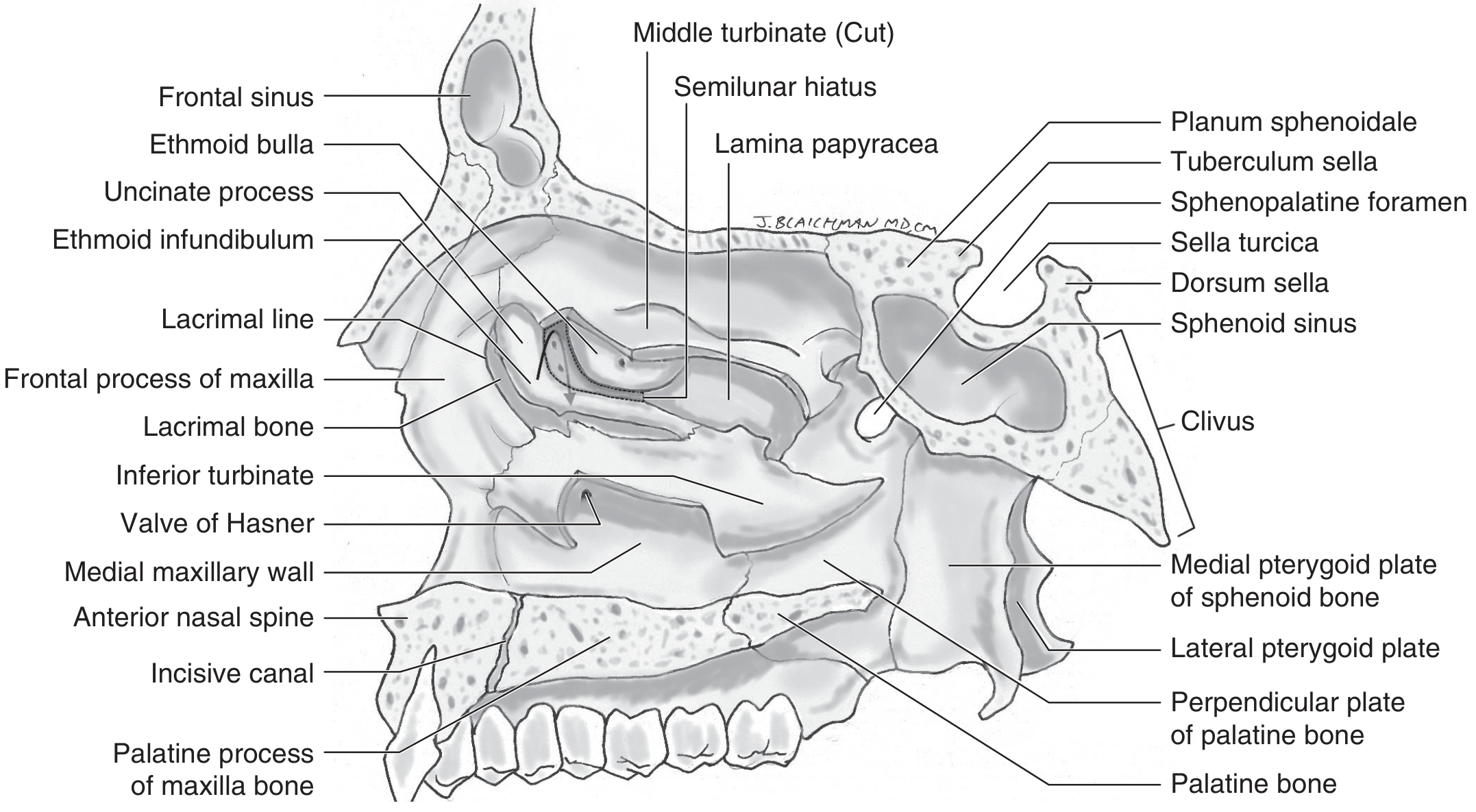
3. Lateral Nasal Wall
Osteology (anterior to posterior):
- Frontal process of maxilla
- Lacrimal bone
- Medial maxillary wall (inferiorly) / Lamina papyracea - LP (superiorly)
- Perpendicular plate of the palatine bone
- Medial pterygoid plate of the sphenoid bone
- The latter two form the sphenopalatine foramen
Five lamellae of the lateral nasal wall (anterior to posterior):
- Uncinate process (UP)
- Ethmoid bulla (EB)
- Basal (ground) lamella of middle turbinate - divides anterior from posterior ethmoid
- Basal lamella of superior turbinate
- Basal lamella of supreme turbinate (when present)
(K.J. Lee's Essential Otolaryngology)
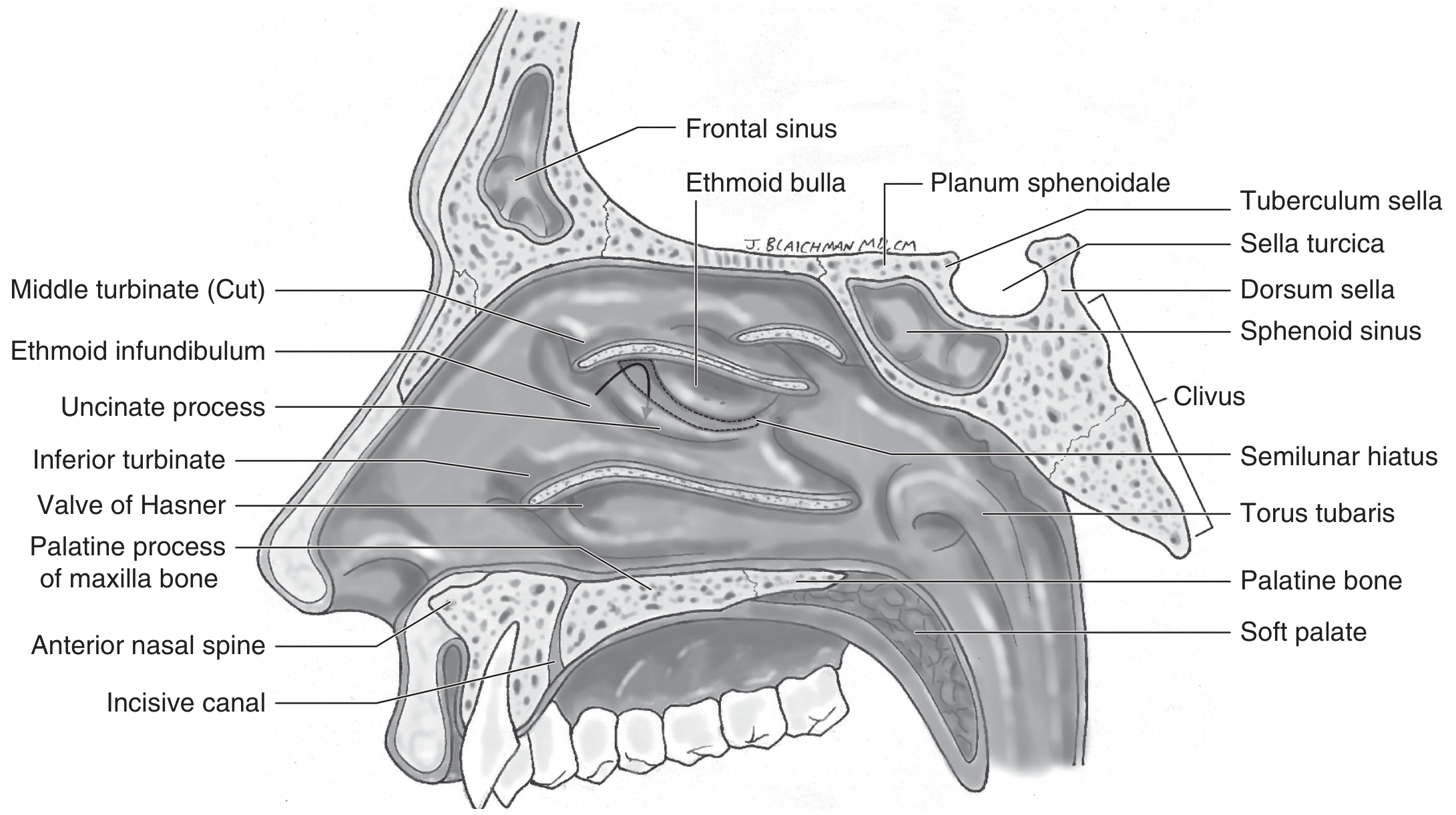
4. Turbinates (Nasal Conchae)
The turbinates are shelves of bone encased in erectile mucosa that alter nasal airway cross-sectional area and serve to warm, humidify, and filter air.
- Inferior turbinate: independent osseous structure (NOT derived from ethmoid)
- Middle, superior, and supreme turbinates: derived from ethmoid bone
Covering epithelium: Stratified squamous epithelium on the anterior tip of the inferior turbinate; pseudostratified ciliated columnar respiratory epithelium everywhere else.
Middle Turbinate (MT) - 3 attachments in 3 planes:
| Portion | Plane | Attachment |
|---|---|---|
| Anterior | Sagittal | Junction of cribriform plate and lateral lamella |
| Middle (basal/ground lamella) | Coronal | Laterally to lamina papyracea |
| Posterior (horizontal) | Axial | Crista ethmoidalis of perpendicular process of palatine bone |
MT variations:
- Concha bullosa: pneumatized MT; present in ~1/3 of population
- Paradoxical MT: lateral surface is convex (curves away from septum)
5. Meatuses and Drainage Pathways
| Meatus | Structures Draining |
|---|---|
| Inferior meatus | Nasolacrimal duct (via Hasner valve, ~1 cm posterior to head of inferior turbinate) |
| Middle meatus | Frontal, anterior ethmoid, and maxillary sinuses |
| Superior meatus | Posterior ethmoid air cells; sphenoethmoidal recess (for sphenoid sinus) |
Nasolacrimal drainage pathway:
Upper/lower lacrimal punctum → canaliculi → common canaliculus → Valve of Rosenmuller → lacrimal sac → nasolacrimal duct → Valve of Hasner → inferior meatus
Upper/lower lacrimal punctum → canaliculi → common canaliculus → Valve of Rosenmuller → lacrimal sac → nasolacrimal duct → Valve of Hasner → inferior meatus
6. Key Structures of the Middle Meatus
Uncinate process (UP):
- Sickle-shaped bone; first lamella of lateral nasal wall
- Superior attachment determines frontal sinus drainage:
- Attaches to lamina papyracea (80%): frontal sinus drains medial to UP into middle meatus - creates a "recessus terminalis" (blind pouch)
- Attaches to fovea ethmoidalis or MT (20%): drains directly into ethmoid infundibulum
Ethmoid infundibulum:
- 3D trough bounded by UP (medial), lamina papyracea (lateral), and ethmoid bulla (posterosuperior)
- Opens inferiorly at the maxillary sinus ostium
Hiatus semilunaris:
- 2D crescentic window into the ethmoid infundibulum
- Bounded by UP anteriorly, ethmoid bulla posteriorly
Osteomeatal complex (OMC):
- Region within middle meatus bounded by: posterior = basal lamella of MT; medial = MT; lateral = LP; superior = fovea ethmoidalis
- The regional confluence of drainage pathways of the maxillary, anterior ethmoid, and frontal sinuses - key in the pathophysiology of acute bacterial rhinosinusitis
Nasal fontanelles:
- Areas of bony dehiscence of the lateral nasal wall covered only by mucosa
- Site of accessory ostia (most commonly in posterior fontanelle, up to 30% of people)
(K.J. Lee's Essential Otolaryngology)
7. Nasal Valve
- Internal nasal valve: angle between the caudal end of the ULC and the nasal septum (~10-15 degrees); the narrowest cross-sectional area of the nasal airway; most important site of nasal resistance
- External nasal valve: soft-tissue area bounded by the piriform aperture, ULC-LLC attachments, and the septum
At rest, air accelerates to ~16 m/s through the nasal valve, then decelerates 4-fold as it enters the nasal cavity. (Cummings Otolaryngology)
8. Blood Supply
Arterial supply (dual - internal and external carotid):
| Artery | Origin | Territory |
|---|---|---|
| Anterior ethmoid artery | Ophthalmic a. (internal carotid) | Upper nasal septum, anterior lateral wall |
| Posterior ethmoid artery | Ophthalmic a. (internal carotid) | Upper posterior septum |
| Sphenopalatine artery | Internal maxillary a. (external carotid) | Posterior/inferior septum and turbinates (MAIN supply); enters via sphenopalatine foramen |
| Greater palatine artery | Internal maxillary a. | Inferior septum |
| Superior labial artery (septal branch) | Facial a. (external carotid) | Columella and caudal septum |
The sphenopalatine artery is the dominant supply to the turbinates and lateral nasal wall. It enters through the sphenopalatine foramen, just inferior to the horizontal attachment of the middle turbinate. The crista ethmoidalis (crest of perpendicular plate of palatine bone) is the key surgical landmark for identifying this vessel.
Little's area (Kiesselbach's plexus): anastomosis of all five arteries on the anteroinferior septum - the most common site of epistaxis.
(Scott-Brown's; Cummings Otolaryngology)
9. Nerve Supply
Sensory innervation:
| Region | Nerve | Division |
|---|---|---|
| Nasal tip, dorsum, ala | External anterior ethmoidal nerve | CN V1 |
| Lateral nose (above medial canthus) | Infratrochlear nerve | CN V1 |
| Lateral nose and ala | Infraorbital nerve | CN V2 |
| Anterior/superior nasal cavity | Internal nasal branch of anterior ethmoidal nerve | CN V1 |
| Posterior nasal cavity | Sphenopalatine (nasopalatine) nerve | CN V2 |
| Anterior nasal cavity/floor | Anterior superior alveolar nerve | CN V2 |
Autonomic innervation:
- Sympathetic (vasoconstriction): superior cervical ganglion → deep petrosal nerve → joins GSPN → Vidian nerve → through sphenopalatine ganglion (without synapsing) → nasal mucosa
- Parasympathetic (vasodilation + secretion): superior salivary nucleus (CN VII) → nervus intermedius → GSPN + greater superficial petrosal nerve → Vidian nerve → synapse in sphenopalatine ganglion → nasal mucosa via V2 branches
(K.J. Lee's Essential Otolaryngology)
PART II: PARANASAL SINUSES
10. Development and Order
Paranasal sinuses in order of development in utero:
- Ethmoid - first to develop; most developed at birth (complete in cell number, not size)
- Maxillary - present at birth
- Sphenoid - pneumatization begins postnatally (~1 year of age)
- Frontal - last to begin and complete development (continues into early adulthood)
Size order (largest to smallest):
Maxillary > Frontal > Sphenoid > Ethmoid
11. Ethmoid Sinuses
Divided into anterior (drain to middle meatus) and posterior (drain to superior meatus) by the basal lamella of the middle turbinate.
Anterior ethmoid cells (smaller but more numerous):
| Cell | Key Features |
|---|---|
| Agger nasi | Most anterior ethmoid cell; projects anterior to MT axilla; posterior limit = anterior border of frontal recess |
| Ethmoid bulla (EB) | Largest, most constant anterior ethmoid cell; attached laterally to LP |
| Sinus lateralis | Suprabullar + retrobullar recesses (above and behind EB) |
| Suprabullar cell | Above EB, without pneumatizing into frontal sinus; roof = fovea ethmoidalis |
| Frontal bulla cell | Suprabullar cell pneumatizing into frontal sinus along posterior wall |
| Supraorbital ethmoid cell | Posterolateral to frontal ostium; AEA typically in posterior wall |
| Haller cell (infraorbital) | Most common anatomic variation; pneumatizes along inferomedial orbit; can obstruct maxillary drainage |
Posterior ethmoid cells (larger but fewer):
| Cell | Key Features |
|---|---|
| Onodi cell (sphenoethmoidal cell) | Posterior ethmoid cell pneumatizing over superolateral sphenoid; optic nerve/ICA may run through it; incidence ~30%; identified on coronal CT as a horizontal septation within the sphenoid sinus |
Skull base anatomy (critical for surgery):
- Fovea ethmoidalis: ethmoid roof/skull base; slopes downward ~15° from anterior to posterior and lateral to medial
- Lateral lamella: formed by ethmoid bone; thinnest/weakest bone in the skull base (most vulnerable to CSF leak)
- Cribriform plate: floor of cribriform fossa; perforated by olfactory nerve fibers
Keros Classification (depth of olfactory fossa = length of lateral lamella):
- Type 1: 1-3 mm (second most common)
- Type 2: 4-7 mm (majority)
- Type 3: 8-16 mm (rare; highest risk of CSF leak during ESS)
12. Maxillary Sinus
Boundaries:
| Wall | Structure |
|---|---|
| Superior | Orbital floor |
| Inferior | Alveolar and palatine process of maxilla |
| Lateral | Zygoma |
| Medial | Lateral nasal wall |
| Posterior | Pterygopalatine fossa (PPF) and infratemporal fossa (ITF) |
| Anterior | Facial surface of maxilla |
Key foramina:
- Infraorbital foramen: contains infraorbital nerve, artery, vein; runs along sinus roof in the infraorbital canal (dehiscent in 14%)
- Incisive foramen: contains greater palatine artery and nerve
- Superior alveolar foramina: posterior, middle, and anterior superior alveolar nerves, arteries, veins
Maxillary ostium: located within the posterior one-third of the ethmoid infundibulum
(K.J. Lee's Essential Otolaryngology)
13. Sphenoid Sinus
Pneumatization patterns:
| Type | Description | Frequency |
|---|---|---|
| Conchal | Absent pneumatization; sinus filled by cancellous bone | Rare |
| Presellar | Pneumatization anterior to a vertical line through tuberculum sella | Second most common |
| Sellar | Pneumatization extends beyond the tuberculum sella | Majority |
| Postsellar | Pneumatization extends beyond dorsum sella | - |
| Arrested | Persistence of fatty marrow; incidental finding; can mimic skull base lesion | - |
Walls and landmarks:
- Planum sphenoidale: sphenoid roof; contiguous with fovea ethmoidalis
- Sella turcica ("Turkish saddle"): rounded projection on posterosuperior wall; contains pituitary gland; bounded by tuberculum sella (anterosuperiorly) and dorsum sella (posteriorly)
- Lateral wall: forms medial wall of cavernous sinus; impressions of ICA (partially dehiscent in 25%) and optic nerve (dehiscent in 6%)
- Lateral pterygoid recess: inferolateral pneumatization; common site of spontaneous CSF leak and encephalocele
- Sphenoid intersinus septum: may insert onto or near the carotid/optic canals - handle with caution during endoscopic skull base surgery
- Clival recess: posteroinferior wall; separates from posterior cranial fossa
- Choanal arch: floor of sphenoid; corresponds to roof of nasopharynx
Landmarks for sphenoid ostium:
- Between nasal septum and posterior insertion of superior turbinate
- 1/3 of the way up from choana to skull base
- 1.5 cm superior to the bony choanal arch
- 7 cm at a 30-degree angle from the anterior nasal spine
14. Frontal Sinus
- Two sinuses, frequently asymmetric, separated by an intersinus septum
- Thick anterior wall, thin posterior wall (= anterior wall of anterior cranial fossa)
- Frontal beak: thick bone of frontal process of maxilla, anterior to agger nasi - limits anteroposterior distance of the frontal recess
Frontal recess (hourglass-shaped space):
- Communicates with frontal sinus superiorly and anterior ethmoid inferiorly
- Boundaries: anterior = frontal beak/agger nasi; medial = lateral lamella; lateral = LP; posterior = ethmoid bulla/suprabullar recess/fovea ethmoidalis
Frontal sinus cells (Kuhn Classification):
| Type | Description |
|---|---|
| Type 1 | Single cell above agger nasi |
| Type 2 | Tier of cells above agger nasi |
| Type 3 | Single cell pneumatizing into the frontal sinus (<50% height - Wormald modification) |
| Type 4 | Isolated cell within the frontal sinus (>50% height - Wormald) |
Drainage: Frontal sinus → frontal recess → anterior ethmoid → middle meatus
Summary Table: Sinus Drainage
| Sinus | Drains Into | Via |
|---|---|---|
| Frontal | Middle meatus | Frontal recess → ethmoid infundibulum |
| Anterior ethmoid | Middle meatus | Ethmoid infundibulum |
| Maxillary | Middle meatus | Natural ostium → ethmoid infundibulum |
| Posterior ethmoid | Superior meatus | Directly |
| Sphenoid | Sphenoethmoidal recess | Sphenoid ostium |
Sources: Cummings Otolaryngology Head and Neck Surgery (9780323612173); K.J. Lee's Essential Otolaryngology, 10th ed. (9781260122237); Scott-Brown's Otorhinolaryngology Head & Neck Surgery, Vol. 1 (9781138094611)
This is a shared conversation. Sign in to Orris to start your own chat.