
Carcinoma
Reading File
The query "Carcinoma" is quite broad. Let me clarify what would be most useful before diving deep.
Asking for Preferences
What aspect of carcinoma would you like to explore?
I'll provide a broad, comprehensive overview of carcinoma - definition, classification, pathogenesis, and key types - drawing from the medical library.
Searching sources...
Finding Sources
Finding Sources
Reading File
Finding Sources
Finding Sources
Finding Sources
Finding Sources
Finding Sources
Reading File
Finding Sources
I now have a strong foundation to write a comprehensive answer. Let me also fetch a relevant histology image.
Loading Image
Reading File
I now have comprehensive textbook material to write a thorough overview. Here is the full answer:
Carcinoma
Definition
A carcinoma is a malignant neoplasm arising from epithelial cells. Although epithelia may be derived from all three germ cell layers (ectoderm, mesoderm, endoderm), malignant neoplasms of epithelial cells are called carcinomas regardless of the tissue of origin. For example:
- Renal tubular epithelium (mesoderm) → renal cell carcinoma
- Skin (ectoderm) → squamous cell carcinoma
- Gut lining (endoderm) → colorectal adenocarcinoma
This distinguishes carcinomas from sarcomas (malignant tumors of mesenchymal/connective tissue) and lymphomas/leukemias (blood cell origin).
- Robbins & Kumar Basic Pathology, p. 216
Classification
Carcinomas are subdivided by their growth pattern and degree of differentiation:
| Type | Features | Examples |
|---|---|---|
| Adenocarcinoma | Glandular growth pattern; mucin-secreting | Colon, lung, breast, prostate, pancreas |
| Squamous cell carcinoma (SCC) | Produces keratin/squamous pearls | Lung, skin, cervix, head & neck, esophagus |
| Transitional cell (urothelial) carcinoma | Arises from urothelium | Bladder, ureter, renal pelvis |
| Small cell carcinoma | Neuroendocrine; small cells, scant cytoplasm | Lung (SCLC), occasionally other sites |
| Large cell carcinoma | Undifferentiated; no squamous/glandular features | Lung |
| Poorly differentiated / undifferentiated carcinoma | Little or no differentiation | Multiple sites |
| Adenosquamous carcinoma | Mixed glandular + squamous elements | Lung, cervix |
| Sarcomatoid carcinoma | Epithelial origin with mesenchymal differentiation | Lung, head & neck |
- Robbins & Kumar Basic Pathology (2021 WHO Classification, Table 11.5)
Pathogenesis
Carcinomas arise through a stepwise accumulation of driver mutations that confer the hallmarks of cancer (unlimited proliferation, invasion, metastasis, angiogenesis, immune evasion, etc.). The order of mutation acquisition is not random - it tends to parallel histologic progression:
- Early events: Loss of tumor suppressor loci (e.g., 3p deletions in lung carcinoma; seen even in histologically normal mucosa of smokers - "field effect")
- Later events: Mutations in TP53, activating mutations in KRAS, or oncogene amplifications
- Targetable mutations: Subset of adenocarcinomas harbor EGFR, ALK, ROS1, HER2, MET, or KRAS mutations that are actionable with targeted therapies
Key carcinogenic influences include:
-
Tobacco: ~90% of lung carcinomas; strong dose-response with pack-years; synergism with asbestos (55-fold risk vs 5-fold for asbestos alone)
-
Oncogenic viruses: HPV 16/18 in cervical, oropharyngeal, and anogenital squamous cell carcinoma; HBV/HCV in hepatocellular carcinoma; EBV in nasopharyngeal carcinoma
-
Chemical carcinogens: Asbestos, arsenic, chromium, vinyl chloride, nitrosamines
-
Radiation: UV radiation (skin carcinomas), ionizing radiation (thyroid, leukemia)
-
Genetic polymorphisms: P-450 monooxygenase variants alter carcinogen activation and individual susceptibility
-
Robbins & Kumar Basic Pathology, p. 485-488
Invasion and Metastasis
Carcinomas characteristically spread via:
- Direct invasion into adjacent tissue
- Lymphatic spread - the primary route for most carcinomas (leading to regional lymph node involvement)
- Hematogenous spread - via veins, leading to distant organ metastases (liver, lung, bone, brain)
- Perineural invasion - particularly adenoid cystic carcinoma, prostate cancer
- Transcoelomic spread - peritoneal seeding in GI and ovarian carcinomas
This contrasts with sarcomas, which more commonly metastasize hematogenously.
Major Carcinomas by Site
Lung Carcinoma
The leading cause of cancer death in both men and women in high-resource countries. ~237,000 new cases/year in the USA (2022 estimates). Four major histologic types:
- Adenocarcinoma - now the most common, especially in women, never-smokers, and those under 45
- Squamous cell carcinoma - strongest association with smoking; arises centrally
- Small cell carcinoma (SCLC) - highly aggressive; treated as systemic disease from diagnosis
- Large cell carcinoma - diagnosis of exclusion
5-year survival: ~20% overall; ~50% for localized disease. Targeted therapy (EGFR, ALK inhibitors) and immune checkpoint blockade have improved outcomes in subsets.
- Robbins & Kumar Basic Pathology, p. 484-485
Lung Cancer - WHO 2021 Classification (Table 11.5)
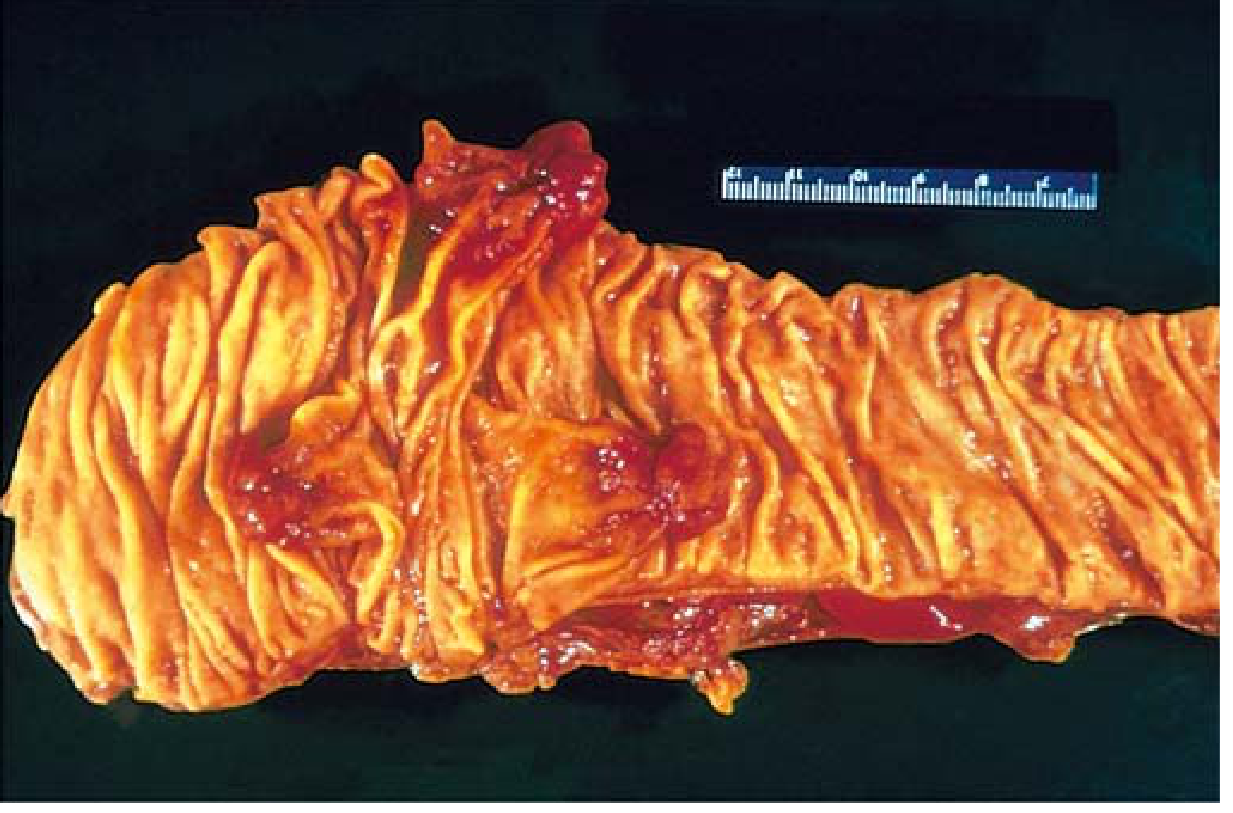
Gross specimen of colonic polyps, an epithelial neoplasm. Robbins & Kumar Basic Pathology.
Other Common Carcinomas
| Site | Most Common Type | Key Features |
|---|---|---|
| Breast | Invasive ductal carcinoma | ER/PR/HER2 receptor status guides therapy |
| Colon/rectum | Adenocarcinoma | APC-KRAS-p53 pathway; screening with colonoscopy |
| Prostate | Acinar adenocarcinoma | Gleason grading; androgen-sensitive |
| Cervix | Squamous cell / adenocarcinoma | HPV-driven; prevented by vaccination |
| Bladder | Urothelial (transitional cell) carcinoma | Arises from basal urothelial cells; 5th most common in adults |
| Pancreas | Ductal adenocarcinoma | Late presentation; KRAS mutation in >90% |
| Liver | Hepatocellular carcinoma | Cirrhosis/HBV/HCV background |
| Thyroid | Papillary carcinoma (most common) | Lymphatic spread; excellent prognosis |
| Skin | Basal cell, squamous cell | UV-induced; BCC most common human cancer |
| Kidney | Clear cell renal cell carcinoma | VHL mutation; hematogenous spread |
Grading and Staging
- Grading reflects degree of differentiation: Grade 1 (well differentiated) to Grade 3/4 (poorly/undifferentiated). Higher grade = more aggressive behavior.
- Staging (TNM) reflects anatomic extent: Tumor size/invasion (T), Nodal involvement (N), Distant Metastasis (M). Staging is the single most important determinant of prognosis.
Summary
Carcinoma = malignant tumor of epithelial origin. It is the most common category of human cancer. The key subtypes - adenocarcinoma and squamous cell carcinoma - account for the majority of cancer deaths worldwide. Pathogenesis involves stepwise genomic alterations driven by carcinogens, viruses, and heritable mutations. Modern oncology increasingly relies on molecular profiling of carcinomas to guide targeted and immunotherapy-based treatment.
Sources: Robbins & Kumar Basic Pathology; Robbins & Kumar Basic Pathology (Lung chapter); Goldman-Cecil Medicine; Sabiston Textbook of Surgery; Fishman's Pulmonary Diseases and Disorders.
This is a shared conversation. Sign in to Orris to start your own chat.