
Features of contralateral hemiplegia
Reading File
Contralateral hemiplegia refers to weakness/paralysis of one side of the body resulting from a lesion on the opposite side of the brain or brainstem. This is due to the crossing of the corticospinal tract in the medullary pyramids.
Searching sources...
Finding Sources
Finding Sources
Finding Sources
Reading File
Reading File
Finding Sources
Reading File
Finding Sources
Reading File
Finding Sources
Reading File
Finding Sources
Reading File
Finding Sources
I now have comprehensive information from the textbooks. Let me also fetch the hemiplegic gait figure for illustration.
Loading Image
Loading Image
Loading Image
Searching Images
hemiplegic gait circumduction spastic arm flexion
I now have all the information needed to give a comprehensive answer. Here is the full detailed response:
Features of Contralateral Hemiplegia
Contralateral hemiplegia is paralysis or severe weakness of one entire side of the body (arm, leg, and lower face) resulting from a lesion of the upper motor neuron (UMN) pathway on the opposite side - at the level of the cerebral cortex, internal capsule, corona radiata, or brainstem (above the pyramidal decussation). It is the classic hallmark of a unilateral supratentorial or high brainstem lesion.
1. Motor Weakness
- Contralateral arm and leg are affected; movements are lost as groups rather than as individual muscles.
- The arm is typically more severely affected than the leg when the lesion is above the level of the facial nucleus (internal capsule, corona radiata, motor cortex).
- Bilateral movements (eyes, jaw, pharynx, upper face, neck, diaphragm) are spared because these muscles have bilateral cortical representation.
- UMN paralysis is rarely complete for a prolonged period - partial recovery is the rule.
2. Facial Involvement - Lower Face Only (Broadbent's Law)
When the lesion is above the facial nucleus in the pons, only the lower half of the face is weak contralaterally. The forehead and upper face are spared due to bilateral cortical innervation (each hemisphere controls the upper face on both sides). This is known as "Broadbent's law" - a supranuclear facial palsy.
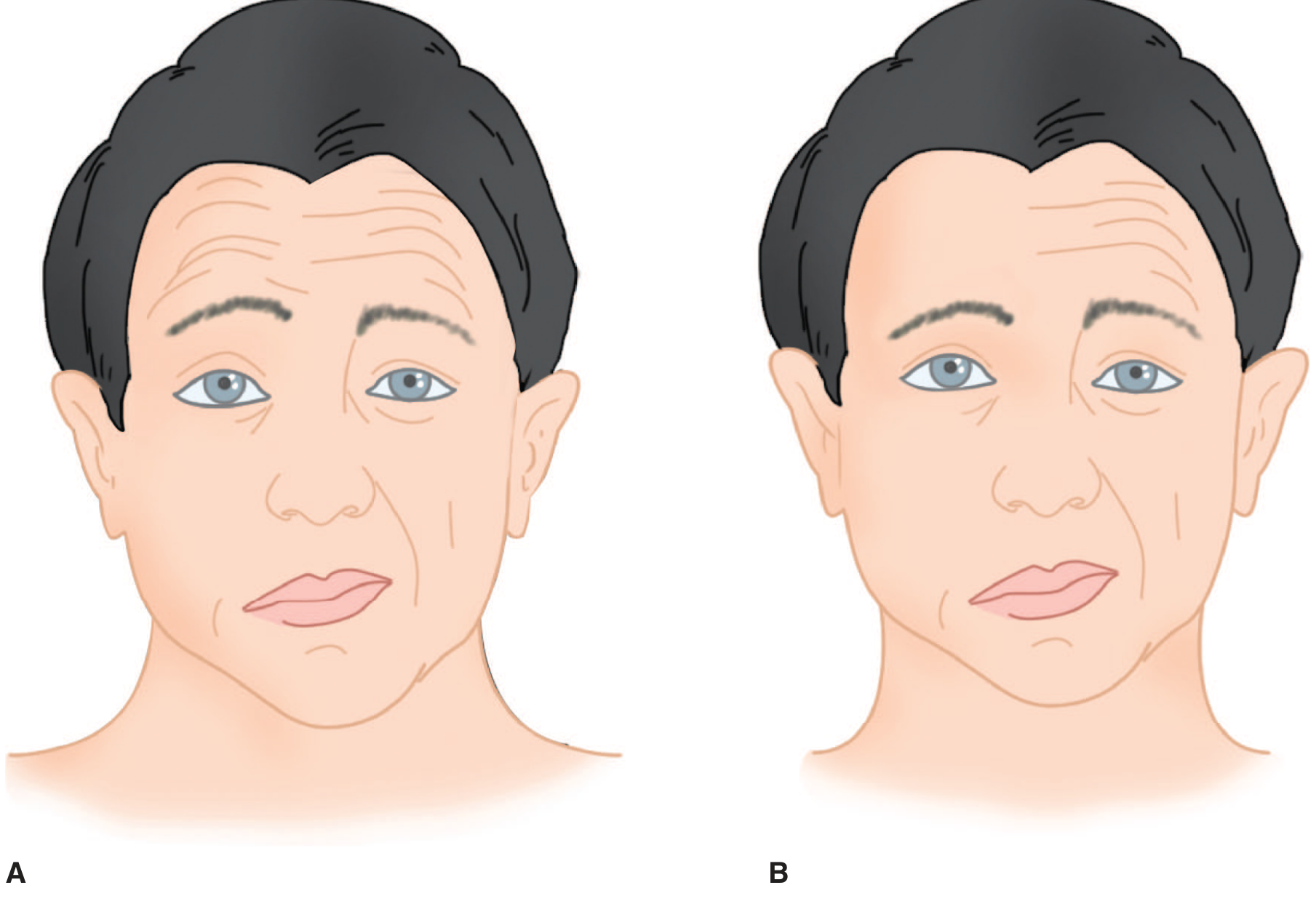
A. Supranuclear (UMN) facial palsy - lower face weak, upper face spared. B. Nuclear/infranuclear palsy - entire face involved.
3. Tone - Spasticity
- Spasticity develops, characterized by velocity-dependent increase in muscle tone (resistance increases with faster passive stretch).
- The "clasp-knife" phenomenon: on rapid passive stretch, there is an initial free movement followed by a catch, then sudden release of resistance.
- Antigravity muscles are predominantly affected: flexors of the arm and extensors of the leg - so the arm tends to be flexed and pronated, the leg extended and adducted.
- Spasticity results from loss of cortical inhibition over the reticulospinal and vestibulospinal tracts.
- Note: acutely, there may be initial flaccidity (especially with spinal cord lesions - "spinal shock"), which evolves into spasticity over days to weeks.
4. Reflexes
- Exaggerated (hyperactive) deep tendon reflexes contralaterally - a "release" phenomenon from loss of descending inhibitory pathways.
- Clonus: rhythmic involuntary muscle contractions (5-7 Hz) in response to sustained stretch, typically at ankle or patella.
- Hoffman's sign: positive on the affected side (flicking the middle fingernail causes thumb flexion).
- Crossed adductor reflex may be present.
- Abdominal and cremasteric superficial reflexes are absent on the affected side.
- Spread of reflexes (radiation): tapping one tendon elicits reflex contractions in distant muscles.
5. Babinski Sign (Plantar Response)
- Extensor plantar response (Babinski sign) is positive on the affected side: stroking the lateral plantar surface of the foot causes extension of the great toe and fanning of other toes - the most reliable indicator of UMN involvement.
- This represents disinhibition of the spinal flexion/protective reflex program.
6. Posture
- Upper limb: flexed at elbow, wrist, and fingers; forearm pronated.
- Lower limb: extended at knee and hip; foot plantar-flexed and inverted (equinovarus).
- This constitutes the classic Wernicke-Mann posture (also called hemiplegic posture).
7. Gait - Circumduction (Hemiplegic Gait)
- The patient holds the affected leg stiffly, unable to flex freely at hip, knee, and ankle.
- The leg rotates outward to describe a semicircle (circumduction) - first away from then toward the trunk.
- The foot scrapes the floor (toe and outer heel contact), producing the characteristic scuffing sound.
- The affected arm is carried in a flexed position and does not swing naturally.
- In hemiparetic children, the arm tends to abduct as they step forward.
- - Adams and Victor's Principles of Neurology, 12th Edition
8. Associated Movements
- Attempted flexion of the affected arm may produce involuntary pronation, flexion of the leg, or dorsiflexion of the foot.
- Volitional movement of the paretic limb may evoke mirror (imitative) movements in the normal limb.
- Some patients recovering from hemiplegia develop movement disorders (tremor, athetosis, chorea) on the affected side - due to associated basal ganglionic/thalamic damage.
9. Involvement of Specific Muscles
- Movements invariably bilateral (eyes, jaw, pharynx, larynx, thorax, diaphragm, abdomen) are not significantly affected - due to bilateral innervation.
- The trapezius on the hemiplegic side may be paretic; notably the head turns away from the hemiplegic side (indicating paresis of contralateral sternocleidomastoid).
10. Acute vs. Chronic Phase
| Phase | Tone | Reflexes | Plantar |
|---|---|---|---|
| Acute | Flaccid (hypotonia) | Depressed/absent | May be extensor or absent |
| Chronic | Spastic | Hyperreflexic + clonus | Extensor (Babinski +ve) |
Crossed (Alternating) Syndromes - Brainstem Lesions
When the lesion is in the brainstem (below the decussation of corticospinal fibers), contralateral hemiplegia occurs alongside ipsilateral cranial nerve palsies - the so-called "crossed syndromes":
| Syndrome | Level | Ipsilateral CN palsy | Contralateral |
|---|---|---|---|
| Weber's syndrome | Midbrain (cerebral peduncle) | CN III palsy | Hemiplegia |
| Millard-Gubler | Pons (ventral) | CN VI + CN VII palsy | Hemiplegia |
| Foville's syndrome | Pons (tegmentum) | CN VII + conjugate gaze palsy | Hemiplegia |
| Medullary syndrome | Medulla (pyramid) | CN XII (tongue deviates to lesion side) | Hemiplegia, sparing face |
These crossed patterns are pathognomonic for a brainstem localization, distinguishing them from purely supratentorial lesions where the face involvement is contralateral (lower face only).
Sources:
- Adams and Victor's Principles of Neurology, 12th Edition - pp. 72-74
- Localization in Clinical Neurology, 8th Edition - Brainstem and Cranial Nerve sections
- Harrison's Principles of Internal Medicine, 22E (2025) - Signs and Symptoms table
This is a shared conversation. Sign in to Orris to start your own chat.