
Coagulation cascade; test for coagulopathy and asra guidelines latest 20 mark answer
Reading File
Now I'll run all three parallel searches to gather comprehensive information on the coagulation cascade, coagulopathy tests, and ASRA guidelines.
Finding Sources
Finding Sources
Finding Sources
Reading File
Reading File
Finding Sources
Reading File
Reading File
Finding Sources
Reading File
Reading File
Finding Sources
Reading File
Finding Sources
Loading Image
Finding Sources
Reading File
Reading File
Finding Sources
Searching the Web
ASRA 2022 guidelines anticoagulation regional anesthesia latest update fourth edition
Reading Web Page
https://rapm.bmj.com/content/early/2025/01/21/rapm-2024-1057…
Reading File
I now have comprehensive data from authoritative sources. Let me compile the full 20-mark answer.
Loading Image
Here is the comprehensive 20-mark answer:
Coagulation Cascade, Tests for Coagulopathy, and ASRA Guidelines (Latest Edition)
PART 1 - THE COAGULATION CASCADE [8 marks]
Overview
The coagulation cascade is a series of amplifying enzymatic reactions that culminate in deposition of an insoluble fibrin clot. Plasma proteins circulate in inactive proenzyme forms. Each reaction step involves an enzyme (activated coagulation factor), a substrate (inactive proenzyme), and a cofactor (reaction accelerator) assembled on a negatively charged phospholipid surface provided by activated platelets, in the presence of calcium. - Robbins Pathologic Basis of Disease
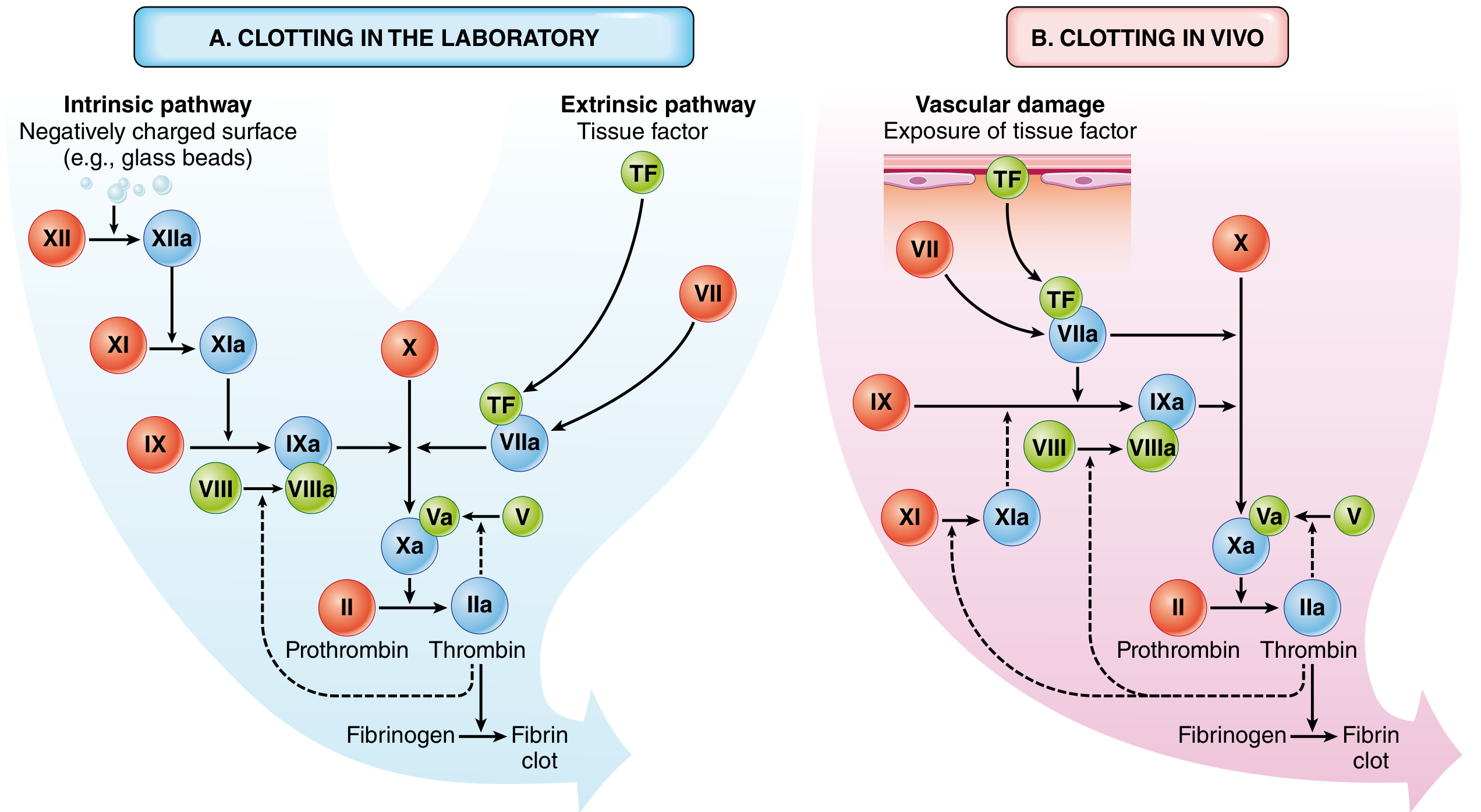
Fig. 4.6 - Coagulation cascade in the laboratory (A) and in vivo (B) - Robbins Pathologic Basis of Disease
A. Extrinsic Pathway (Tissue Factor Pathway)
- Initiated when vascular injury exposes Tissue Factor (TF) on subendothelial cells
- TF binds circulating factor VII -> forms TF-VIIa complex (extrinsic tenase)
- TF-VIIa activates factor X -> Xa (directly) and factor IX -> IXa (cross-activation to intrinsic pathway)
- This is the primary initiator of coagulation in vivo
- Measured in vitro by the Prothrombin Time (PT) assay
B. Intrinsic Pathway (Contact Activation Pathway)
- Initiated by contact with negatively charged surfaces (collagen, glass)
- Factor XII (Hageman factor) is activated -> XIIa
- XIIa activates XI -> XIa
- XIa activates IX -> IXa
- Thrombin (generated from the extrinsic pathway) also cleaves XI -> XIa (amplification loop)
- IXa + VIIIa + phospholipid + Ca²+ = intrinsic tenase complex -> activates X -> Xa
- Factor VIII circulates bound to von Willebrand factor (vWF); vWF deficiency secondarily causes low factor VIII
- Measured by the aPTT (Activated Partial Thromboplastin Time)
Note: Factor XI deficiency causes only mild bleeding, suggesting the contact pathway plays a minor role in hemostasis in vivo; factor XI appears more relevant in pathologic thrombosis. - Barash Clinical Anesthesia 9e
C. Common Pathway
- Factor Xa (from either pathway) combines with factor Va + phospholipid + Ca²+ = prothrombinase complex
- Prothrombinase converts Prothrombin (factor II) -> Thrombin (IIa)
- Thrombin cleaves fibrinogen -> fibrin monomers, which polymerize
- Factor XIIIa (activated by thrombin) cross-links fibrin polymers -> stable insoluble fibrin clot
- Fibrin also cross-links activated platelets via GP IIb/IIIa receptors
D. Thrombin - Central Role
Thrombin has multiple amplification functions:
- Activates platelets via PAR-1 and PAR-4 receptors
- Activates factor V -> Va, factor VIII -> VIIIa, factor XI -> XIa (intrinsic amplification)
- Activates factor XIII -> XIIIa (clot stabilization)
- Cleaves fibrinogen -> fibrin
E. Vitamin K-Dependent Factors
Factors II, VII, IX, X (+ Protein C and S) require gamma-carboxylation at glutamic acid residues to bind phospholipid and Ca²+. Vitamin K (reduced form) is the cofactor for this reaction. Warfarin antagonizes vitamin K epoxide reductase, blocking synthesis of these factors. - Barash Clinical Anesthesia 9e
F. Natural Anticoagulant Systems
Three major regulatory inhibitors:
- Antithrombin III (AT-III) - inhibits thrombin and factor Xa; activity enhanced 1000x by heparin
- Protein C / Protein S system - thrombomodulin + thrombin activates Protein C -> degrades Va and VIIIa
- Tissue Factor Pathway Inhibitor (TFPI) - inhibits TF-VIIa-Xa complex
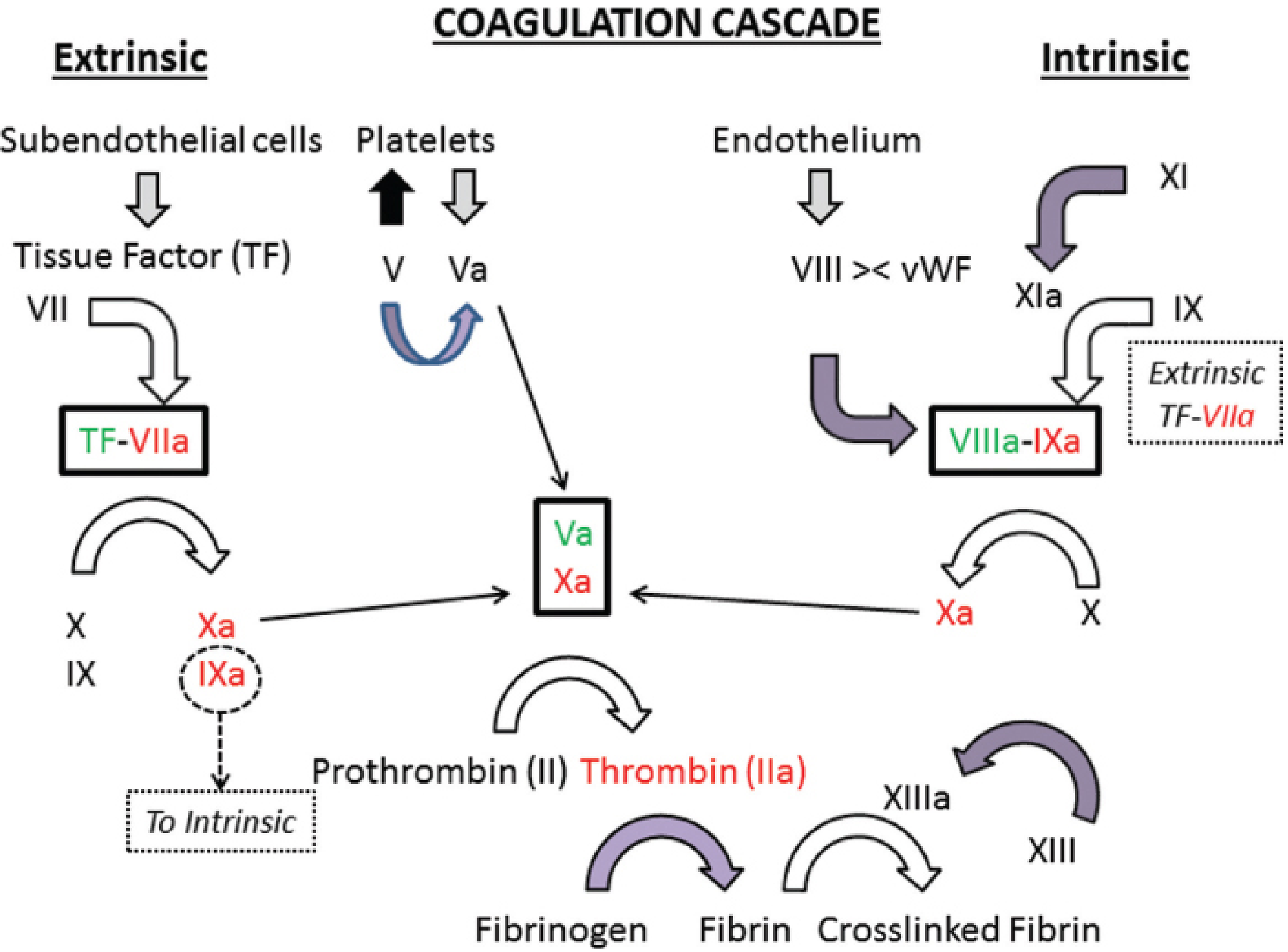
Coagulation cascade showing extrinsic and intrinsic pathways converging - Barash Clinical Anesthesia 9e
PART 2 - TESTS FOR COAGULOPATHY [6 marks]
Standard Laboratory Tests
| Test | Pathway Assessed | Normal Value | Factors Measured |
|---|---|---|---|
| Prothrombin Time (PT) | Extrinsic + Common | 11-13 sec | VII, X, V, II, fibrinogen |
| INR | Standardized PT ratio | 0.8-1.2 | Same as PT |
| aPTT | Intrinsic + Common | 25-35 sec | XII, XI, IX, VIII, X, V, II, fibrinogen |
| Thrombin Time (TT) | Fibrinogen -> Fibrin conversion | 14-16 sec | Fibrinogen activity |
| Fibrinogen level | Fibrinogen quantity | 200-400 mg/dL | Fibrinogen |
| Platelet count | Primary hemostasis | 150,000-400,000/µL | Platelet number |
| Bleeding Time | Platelet function + vessel integrity | 2-9 min | Platelet/vessel interaction |
Interpretation of Coagulation Test Abnormalities
(Morgan & Mikhail's Clinical Anesthesiology, 7e)
| Condition | PT | aPTT | TT | Fibrinogen |
|---|---|---|---|---|
| Advanced liver disease | ↑ | ↑ | N or ↑ | N or ↓ |
| DIC | ↑ | ↑ | ↑ | ↓ |
| Vitamin K deficiency | ↑↑ | ↑ | N | N |
| Warfarin therapy | ↑↑ | ↑ | N | N |
| Heparin therapy | ↑ | ↑↑ | ↑ | N |
| Factor VIII deficiency (Hemophilia A) | N | ↑ | N | N |
| Factor IX deficiency (Hemophilia B) | N | ↑ | N | N |
| Factor VII deficiency | ↑ | N | N | N |
| Factor XIII deficiency | N | N | N | N |
Point-of-Care Viscoelastic Testing
These tests assess global hemostasis in real time using whole blood:
-
TEG (Thromboelastography) - Parameters:
- R (reaction time) - time to initial fibrin formation
- K - clot formation kinetics
- α-angle - rate of clot strengthening
- MA (Maximum Amplitude) - clot strength (platelet + fibrin contribution)
- LY30 - percentage lysis at 30 minutes
-
ROTEM (Rotational Thromboelastometry) - Similar metrics:
- CT (clot time), CFT (clot formation time), MCF (maximum clot firmness), CLI30
- Multiple activators: EXTEM (extrinsic), INTEM (intrinsic), FIBTEM (fibrinogen), HEPTEM (heparin effect)
TEG and ROTEM provide a more complete in vivo assessment than standard assays - they evaluate primary and secondary hemostatic pathways together, detect hyperfibrinolysis, and guide targeted blood product therapy. An INR of 3 with platelet count of 40,000/µL may paradoxically represent a hypercoagulable state in cirrhosis. - Morgan & Mikhail's Clinical Anesthesiology 7e
Additional Specific Tests
- Anti-Xa level - monitors LMWH activity (therapeutic range 0.5-1.0 IU/mL)
- ACT (Activated Clotting Time) - monitors high-dose heparin (cardiopulmonary bypass; target >480 sec)
- dTT (dilute Thrombin Time) / ECT (Ecarin Clotting Time) - monitor direct thrombin inhibitors (dabigatran)
- Mixing studies - PT/aPTT corrects with normal plasma in factor deficiency; fails to correct in the presence of inhibitors (e.g., lupus anticoagulant)
PART 3 - ASRA GUIDELINES (Latest - 5th Edition, 2025) [6 marks]
Background
The American Society of Regional Anesthesia and Pain Medicine (ASRA) has published 5 editions of evidence-based guidelines for regional anesthesia in patients receiving antithrombotic or thrombolytic therapy (1998, 2003, 2010, 2018, 2025). The 5th edition (Reg Anesth Pain Med, January 2025) is the most current. - RAPM 2025
Key principles:
- Risk of spinal hematoma must be weighed against benefit of regional anesthesia for each individual
- Timing of needle/catheter insertion and removal must reflect the pharmacokinetics of the specific anticoagulant
- Frequent neurologic monitoring is essential
- Concurrent use of multiple anticoagulants increases hemorrhagic risk
- These guidelines do NOT define standard of care and do not replace clinical judgment
Drug-Specific Recommendations (ASRA 4th + 5th Edition)
1. Unfractionated Heparin (UFH)
| Indication | Recommendation |
|---|---|
| Prophylactic dose (5000 U SC BID/TID) | Neuraxial block/catheter removal: 4-6 hours after last dose; resume 1 hour after removal |
| IV therapeutic UFH | Neuraxial block: 4-6 hours after cessation; check aPTT/ACT to confirm normalization; resume 1 hour after catheter removal |
Heparin can be given intraoperatively after neuraxial needle placement (after 1 hour interval); this sequence is used safely in vascular surgery.
2. Low Molecular Weight Heparin (LMWH)
| Indication | Pre-procedure interval | Post-catheter removal |
|---|---|---|
| Prophylactic dose | 12 hours | Resume 4 hours after removal |
| Therapeutic dose | 24 hours | Resume 24 hours after removal |
| Twice-daily prophylactic | Catheter should NOT be left in situ | Remove catheter 4 hours before first dose |
| Once-daily prophylactic (postop) | Catheter may be maintained | Remove 12 hours after last dose |
3. Warfarin (VKA)
- Stop warfarin 5 or more days before surgery
- Check INR within 24 hours pre-procedure
- Neuraxial block only if INR is normal (≤1.1 per 5th edition; ≤1.5 per 4th edition)
- Remove catheter when INR ≤1.5 (with monitoring for neurologic changes)
- Single dose of warfarin ≤24 hours before surgery: neuraxial block permissible (4th edition)
- Low-dose oral Vitamin K (1-5 mg) can be given if INR 1.5-3.0 at 6-10 hours pre-procedure
4. Direct Oral Anticoagulants (DOACs)
| Drug | Class | Pre-procedure interval (neuraxial) | Resume post-catheter removal |
|---|---|---|---|
| Dabigatran | Direct thrombin inhibitor | 5 days (CrCl >80), longer if impaired renal function | 6 hours after removal |
| Rivaroxaban | Anti-Xa | 3 days | 6 hours after removal |
| Apixaban | Anti-Xa | 3 days | 6 hours after removal |
| Edoxaban | Anti-Xa | 3 days | 6 hours after removal |
| Fondaparinux | Anti-Xa (indirect) | Neuraxial not recommended with therapeutic dosing | - |
For therapeutic (high-dose) DOACs: 72-hour drug-free interval is recommended. Laboratory confirmation (anti-Xa or dTT) is advised if CrCl <30 mL/min. - ASRA 5th Edition 2025
5. Antiplatelet Agents
| Drug | Pre-procedure interval |
|---|---|
| Aspirin/NSAIDs alone | No specific interval required (Grade 1A) |
| Clopidogrel | 5-7 days |
| Prasugrel | 7-10 days |
| Ticagrelor | 5-7 days |
| Ticlopidine | 10 days |
| Cangrelor (IV) | 3 hours after discontinuation |
Neuraxial catheters should NOT be maintained with prasugrel or ticagrelor due to rapid onset and offset. With clopidogrel/ticlopidine (no loading dose), catheter may remain 1-2 days. - ASRA 4th Edition; OpenAnesthesia
6. Fibrinolytics / Thrombolytics (e.g., tPA, streptokinase)
- Absolute contraindication to neuraxial procedures within 10 days of thrombolytic use
- If catheter in situ when thrombolytic given: avoid removal until fibrinogen level normalizes (>100 mg/dL)
- Monitor neurologic status every 2 hours
7. Deep Peripheral and Plexus Blocks
- The 4th and 5th editions explicitly apply neuraxial recommendations to deep peripheral nerve and deep plexus blocks (e.g., lumbar plexus, paravertebral, deep cervical plexus)
- Superficial nerve blocks may be performed without therapy-free intervals regardless of anticoagulant dose (low bleeding risk)
Signs of Spinal Hematoma (Warning Signs - Monitor Post-Neuraxial)
- New or worsening back pain
- Bowel or bladder dysfunction
- Progressive motor weakness or sensory deficit after apparent resolution
- If suspected: urgent MRI and neurosurgical consultation - outcomes best if decompressed within 8 hours of onset
Summary Quick-Reference Table
| Anticoagulant | Pre-procedure stop | Resume post-catheter removal |
|---|---|---|
| UFH prophylactic | 4-6 hours | 1 hour |
| UFH therapeutic | 4-6 hours (check aPTT) | 1 hour |
| LMWH prophylactic | 12 hours | 4 hours |
| LMWH therapeutic | 24 hours | 24 hours |
| Warfarin | INR normal (≤1.1-1.5) | INR ≤1.5 |
| DOACs (therapeutic) | 72 hours | 6 hours |
| Clopidogrel | 5-7 days | - |
| Aspirin alone | No restriction | - |
Key Sources:
- Coagulation cascade: Robbins Pathologic Basis of Disease (Robbins), p.122; Barash Clinical Anesthesia 9e, pp. 1268-1278
- Tests for coagulopathy: Morgan & Mikhail's Clinical Anesthesiology 7e, Table 34-1; Barash Clinical Anesthesia 9e, p.1278
- ASRA Guidelines: Morgan & Mikhail's Clinical Anesthesiology 7e, p.1505 (4th Edition); ASRA 5th Edition, RAPM 2025; Miller's Anesthesia 10e, p.11743
Add when to remove catheter also
Here is the updated ASRA guidelines section with a dedicated catheter removal column clearly specified for every drug class:
ASRA Guidelines - Complete Table: Needle/Catheter Insertion AND Catheter Removal Timing
The risk of spinal hematoma is equally significant at the time of catheter removal as at needle insertion, because removal disrupts the epidural venous plexus in an anticoagulated patient.
1. Unfractionated Heparin (UFH)
| Scenario | Before needle/insertion | Catheter removal | Resume drug after removal |
|---|---|---|---|
| Prophylactic SC (5000 U BID/TID) | 4-6 hours | 4-6 hours after last dose | 1 hour after removal |
| IV therapeutic | 4-6 hours + confirm aPTT normal | 4-6 hours after stopping infusion; confirm aPTT/ACT normal | 1 hour after removal |
| Intraoperative IV heparin (e.g., vascular surgery) | Place neuraxial first; wait 1 hour, then give heparin | 4-6 hours after last IV dose; check aPTT | 1 hour after removal |
2. Low Molecular Weight Heparin (LMWH)
| Regimen | Before needle/insertion | Catheter removal | Resume after removal |
|---|---|---|---|
| Prophylactic once-daily (postop) | 12 hours | Remove at least 12 hours after last dose | 4 hours after removal |
| Prophylactic twice-daily (postop) | Catheter should NOT be left in situ | Remove catheter ≥4 hours before first postop dose | Do NOT give with indwelling catheter |
| Therapeutic dose (1 mg/kg BD or 1.5 mg/kg OD) | 24 hours | Remove at least 24 hours after last dose | 24 hours after removal |
Anti-Xa level measurement is recommended before removal if renal impairment (CrCl <30 mL/min) is present.
3. Warfarin (VKA)
| Situation | Before needle/insertion | Catheter removal | Resume after removal |
|---|---|---|---|
| Chronic warfarin (stopped ≥5 days) | INR ≤1.1 (5th edition) or ≤1.5 (4th edition) | Remove when INR ≤1.5; monitor neuro for 24 hours after | As clinically indicated |
| Single preop prophylactic dose (<24 hours) | Permissible without INR check | Check INR before removal if >1 dose given | - |
The INR should be checked daily while catheter is in situ in patients restarted on warfarin. If INR rises to 1.5-3.0, increase monitoring; if INR >3.0, hold warfarin and do not remove catheter until INR falls.
4. Direct Oral Anticoagulants (DOACs)
| Drug | Before needle/insertion | Catheter removal | Resume after removal |
|---|---|---|---|
| Dabigatran (DTI) | 5 days (normal renal function) | Remove catheter 6 hours before first postop dose; if unanticipated administration with catheter in situ - hold dabigatran 34-36 hours OR check dTT/ECT first | 6 hours after removal |
| Rivaroxaban | 3 days (72 hours) | Remove catheter at least 6 hours before first postop dose | 6 hours after removal |
| Apixaban | 3 days (72 hours) | Remove catheter at least 6 hours before first postop dose | 6 hours after removal |
| Edoxaban | 3 days (72 hours) | Remove catheter at least 6 hours before first postop dose | 6 hours after removal |
| Fondaparinux | Therapeutic dose: neuraxial NOT recommended | Single prophylactic dose: remove catheter before initiating | Not recommended with indwelling catheter |
For all DOACs in patients with CrCl <30 mL/min (or dabigatran with CrCl <50 mL/min): extend drug-free intervals and confirm with laboratory testing (anti-Xa or dTT) before catheter removal.
5. Antiplatelet Agents
| Drug | Before needle/insertion | Catheter removal | Resume after removal |
|---|---|---|---|
| Aspirin/NSAIDs alone | No restriction (Grade 1A) | No restriction | Immediately |
| Clopidogrel | 5-7 days | Catheter may remain 1-2 days if no loading dose given; remove before resuming | As clinically indicated |
| Prasugrel | 7-10 days | Remove catheter before first postop dose; catheter should NOT be maintained | 6-8 hours after removal |
| Ticagrelor | 5-7 days | Remove catheter before first postop dose; catheter should NOT be maintained due to rapid onset | Immediately after removal if no loading dose; 6 hours if loading dose given |
| Ticlopidine | 10 days | Remove before reinstituting therapy | As clinically indicated |
| Cangrelor (IV) | 3 hours after stopping infusion | Remove catheter before reinstituting cangrelor | 8 hours after removal |
| GP IIb/IIIa inhibitors (eptifibatide, tirofiban) | 4-8 hours; abciximab 24-48 hours | Avoid neuraxial with indwelling catheter | Contraindicated with indwelling catheter |
6. Fibrinolytics / Thrombolytics
| Drug | Before needle/insertion | Catheter removal | Resume after removal |
|---|---|---|---|
| tPA, streptokinase, urokinase | Absolute contraindication within 10 days | Do NOT remove catheter until fibrinogen normalizes (>100 mg/dL) + TT/aPTT normalize | Avoid neuraxial in future if possible |
7. Herbal Supplements (new in 4th/5th editions)
- Garlic, Ginkgo, Ginseng - no mandatory stop; use caution with concurrent anticoagulants
- No specific catheter removal interval required for herbal agents alone
Complete Summary Quick-Reference
| Drug | Pre-procedure stop | When to remove catheter | Resume after removal |
|---|---|---|---|
| UFH prophylactic (SC) | 4-6 h | 4-6 h after last dose | 1 h |
| UFH therapeutic (IV) | 4-6 h + normal aPTT | 4-6 h after stopping; normal aPTT | 1 h |
| LMWH prophylactic OD | 12 h | 12 h after last dose | 4 h |
| LMWH prophylactic BD | Not with catheter in situ | ≥4 h before first dose | Do not use with catheter |
| LMWH therapeutic | 24 h | 24 h after last dose | 24 h |
| Warfarin | INR ≤1.1-1.5 | INR ≤1.5 | Clinically indicated |
| Dabigatran | 5 days | 6 h before first postop dose | 6 h after removal |
| Rivaroxaban/Apixaban/Edoxaban | 72 h | 6 h before first postop dose | 6 h after removal |
| Fondaparinux (prophylactic) | Remove catheter first | Remove before starting | Not with catheter |
| Clopidogrel | 5-7 days | 1-2 days; remove before resuming | Clinically indicated |
| Prasugrel / Ticagrelor | 7-10 d / 5-7 d | Remove before first postop dose | 6-8 h / immediate |
| Aspirin alone | None | None | Immediately |
| Thrombolytics | Contraindicated | Only after fibrinogen >100 mg/dL | Avoid |
Key principle to remember for exams:
The interval before catheter removal = the same interval required before needle insertion for most drugs. The interval before resuming the drug after removal is generally shorter (1-6 hours), to allow the puncture site to seal before re-anticoagulating.
Sources: Morgan & Mikhail's Clinical Anesthesiology 7e, p.1505; Miller's Anesthesia 10e, p.11743-11744; ASRA 5th Edition Guidelines, RAPM January 2025; OpenAnesthesia ASRA 4th Edition Summary
This is a shared conversation. Sign in to Orris to start your own chat.