
Management of dengue
I'll start by reading the medical library skill, then search for dengue management content in parallel.
Searching sources...
Reading File
Now I'll run parallel searches across the medical library and PubMed simultaneously.
Finding Sources
Searching PubMed
"dengue"[MeSH Terms] AND "management" AND "treatment"
The best sources are Harrison's (2025), Rosen's Emergency Medicine, Red Book 2021, Goldman-Cecil Medicine, and the Washington Manual. Let me read the key sections in parallel.
Reading File
Reading File
Reading File
Good content gathered. Now let me read the specific management/treatment sections from Red Book and Goldman-Cecil, plus the Washington Manual for specific treatment protocols.
Reading File
Finding Sources
Reading File
Let me get the treatment/management sections from Goldman-Cecil and Park's (which had specific critical phase management detail), and the Red Book treatment section.
Reading File
Reading File
Reading File
Now let me get the Park's treatment section and a quick web search for WHO 2024 dengue guidelines.
Reading File
Searching the Web
WHO dengue management guidelines 2024 treatment fluid therapy
Let me now get the Park's treatment section and the dengue illness course figure, plus the specific management text.
Reading File
Reading Web Page
https://www.cdc.gov/dengue/media/pdfs/2024/05/20240521_34284…
Let me get the specific treatment/management section from Park's textbook.
Reading File
Reading File
Reading File
Reading File
Let me get the critical phase fluid management text and the dengue shock syndrome management from Park's.
Reading File
I now have comprehensive content. Let me fetch the key clinical images from the textbooks.
Loading Image
Loading Image
I now have comprehensive content from multiple authoritative sources. Let me compile the full, detailed answer.
Management of Dengue
Overview
Dengue is caused by one of four related flaviviruses (DENV 1-4) transmitted by Aedes aegypti (primarily) and Aedes albopictus mosquitoes. There is no specific antiviral therapy; management is entirely supportive, guided by clinical phase and severity. With appropriate care, case-fatality from severe dengue can be reduced from 5-10% to less than 1%. - Red Book 2021, p. 524
WHO 2009 Classification (Severity Staging)
The WHO 2009 framework replaced the older DHF grading and is the basis for modern triage and management decisions:
| Category | Criteria |
|---|---|
| Dengue without warning signs | Fever + 2 of: nausea/vomiting, rash, aches/pains, leukopenia, positive tourniquet test |
| Dengue with warning signs | Above + any of: abdominal pain/tenderness, persistent vomiting, clinical fluid accumulation (ascites/pleural effusion), mucosal bleeding, lethargy/restlessness, liver >2 cm enlargement, rapid platelet fall + rising Hct |
| Severe dengue | Severe plasma leakage with shock or respiratory distress, severe bleeding, severe organ impairment (AST/ALT ≥1000, impaired consciousness, myocarditis, organ failure) |
The older WHO DHF grading (Grades I-IV) is still taught and used in many countries:
| Grade | Description |
|---|---|
| I (DHF) | Fever, +ve tourniquet test, plasma leakage; platelet <100,000, Hct rise ≥20% |
| II (DHF) | Grade I + spontaneous bleeding (epistaxis, melena, gum bleeding) |
| III (DSS) | Grade II + circulatory failure: weak rapid pulse, pulse pressure ≤20 mmHg, cold clammy skin |
| IV (DSS) | Profound shock, undetectable BP or pulse |
- Park's Textbook of Preventive and Social Medicine, p. 295
The Three Phases of Dengue Illness
Understanding the natural course is essential for management:
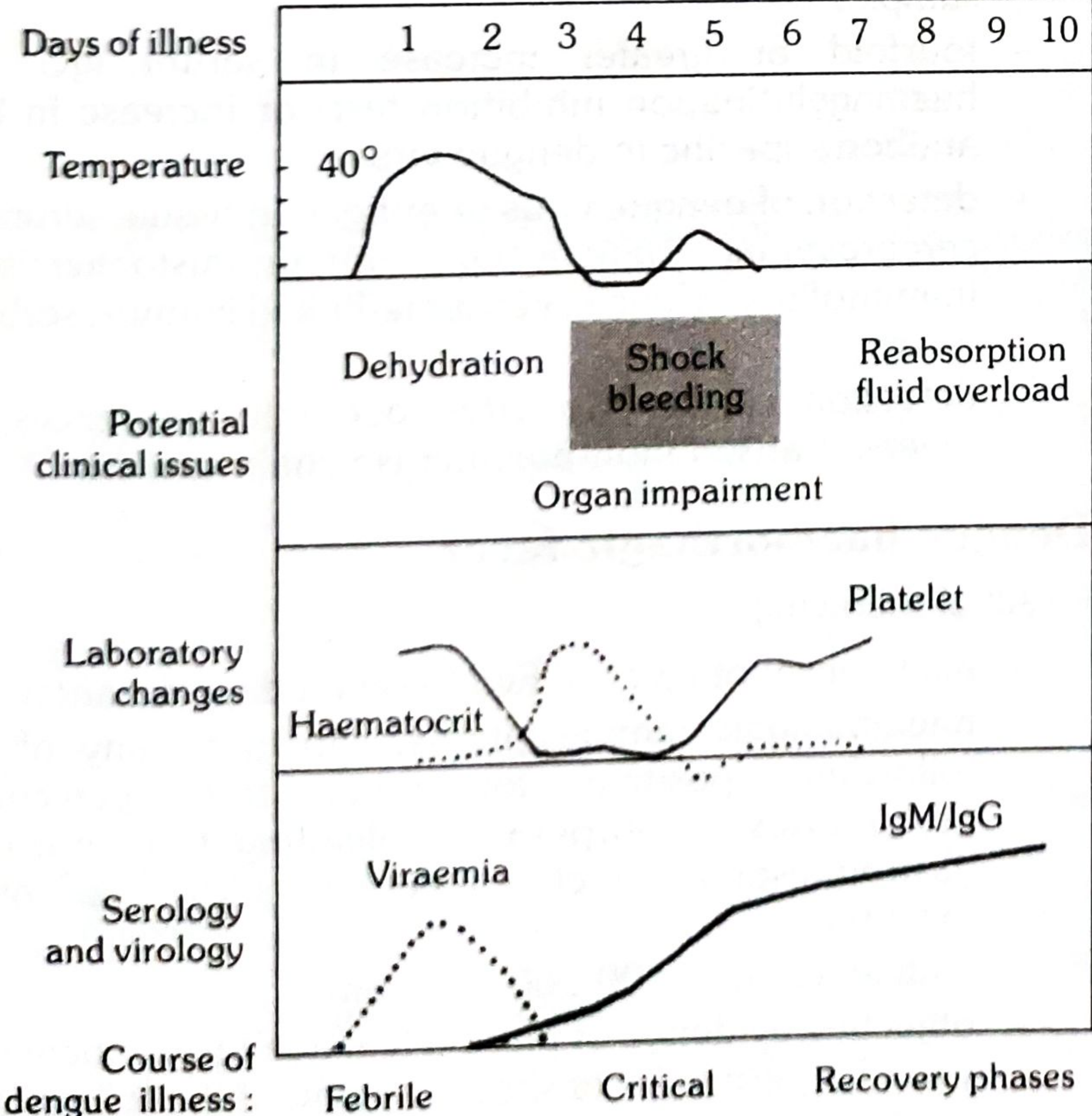
Course of dengue illness - Park's Textbook of Preventive and Social Medicine
Phase 1 - Febrile (Days 1-3): High fever (39-40°C), headache, retro-orbital pain, severe myalgia/arthralgia, maculopapular rash, leukopenia, early thrombocytopenia. Viremia is at its peak.
Phase 2 - Critical (Days 3-7, around defervescence): Temperature drops to ≤37.5-38°C. This marks the onset of increased capillary permeability with plasma leakage. Hematocrit rises, platelet count drops rapidly. The period of clinically significant plasma leakage usually lasts only 24-48 hours and is the most dangerous window. Shock occurs when critical volume is lost. Pulse pressure narrowing (≤20 mmHg) is an early sign of impending shock. Patients may appear conscious and lucid even in early shock, deceiving the inexperienced clinician.
Phase 3 - Recovery (Days 6-10+): Gradual reabsorption of extravascular fluid. Well-being returns, appetite improves, diuresis ensues. Caution: during recovery, excessive IV fluids can cause pulmonary edema or congestive heart failure as fluid re-enters the vascular compartment. The characteristic rash of "isles of white in a sea of red" may appear.
- Park's Textbook, p. 291-292
Diagnostic Tests
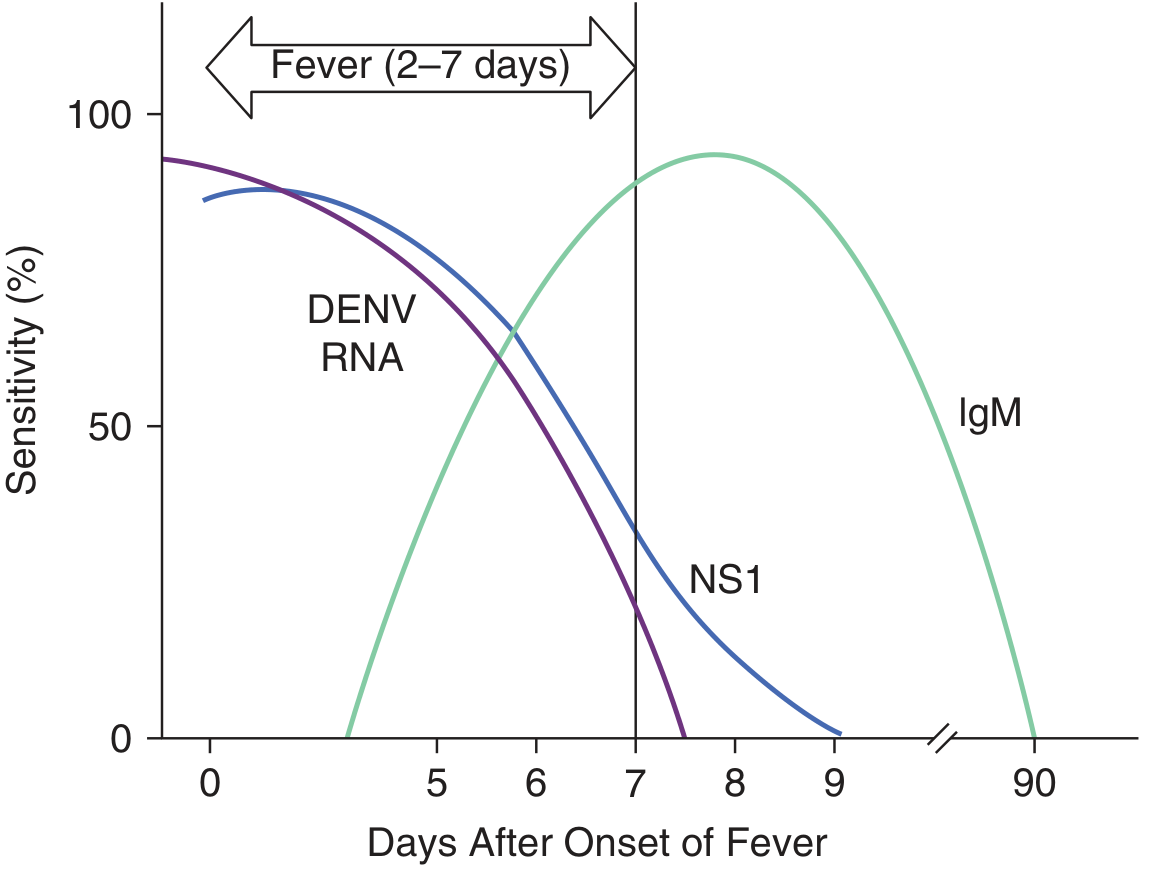
Diagnostic test sensitivity over time - Goldman-Cecil Medicine
| Test | Timing | Notes |
|---|---|---|
| RT-PCR (DENV RNA) | Days 1-7 | High sensitivity early; gold standard |
| NS1 antigen (EIA/RDT) | Days 1-9 | Detects both primary and secondary infections; commercial kits available |
| IgM antibody (MAC-ELISA) | From day 3-5 onwards | 99% positive by day 10; peaks at 2 weeks; persists 2-3 months |
| IgG antibody | Convalescent phase | Persists for life; fourfold rise between acute and convalescent confirms infection |
| Combined NS1 + IgM | Days 1-10 | Identifies ≥90% of primary and secondary cases |
Routine labs: CBC (leukopenia, thrombocytopenia, rising hematocrit), LFTs (elevated transaminases), coagulation studies in DHF/DSS. Serial hematocrit is the most important monitoring tool.
- Red Book 2021, p. 523; Goldman-Cecil Medicine
Management by Severity
1. Dengue Fever (No Warning Signs) - Outpatient Management
Most patients can be managed at home if they can tolerate oral fluids and urinate at least every 6 hours. The management is:
-
Oral hydration: ORS, fruit juices, electrolyte-containing fluids. Adequate oral intake reduces hospitalizations. Avoid plain water alone (dilutional hyponatremia risk).
-
Antipyretics: Paracetamol (acetaminophen) to keep temperature below 39°C. Dosing interval not less than 6 hours.
-
Strict avoidance: Aspirin (risk of Reye's syndrome and bleeding), ibuprofen/NSAIDs (worsen gastritis and bleeding tendency), steroids (not recommended).
-
Return precautions (red flag symptoms): Instruct patients to return immediately if they develop severe abdominal pain, persistent vomiting, cold/clammy extremities, lethargy, restlessness, mucosal bleeding, black tarry stools, or no urine >4-6 hours.
-
Monitoring: Daily review of temperature, fluid intake/output, urine frequency, serial CBC (platelet count and hematocrit from day 3 onward).
-
Park's Textbook, p. 295; Rosen's Emergency Medicine, p. 2630
2. Dengue with Warning Signs (DHF Grades I-II) - Hospitalize
These patients require admission for close monitoring and IV fluid support:
- IV isotonic crystalloid (Normal saline or Ringer's lactate) - start if oral intake is insufficient or patient is vomiting. Use the minimum necessary to maintain hemodynamic status.
- Serial hematocrit every 4-6 hours guides fluid therapy. A rising Hct indicates ongoing plasma leakage.
- Monitor for early signs of shock (pulse pressure narrowing, tachycardia, reduced urine output).
- Reduce IV fluid rate as hemodynamic status improves or diuresis ensues.
- Watch for fluid overload - a falling hematocrit during the critical phase may indicate bleeding or dilution from over-hydration, not resolution.
- No evidence supports platelet transfusion in patients without active bleeding, even at low counts.
3. Dengue Shock Syndrome (DHF Grades III-IV / Severe Dengue) - ICU Admission
Immediate resuscitation is required:
-
Oxygen by face mask or nasal prongs.
-
IV fluid bolus: Isotonic crystalloid (NS or RL) 10-20 ml/kg over 15-30 minutes. Reassess after each bolus.
-
If no improvement: Switch to IV colloid (Dextran 40 or polygeline) 10 ml/kg.
-
Reassess constantly: Improvement = Hct falls, pulse rate and BP stabilize, urine output rises. No improvement = Hct or pulse rate rises, pulse pressure falls <20 mmHg, urine output falls.
-
Monitor for ABCS: Acidosis, Bleeding, Calcium/electrolyte disorders, Sugar (glucose) - correct each.
-
Blood products:
- Indications: overt blood loss ≥10% total blood volume, refractory shock with declining hematocrit/hemoglobin.
- Whole blood or packed red cells 10 ml/kg; coagulation panel before transfusion.
- Packed cells if fluid overload is present.
- Platelet transfusion: only for active significant bleeding with severe thrombocytopenia.
-
Avoid: Hyperosmolar or Ringer's lactate in acidosis.
-
Monitor: Vital signs, urine output, and hematocrit every hour.
-
Park's Textbook, p. 296-297; Red Book 2021, p. 515
4. Recovery Phase Management
- Reduce IV fluids promptly as clinical signs improve (stable vitals, rising urine output, falling hematocrit due to dilution).
- Watch for fluid overload during reabsorption - may manifest as pulmonary edema, even in patients who appeared stable.
- Bradycardia and ECG changes are common in recovery and usually benign.
- Platelet count recovers later than WBC count.
Special Situations
| Scenario | Management Note |
|---|---|
| Severe dengue with encephalopathy | Supportive; manage cerebral edema; avoid hypotonic fluids |
| Severe hepatitis (AST/ALT ≥1000) | Supportive liver care; avoid hepatotoxic drugs |
| Dengue myocarditis | Supportive cardiac monitoring; avoid aggressive fluid loading |
| Hemophagocytic lymphohistiocytosis (HLH) | Rare but potentially fatal complication; may require specific HLH therapy |
| Pregnancy | Higher risk of severe dengue near delivery; vertical transmission ~20%; intensive monitoring |
| Diabetes/asthma/sickle cell | High-risk groups; lower threshold for hospitalization |
| Steroids | Not recommended - evidence inconclusive, cannot be recommended routinely |
- Red Book 2021; Goldman-Cecil; Rosen's Emergency Medicine
Differential Diagnosis
Other diagnoses to consider: Malaria, Zika, Chikungunya, Leptospirosis, Rickettsial infections, Yellow fever, other viral hemorrhagic fevers (Ebola, Marburg, bunyavirus), Measles (in febrile returned traveler with rash). - Rosen's Emergency Medicine, p. 2630
Disposition
| Category | Disposition |
|---|---|
| Dengue without warning signs + tolerating oral fluids | Outpatient with daily monitoring |
| Dengue with warning signs | Hospital admission |
| DHF/Severe dengue | Hospital (monitored ward) |
| Dengue shock syndrome | ICU |
Prevention and Vaccines
-
Vector control: Eliminate standing water breeding sites. Insect repellents, screened windows, protective clothing, bed nets.
-
Dengvaxia (CYD-TDV): Recombinant live-attenuated tetravalent vaccine. Three doses at 0, 6, 12 months. FDA-approved for ages 9-16 years in dengue-endemic areas, only in previously seropositive individuals. Seronegative recipients face an increased risk of severe dengue on subsequent natural infection. Do not use if prior dengue status is unknown.
-
Wolbachia strategy: Infecting A. aegypti with Wolbachia pipientis reduces dengue transmission by ~75% in endemic areas.
-
Quadrivalent dengue vaccine (newer formulation): ~80% efficacy in children 4-16 years; ~90% protection against hospitalization.
-
Red Book 2021, p. 521-524; Goldman-Cecil Medicine, p. 3657-3658
Key Points Summary
- No specific antivirals exist - management is phase-directed and supportive.
- The critical phase (around defervescence, days 3-7) lasts only 24-48 hours but is life-threatening due to plasma leakage.
- Hematocrit is the most important bedside monitoring parameter.
- Crystalloids are first-line for fluid resuscitation; colloids for refractory shock.
- Never give aspirin or NSAIDs - risk of bleeding and Reye's syndrome.
- Fluid overload is a major risk in both critical and recovery phases.
- Steroids are not routinely recommended.
- Platelet transfusion is reserved for active significant hemorrhage, not prophylactic.
- Early recognition of warning signs and prompt IV hydration can prevent progression to shock.
- Dengvaxia is only for seropositive individuals in endemic areas - use in seronegatives is contraindicated.
This is a shared conversation. Sign in to Orris to start your own chat.