
Rationale behind preferring Azithromycin over Erythromycin
Reading File
Azithromycin is preferred over erythromycin primarily because of its superior pharmacokinetics (longer half-life allowing once-daily dosing and shorter courses), better GI tolerability, and broader activity. Let me pull the full details from the medical library.
Searching sources...
Finding Sources
Finding Sources
Searching PubMed
azithromycin erythromycin comparison pharmacokinetics tolerability
Now let me read the key sections from the textbooks for comprehensive detail.
Reading File
Reading File
Reading File
I now have enough textbook content for a thorough answer. Let me fetch the macrolide spectrum diagram for visual clarity.
Loading Image
Reading File
Reading File
I now have comprehensive data from multiple authoritative sources. Here is the full answer:
Azithromycin vs. Erythromycin: Why Azithromycin is Preferred
Azithromycin and clarithromycin are semisynthetic derivatives of erythromycin that have largely replaced it in clinical use. The rationale spans structural chemistry, pharmacokinetics, tolerability, drug interactions, and spectrum of activity.
1. Structural Basis
Erythromycin has a 14-membered lactone ring and is acid-labile. Azithromycin differs structurally by the addition of a methyl-substituted nitrogen atom into the lactone ring, converting it into a 15-membered azalide ring. This single structural modification confers all the major advantages over erythromycin, including:
-
Increased acid stability
-
Enhanced tissue penetration
-
Broadened spectrum of activity
-
Goodman & Gilman's Pharmacological Basis of Therapeutics, p. 1202
-
Fitzpatrick's Dermatology, p. 1000
2. Pharmacokinetic Superiority
This is the most important reason azithromycin is preferred.
| Property | Erythromycin | Azithromycin |
|---|---|---|
| Half-life | ~2 hours | ~68 hours (tissue t½ 2-4 days) |
| Dosing frequency | 3-4 times daily | Once daily |
| Tissue/serum ratio | Moderate | 10-100x serum levels |
| Acid stability | Labile (needs enteric coating or ester forms) | Stable in gastric acid |
| CSF penetration | Good (except CSF) | Poor (CSF excluded) |
- Lippincott Pharmacology, p. 1000-1001
Key points:
-
The tissue half-life of 2-4 days allows a 5-day course or even a single-dose regimen (e.g., single 1 g dose for chlamydial cervicitis) -- impossible with erythromycin.
-
Azithromycin concentrates avidly in neutrophils, macrophages, and fibroblasts - meaning it accumulates precisely where infection occurs intracellularly. Serum concentrations are deliberately low (~0.4 mcg/mL after 500 mg), but tissue concentrations are disproportionately high.
-
Erythromycin base is destroyed by gastric acid; enteric-coated or esterified formulations are needed. Azithromycin is acid-stable and absorbs reliably.
-
Katzung's Basic and Clinical Pharmacology, p. 1909-1911
3. Gastrointestinal Tolerability
Erythromycin is a motilin receptor agonist - it binds motilin receptors on GI smooth muscle and stimulates gastric contractions (sometimes exploited therapeutically in gastroparesis and postoperative ileus). At antibacterial doses, this translates into:
- Nausea, vomiting, abdominal cramping, diarrhea
- The most common cause of non-compliance with erythromycin therapy
Azithromycin causes significantly less GI distress because it has far weaker motilin agonist activity. This is a major practical advantage for outpatient adherence.
- Lippincott Pharmacology, p. 1002
4. Hepatotoxicity
Erythromycin estolate (and other forms to a lesser extent) can cause acute cholestatic hepatitis - thought to be a hypersensitivity reaction with fever, jaundice, and impaired liver function. Azithromycin does not carry this same risk profile.
- Katzung's Basic and Clinical Pharmacology, p. 1891
5. Drug Interactions - Major Advantage of Azithromycin
This is clinically very significant:
-
Erythromycin metabolites strongly inhibit CYP450 enzymes (primarily CYP3A4), increasing serum levels of warfarin, cyclosporine, digoxin, methylprednisolone, azole antifungals, and direct-acting anticoagulants - creating a high drug-drug interaction burden.
-
Azithromycin does NOT significantly inhibit CYP3A4, making it far safer in patients on polypharmacy. It is primarily excreted in bile as active drug rather than being hepatically metabolized.
-
Katzung's Basic and Clinical Pharmacology, p. 1893
6. Expanded Spectrum
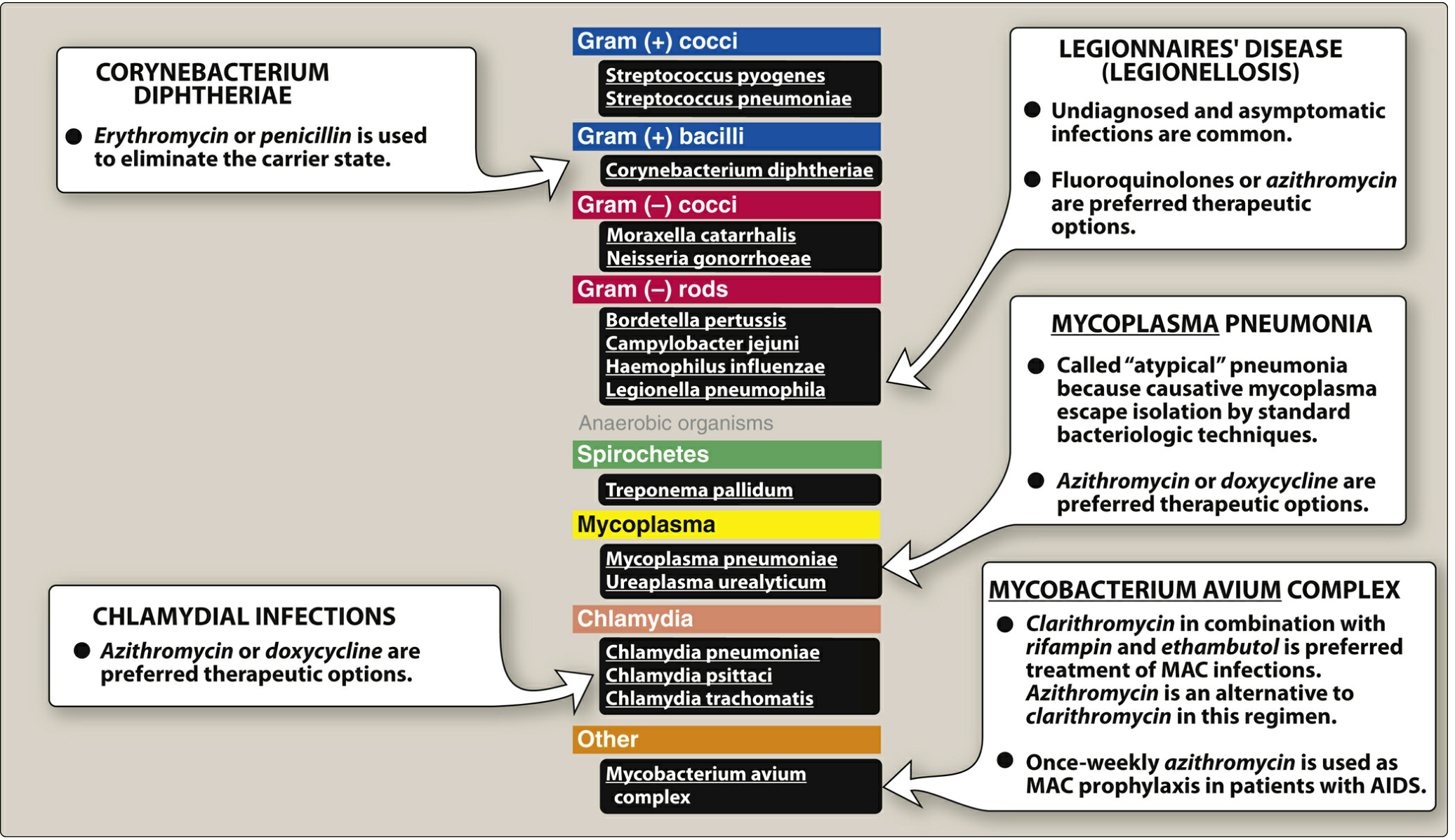
Figure: Typical therapeutic applications of macrolides - Lippincott Pharmacology
While both share a similar core spectrum, azithromycin offers important additions:
- Greater activity against H. influenzae and Moraxella catarrhalis (important respiratory pathogens)
- Highly active against Chlamydia spp. (preferred agent for chlamydial infections)
- Active against Mycobacterium avium complex (MAC) - used for MAC prophylaxis in AIDS (once-weekly dosing feasible due to long half-life)
- Active against Toxoplasma gondii
- Active against Legionella pneumophila and Mycoplasma pneumoniae (atypical pneumonia organisms)
Notably, azithromycin is slightly less active than erythromycin against streptococci and staphylococci - but this is rarely a clinical limitation given its other advantages.
- Lippincott Pharmacology, p. 998-999; Katzung, p. 1909
7. Ototoxicity
Erythromycin is associated with transient hearing loss, especially at high doses. Azithromycin carries this risk to a lesser extent (though not absent).
Summary Table
| Feature | Erythromycin | Azithromycin | Clinical Impact |
|---|---|---|---|
| Half-life | 2 hours | ~68 hours | Once-daily/single-dose regimens |
| GI side effects | Severe (motilin agonism) | Mild | Better compliance |
| CYP3A4 inhibition | Strong | Minimal | Safer in polypharmacy |
| Acid stability | Unstable (needs ester/enteric coating) | Stable | Reliable oral absorption |
| Tissue penetration | Moderate | 10-100x serum | Effective for intracellular pathogens |
| Cholestatic hepatitis | Yes (estolate form) | Rare | Lower hepatotoxicity risk |
| H. influenzae activity | Modest | Better | Better respiratory coverage |
| Chlamydia coverage | Yes | Excellent | Preferred for STIs |
The bottom line: azithromycin's superior pharmacokinetics (especially its extraordinary tissue half-life), markedly better GI tolerability, minimal CYP450 drug interactions, and reliable acid stability collectively explain why it has largely replaced erythromycin in clinical practice for nearly all indications where a macrolide is indicated.
Drugs active against MRSA in brief
Key anti-MRSA drugs: Vancomycin (IV, gold standard), Linezolid (IV/oral), Daptomycin (IV, not for pneumonia), Tigecycline, TMP-SMX (community MRSA), Clindamycin, Teicoplanin, Ceftaroline, and newer agents like Dalbavancin/Oritavancin. Let me get the full textbook detail.
Searching sources...
Finding Sources
Finding Sources
Finding Sources
Finding Sources
Reading File
Reading File
Finding Sources
Excellent - I now have comprehensive, authoritative data. Here is the concise but complete answer:
Drugs Active Against MRSA
MRSA owes its resistance to the mecA gene, which encodes PBP2a - a modified penicillin-binding protein with low affinity for all beta-lactams (except ceftaroline). All anti-MRSA agents therefore work by mechanisms that bypass or overcome PBP2a.
First-Line / Preferred Agents
1. Vancomycin (Glycopeptide)
- Gold standard for serious MRSA infections (bacteremia, endocarditis, pneumonia, osteomyelitis)
- Mechanism: Binds D-Ala-D-Ala terminus of peptidoglycan precursors → inhibits cell wall synthesis (does not use PBPs)
- IV only; dose 15-20 mg/kg IV q8-12h; AUC-guided dosing preferred
- Concern: VISA (MIC 4-8 mg/L) and rare VRSA (MIC >8 mg/L) strains emerging
- Not active against gram-negatives
2. Daptomycin (Cyclic Lipopeptide)
- IV only; alternative to vancomycin for bacteremia and right-sided endocarditis
- Mechanism: Inserts into bacterial cell membrane → depolarization → rapid cell death (bactericidal)
- NOT for pneumonia - inactivated by pulmonary surfactant
- Dose: 6-10 mg/kg/day (higher doses for endocarditis/bacteremia)
- Useful when vancomycin MIC is elevated (>1.5 mcg/mL)
3. Linezolid (Oxazolidinone)
- IV and oral (100% bioavailability - unique among anti-MRSA drugs)
- Mechanism: Binds 23S rRNA of 50S subunit → inhibits initiation of protein synthesis
- Effective for pneumonia, SSTIs, and as step-down oral therapy
- 600 mg q12h
- ADEs: myelosuppression (prolonged use), serotonin syndrome (with SSRIs), peripheral/optic neuropathy
- Bacteriostatic against staphylococci
Alternative / Newer Agents
4. Tedizolid (2nd-generation Oxazolidinone)
- Oral and IV; 200 mg once daily (vs linezolid's twice-daily dosing)
- Active against some linezolid-resistant strains
- Fewer myelosuppression side effects
- Approved for SSTIs
5. Ceftaroline (5th-generation Cephalosporin)
- Only beta-lactam active against MRSA
- Mechanism: Binds PBP2a with high affinity (unlike other beta-lactams)
- IV only; 600 mg q12h
- Used for SSTIs and community-acquired pneumonia
- Also used as combination therapy for persistent MRSA bacteremia with vancomycin or daptomycin
6. TMP-SMX (Trimethoprim-Sulfamethoxazole)
- Key oral agent for community-acquired MRSA (CA-MRSA) - e.g., skin and soft tissue infections
- Synergistic inhibition of folate synthesis
- Inexpensive; good oral bioavailability
- Not reliably active against all MRSA strains; susceptibility testing recommended
7. Clindamycin
- Oral and IV; useful for CA-MRSA SSTIs and necrotizing fasciitis
- Mechanism: Binds 50S ribosome, inhibits translocation
- Susceptibility testing required; check for inducible resistance (D-zone test)
8. Tetracyclines (Doxycycline, Minocycline)
- Oral agents for mild CA-MRSA infections (SSTIs)
- Susceptibility must be confirmed
Lipoglycopeptides (Long-Acting IV Agents)
These are semisynthetic vancomycin derivatives with extended half-lives:
| Drug | Half-life | Dosing | Notes |
|---|---|---|---|
| Telavancin | ~8 hours | Daily IV | Approved for MRSA SSTI and HAP/VAP |
| Dalbavancin | ~8-10 days | Single or 2-dose IV | Excellent for SSTI; allows outpatient treatment |
| Oritavancin | ~10 days | Single IV dose | SSTIs only; inhibits both cell wall synthesis and membrane function |
All three are active against MRSA, VISA, and some VRSA strains.
- Washington Manual of Medical Therapeutics; Fitzpatrick's Dermatology
Tigecycline (Glycylcycline)
- IV; broad-spectrum including MRSA
- Active against many resistant organisms including MRSA and VRE
- Not for bacteremia (low serum levels; associated with increased mortality)
- Used for complicated SSTIs and intra-abdominal infections
Quinupristin-Dalfopristin (Streptogramin)
- IV combination; bactericidal against MRSA
- Reserved for resistant infections; significant myalgia and phlebitis
- Not active against Enterococcus faecalis
Rifampin
- Never used alone (rapid resistance develops)
- Added as adjunct in prosthetic joint infections and biofilm-associated MRSA (enhances intracellular and biofilm penetration)
Summary by Setting
| Setting | Preferred Drug(s) |
|---|---|
| Bacteremia / Endocarditis | Vancomycin or Daptomycin |
| Pneumonia (HAP/VAP) | Vancomycin or Linezolid (NOT Daptomycin) |
| SSTI - Outpatient (CA-MRSA) | TMP-SMX, Clindamycin, Doxycycline |
| SSTI - Inpatient (complicated) | Vancomycin, Linezolid, Daptomycin, Ceftaroline, Dalbavancin |
| Osteomyelitis | Vancomycin (IV), then step-down to Linezolid or TMP-SMX oral |
| Persistent bacteremia (salvage) | Daptomycin + Ceftaroline ± Rifampin |
| Prosthetic device infections | Vancomycin/Daptomycin + Rifampin |
- Harrison's Principles of Internal Medicine 22E, p. 2185-2195
- Tietz Textbook of Laboratory Medicine 7E (Table 85.5)
- Lippincott Illustrated Reviews Pharmacology
- Washington Manual of Medical Therapeutics
Drugs active against Anaerobic Organisms in very brief
Key anti-anaerobic drugs: Metronidazole, Clindamycin, Beta-lactam/inhibitor combos (Piperacillin-tazobactam, Amoxicillin-clavulanate), Carbapenems, Chloramphenicol. Let me verify from the textbooks quickly.
Searching sources...
Finding Sources
Finding Sources
Reading File
Got exactly what's needed. Here is the brief answer:
Drugs Active Against Anaerobic Organisms
Key principle: Most anaerobic infections are mixed (anaerobes + facultative aerobes) and almost always require surgical drainage + antibiotics. Bacteroides fragilis group is the toughest target - it universally produces beta-lactamase.
First-Line Agents
| Drug | Notes |
|---|---|
| Metronidazole | Most reliable; virtually no anaerobe is resistant. Drug of choice for B. fragilis (below diaphragm). Also covers C. difficile, amoeba. Oral & IV. |
| Clindamycin | Highly active; preferred for above-diaphragm infections (aspiration pneumonia, lung abscess, oral/dental). Resistance in B. fragilis group is increasing. |
Beta-Lactam / Beta-Lactamase Inhibitor Combinations
Cover anaerobes (including B. fragilis) by protecting the beta-lactam from destruction:
- Amoxicillin-clavulanate (oral)
- Ampicillin-sulbactam (IV)
- Piperacillin-tazobactam (IV) - broadest coverage; adds gram-negative activity
Carbapenems
- Imipenem, Meropenem, Ertapenem, Doripenem
- Excellent anaerobic coverage; resistance still uncommon
- Reserved for serious/mixed polymicrobial infections
Other Agents
| Drug | Notes |
|---|---|
| Cefoxitin / Cefotetan (2nd-gen cephalosporins) | Good anaerobic activity; useful for GYN and abdominal infections; not as potent as clindamycin or metronidazole |
| Penicillin G | Drug of choice for anaerobes that do NOT produce beta-lactamase (e.g., oral anaerobes, Clostridium perfringens, Actinomyces) |
| Tigecycline | Good in vitro activity including B. fragilis group; used in polymicrobial infections |
| Chloramphenicol | Broad anaerobic coverage; rarely used today due to toxicity (aplastic anemia) |
| Moxifloxacin | Some anaerobic activity; used in intra-abdominal infections |
Location-Based Choice (Quick Reference)
| Site | Preferred Agent(s) |
|---|---|
| Above diaphragm (lung abscess, aspiration, oral/dental) | Clindamycin or Amoxicillin-clavulanate |
| Below diaphragm (intra-abdominal, colorectal, pelvic) | Metronidazole ± beta-lactam; Pip-Tazo; Carbapenems |
| CNS (brain abscess) | Metronidazole + Penicillin (or Ceftriaxone) |
| Clostridium difficile | Metronidazole (mild); Vancomycin oral / Fidaxomicin (severe) |
| Gas gangrene (C. perfringens) | Penicillin G + Clindamycin (anti-toxin effect) |
| Actinomycosis | Penicillin G (prolonged) |
Memory hook: "Might Clean Pus Carefully" = Metronidazole, Clindamycin, Piperacillin-tazobactam, Carbapenems
- Jawetz Melnick & Adelberg's Medical Microbiology 28E
- Henry's Clinical Diagnosis and Management by Laboratory Methods
1.Advantages of Neomycin & Soframycin over Gentamicin 2.Advantages of Doxycycline over Tetracycline in very very brief
Searching sources...
Finding Sources
Finding Sources
Finding Sources
Finding Sources
Finding Sources
Finding Sources
Finding Sources
Finding Sources
Reading File
Finding Sources
I have solid textbook data for doxycycline. For neomycin/soframycin, the textbooks confirm they are topical aminoglycosides, and I'll answer from well-established pharmacology knowledge supplemented by what the library confirmed. Here is the brief answer:
1. Neomycin & Soframycin (Framycetin) vs. Gentamicin
Both neomycin and framycetin are aminoglycosides used topically only - and that is precisely their advantage over gentamicin:
| Feature | Neomycin / Soframycin | Gentamicin |
|---|---|---|
| Route | Topical only (skin, eye, ear drops) | IV/IM (systemic) |
| Systemic toxicity | Negligible - not absorbed through intact skin | Nephrotoxic + Ototoxic systemically |
| Resistance concern | Low clinical importance (not used systemically) | Resistance limits systemic use |
| Cost | Cheap, widely available OTC | Requires IV access, monitoring |
| Bowel sterilization | Neomycin oral used for pre-op gut prep / hepatic encephalopathy (acts locally, not absorbed) | Not used for this purpose |
Key point: Gentamicin is reserved for serious systemic gram-negative infections where TDM (therapeutic drug monitoring) is mandatory due to nephro/ototoxicity. Neomycin and framycetin avoid these systemic risks entirely by staying topical.
Note: Neomycin is actually more nephrotoxic and ototoxic than gentamicin if absorbed systemically - this is precisely WHY it is restricted to topical/local use only.
2. Doxycycline vs. Tetracycline
| Feature | Tetracycline | Doxycycline |
|---|---|---|
| Half-life | ~8 hours (4x/day dosing) | ~18 hours (once or twice daily) |
| Food interaction | Must be taken on empty stomach (food/dairy chelates it) | Can be taken with food - no significant effect |
| Renal failure | Accumulates - dose adjustment needed (excreted renally) | Safe in renal failure - excreted in feces; no dose adjustment needed |
| Lipid solubility | Low | High - better tissue penetration (prostate, lung, bile, genital tract) |
| Absorption | Incomplete | Better and more consistent |
| Dosing | 250-500 mg 4x/day | 100 mg once or twice daily |
| Uses | Narrower | Broader - atypicals, MRSA SSTIs, malaria prophylaxis, Lyme, Chlamydia, Rickettsia |
Summary: Doxycycline is preferred over tetracycline in almost all situations because of once-daily dosing, food compatibility, safety in renal impairment, and superior tissue penetration.
- Fitzpatrick's Dermatology, p. 2601
- Lippincott Illustrated Reviews Pharmacology
Rationale behind combining Amoxicillin with Clavulinic Acid in very very brief
Finding Sources
Reading File
Finding Sources
Amoxicillin + Clavulanic Acid (Co-amoxiclav) - Rationale
The Problem: Beta-Lactamase
Amoxicillin is a broad-spectrum aminopenicillin, but many clinically important bacteria produce beta-lactamase - an enzyme that breaks open the beta-lactam ring of amoxicillin, rendering it inactive. Key beta-lactamase producers include:
- S. aureus (MSSA)
- H. influenzae
- Moraxella catarrhalis
- E. coli, Klebsiella
- Bacteroides fragilis
- Prevotella spp.
The Solution: Clavulanic Acid as a "Suicide Inhibitor"
Clavulanic acid itself has minimal antibacterial activity, but it:
- Binds irreversibly to beta-lactamase - acts as a "suicide substrate" or "mechanism-based inhibitor"
- Permanently inactivates the enzyme
- Shields amoxicillin from destruction, allowing it to reach its target (PBP - penicillin binding proteins) and inhibit cell wall synthesis
Clavulanic acid sacrifices itself to protect amoxicillin - hence called a beta-lactamase inhibitor, not an antibiotic.
Net Result
| Without Clavulanate | With Clavulanate |
|---|---|
| Beta-lactamase destroys amoxicillin | Beta-lactamase neutralized |
| Organism resistant | Organism susceptible again |
| Narrow spectrum | Restored + extended spectrum |
Extended Coverage Gained
Adding clavulanate extends amoxicillin's spectrum to cover:
- Beta-lactamase-producing S. aureus (MSSA)
- H. influenzae, M. catarrhalis
- Many gram-negatives (E. coli, Klebsiella)
- Oral anaerobes and Bacteroides spp.
Clinical Uses of Co-amoxiclav
- RTIs (sinusitis, otitis media, community-acquired pneumonia)
- UTIs with resistant E. coli
- Skin/soft tissue infections
- Animal/human bites (polymicrobial + anaerobes)
- Diabetic foot infections
Bottom line: Clavulanate does not make amoxicillin stronger - it removes the shield bacteria use against it, restoring amoxicillin's full bactericidal effect against resistant organisms.
- Katzung's Basic and Clinical Pharmacology 16E, p. 1110
- Dermatology 2-Volume Set 5E
Management of Anaphylactic Shock by Penicillins in very very brief
Searching sources...
Finding Sources
Finding Sources
Finding Sources
Finding Sources
Reading File
Finding Sources
Reading File
Good data acquired. Here is the concise answer:
Management of Anaphylactic Shock due to Penicillin
Pathophysiology (in one line)
Penicillin acts as a hapten → binds to plasma proteins → IgE-mediated Type I hypersensitivity → massive mast cell/basophil degranulation → histamine, leukotrienes → vasodilation, bronchospasm, hypotension.
Immediate Steps
Step 1 - STOP the drug immediately
- Discontinue penicillin at once
- Remove IV cannula if drug was IV
Step 2 - Position
- Lay patient flat with legs elevated (Trendelenburg) to improve venous return
- If dyspneic/respiratory distress - sit upright
Step 3 - Airway & Oxygen
- 100% O₂ via face mask
- Prepare for intubation/tracheotomy if laryngeal edema develops rapidly
Drug Treatment
| Drug | Dose | Route | Purpose |
|---|---|---|---|
| Epinephrine (Adrenaline) ← FIRST & MOST IMPORTANT | 0.3-0.5 mg (1:1000) | IM (thigh) | Reverses bronchospasm, vasoconstriction, reduces oedema |
| Repeat epinephrine if needed | Every 10-20 min | IM | If no response |
| IV fluids | Normal saline bolus | IV | Restore circulating volume / hypotension |
| Antihistamine (Diphenhydramine / Chlorpheniramine) | 25-50 mg | IM/IV | Block H1 receptors, reduce urticaria/oedema |
| H2 blocker (Ranitidine) | 50 mg | IV | Block H2 receptors (adjunct) |
| Corticosteroid (Hydrocortisone or Methylprednisolone) | 200-500 mg hydrocortisone | IV | Prevent biphasic/late-phase reaction (takes hours to act) |
| Salbutamol nebulisation | 2.5-5 mg | Inhaled | Persistent bronchospasm |
Epinephrine is the only life-saving drug - antihistamines and corticosteroids are adjuncts only and do NOT replace it.
Why Each Drug?
- Epinephrine: α1 → vasoconstriction (reverses hypotension); β2 → bronchodilation; β1 → increased cardiac output; also reduces mast cell degranulation
- Antihistamines: Competitive antagonism at H1 receptors → reduce itch, urticaria, angioedema
- Corticosteroids: Suppress inflammatory mediator synthesis; prevent delayed/biphasic anaphylaxis (onset 4-8 hours later)
- IV fluids: Up to 2-3 L may be needed - massive vasodilation causes relative hypovolaemia
Future Prevention
-
Document penicillin allergy clearly
-
Skin test before re-use if unavoidable
-
Desensitization protocol if penicillin is absolutely necessary (e.g., neurosyphilis, enterococcal endocarditis)
-
Cross-reactivity with cephalosporins: ~1-2% (not all cephalosporins are contraindicated)
-
Andrews' Diseases of the Skin, p. 3265
-
Harrison's Principles of Internal Medicine 22E
This is a shared conversation. Sign in to Orris to start your own chat.