
Teach me anatomy
Asking for Preferences
Which area of anatomy would you like to focus on? · What's your background level?
Asking for Preferences
Which body system would you like to start with?
Reading File
Finding Sources
Searching Images
human skeletal system overview diagram labeled bones
Finding Sources
Finding Sources
Finding Sources
Finding Sources
Finding Sources
Reading File
Finding Sources
Reading File
Finding Sources
Reading File
Searching Images
synovial joint structure diagram labeled capsule cartilage
I have everything I need. Here's your beginner-friendly introduction to the Skeletal System.
🦴 The Skeletal System — A Beginner's Guide
What Is the Skeleton?
The adult human skeleton contains 206 bones. Together with cartilage, joints, ligaments, and tendons, they form the musculoskeletal system — the framework that holds your body together and lets you move.
Bone is a living, calcified connective tissue — not dead rock. It contains blood vessels, nerves, and cells that constantly remodel it. Bones perform five key functions:
| Function | Example |
|---|---|
| Support | Your leg bones hold you upright |
| Protection | Skull protects the brain; ribs protect the heart & lungs |
| Movement | Muscles pull on bones to create motion |
| Mineral storage | Bones store calcium and phosphorus |
| Blood cell production | Marrow inside bones makes red and white blood cells |
Types of Bone Tissue
Bones are made of two tissue types:
- Compact bone — Dense, solid outer layer. Forms the hard shell of every bone.
- Spongy (cancellous/trabecular) bone — Porous inner layer with a lattice-like structure. Contains the marrow where blood cells are made.
Classification of Bones by Shape
Bones are classified by their shape into 5 types:
| Type | Shape | Examples |
|---|---|---|
| Long | Tubular, longer than wide | Femur (thigh), Humerus (upper arm) |
| Short | Roughly cuboidal | Wrist bones (carpals), Ankle bones (tarsals) |
| Flat | Two compact layers sandwiching spongy bone | Skull, Sternum, Ribs |
| Irregular | Complex, varied shape | Vertebrae, Facial bones |
| Sesamoid | Small, round, develop inside tendons | Patella (kneecap) |
💡 The patella is the largest sesamoid bone. Smaller sesamoids also exist in tendons of the thumb and big toe.
Bone Structure — Blood & Nerve Supply
- Every bone is covered by a membrane called the periosteum (except where cartilage covers joint surfaces). The periosteum contains blood vessels and sensory nerves — this is why bone injuries are so painful.
- A nutrient artery (usually one per bone) enters through a small hole and supplies the internal marrow and spongy bone.
- The periosteum has the unique ability to form new bone — critical for repair after fractures.
How Do Bones Form?
All bones develop from embryonic mesenchyme (primitive connective tissue) by one of two processes:
- Intramembranous ossification — Mesenchyme converts directly to bone (e.g., flat bones of the skull)
- Endochondral ossification — A cartilage model forms first, then gets replaced by bone (e.g., most long bones of the limbs)
The Axial vs. Appendicular Skeleton
The skeleton is divided into two parts:
Axial skeleton (80 bones) — the central axis of the body:
- Skull (22 bones)
- Vertebral column (26 bones: 7 cervical, 12 thoracic, 5 lumbar, 1 sacrum, 1 coccyx)
- Thoracic cage (25 bones: 12 pairs of ribs + sternum)
Appendicular skeleton (126 bones) — the limbs and their girdles:
- Shoulder girdles + upper limbs
- Pelvic girdle + lower limbs
Joints (Articulations)
A joint is any site where two skeletal elements meet. There are two main categories:
1. Solid Joints (no cavity)
The bones are held together by connective tissue — little or no movement.
- Fibrous joints — bones joined by dense fibrous tissue (e.g., sutures of the skull)
- Cartilaginous joints — bones joined by cartilage (e.g., the pubic symphysis, intervertebral discs)
2. Synovial Joints (have a cavity)
These are the freely movable joints — the most common and clinically important type.
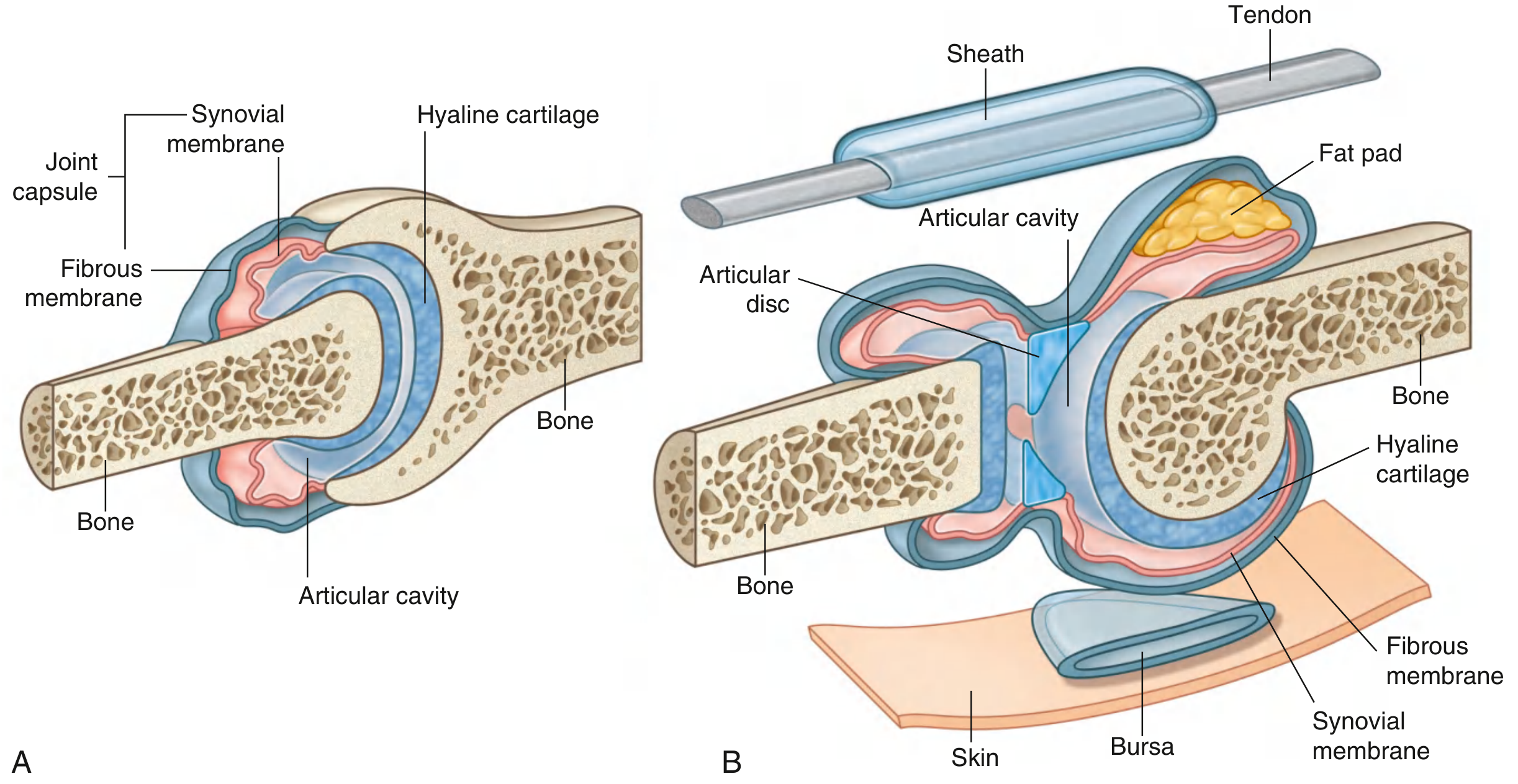
Key features of every synovial joint:
- Articular cartilage (usually hyaline) covers the bone surfaces so bone never directly contacts bone
- Joint capsule consisting of:
- Synovial membrane (inner layer) — produces synovial fluid that lubricates the joint
- Fibrous membrane (outer layer) — tough, stabilizing; thickens to form ligaments
- Articular cavity — the fluid-filled space between the bones
Types of Synovial Joints
| Type | Movement | Example |
|---|---|---|
| Plane (gliding) | Sliding | Intercarpal joints of wrist |
| Hinge | One direction (uniaxial) | Elbow, Knee, Ankle |
| Pivot | Rotation around one axis | Atlas–axis (head rotation) |
| Condylar / Ellipsoid | Two planes (biaxial) | Wrist joint |
| Saddle | Two planes, thumb-like | Thumb (1st carpometacarpal) |
| Ball and socket | All directions (multiaxial) | Hip, Shoulder |
💡 Bursae are fluid-filled sacs near joints that reduce friction between tendons, bone, and skin. Inflammation of a bursa = bursitis.
Clinical Pearls for Beginners
| Condition | What happens |
|---|---|
| Fracture | Break in bone continuity; heals via a callus of new bone laid down by osteoblasts |
| Greenstick fracture | Partial break (like a young tree branch) — seen in children's bones |
| Avascular necrosis | Bone dies when its blood supply is cut off — common in the femoral head after a hip fracture |
| Growth plate injuries | In children, fractures through the growth plate can disrupt normal bone growth |
What's Next?
Now that you understand the skeleton's framework, logical next topics would be:
- The Muscular System — how muscles attach to bones and create movement
- A specific region — e.g., the Upper Limb, Lower Limb, or Spine in detail
- Joints in depth — e.g., the knee or shoulder in clinical detail
Just say the word and we'll go deeper!
Sources: Gray's Anatomy for Students, 4e; Imaging Anatomy: Bones, Joints, Vessels and Nerves
This is a shared conversation. Sign in to Orris to start your own chat.