
All type horns
Asking for Preferences
What kind of horns are you asking about?
Here's a broad overview of all types of horns across major categories:
🎺 Musical Horns (Brass Instruments)
| Horn | Description |
|---|---|
| French Horn | Coiled brass instrument with rotary valves; orchestral staple |
| English Horn | Actually a woodwind (double-reed oboe family), not a true horn |
| Hunting Horn | Early natural horn used for signaling in hunts |
| Natural Horn | Valveless brass horn; predecessor to the French horn |
| Mellophone | Marching-band substitute for the French horn |
| Flugelhorn | Wide-bored, mellow-toned brass instrument |
| Alphorn | Very long wooden horn from the Swiss Alps |
| Post Horn | Small coiled horn historically used by postal coaches |
| Bugle | Simple valveless horn used for military signals |
| Wagner Tuba | Hybrid of horn and tuba, invented for Wagner's Ring cycle |
| Oliphant | Medieval ivory horn carved from elephant tusk |
| Shofar | Ram's horn used in Jewish religious ceremonies |
| Vuvuzela | Plastic stadium horn popular in South African football |
| Didgeridoo | Aboriginal Australian wind instrument (sometimes classified as a horn) |
🦌 Animal Horns (Biology)
| Type | Examples | Notes |
|---|---|---|
| True horns | Cattle, bison, goats, sheep | Permanent bony core covered in keratin; not shed |
| Antlers | Deer, elk, moose, caribou | Bone, shed and regrown annually |
| Pronghorns | Pronghorn antelope | Branched, but the sheath is shed (unique hybrid type) |
| Ossicones | Giraffe, okapi | Skin-covered cartilage/bone protrusions |
| Rhinoceros horn | White rhino, black rhino | Solid keratin, no bone core |
| Narwhal tusk | Narwhal | Modified tooth, often called a horn |
🚗 Vehicle / Warning Horns
| Type | Use |
|---|---|
| Electric horn | Standard car horn |
| Air horn | Trucks, trains, ships — compressed air |
| Fog horn | Ships/lighthouses in low visibility |
| Train horn | Legally required on locomotives |
| Bicycle horn / Bulb horn | Small squeeze horn |
| Klaxon | Loud electromechanical warning horn |
📡 Other Uses of "Horn"
| Type | Field | Description |
|---|---|---|
| Horn antenna | Telecommunications | Flared waveguide antenna for microwave/radio signals |
| Horn loudspeaker | Audio engineering | Uses a flared horn to amplify/direct sound |
| Cape Horn | Geography | Southernmost tip of South America |
| Horn of Africa | Geography | Peninsula including Ethiopia, Somalia, Eritrea, Djibouti |
| Powder horn | History | Hollowed animal horn used to carry gunpowder |
Let me know which category you'd like to explore further!
All type horn in medical
Reading File
Finding Sources
Finding Sources
Reading File
Reading File
Finding Sources
Loading Image
Finding Sources
Here is a comprehensive overview of all types of "horns" in medicine, organized by anatomical system:
🧠 1. Spinal Cord Horns (Gray Matter)
The spinal cord gray matter is H-shaped in cross-section, forming three paired horns:
| Horn | Also Called | Function |
|---|---|---|
| Dorsal Horn | Posterior horn | Sensory processing; receives and integrates nociceptive (pain), temperature, and touch signals |
| Ventral Horn | Anterior horn | Motor function; contains lower motor neurons (alpha and gamma) that innervate skeletal muscle |
| Lateral Horn | Intermediolateral column | Autonomic function (only in T1–L2 and S2–S4); contains preganglionic sympathetic/parasympathetic neurons |
Clinical relevance:
- Dorsal horn — central sensitization in chronic pain; site of opioid/gabapentin action
- Anterior horn — damaged in poliomyelitis, ALS, spinal muscular atrophy (SMA), Werdnig–Hoffmann disease
- Lateral horn — affected in Horner syndrome (T1 level)
— Localization in Clinical Neurology, 8e; Adams and Victor's Principles of Neurology, 12th Ed.
🧠 2. Anterior Horn Cell Syndromes
Diseases selectively destroying anterior horn cells (lower motor neurons):
| Disease | Notes |
|---|---|
| Poliomyelitis | Spinal, bulbar, or bulbospinal forms |
| Acute Flaccid Myelitis (AFM) | Polio-like, enterovirus D68 in children |
| SMA Type I (Werdnig–Hoffmann) | Infantile; most severe |
| SMA Type II | Intermediate form |
| SMA Type III (Kugelberg–Welander) | Juvenile form |
| SMA Type IV | Adult onset |
| Kennedy Syndrome | X-linked bulbospinal muscular atrophy |
| Hirayama Disease | Cervical myelopathy at C7–C8 |
| Postpolio Syndrome | Late motor neuron loss decades after acute polio |
Clinical features: flaccid weakness, atrophy, fasciculations, absent reflexes — sensation preserved.
— Localization in Clinical Neurology, 8e
🧠 3. Ventricular Horns (Brain)
The lateral ventricles of the brain have three horn-like extensions:
| Horn | Location | Notes |
|---|---|---|
| Frontal (Anterior) Horn | Frontal lobe | Bounded by corpus callosum, caudate nucleus |
| Occipital (Posterior) Horn | Occipital lobe | Highly variable in size |
| Temporal (Inferior) Horn | Temporal lobe | Contains the hippocampus on its floor |
| Atrium (Trigone) | Junction | Where occipital + temporal horns and body converge |
Clinical relevance: Enlarged temporal horns on CT/MRI suggest hippocampal atrophy (Alzheimer's disease). Asymmetric occipital horns are normal variants.
— Neuroanatomy through Clinical Cases, 3rd Ed.
🧠 4. Ammon's Horn (Hippocampus)
- Cornu Ammonis (CA) — the curved structure of the hippocampus resembling a ram's horn
- Divided into sectors: CA1, CA2, CA3, CA4
- CA1 is most vulnerable to hypoxic/ischemic injury ("Sommer's sector")
- Relevant in: Alzheimer's disease, temporal lobe epilepsy, memory disorders
🦴 5. Bony / Skeletal Horns (Anatomy)
| Horn | Bone | Details |
|---|---|---|
| Greater Horn of Hyoid | Hyoid bone | Large lateral projection; landmark for laryngeal nerve block |
| Lesser Horn of Hyoid | Hyoid bone | Small anterior projection; attached to stylohyoid ligament |
| Superior Horn of Thyroid Cartilage | Thyroid cartilage | Attaches to thyrohyoid ligament |
| Inferior Horn of Thyroid Cartilage | Thyroid cartilage | Articulates with cricoid cartilage |
| Sacral Horns (Cornua) | Sacrum | Flank the sacral hiatus; landmarks for caudal epidural |
| Coccygeal Horns (Cornua) | Coccyx | Articulate with sacral horns |
| Iliac Horn | Ilium | Seen in Nail-Patella syndrome (hereditary onycho-osteodysplasia) |
— Gray's Anatomy for Students; Miller's Anesthesia, 10e
🔵 6. Uterine Horns (Gynecology)
- The uterine horns are the two upper lateral angles of the uterus where the fallopian tubes enter
- In Müllerian duct anomalies, abnormal fusion leads to:
| Anomaly | Feature |
|---|---|
| Bicornuate uterus | Two uterine horns, single cervix; fundal cleft |
| Uterus didelphys | Two completely separate horns and cervices |
| Unicornuate uterus | One horn; may have a rudimentary contralateral horn |
| Ectopic pregnancy in horn | Cornual/interstitial ectopic — high rupture risk |
— Creasy & Resnik's Maternal–Fetal Medicine; Grainger & Allison's Diagnostic Radiology
🩺 7. Cutaneous Horn (Dermatology / Surgery)
A cutaneous horn (cornu cutaneum) is a cone-shaped, keratin-filled projection from the skin surface.
- Sites: dorsal hands, scalp, ears, penis, eyelids
- Underlying lesions:
- ~60% benign (seborrheic keratosis, verruca, trichilemmoma)
- ~20–30% premalignant (actinic keratosis)
- ~20% malignant (squamous cell carcinoma, basal cell carcinoma)
- Penile horns: 1 in 3 associated with malignancy
- Management: excisional biopsy of the base is mandatory
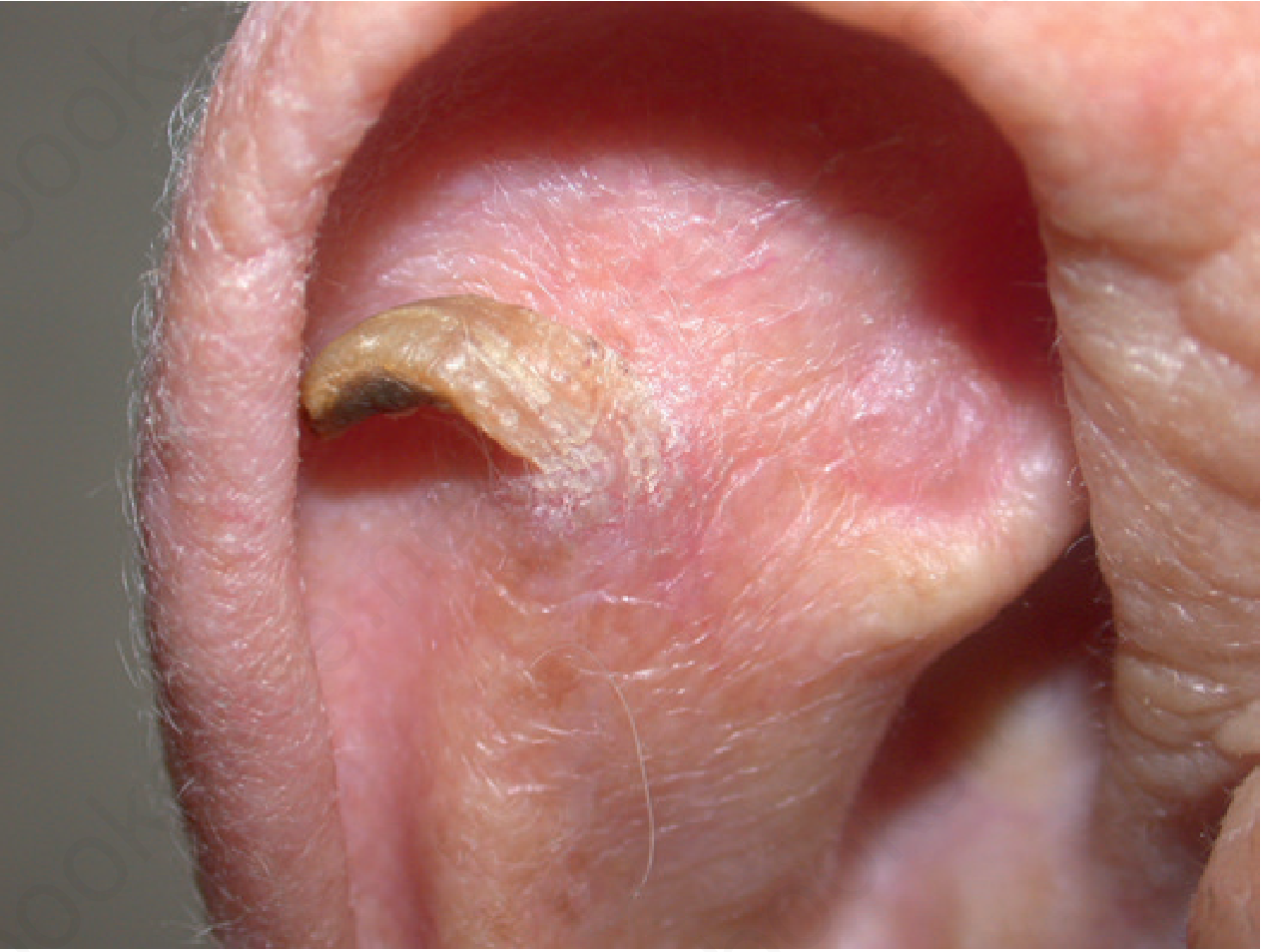
— Andrews' Diseases of the Skin, 5e; Pfenninger and Fowler's Procedures for Primary Care
🟡 8. Occipital Horn Syndrome (Metabolic/Genetic)
- X-linked recessive copper transport disorder (ATP7A gene mutation)
- Related to Menkes disease (allelic)
- Features: occipital exostoses ("occipital horns" — bilateral bony projections from the occipital bone), connective tissue laxity, bladder diverticula, chronic diarrhea, skeletal dysplasia
- Also called: X-linked cutis laxa or Ehlers–Danlos type IX (historical)
Summary Table
| Horn | System | Key Relevance |
|---|---|---|
| Dorsal horn | Spinal cord | Pain modulation |
| Ventral/Anterior horn | Spinal cord | Lower motor neuron; ALS, polio, SMA |
| Lateral horn | Spinal cord | Autonomic (sympathetic) |
| Frontal horn | Brain ventricle | Hydrocephalus imaging |
| Temporal horn | Brain ventricle | Hippocampal atrophy (Alzheimer's) |
| Occipital horn | Brain ventricle | Anatomical variant |
| Ammon's horn (CA) | Hippocampus | Memory, epilepsy |
| Hyoid horns | Hyoid bone | Airway anatomy, nerve blocks |
| Thyroid cartilage horns | Larynx | Surgical landmarks |
| Sacral/coccygeal horns | Sacrum/coccyx | Caudal epidural landmark |
| Iliac horn | Ilium | Nail-Patella syndrome |
| Uterine horns | Uterus | Müllerian anomalies, ectopic pregnancy |
| Cutaneous horn | Skin | Premalignant/malignant potential |
| Occipital horn syndrome | Genetic | Copper transport disorder |
This is a shared conversation. Sign in to Orris to start your own chat.