
Hey mskr a flowchart of fibrolysis and all enzymes and acruvators related to it usmle exam solving
A detailed USMLE-style medical flowchart of fibrinolysis showing all enzymes, activators, and inhibitors. The flowchart should include: ACTIVATORS section (top): - tPA (tissue plasminogen activator) - released from vascular endothelium, stimulated by activated Protein C (APC) and bradykinin - uPA (urokinase-type plasminogen activator) - single-chain (1c-uPA) activated to two-chain (2c-uPA) by Factor XIIa and Kallikrein - Streptokinase (exogenous, from beta-hemolytic Streptococcus) - allosteric modifier, forms streptokinase-plasminogen complex CENTRAL PATHWAY (middle): - Plasminogen (zymogen, binds fibrin via c-lysine residues) → [tPA / uPA / Streptokinase] → Plasmin (active serine protease) - Fibrin (cofactor, increases tPA activity 1000x) → Fibrin Degradation Products (FDP / D-dimer) - Plasmin cleaves cross-linked fibrin → FDPs cleared by liver CONTACT ACTIVATION pathway: - Factor XII → Factor XIIa → activates Prekallikrein → Kallikrein (with HMWK cofactor) - Kallikrein → activates 1c-uPA to 2c-uPA; Kallikrein cleaves HMWK → Bradykinin → stimulates endothelium to release tPA INHIBITORS section (bottom, with red inhibitory arrows): - PAI-1 (Plasminogen Activator Inhibitor-1, serpin) → inhibits tPA and uPA → forms tPA-PAI-1 complex (cleared by liver) - α2-Antiplasmin (serpin, crosslinked to fibrin by Factor XIIIa) → inhibits free circulating Plasmin → forms PAP complex (cleared by liver) - TAFIa (Thrombin-Activatable Fibrinolysis Inhibitor) → activated by Thrombin-Thrombomodulin complex → cleaves c-lysine residues from fibrin → prevents plasminogen binding DRUG TARGETS box: - tPA drugs: Alteplase, Tenecteplase (TNK), Reteplase (rPA) - Non-fibrin-specific: Streptokinase - All convert plasminogen → plasmin → dissolve fibrin clot Use blue arrows for activation, red flat-headed arrows for inhibition, green boxes for enzymes/active forms, yellow boxes for zymogens, orange boxes for inhibitors. Clean white background with clear labels and professional medical diagram style.
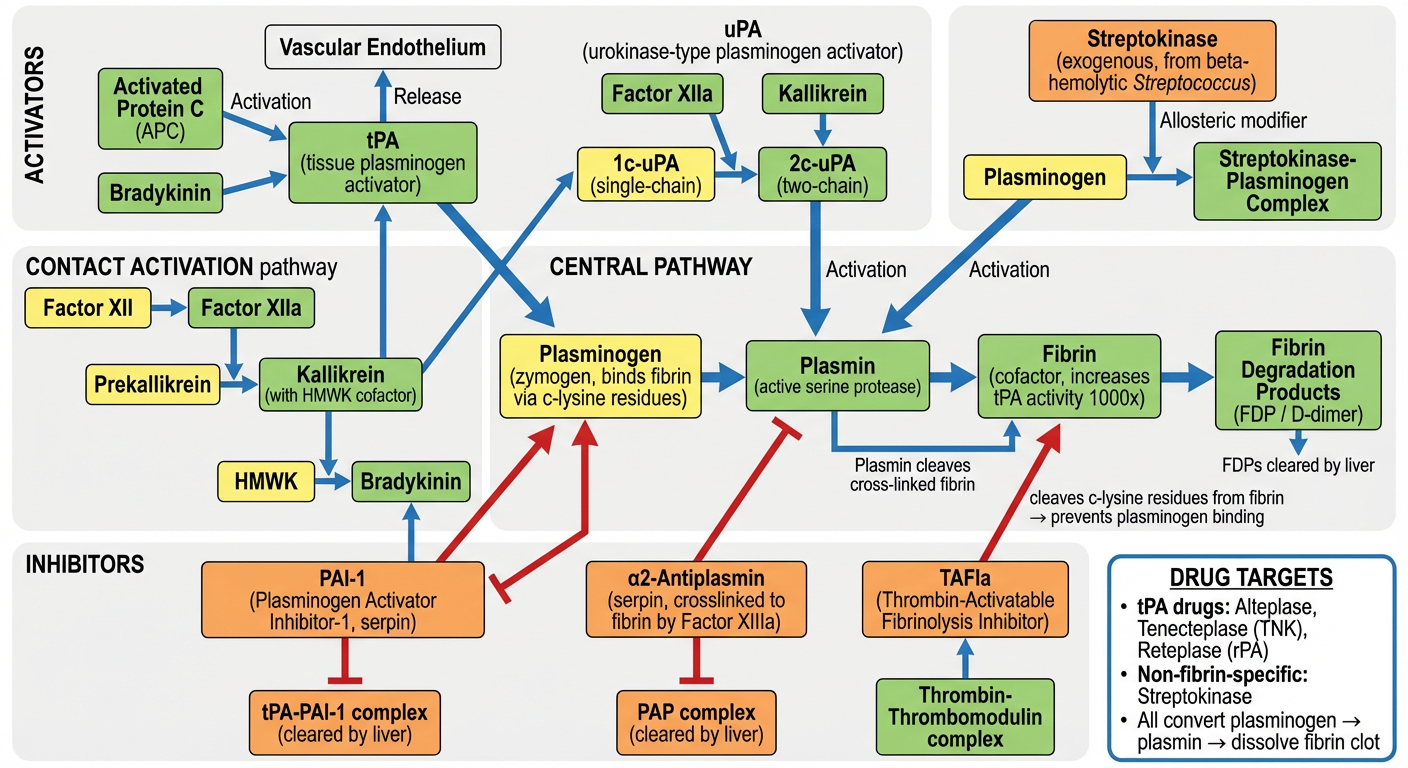
Fibrinolysis — Complete USMLE Flowchart
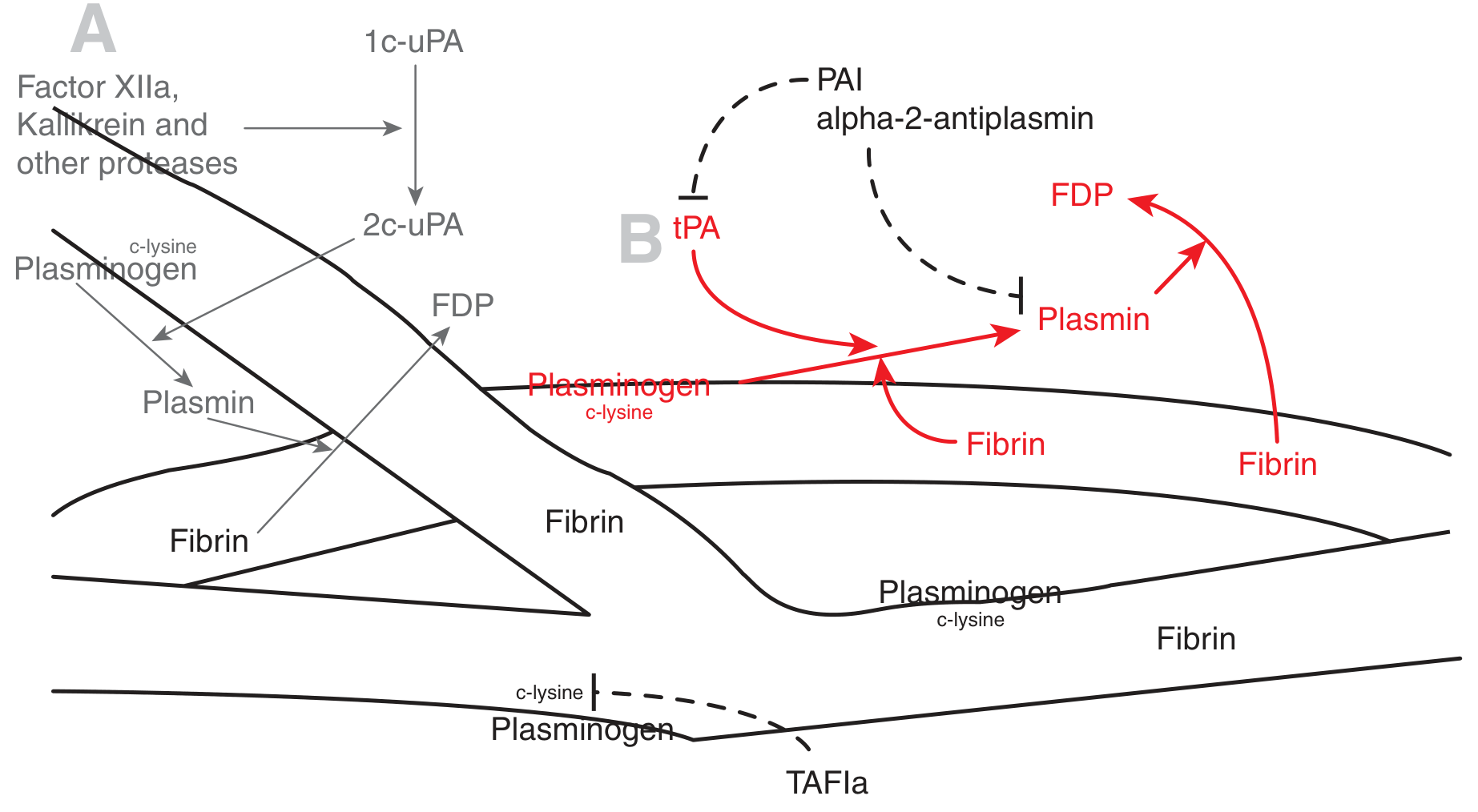
Key Concepts to Know for USMLE
Central Reaction
Plasminogen → Plasmin (via plasminogen activators) Plasmin cleaves fibrin → FDPs + D-dimer
Activators
| Activator | Source | Notes |
|---|---|---|
| tPA (tissue plasminogen activator) | Vascular endothelium | Fibrin-specific; fibrin increases its activity 1000×; stimulated by bradykinin and Protein C |
| uPA (urokinase-type PA) | Most cells/tissues | 1c-uPA (inactive) → 2c-uPA (active) via kallikrein/Factor XIIa; extravascular role |
| Streptokinase | β-hemolytic Streptococcus | NOT an enzyme; allosteric modifier of plasminogen; forms SK–plasminogen complex → autocatalyzes plasmin |
Contact Activation Pathway (links to fibrinolysis)
- Kallikrein activates 1c-uPA → 2c-uPA
- Kallikrein cleaves HMWK → bradykinin → endothelium releases tPA
Inhibitors
| Inhibitor | Target | Mechanism |
|---|---|---|
| PAI-1 (Plasminogen Activator Inhibitor-1) | tPA and uPA | Serpin; forms tPA–PAI-1 complex → cleared by liver |
| α2-Antiplasmin | Plasmin (free) | Serpin; crosslinked to fibrin by Factor XIIIa; inactivates circulating plasmin → PAP complex |
| TAFIa (Thrombin-Activatable Fibrinolysis Inhibitor) | Fibrin lysine residues | Activated by thrombin–thrombomodulin complex; cleaves c-lysine residues → prevents plasminogen binding |
🔑 Key point: Clot-bound plasmin is protected from α2-antiplasmin; free circulating plasmin is rapidly neutralized. This localizes fibrinolysis to the clot site.
Fibrinolytic Drugs (USMLE Favorites)
| Drug | Type | Notes |
|---|---|---|
| Alteplase (tPA) | Fibrin-specific | Gold standard for ischemic stroke; 15 mg bolus + infusion for STEMI |
| Tenecteplase (TNK) | Fibrin-specific | Single weight-based IV bolus; STEMI use |
| Reteplase (rPA) | Fibrin-specific | Double-bolus regimen; STEMI use |
| Streptokinase | Non-fibrin-specific | Antigenic (cannot repeat within 1 year); 1.5 MU IV over 1h |
D-dimer — The Marker
- D-dimer is an epitope created by Factor XIIIa action on cross-linked fibrin, then cleaved by plasmin
- Elevated in: DVT, PE, DIC, recent surgery, pregnancy
- High sensitivity, low specificity → excellent for ruling out PE/DVT
— Tietz Textbook of Laboratory Medicine, 7th Ed. | Basic Medical Biochemistry, 6th Ed. | Harrison's Principles of Internal Medicine, 22nd Ed.