
What is trap door sing in bone cyst how to identify
Reading File
Searching for information on the trapdoor sign in bone cysts — both textual and imaging findings.
search_medical_text
trapdoor sign bone cyst radiology
Bailey and Love's Short Practice of Surgery 28th Edition
Page 606
search_medical_image
trapdoor sign simple unicameral bone cyst fracture
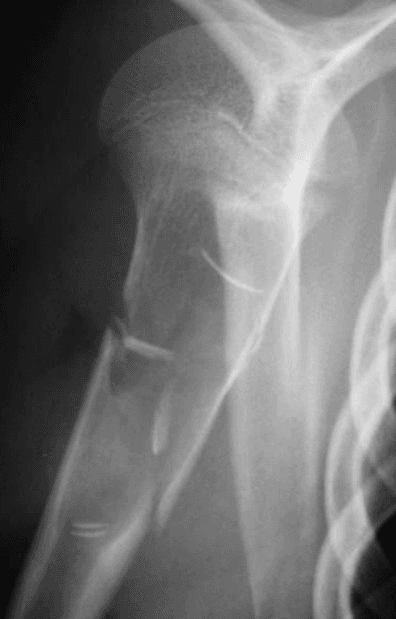
Hugging Face ROCO-Radiology
Page 0
GradeResponse
GradeResponse
search_medical_text
fallen fragment sign trapdoor sign unicameral bone cyst pathognomonic
Bailey and Love's Short Practice of Surgery 28th Edition
Page 606
search_medical_image
fallen fragment sign bone cyst humerus X-ray pathognomonic
Hugging Face ROCO-Radiology
Page 0
GradeResponse
GradeResponse
Trapdoor Sign (Fallen Fragment Sign) in Bone Cyst
The "trapdoor sign" is the same phenomenon as the more widely used term "fallen fragment sign" — both describe the same pathognomonic radiological finding in a simple (unicameral) bone cyst (SBC).
What Is It?
When a pathologic fracture occurs through a unicameral bone cyst, a cortical bone fragment breaks off from the wall of the cyst. Because the cyst is hollow and fluid-filled, this fragment has no solid tissue to support it — it sinks (falls) to the most dependent (gravity-dependent) part of the cyst cavity.
This detached, sunken fragment is called:
- Fallen fragment sign (most common term)
- Trapdoor sign (because the fragment flips inward like a trapdoor)
Why Is It Important?
It is considered pathognomonic (diagnostic by itself) for a simple/unicameral bone cyst, because:
| Feature | Simple Bone Cyst | Aneurysmal Bone Cyst / Giant Cell Tumor |
|---|---|---|
| Cyst content | Serous fluid (hollow) | Solid tissue / blood clot |
| Fragment behavior on fracture | Fragment sinks to bottom | Fragment remains suspended in solid tissue |
| Trapdoor/fallen fragment sign | Present | Absent |
How to Identify It on X-ray
Here is the classic appearance:
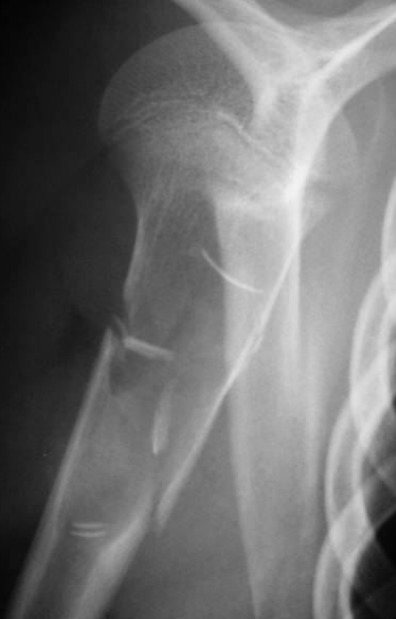
Step-by-step identification:
- Find the lytic lesion — Look for a well-defined, radiolucent (dark), expansile lesion in the metadiaphysis of a long bone (most commonly the proximal humerus or proximal femur in children).
- Look for cortical thinning — The cortex overlying the cyst will appear thin and may be disrupted.
- Identify the fracture — A pathologic fracture line crosses through the cystic area.
- Spot the fragment — A small, dense (white) cortical bone fragment is seen lying at the bottom (dependent portion) of the cyst, separate from the fracture margins.
- Confirm the position — The fragment should be in the most inferior/gravity-dependent part of the cavity, not embedded in solid tissue.
Key Radiological Features of the Underlying Cyst (SBC)
- Location: Metadiaphysis, central in medullary cavity
- Borders: Well-defined, geographic lytic lesion
- Matrix: No internal mineralization (no calcifications inside)
- Cortex: Thinned but intact until fracture
- Epiphysis: Does not cross the growth plate
- Age: Typically in children/adolescents
Clinical Context (Bailey & Love, 28th Ed., p. 606)
A simple bone cyst is a membrane-lined cavity filled with serous fluid, usually occurring in the proximal long bones of children. Cortical thinning predisposes to pathologic fracture, which is often the first presentation. Most fractures heal conservatively, though the cyst may only partially resolve.
Summary
Trapdoor / Fallen fragment sign = a cortical bone fragment lying at the dependent floor of a cystic cavity after pathologic fracture. Its presence on X-ray is diagnostic of a simple unicameral bone cyst, because only a truly hollow, fluid-filled cyst allows the fragment to fall freely by gravity.
This is a shared conversation. Sign in to Orris to start your own chat.