
Bioassay
Reading File
"Bioassay" is a broad topic. Let me clarify what you're looking for before diving in.
Asking for Preferences
What aspect of bioassay are you interested in?
Searching the medical library for comprehensive bioassay content now.
Finding Sources
Finding Sources
The library has some content but the main pharmacology-specific bioassay sections are in Katzung and Tietz. Let me pull the dedicated bioassay section from Tietz and search for more pharmacology-specific content (graded/quantal dose-response, ED50, LD50, therapeutic index).
Reading File
Finding Sources
Finding Sources
Finding Sources
Finding Sources
Reading File
Finding Sources
Reading File
Reading File
Reading File
Reading File
I now have comprehensive material from Katzung's and Miller's textbooks. Let me fetch the key figures to include visually.
Loading Image
Loading Image
I now have all the material needed for a comprehensive pharmacology exam-focused bioassay guide. Here it is:
Bioassay - Pharmacology Exam Guide
1. Definition
A bioassay (biological assay) is the estimation of the potency (or concentration) of a substance by measuring its effect on a living system - an intact animal, isolated tissue, cell line, or microorganism - and comparing it against a standard preparation.
Bioassays are used when:
- The substance cannot be chemically characterized (e.g., complex mixtures)
- The chemical structure is known but activity must be confirmed
- The substance requires calibration against a biological standard (e.g., insulin, heparin, oxytocin)
2. Types of Bioassay
A. Graded (Quantitative) Dose-Response Assay
- The response varies continuously with dose (e.g., blood pressure change, muscle contraction)
- A single organism/tissue gives graded responses at increasing doses
- Described mathematically by: E = (Emax × C) / (C + EC50)
- The curve is hyperbolic on a linear scale, and sigmoidal on a log scale
- Key parameters: EC50 (concentration producing 50% of maximal effect), Emax (maximal efficacy)
Classic examples:
- Guinea pig ileum contraction for histamine
- Rabbit uterus (Magnus preparation) for oxytocin
- Frog rectus abdominis for acetylcholine
- Cat blood pressure for adrenaline
- Isolated rat uterus (Schultz-Dale) for histamine/allergen testing
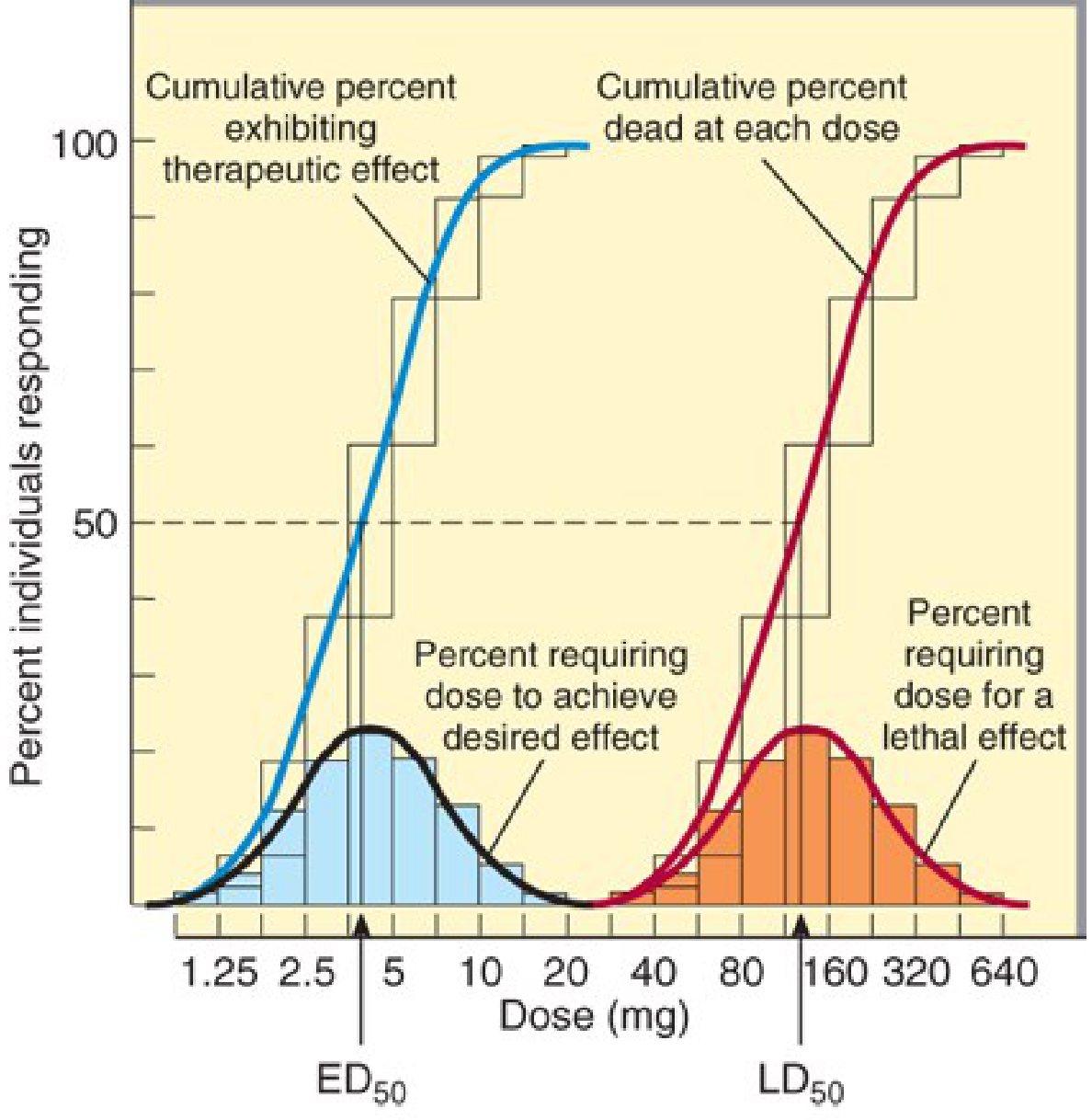
B. Quantal (All-or-None) Dose-Response Assay
- The response is binary - either it occurs or it doesn't (e.g., convulsion, death, sleep, analgesia)
- Each individual has a threshold dose - below it, no effect; above it, full effect
- A population shows a normal (log-normal) distribution of threshold doses
- When cumulated, this gives the characteristic S-shaped sigmoid curve
3. Key Parameters
| Parameter | Definition |
|---|---|
| ED50 | Dose producing the desired effect in 50% of subjects (quantal) |
| TD50 | Dose producing toxicity in 50% of subjects |
| LD50 | Dose causing death in 50% of subjects |
| EC50 | Concentration producing 50% of maximal effect (graded) |
| Emax | Maximal possible effect of a drug |
| Potency | Dose/concentration needed for 50% effect; determined by EC50 or ED50 |
| Efficacy | Maximum response a drug can produce (Emax); independent of potency |
Exam tip: A drug can be MORE POTENT (lower ED50) but LESS EFFICACIOUS (lower Emax) than another. These are independent concepts.
4. Therapeutic Index (TI)
$$TI = \frac{LD_{50}}{ED_{50}}$$
- A higher TI = safer drug (wide margin between effective and lethal doses)
- Inhalational anesthetics have TI of only 2-4 - among the most dangerous drugs in clinical use (Miller's Anesthesia)
Therapeutic Window (clinically more useful):
- The range between the minimum effective dose and the minimum toxic dose
- Overlapping therapeutic and toxic dose ranges = narrow therapeutic window (e.g., digoxin, warfarin, lithium, aminoglycosides)
Certain safety factor (CSF) = LD1 / ED99
- More conservative: the dose that kills 1% vs. dose effective in 99%
- If LD1 < ED99, the drug is clinically unacceptable
5. Competitive vs. Non-competitive Antagonism in Bioassays
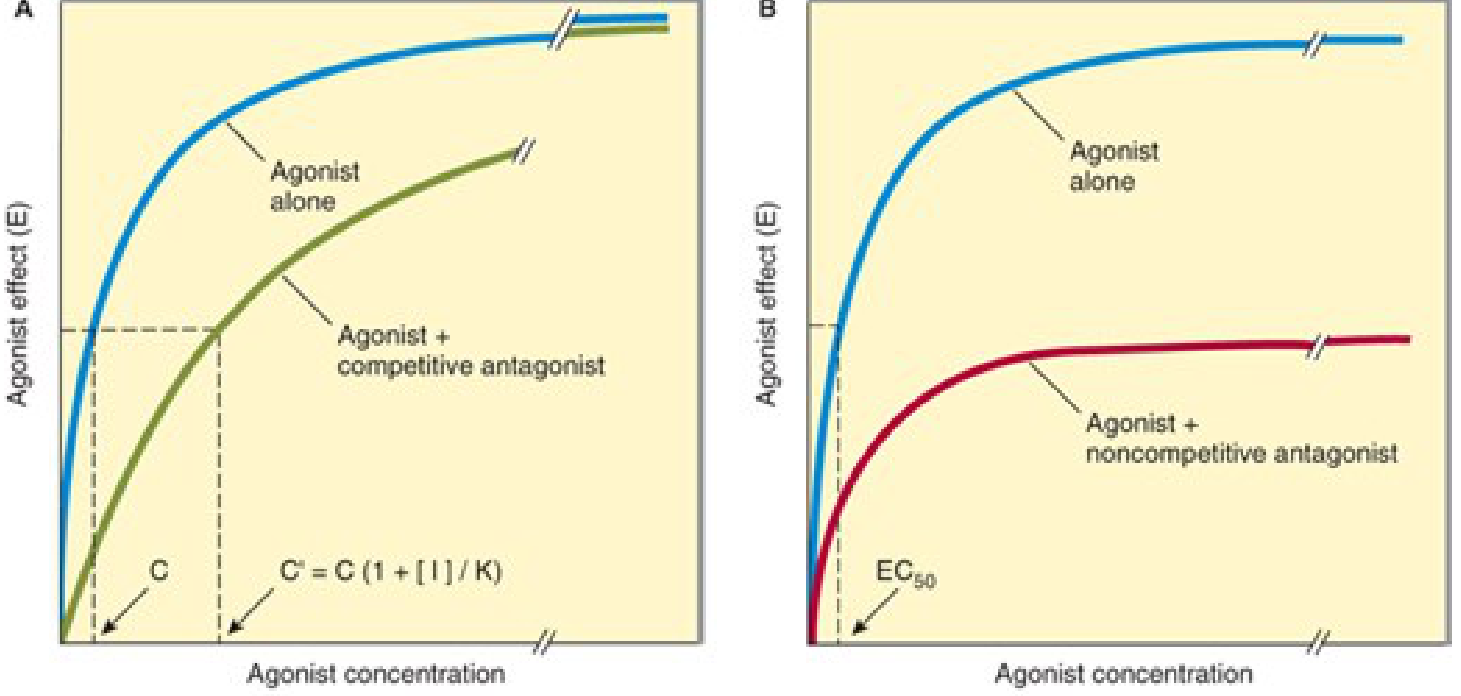
This is tested by constructing dose-response curves in the presence of increasing concentrations of antagonist:
| Feature | Competitive Antagonist | Non-competitive (Irreversible) Antagonist |
|---|---|---|
| Effect on Emax | Unchanged (can be overcome) | Reduced (cannot be overcome) |
| Effect on EC50 | Shifted RIGHT (increased) | May or may not change EC50 |
| Dose-response curve | Parallel right shift | Flattened (depressed ceiling) |
| Example | Atropine vs. ACh | Phenoxybenzamine vs. norepinephrine |
Schild Equation (for competitive antagonism):
$$\frac{C'}{C} = 1 + \frac{[I]}{K}$$
Where C' = agonist concentration needed in presence of antagonist [I], K = dissociation constant of antagonist.
6. Methods of Bioassay
Matching method
The unknown dose is matched with a known standard until equal responses are obtained.
Interpolation method
Responses to unknown are read off a standard dose-response curve.
Bracketing method
Unknown dose is bracketed between two known standard doses.
Statistical methods
- 3-point assay, 4-point assay (2+2 dose assay) - most common in pharmacology
- Uses parallel line dose-response curves; potency ratio is estimated from the horizontal distance between curves
7. Types by System Used
| System | Example Assay | Substance Estimated |
|---|---|---|
| In vivo | Rabbit uterus contraction | Oxytocin |
| In vivo | Rat blood pressure | Adrenaline/ACh |
| In vivo | Blood glucose in rabbit | Insulin |
| In vitro | Guinea pig ileum | Histamine, ACh |
| In vitro | Rat uterus (oestrogen-primed) | Oxytocin |
| In vitro | Frog heart | Digitalis glycosides |
| Cell-based | cAMP production in cells | LH, FSH (now replaced by immunoassay) |
Note: According to Tietz Textbook of Laboratory Medicine, bioassays for hormones are largely replaced by immunoassays and mass spectrometry in modern clinical laboratories because bioassays are imprecise and labor-intensive.
8. Advantages and Disadvantages
| Advantages | Disadvantages |
|---|---|
| Detects biologically active forms | Imprecise (high variability) |
| No need for chemical characterization | Time-consuming |
| Can detect synergism/antagonism | Requires animals or cell cultures |
| Measures total biological activity | Ethical concerns (animal use) |
| Useful for complex biological preparations | Cannot distinguish between related compounds |
9. High-Yield Exam Points
- Potency is about the dose needed (ED50); efficacy is about the maximum effect (Emax)
- A partial agonist has intrinsic activity (α) between 0 and 1; it is an antagonist at high agonist concentrations
- Competitive antagonism = parallel rightward shift of dose-response curve, Emax preserved
- Non-competitive antagonism = Emax depressed, curve cannot be overcome
- Therapeutic Index = LD50/ED50 (higher = safer)
- Certain safety factor = LD1/ED99 (more conservative estimate of safety)
- Guinea pig ileum contraction is the classic bioassay for histamine
- Rabbit uterus (in vivo) or rat uterus (in vitro) is used for oxytocin
- Blood glucose in fasted rabbits is the classic bioassay for insulin
- Log dose-response curve is sigmoidal - this is the standard way to plot it for analysis
Sources: Katzung's Basic and Clinical Pharmacology, 16th Ed. | Miller's Anesthesia, 10th Ed. | Tietz Textbook of Laboratory Medicine, 7th Ed.
This is a shared conversation. Sign in to Orris to start your own chat.