
What is gangila
Reading File
Finding Sources
Finding Sources
Reading File
Reading File
Here is a comprehensive overview of ganglia (singular: ganglion):
What are Ganglia?
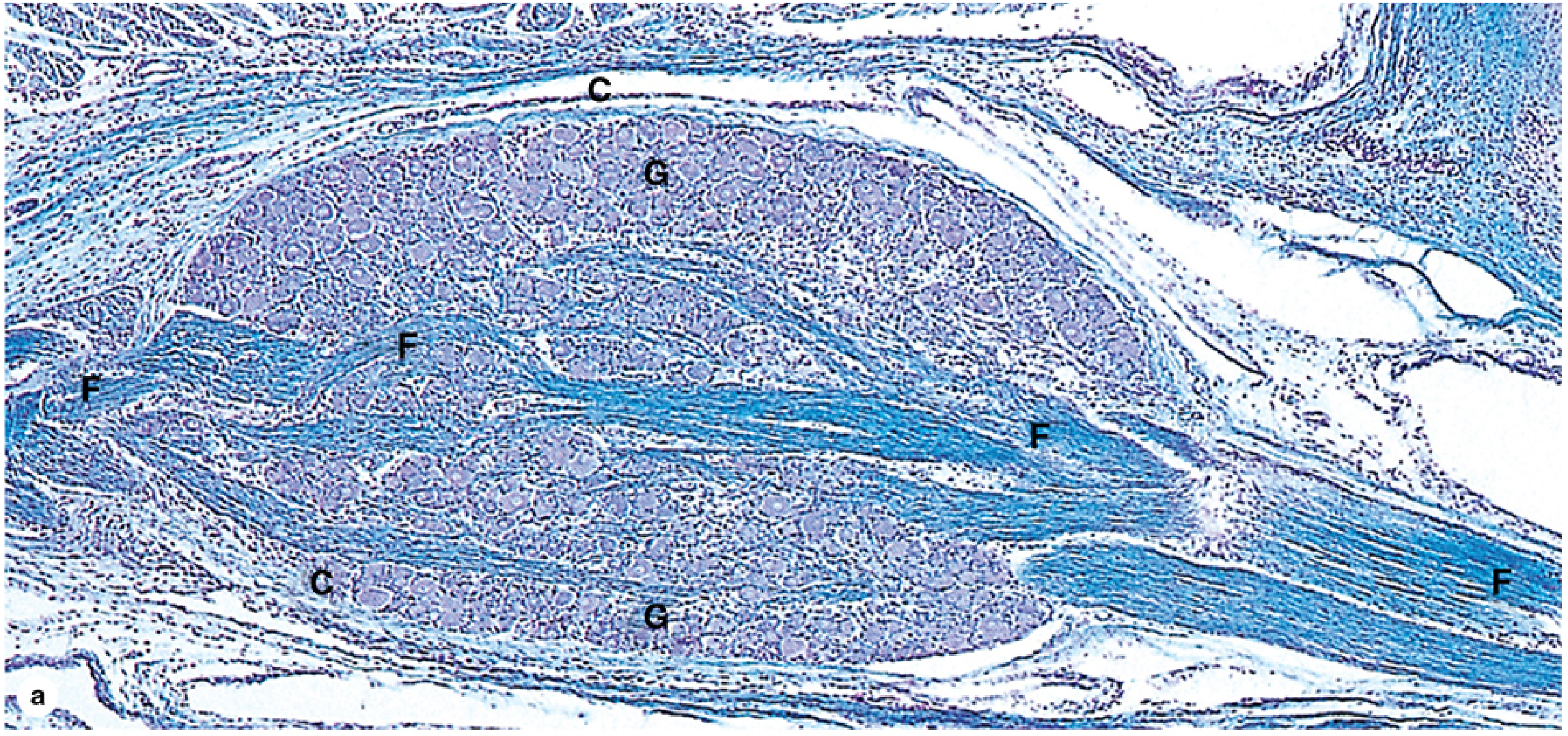
Ganglia are ovoid (egg-shaped) structures in the peripheral nervous system containing clusters of neuronal cell bodies, their surrounding glial satellite cells, connective tissue support, and a dense outer capsule. They serve as relay stations for nerve impulses — at least one nerve enters and another exits each ganglion. — Junqueira's Basic Histology, 17e
Types of Ganglia
Ganglia are classified into two main categories based on the direction of nerve impulse transmission:
1. Sensory Ganglia
- Receive afferent (incoming) impulses heading toward the CNS
- Neurons are pseudounipolar — they relay information from peripheral nerve endings to the gray matter of the spinal cord
- Surrounded by a well-defined connective tissue capsule
- Associated with:
- Dorsal root ganglia — found along all spinal nerves
- Cranial nerve ganglia, including:
- Trigeminal (Gasserian) ganglion — CN V
- Geniculate ganglion — CN VII
- Spiral ganglion (bipolar neurons) — cochlear branch of CN VIII
- Vestibular ganglion (bipolar neurons) — vestibular branch of CN VIII
- Superior/inferior ganglia of CN IX and CN X
2. Autonomic Ganglia
Autonomic ganglia regulate involuntary activities (smooth muscle, glandular secretion, heart rate) to maintain homeostasis. They typically contain multipolar neurons and have less well-developed connective tissue capsules.
Sympathetic Ganglia:
- Sympathetic trunk (paravertebral) ganglia — run alongside the vertebral column; the highest is the superior cervical ganglion
- Prevertebral ganglia — near origins of large abdominal aorta branches: celiac, superior mesenteric, inferior mesenteric, and aorticorenal ganglia
- The adrenal medulla is considered a modified sympathetic ganglion
Parasympathetic Ganglia:
- Ciliary ganglion — CN III
- Submandibular ganglion — CN VII
- Pterygopalatine (sphenopalatine) ganglion — CN VII
- Otic ganglion — CN IX
- Terminal ganglia — located within or near target organs (e.g., cardiac ganglia in the epicardial fat of the heart)
Microscopic Structure
Each ganglion contains:
- Large neuronal cell bodies (perikarya)
- Glial satellite cells — small cells that wrap thin, sheetlike extensions completely around each neuron
- Connective tissue capsule and internal framework
- Nerve fiber fascicles that enter and exit
Special Note: Basal Ganglia
The term "basal ganglia" refers to deep brain nuclei (not truly peripheral ganglia) involved in motor control. They include structures like the caudate nucleus, putamen, and globus pallidus, and are implicated in disorders such as Parkinson's disease and Huntington's disease.
In summary, ganglia are peripheral nervous system structures that house neuron cell bodies and act as relay or integration points for sensory and autonomic signals throughout the body.
This is a shared conversation. Sign in to Orris to start your own chat.