


It is my physiology syllabus and i need to make an study plan i send you two screenshots more and after make notes for me in detail pleas as you like one by one chapter or all syllabus
Syllabus Breakdown
- General Physiology - cell structure, sub-cellular units, cell membrane/transport, bioelectric potentials, body fluids/homeostasis
- Blood - plasma proteins, bone marrow, erythrocytes, hemoglobin, anemia, jaundice, leucocytes, thrombocytes, hemostasis/coagulation, blood groups, lymph & immunity
- Cardiovascular System - heart structure, ECG, cardiac cycle, heart sounds, blood pressure, circulation (coronary/cerebral/renal/pulmonary)
- Respiratory System - mechanics of respiration, lung volumes, alveolar ventilation, pulmonary circulation, respiratory centers, hypoxia/high altitude physiology
- Digestive System - saliva, stomach, pancreas, liver/bile, small & large intestine, GI hormones, GI movements, digestion/absorption
Quick Overview
Which chapter/topic should I go deep into first for detailed notes? · How much time do you have until your exam? This helps me build a realistic day-by-day plan.
Syllabus Breakdown
- General Physiology - cell structure, sub-cellular units, cell membrane/transport, bioelectric potentials, body fluids/homeostasis
- Blood - plasma proteins, bone marrow, erythrocytes, hemoglobin, anemia, jaundice, leucocytes, thrombocytes, hemostasis/coagulation, blood groups, lymph & immunity
- Cardiovascular System - heart structure, ECG, cardiac cycle, heart sounds, blood pressure, circulation (coronary/cerebral/renal/pulmonary)
- Respiratory System - mechanics of respiration, lung volumes, alveolar ventilation, pulmonary circulation, respiratory centers, hypoxia/high altitude physiology
- Digestive System - saliva, stomach, pancreas, liver/bile, small & large intestine, GI hormones, GI movements, digestion/absorption
Quick Overview


Now it is completed with reference books too
How much time do you have until your exam? This decides how many chapters/day I schedule. · Which chapter should I write detailed notes for FIRST?
Syllabus Breakdown
- General Physiology - cell structure, sub-cellular units, cell membrane/transport, bioelectric potentials, body fluids/homeostasis
- Blood - plasma proteins, bone marrow, erythrocytes, hemoglobin, anemia, jaundice, leucocytes, thrombocytes, hemostasis/coagulation, blood groups, lymph & immunity
- Cardiovascular System - heart structure, ECG, cardiac cycle, heart sounds, blood pressure, circulation (coronary/cerebral/renal/pulmonary)
- Respiratory System - mechanics of respiration, lung volumes, alveolar ventilation, pulmonary circulation, respiratory centers, hypoxia/high altitude physiology
- Digestive System - saliva, stomach, pancreas, liver/bile, small & large intestine, GI hormones, GI movements, digestion/absorption
Quick Overview
Physiology Study Plan + Chapter 1 Detailed Notes
PART A: FULL STUDY PLAN (Week-by-Week)
| Week | Paper | Topic | Est. Days | Key Focus |
|---|---|---|---|---|
| 1 | I | General Physiology (cell, membrane, transport, RMP/AP, body fluids) | 5 | Foundation for everything else - do NOT rush this |
| 1-2 | I | Blood (plasma proteins → immunity) | 5 | RBC indices, Hb, clotting cascade, blood groups |
| 3 | I | Cardiovascular System | 6 | Cardiac cycle, ECG, heart sounds, BP regulation |
| 4 | I | Respiratory System | 5 | Lung volumes, gas transport, hypoxia types |
| 4-5 | I | Digestive System | 4 | Secretions + regulation of each organ |
| 5 | — | Revise Paper I | 2 | Flowcharts + previous year Qs |
| 6 | II | Excretory System | 3 | Nephron, GFR, concentration of urine |
| 6 | II | Endocrine System | 4 | Each gland: hormone → action → hypo/hyperfunction |
| 7 | II | Reproductive System | 3 | Menstrual cycle, pregnancy, lactation |
| 7 | II | Nerve-Muscle Physiology | 2 | NMJ, excitation-contraction coupling |
| 8 | II | CNS (largest section - split it) | 7 | Tracts, motor systems, cerebellum, basal ganglia, thalamus/hypothalamus, cortex |
| 9 | II | ANS + Special Senses (vision, hearing, smell, taste) | 5 | Vision and hearing are high-yield and image-heavy |
| 9-10 | — | Revise Paper II | 3 | Flowcharts + previous year Qs |
| 10 | Practicals | Haematology + Human Physiology experiments | 3 | Even if "demonstration only," know principle, normal values, and clinical relevance - these are viva favorites |
| 10 | — | Full mock test + weak-area repair | 2 | — |
PART B: DETAILED NOTES — UNIT I: GENERAL PHYSIOLOGY
1. Cell Structure & Sub-cellular Units
| Organelle | Function |
|---|---|
| Nucleus | Genetic control center - DNA, transcription |
| Mitochondria | ATP synthesis via oxidative phosphorylation ("powerhouse") |
| Endoplasmic reticulum (rough/smooth) | Protein synthesis (rough), lipid/steroid synthesis, Ca²⁺ storage (smooth) |
| Golgi apparatus | Packaging, glycosylation, vesicle formation |
| Lysosomes | Intracellular digestion (hydrolytic enzymes) |
| Peroxisomes | Oxidation of long-chain fatty acids, detoxification |
| Cytoskeleton (microtubules, actin filaments) | Shape, movement, intracellular transport |
2. Cell Membrane and Its Properties
- Composition: phospholipids (amphipathic - hydrophilic heads face out/in, hydrophobic tails face each other), cholesterol (stabilizes fluidity), membrane proteins (integral/transmembrane and peripheral), carbohydrates (glycocalyx - cell recognition).
- Membrane proteins function as: ion channels, carrier/transport proteins, receptors, enzymes, cell-adhesion molecules.
- Per Guyton and Hall, several types of transport proteins are recruited to the membrane specifically to allow selective movement of substances that cannot cross the lipid bilayer directly (- Guyton and Hall Textbook of Medical Physiology).
3. Transport Mechanisms Across the Cell Membrane
- Simple diffusion - movement down concentration gradient (through lipid bilayer for lipid-soluble substances, or through channels for ions/water).
- Facilitated diffusion - carrier-mediated, down gradient, but saturable (e.g., GLUT transporters for glucose).
- Osmosis - diffusion of water across a semipermeable membrane from low to high solute concentration.
- Primary active transport - directly uses ATP (e.g., Na⁺-K⁺ ATPase pump - moves 3 Na⁺ out, 2 K⁺ in per ATP hydrolyzed; Ca²⁺ ATPase; H⁺ ATPase).
- Secondary active transport - uses the energy stored in an ion gradient (created by primary active transport) to move another substance:
- Co-transport (symport): both substances move in the same direction (e.g., Na⁺-glucose cotransporter in intestine/kidney).
- Counter-transport (antiport): substances move in opposite directions (e.g., Na⁺-Ca²⁺ exchanger, Na⁺-H⁺ exchanger).
- Isotonic solution: no change in cell volume.
- Hypotonic solution: water enters cell → swelling → hemolysis (in RBCs).
- Hypertonic solution: water leaves cell → shrinkage (crenation).
4. Bioelectric Potentials
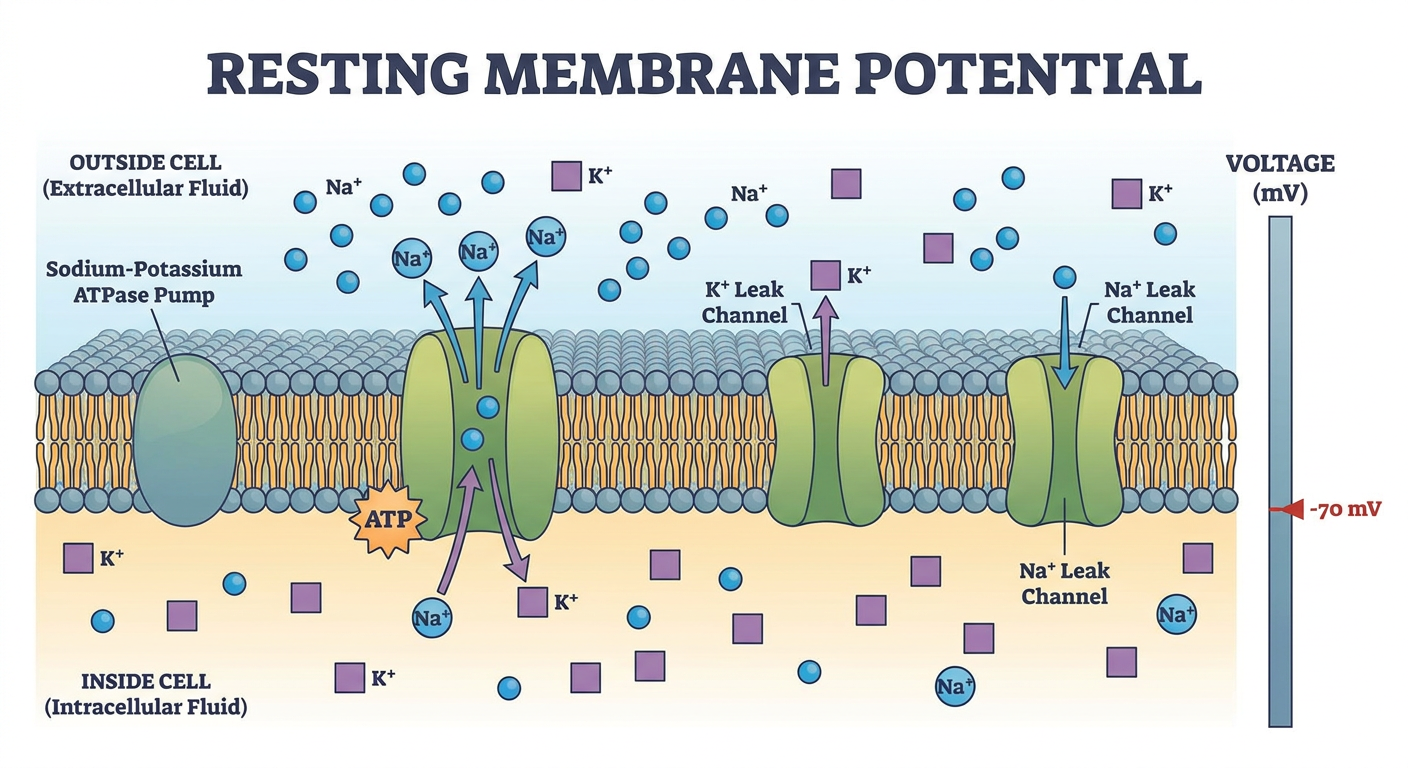
- Defined as the potential difference across the cell membrane at rest, with the inside being negative relative to outside.
- Typical values: nerve fiber ≈ -70 mV; skeletal muscle ≈ -90 mV; cardiac muscle ≈ -90 mV.
- Cause: unequal distribution of ions (high intracellular K⁺, high extracellular Na⁺) maintained by the Na⁺-K⁺ ATPase pump, combined with differential membrane permeability - at rest the membrane is far more permeable to K⁺ than to Na⁺, so RMP lies close to the K⁺ equilibrium potential (Costanzo Physiology, 7th ed.).
- Nernst equation gives the equilibrium potential for a single ion: Ex = (61/z) × log₁₀([X]out/[X]in) at body temperature (z = valence of ion).
- Driving force on any ion = Em - Ex (the difference between actual membrane potential and that ion's own equilibrium potential). If driving force = 0, the ion is at electrochemical equilibrium and there's no net movement (Costanzo Physiology).
- Goldman-Hodgkin-Katz (GHK) equation is used when more than one ion contributes to membrane potential (accounts for relative permeabilities of Na⁺, K⁺, Cl⁻).
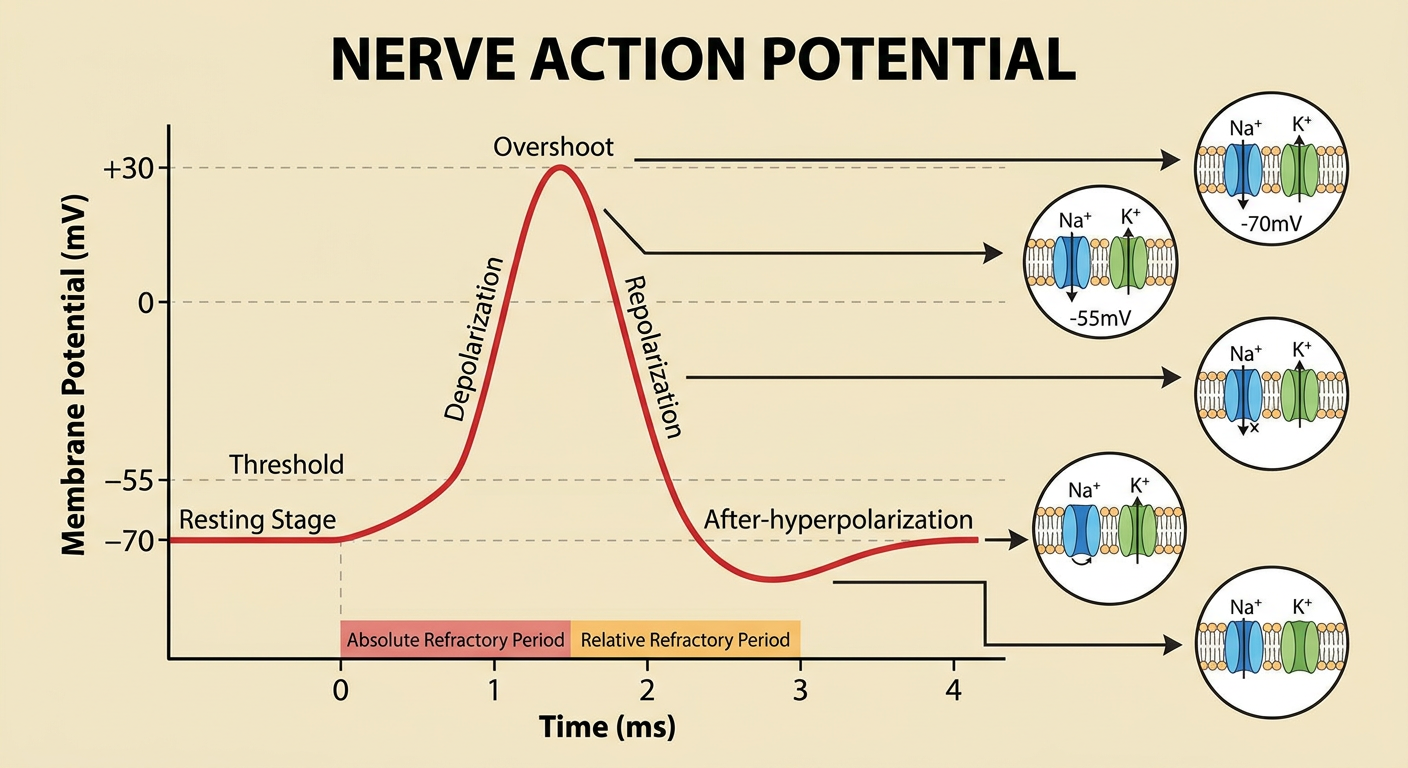
- Resting stage - membrane polarized at RMP.
- Depolarization - stimulus opens voltage-gated Na⁺ channels → rapid Na⁺ influx → membrane potential moves toward Na⁺ equilibrium potential (~+60 mV), overshoot beyond zero.
- Repolarization - Na⁺ channels inactivate; voltage-gated K⁺ channels open → K⁺ efflux → membrane returns toward resting potential.
- After-hyperpolarization (in some cells) - K⁺ channels remain open slightly longer, undershoot below RMP.
5. Body Fluids and Homeostasis
- Total body water (TBW) ≈ 60% of body weight, distributed into:
- Intracellular fluid (ICF) ≈ 2/3 of TBW - rich in K⁺, Mg²⁺, phosphate, protein.
- Extracellular fluid (ECF) ≈ 1/3 of TBW - subdivided into plasma (~1/4 of ECF) and interstitial fluid (~3/4 of ECF) - rich in Na⁺, Cl⁻, HCO₃⁻.
- Extracellular fluid contains large amounts of sodium but only small amounts of potassium, and large amounts of chloride, while the reverse is true intracellularly - this ionic asymmetry is fundamental to bioelectric phenomena described above (- Guyton and Hall Textbook of Medical Physiology).
- Homeostasis: the maintenance of a relatively constant internal environment despite external changes, achieved through negative feedback control systems (sensor → control center → effector), e.g., regulation of blood glucose, temperature, pH, blood pressure. A few systems (e.g., parturition, blood clotting) work via positive feedback - self-amplifying until a natural endpoint is reached.
- Fluid balance regulation involves ADH (water reabsorption), aldosterone (Na⁺ reabsorption), thirst mechanism, and atrial natriuretic peptide (ANP).
Quick Recall - Unit I Flow
Make diagrams/visual posters of Cell Membrane, RMP, and Action Potential
An educational physiology poster diagram of the cell membrane structure, showing the phospholipid bilayer with hydrophilic heads and hydrophobic tails, embedded integral and peripheral membrane proteins, ion channels, carrier proteins, cholesterol molecules, glycoproteins and glycolipids on the outer surface, and labeled parts including extracellular fluid and intracellular fluid sides
An educational physiology poster diagram illustrating the resting membrane potential of a nerve cell, showing a cross section of the cell membrane with concentration gradients of sodium ions outside and potassium ions inside, the sodium-potassium ATPase pump, leak channels, and a labeled voltage scale showing -70 mV inside relative to outside
An educational physiology poster diagram of a nerve action potential graph, showing membrane potential in millivolts on the y axis and time on the x axis, with labeled phases including resting stage, threshold, depolarization, overshoot, repolarization, after-hyperpolarization, and absolute and relative refractory periods, alongside small illustrations of sodium and potassium channel gates opening and closing at each phase
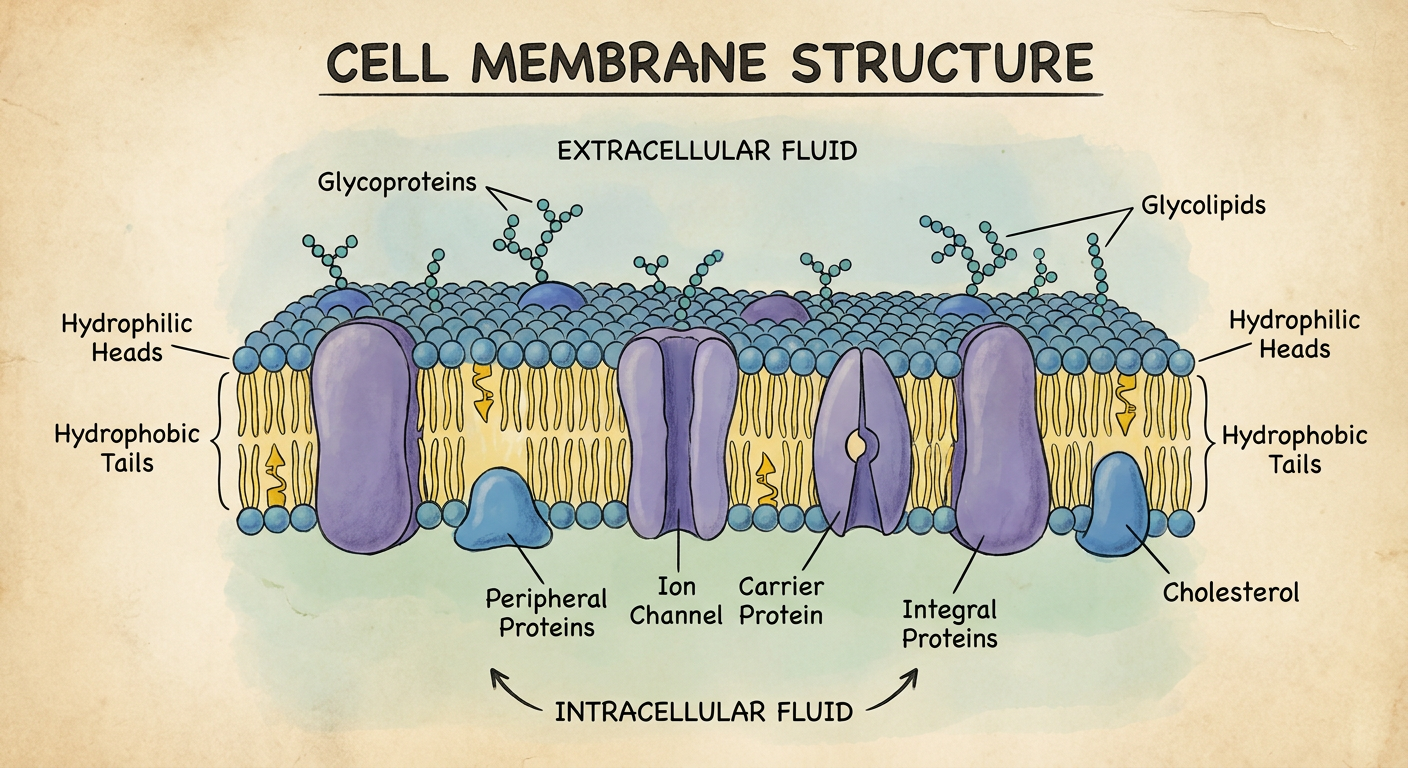
- Cell Membrane poster: label it blind from memory - test yourself on which transport mechanism (diffusion, facilitated diffusion, primary/secondary active transport) would move a given substance.
- RMP poster: be able to explain why the resting potential is close to the K⁺ equilibrium potential (membrane is more permeable to K⁺ at rest) - a favorite viva question.
- Action Potential poster: practice drawing this curve from scratch and annotating which channel (Na⁺ or K⁺, voltage-gated) is responsible for each phase, plus where each refractory period falls.
Make these type of posters with each chapter now make detailed notes of next one accounting to our plan
An educational physiology poster diagram of erythropoiesis, showing the maturation sequence of red blood cell development from hematopoietic stem cell to proerythroblast, basophilic normoblast, polychromatophilic normoblast, orthochromatic normoblast, reticulocyte, and mature erythrocyte, with labels for nuclear changes and hemoglobin accumulation, and a side note on erythropoietin regulation from the kidney
An educational physiology poster diagram of hemoglobin structure, showing four globin polypeptide chains (two alpha and two beta subunits) each holding a heme group with a central iron atom, labeled binding sites for oxygen, and a small inset showing the globular quaternary protein structure
An educational physiology poster diagram of the blood coagulation cascade, showing the intrinsic pathway and extrinsic pathway converging on a common pathway, with labeled clotting factors leading to prothrombin activator, prothrombin converting to thrombin, and fibrinogen converting to fibrin to form a stable clot
An educational physiology poster diagram of the ABO and Rh blood group system, showing four red blood cells labeled type A, type B, type AB, and type O with their surface antigens, a table of corresponding plasma antibodies, and a small diagram illustrating agglutination reaction when incompatible blood types are mixed
Syllabus Breakdown
- General Physiology - cell structure, sub-cellular units, cell membrane/transport, bioelectric potentials, body fluids/homeostasis
- Blood - plasma proteins, bone marrow, erythrocytes, hemoglobin, anemia, jaundice, leucocytes, thrombocytes, hemostasis/coagulation, blood groups, lymph & immunity
- Cardiovascular System - heart structure, ECG, cardiac cycle, heart sounds, blood pressure, circulation (coronary/cerebral/renal/pulmonary)
- Respiratory System - mechanics of respiration, lung volumes, alveolar ventilation, pulmonary circulation, respiratory centers, hypoxia/high altitude physiology
- Digestive System - saliva, stomach, pancreas, liver/bile, small & large intestine, GI hormones, GI movements, digestion/absorption
Quick Overview
PART A: FULL STUDY PLAN (Week-by-Week)
| Week | Paper | Topic | Est. Days | Key Focus |
|---|---|---|---|---|
| 1 | I | General Physiology (cell, membrane, transport, RMP/AP, body fluids) | 5 | Foundation for everything else - do NOT rush this |
| 1-2 | I | Blood (plasma proteins → immunity) | 5 | RBC indices, Hb, clotting cascade, blood groups |
| 3 | I | Cardiovascular System | 6 | Cardiac cycle, ECG, heart sounds, BP regulation |
| 4 | I | Respiratory System | 5 | Lung volumes, gas transport, hypoxia types |
| 4-5 | I | Digestive System | 4 | Secretions + regulation of each organ |
| 5 | — | Revise Paper I | 2 | Flowcharts + previous year Qs |
| 6 | II | Excretory System | 3 | Nephron, GFR, concentration of urine |
| 6 | II | Endocrine System | 4 | Each gland: hormone → action → hypo/hyperfunction |
| 7 | II | Reproductive System | 3 | Menstrual cycle, pregnancy, lactation |
| 7 | II | Nerve-Muscle Physiology | 2 | NMJ, excitation-contraction coupling |
| 8 | II | CNS (largest section - split it) | 7 | Tracts, motor systems, cerebellum, basal ganglia, thalamus/hypothalamus, cortex |
| 9 | II | ANS + Special Senses (vision, hearing, smell, taste) | 5 | Vision and hearing are high-yield and image-heavy |
| 9-10 | — | Revise Paper II | 3 | Flowcharts + previous year Qs |
| 10 | Practicals | Haematology + Human Physiology experiments | 3 | Even if "demonstration only," know principle, normal values, and clinical relevance - these are viva favorites |
| 10 | — | Full mock test + weak-area repair | 2 | — |
PART B: DETAILED NOTES — UNIT I: GENERAL PHYSIOLOGY
1. Cell Structure & Sub-cellular Units
| Organelle | Function |
|---|---|
| Nucleus | Genetic control center - DNA, transcription |
| Mitochondria | ATP synthesis via oxidative phosphorylation ("powerhouse") |
| Endoplasmic reticulum (rough/smooth) | Protein synthesis (rough), lipid/steroid synthesis, Ca²⁺ storage (smooth) |
| Golgi apparatus | Packaging, glycosylation, vesicle formation |
| Lysosomes | Intracellular digestion (hydrolytic enzymes) |
| Peroxisomes | Oxidation of long-chain fatty acids, detoxification |
| Cytoskeleton (microtubules, actin filaments) | Shape, movement, intracellular transport |
2. Cell Membrane and Its Properties
- Composition: phospholipids (amphipathic - hydrophilic heads face out/in, hydrophobic tails face each other), cholesterol (stabilizes fluidity), membrane proteins (integral/transmembrane and peripheral), carbohydrates (glycocalyx - cell recognition).
- Membrane proteins function as: ion channels, carrier/transport proteins, receptors, enzymes, cell-adhesion molecules.
- Per Guyton and Hall, several types of transport proteins are recruited to the membrane specifically to allow selective movement of substances that cannot cross the lipid bilayer directly (- Guyton and Hall Textbook of Medical Physiology).
3. Transport Mechanisms Across the Cell Membrane
- Simple diffusion - movement down concentration gradient (through lipid bilayer for lipid-soluble substances, or through channels for ions/water).
- Facilitated diffusion - carrier-mediated, down gradient, but saturable (e.g., GLUT transporters for glucose).
- Osmosis - diffusion of water across a semipermeable membrane from low to high solute concentration.
- Primary active transport - directly uses ATP (e.g., Na⁺-K⁺ ATPase pump - moves 3 Na⁺ out, 2 K⁺ in per ATP hydrolyzed; Ca²⁺ ATPase; H⁺ ATPase).
- Secondary active transport - uses the energy stored in an ion gradient (created by primary active transport) to move another substance:
- Co-transport (symport): both substances move in the same direction (e.g., Na⁺-glucose cotransporter in intestine/kidney).
- Counter-transport (antiport): substances move in opposite directions (e.g., Na⁺-Ca²⁺ exchanger, Na⁺-H⁺ exchanger).
- Isotonic solution: no change in cell volume.
- Hypotonic solution: water enters cell → swelling → hemolysis (in RBCs).
- Hypertonic solution: water leaves cell → shrinkage (crenation).
4. Bioelectric Potentials
- Defined as the potential difference across the cell membrane at rest, with the inside being negative relative to outside.
- Typical values: nerve fiber ≈ -70 mV; skeletal muscle ≈ -90 mV; cardiac muscle ≈ -90 mV.
- Cause: unequal distribution of ions (high intracellular K⁺, high extracellular Na⁺) maintained by the Na⁺-K⁺ ATPase pump, combined with differential membrane permeability - at rest the membrane is far more permeable to K⁺ than to Na⁺, so RMP lies close to the K⁺ equilibrium potential (Costanzo Physiology, 7th ed.).
- Nernst equation gives the equilibrium potential for a single ion: Ex = (61/z) × log₁₀([X]out/[X]in) at body temperature (z = valence of ion).
- Driving force on any ion = Em - Ex (the difference between actual membrane potential and that ion's own equilibrium potential). If driving force = 0, the ion is at electrochemical equilibrium and there's no net movement (Costanzo Physiology).
- Goldman-Hodgkin-Katz (GHK) equation is used when more than one ion contributes to membrane potential (accounts for relative permeabilities of Na⁺, K⁺, Cl⁻).
- Resting stage - membrane polarized at RMP.
- Depolarization - stimulus opens voltage-gated Na⁺ channels → rapid Na⁺ influx → membrane potential moves toward Na⁺ equilibrium potential (~+60 mV), overshoot beyond zero.
- Repolarization - Na⁺ channels inactivate; voltage-gated K⁺ channels open → K⁺ efflux → membrane returns toward resting potential.
- After-hyperpolarization (in some cells) - K⁺ channels remain open slightly longer, undershoot below RMP.
5. Body Fluids and Homeostasis
- Total body water (TBW) ≈ 60% of body weight, distributed into:
- Intracellular fluid (ICF) ≈ 2/3 of TBW - rich in K⁺, Mg²⁺, phosphate, protein.
- Extracellular fluid (ECF) ≈ 1/3 of TBW - subdivided into plasma (~1/4 of ECF) and interstitial fluid (~3/4 of ECF) - rich in Na⁺, Cl⁻, HCO₃⁻.
- Extracellular fluid contains large amounts of sodium but only small amounts of potassium, and large amounts of chloride, while the reverse is true intracellularly - this ionic asymmetry is fundamental to bioelectric phenomena described above (- Guyton and Hall Textbook of Medical Physiology).
- Homeostasis: the maintenance of a relatively constant internal environment despite external changes, achieved through negative feedback control systems (sensor → control center → effector), e.g., regulation of blood glucose, temperature, pH, blood pressure. A few systems (e.g., parturition, blood clotting) work via positive feedback - self-amplifying until a natural endpoint is reached.
- Fluid balance regulation involves ADH (water reabsorption), aldosterone (Na⁺ reabsorption), thirst mechanism, and atrial natriuretic peptide (ANP).
Quick Recall - Unit I Flow
- Cell Membrane poster: label it blind from memory - test yourself on which transport mechanism (diffusion, facilitated diffusion, primary/secondary active transport) would move a given substance.
- RMP poster: be able to explain why the resting potential is close to the K⁺ equilibrium potential (membrane is more permeable to K⁺ at rest) - a favorite viva question.
- Action Potential poster: practice drawing this curve from scratch and annotating which channel (Na⁺ or K⁺, voltage-gated) is responsible for each phase, plus where each refractory period falls.
Error calling model 'gemini-3-pro-image' (RESOURCE_EXHAUSTED): 429 RESOURCE_EXHAUSTED. {'error': {'code': 429, 'message': 'Resource has been exhausted (e.g. check quota).', 'status': 'RESOURCE_EXHAUSTED'}}
We encountered an error while processing your request. Please try again or reach out to us for help.
Error calling model 'gemini-3-pro-image' (RESOURCE_EXHAUSTED): 429 RESOURCE_EXHAUSTED. {'error': {'code': 429, 'message': 'Resource has been exhausted (e.g. check quota).', 'status': 'RESOURCE_EXHAUSTED'}}
We encountered an error while processing your request. Please try again or reach out to us for help.
Try again
Try again