
i have a seminar on " pathophysiology of itch and clinical approach to chronic pruritis" take this seminar as base seminar shorten it to 70-80 slides include newer things related to this topic and also make it interesting to learn if possible
~/
chronic pruritus
2025 chronic pruritus clinical practice guideline itch pathophysiology new treatments
~/attachments/335defa8-3f94-4a11-8206-0263c146f6f1
diagram pathophysiology chronic itch peripheral sensory neuron spinal cord brain itch scratch cycle
clinical image prurigo nodularis chronic pruritus nodules
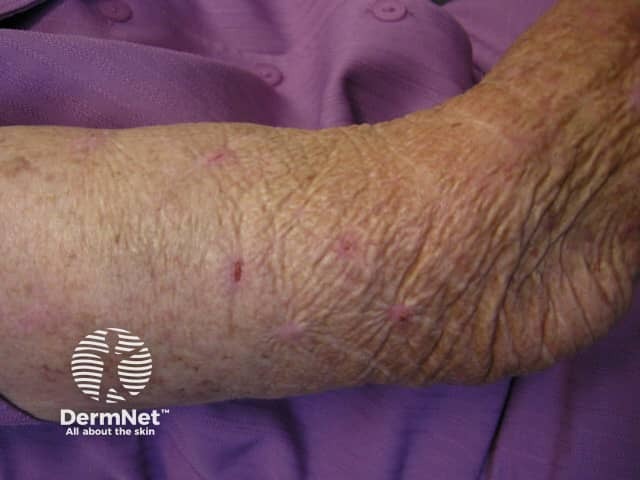
Clinical photography of a forearm demonstrates multiple small pink to violaceous papules with excoriations and crusting, arranged in scattered clusters along the dermal forearm. The skin surface is dry with mild scaling and subtle lichenification, consistent with chronic scratching. Several lesions appear as raised nodules or plaques, while other areas show shallow erosions and crusts, reflecting ongoing pruritus. The overall appearance is typical for scratched prurigo or prurigo nodularis, a chronic pruritic dermatosis. Under visible light, the lesions lack erythematous halo or vesiculation and do not display ulceration. The forearm location corresponds to a commonly affected cutaneous site in prurigo, with possible involvement of flexural or extensor surfaces depending on scratching behavior. The imaging modality is a standard clinical photograph (visible light), with close-up field to highlight individual lesions and textural changes. Pathologically, prurigo nodularis features epidermal hyperplasia, hyperkeratosis, and dermal inflammatory infiltrates; however, histology is not provided here. Clinically, prominent pruritus, scratching-induced excoriations, and nodular formation support a diagnosis of prurigo nodularis or chronic pruritus with secondary prurigo. This image is relevant for dermatology education, lesion recognition, and machine learning datasets for itch-related dermatoses, differential diagnosis, and treatment planning. Further evaluation may include pruritus assessment and screening as needed.
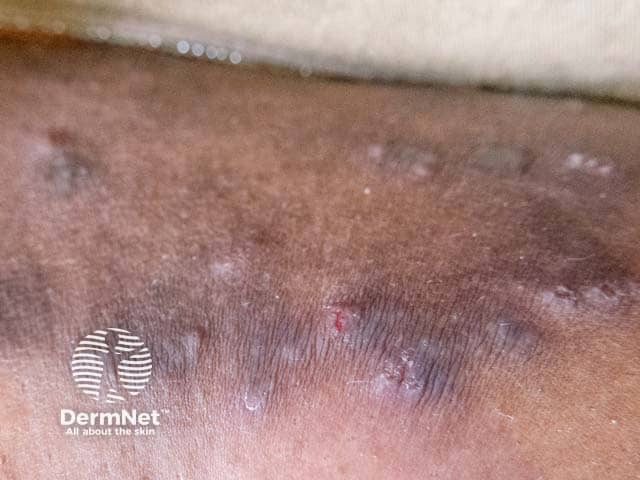
Clinical photograph of the lower leg showing features typical of nodular prurigo (prurigo nodularis) with accompanying post-inflammatory hyperpigmentation. The image captures multiple, firm, dome-shaped nodules and plaques arranged longitudinally along the anterior-lateral aspect of the leg. Lesions are hyperpigmented to brown-black, with some areas of lighter erythematous or inflamed skin and visible excoriations, crusts, and subtle scale. Surrounding skin demonstrates lichenification and diffuse dermal hyperpigmentation consistent with chronic scratching. The nodules vary in size from approximately 3 to 8 millimeters in diameter and possess a keratotic or smooth surface depending on maturity. No epistemic imaging artifacts or dermoscopic details are provided; this is a macroscopic bedside dermatology photo. The appearance is diagnostic when correlated with history of chronic pruritus and scratching, supporting a differential that includes prurigo nodularis, lichen simplex chronicus, and chronic dermatitis. The pigmentation likely reflects post-inflammatory pigmentation rather than a pigmentary disorder alone. Clinically important associations include severe itching, secondary infection risk, and possible underlying atopic dermatitis or neuropathic itch. The image is intended for educational and clinical reference, illustrating typical leg-limited distribution, lesion morphology, and the pigmentary sequelae of scratching in prurigo nodularis. Clinical correlation and biopsy may further confirm prurigo nodularis.
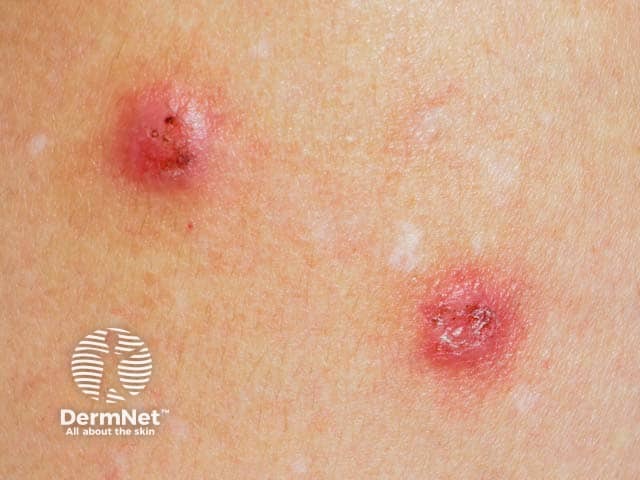
Clinical photography of cutaneous lesions showing excoriated nodules in nodular prurigo (prurigo nodularis) in a patient labeled NP-patient1. Modality and perspective: high-magnification close-up dermatologic image, noninvasive, no contrast, daylight-equivalent illumination. Anatomical location: cutaneous tissue of the skin (integumentary system); two discrete nodules with erythematous bases are visible on exposed skin. Lesion morphology: dome- or rounded-configuration nodules with central crusting, surface excoriation, and crusted tips; surrounding skin shows mild erythema without overt ulceration. Color varies from pink to reddish-brown; borders are well defined; tactile feel would be firm. If present, secondary excoriation lesions reflect chronic scratching. The features are characteristic of prurigo nodularis: chronic pruritus, intensely pruritic papules and nodules that become thickened, hyperkeratotic, and sometimes crusted due to scratching. The clinical significance lies in recognizing prurigo nodularis as a manifestation of chronic itch disorder and in distinguishing from other nodular dermatoses such as prurigo simplex, hypertrophic lichen planus, or neuropathic ulcers. Diagnostic use cases include documentation for treatment response, baseline assessment, and patient education. Potential management implications include topical corticosteroids, calcineurin inhibitors, antihistamines, and itch-control strategies. The image supports clinical correlation and dermatologic evaluation. Photographic scale and context: mark reference size and lighting conditions for reproducibility, and clinician notes.
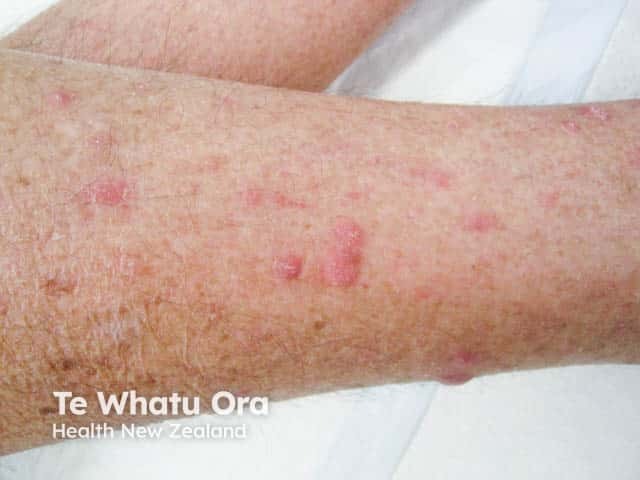
Clinical photograph of the right or left lower leg (calf) showing multiple nodular prurigo lesions on the lateral aspect. The image captures several firm, dome-shaped papules ranging from 4 to 8 millimeters in diameter, with erythematous to pink-red coloration and a slightly shiny, smooth surface. Some nodules appear crusted or excoriated, reflecting the patient's chronic scratching. The distribution is localized to the lateral calf and is irregular but clustered, without deep ulceration or pigmentary change. The surrounding skin shows mild linear or punctate scars consistent with repeated pruritus and trauma. The lesions are non-blanching and well circumscribed, with varied elevation indicating nodularity rather than flat plaques. Lighting is natural to studio-like, providing adequate detail of surface texture, color heterogeneity, and margin definition. Clinically, these findings are compatible with nodular prurigo (prurigo nodularis), a pruritic dermatosis often linked to chronic itch-scratch cycles and neuroimmune dysregulation. Differential diagnoses include lichen simplex chronicus, pruritic papular eruption, or eczema; correlation with patient history, pruritus intensity, and response to therapy is essential. This image serves educational purposes, illustrating typical nodular morphology, topography on the leg, and the appearance of excoriated nodules in chronic pruritus. Correlation with history and biopsy may confirm prurigo nodularis for assessment.
chronic pruritus IL-31 treatment
FDA approved treatments prurigo nodularis nemolizumab 2024 chronic pruritus
python -c "from pptx import Presentation; p=Presentation('/tmp/workspace/attachments/335defa8-3f94-4a11-8206-0263c146f6f1/Pruritis -ankita.pptx'); print('slides',len(p.slides),'layouts',[x.name for x in p.slide_layouts]);\nfor i,s in enumerate(p.slides,1):\n t=[]\n for sh in s.shapes:\n if hasattr(sh,'text') and sh.text.strip(): t.append(sh.text.replace('\\n',' | '))\n print(f'{i}: '+ ' || '.join(t)[:700])"
python -c "from pptx import Presentation; p=Presentation('/tmp/workspace/attachments/335defa8-3f94-4a11-8206-0263c146f6f1/Pruritis -ankita.pptx'); print('slides',len(p.slides)); [print(str(i)+': '+ ' || '.join([sh.text.replace(chr(10),' | ') for sh in s.shapes if hasattr(sh,'text') and sh.text.strip()])[:500]) for i,s in enumerate(p.slides,1)]"
PMID: 40843597
PMID: 37888917
mkdir -p "/tmp/workspace/chronic-pruritus-seminar/src" "/tmp/workspace/chronic-pruritus-seminar/output" "/tmp/workspace/chronic-pruritus-seminar/assets" && python /tmp/skills/shared/scripts/fetch_images.py "https://cdn.orris.care/cdss_images/DermNetNZ_1760032081720_276d4fa6-71e8-422b-8f48-821d43e70f1f.jpg"
python -c "import base64,json,subprocess; r=json.loads(subprocess.check_output(['python','/tmp/skills/shared/scripts/fetch_images.py','https://cdn.orris.care/cdss_images/DermNetNZ_1760032081720_276d4fa6-71e8-422b-8f48-821d43e70f1f.jpg'])); open('/tmp/workspace/chronic-pruritus-seminar/assets/prurigo.jpg','wb').write(base64.b64decode(r[0]['base64'].split(',',1)[1]))" && python -c "from PIL import Image; im=Image.open('/tmp/workspace/chronic-pruritus-seminar/assets/prurigo.jpg'); print(im.size)"
python - <<'PY' from pathlib import Path p=Path('/tmp/workspace/chronic-pruritus-seminar/src/build.py') p.write_text(r'''from pptx import Presentation from pptx.util import Inches, Pt from pptx.enum.shapes import MSO_SHAPE, MSO_CONNECTOR from pptx.enum.text import PP_ALIGN, MSO_ANCHOR from pptx.dml.color import RGBColor from pptx.enum.dml import MSO_THEME_COLOR from pptx.enum.shapes import MSO_AUTO_SHAPE_TYPE from pptx.enum.text import MSO_AUTO_SIZE from pathlib import Path OUT=Path('/tmp/workspace/chronic-pruritus-seminar/output/Chronic_Pruritus_Seminar_Updated.pptx') IMG='/tmp/workspace/chronic-pruritus-seminar/assets/prurigo.jpg' prs=Presentation(); prs.slide_width=Inches(13.333); prs.slide_height=Inches(7.5) blank=prs.slide_layouts[6] # palette NAVY=RGBColor(12,31,49); BLUE=RGBColor(26,90,128); CYAN=RGBColor(52,185,200); TEAL=RGBColor(25,142,128); GOLD=RGBColor(243,178,71); RED=RGBColor(210,80,79); INK=RGBColor(28,43,54); MUTED=RGBColor(91,110,121); PALE=RGBColor(242,247,248); WHITE=RGBColor(255,255,255); LBLUE=RGBColor(222,241,245); LRED=RGBColor(253,234,232) def bg(s,c=WHITE): s.background.fill.solid(); s.background.fill.fore_color.rgb=c def rect(s,x,y,w,h,fill, radius=False, line=None): sh=s.shapes.add_shape(MSO_SHAPE.ROUNDED_RECTANGLE if radius else MSO_SHAPE.RECTANGLE, Inches(x),Inches(y),Inches(w),Inches(h)) sh.fill.solid(); sh.fill.fore_color.rgb=fill sh.line.color.rgb=line or fill if radius: sh.adjustments[0]=0.08 return sh def text(s,txt,x,y,w,h,size=20,color=INK,bold=False,align=PP_ALIGN.LEFT,font='Aptos',val=None): tb=s.shapes.add_textbox(Inches(x),Inches(y),Inches(w),Inches(h)); tf=tb.text_frame; tf.clear(); tf.word_wrap=True tf.margin_left=tf.margin_right=Inches(.04); tf.margin_top=tf.margin_bottom=Inches(.02) p=tf.paragraphs[0]; p.alignment=align; p.text=txt for r in p.runs: r.font.name=font; r.font.size=Pt(size); r.font.bold=bold; r.font.color.rgb=color if val: tf.vertical_anchor=val return tb def title(s,t,sub=None,n=0): text(s,t,.58,.33,11.9,.48,27,NAVY,True) rect(s,.58,1.0,1.1,.055,CYAN) if sub:text(s,sub,.58,1.08,11.7,.32,10,MUTED) text(s,str(n).zfill(2),12.35,.38,.45,.25,9,MUTED,True,align=PP_ALIGN.RIGHT) def footer(s): rect(s,.58,7.10,12.15,.012,RGBColor(218,228,231)) text(s,'Pathophysiology of itch and clinical approach to chronic pruritus',.58,7.17,8,.16,8,MUTED) def bullets(s,items,x,y,w,h,size=18,color=INK,accent=CYAN): tb=s.shapes.add_textbox(Inches(x),Inches(y),Inches(w),Inches(h)); tf=tb.text_frame; tf.clear(); tf.word_wrap=True tf.margin_left=Inches(.05);tf.margin_right=0;tf.margin_top=0 for j,it in enumerate(items): p=tf.paragraphs[0] if j==0 else tf.add_paragraph(); p.text=it; p.level=0; p.space_after=Pt(9); p.font.size=Pt(size); p.font.name='Aptos';p.font.color.rgb=color p.bullet=True return tb def section(t,kicker,n): s=prs.slides.add_slide(blank);bg(s,NAVY) text(s,kicker.upper(),.75,1.25,8,.28,13,CYAN,True) text(s,t,.75,1.72,11.4,1.2,39,WHITE,True) rect(s,.75,3.25,2.0,.08,GOLD) text(s,'A focused learning module',.75,3.55,6,.35,17,RGBColor(196,216,224)) text(s,str(n).zfill(2),11.6,6.42,.7,.35,16,CYAN,True,align=PP_ALIGN.RIGHT); return s def standard(t,items,n,sub=None): s=prs.slides.add_slide(blank);bg(s);title(s,t,sub,n);bullets(s,items,.78,1.55,11.6,4.9,19);footer(s);return s def cards(t,cards,n,sub=None): s=prs.slides.add_slide(blank);bg(s);title(s,t,sub,n); cols=len(cards); gap=.25; W=(12.0-gap*(cols-1))/cols for i,(h,b,c) in enumerate(cards): x=.66+i*(W+gap);rect(s,x,1.65,W,4.55,PALE,True) rect(s,x,1.65,W,.14,c) text(s,h,x+.18,1.98,W-.36,.55,20,NAVY,True) bullets(s,b,x+.18,2.75,W-.36,3.05,15,INK,c) footer(s);return s def quote(t,q,by,n): s=prs.slides.add_slide(blank); bg(s,NAVY); text(s,t,.75,.7,11.5,.4,14,CYAN,True); text(s,'“'+q+'”',1.15,2.0,10.9,1.8,31,WHITE,True,align=PP_ALIGN.CENTER);text(s,by,1.2,4.2,10.8,.3,14,RGBColor(195,216,224),align=PP_ALIGN.CENTER);return s def flow(t,steps,n,sub=None): s=prs.slides.add_slide(blank); bg(s);title(s,t,sub,n); W=11.7/len(steps) for i,(h,b,c) in enumerate(steps): x=.78+i*W; rect(s,x,2.05,W-.25,2.2,PALE,True);rect(s,x,2.05,W-.25,.12,c); text(s,h,x+.12,2.42,W-.49,.45,17,NAVY,True,align=PP_ALIGN.CENTER);text(s,b,x+.15,3.05,W-.55,.7,12,INK,align=PP_ALIGN.CENTER) if i<len(steps)-1:text(s,'→',x+W-.18,2.86,.28,.3,22,BLUE,True,align=PP_ALIGN.CENTER) footer(s);return s def clinical_image(n): s=prs.slides.add_slide(blank);bg(s);title(s,'When itch becomes disease: chronic prurigo',None,n) s.shapes.add_picture(IMG,Inches(.72),Inches(1.48),width=Inches(5.45),height=Inches(4.1)) text(s,'Chronic itch + repeated scratching',6.65,1.72,5.6,.38,24,NAVY,True) bullets(s,['Hyperkeratotic, excoriated papules or nodules','A neuroimmune disease, not “just picking”','Assess severity, sleep, mood, infection, and underlying driver','Break the itch-scratch cycle early'],6.65,2.45,5.5,2.8,18) text(s,'Educational clinical image: DermNet. Use only according to its image licence.',.76,5.75,7.3,.2,9,MUTED);footer(s);return s # 1-5 s=prs.slides.add_slide(blank);bg(s,NAVY);text(s,'PATHOPHYSIOLOGY OF ITCH',.72,1.38,11.6,.65,34,WHITE,True);text(s,'and clinical approach to chronic pruritus',.75,2.1,10.5,.5,25,RGBColor(203,229,234));rect(s,.75,2.9,2.3,.09,GOLD);text(s,'Seminar | Updated evidence through 2026',.75,3.25,7,.3,16,CYAN,True);text(s,'Presenter: ____________________\nDepartment: ____________________',.75,5.7,6,.55,15,RGBColor(205,222,228)); standard('Learning objectives',['Differentiate acute itch from chronic pruritus and chronic prurigo','Map itch from skin to spinal cord to brain','Use morphology, distribution, history and targeted investigations to identify cause','Choose mechanism- and disease-directed treatment, including new targeted therapies'],2) flow('A 60-second opening case',[('Patient','62-year-old with 8 months of relentless generalized itch'),('Clues','No primary rash, sleep loss, new cholestatic symptoms'),('Question','Skin disease, systemic disease, nerve disease, drug, or mixed?'),('Goal','Diagnose the driver and relieve itch today')],3,'Think before naming a cream') quote('Why itch matters','Itch is not a minor symptom. It can destroy sleep, concentration, mood, and skin integrity.','Clinical framing for every patient with chronic pruritus',4) cards('Seminar roadmap',[('1. Biology',['Skin and mediators','Neural circuits','Sensitization'],CYAN),('2. Clinical reasoning',['Phenotype','Red flags','Work-up'],TEAL),('3. Treatment',['Cause-directed care','Stepwise relief','New therapies'],GOLD)],5) # 6-22 section('The biology of itch','Part 1',6) standard('Definition and threshold',['Pruritus is an unpleasant sensation that evokes the desire to scratch.','Chronic pruritus persists for ≥6 weeks.','Itch is distinct from pain, yet shares peripheral and central circuitry.','The key clinical transition is sensitization: itch persists after the original trigger is gone.'],7) cards('Clinical classification: start with the skin',[('Group I',['Pruritus on diseased skin','Primary lesions present','Example: eczema, scabies'],CYAN),('Group II',['Pruritus on non-diseased skin','No primary lesions','Consider systemic, neuropathic, drug causes'],GOLD),('Group III',['Chronic secondary scratch lesions','Excoriations, lichenification, prurigo nodules'],RED)],8,'IFSI clinical groups') flow('Itch is a skin-to-brain signal',[('Trigger','Barrier injury, inflammation, metabolic mediators'),('Transducer','Pruriceptor endings in epidermis/dermis'),('Relay','DRG → dorsal horn → ascending pathways'),('Perception','Thalamus, somatosensory, cingulate and premotor networks')],9) cards('The skin is an active sensory organ',[('Keratinocyte',['Barrier failure','TSLP, IL-33, proteases','Communicates with nerves'],CYAN),('Immune cell',['Mast cell: histamine, tryptase','T cell: IL-4, IL-13, IL-31','Eosinophil and basophil signals'],TEAL),('Sensory neuron',['Free nerve endings','GPCRs, cytokine receptors','TRP channels'],GOLD)],10) standard('Peripheral pruriceptors: not one pathway',['Unmyelinated C fibers and a subset of Aδ fibers detect itch.','Histaminergic itch and non-histaminergic itch use partly distinct fibers.','Important detectors: H1/H4, PAR2, Mrgpr, IL-31RA, TSLPR and TRPV1/TRPA1.','Clinical consequence: antihistamines work best when histamine is the main driver, especially urticaria.'],11) flow('Signal transduction: a useful mental model',[('Ligand','Histamine, protease, cytokine, bile-related signal'),('Receptor','GPCR or cytokine receptor on neuron / skin cell'),('Ion channel','TRPV1 or TRPA1 opens'),('Action potential','Impulse travels to dorsal root ganglion')],12) cards('Major mediators and their clinical meaning',[('Histamine',['Mast-cell associated','Wheal-and-flare itch','Urticaria is the prototype'],CYAN),('Proteases',['PAR2 signaling','Cowhage model','Atopic and non-histaminergic itch'],TEAL),('Type 2 cytokines',['IL-4/13 sensitize neurons','IL-31 is strongly pruritogenic','Atopic dermatitis and prurigo'],GOLD),('Neuropeptides',['Substance P, CGRP','Neuroimmune cross-talk','NK1 pathway'],RED)],13) standard('IL-31: the “itch cytokine”',['Produced mainly by activated type 2 immune cells; receptor complex includes IL-31RA and OSMRβ.','Acts on sensory nerves and also impairs keratinocyte differentiation and barrier function.','Relevant in atopic dermatitis, prurigo nodularis and some other chronic itch states.','Therapeutic implication: IL-31 receptor blockade is now clinically meaningful, not theoretical.'],14) cards('TRP channels: sensory amplifiers',[('TRPV1',['Heat, capsaicin, inflammatory signaling','Targeted by topical capsaicin'],RED),('TRPA1',['Cold/irritant and non-histaminergic signals','Links to Mrgpr pathways'],CYAN),('TRPM8',['Cooling sensation','Menthol can provide symptomatic relief'],TEAL)],15) flow('The spinal itch circuit',[('Primary afferent','Cell body in dorsal root ganglion'),('Dorsal horn','GRP/GRPR and interneuron networks'),('Crossing','Anterolateral / spinothalamic pathway'),('Brain','Thalamus → cortex, cingulate, motor planning')],16) standard('Brain networks explain the patient experience',['Somatosensory cortex localizes itch.','Anterior cingulate and insula encode unpleasantness and urge.','Premotor areas prepare scratching.','Attention, stress, expectation and sleep loss can amplify itch perception.'],17) flow('Why scratch helps - then harms',[('Scratch','Noxious mechanical input'),('Short relief','Spinal inhibition can transiently suppress itch'),('Skin injury','Barrier disruption and inflammation'),('Chronic loop','More pruritogens + sensitization + more urge to scratch')],18) standard('Sensitization: the engine of chronic itch',['Peripheral sensitization: inflammatory mediators lower neuronal firing threshold.','Central sensitization: spinal and brain circuits amplify normal inputs.','Alloknesis: light touch provokes itch. Hyperknesis: increased itch to a pruritogen.','Look for this when itch seems disproportionate to visible inflammation.'],19) flow('A modern neuroimmune loop',[('Barrier defect','Dryness, scratching, infection, inflammation'),('Immune activation','Type 2 cytokines, proteases, mast-cell mediators'),('Neural sensitization','Peripheral and central gain increases'),('Behavior + sleep','Scratching and insomnia feed back to barrier and stress')],20) standard('Checkpoint quiz',['A patient has itch without wheals and no response to non-sedating antihistamines. What is the likely lesson?','Answer: histamine-independent pathways may dominate. Reassess phenotype and cause rather than simply escalating antihistamines.'],21,'Pause: mechanism should guide therapy') section('Clinical approach','Part 2',22) # 23-45 standard('First, phenotype the itch',['Duration: acute versus chronic (≥6 weeks).','Distribution: localized, generalized, dermatomal, acral, nocturnal, aquagenic.','Skin status: primary lesions, normal skin, or only scratch lesions.','Quality: itch alone or itch plus burning, pain, tingling, dysesthesia.'],23) flow('The first diagnostic fork',[('Primary dermatosis?','Yes: morphology leads'),('No primary lesion?','Think systemic, drug, neuropathic, hematologic'),('Localized neuropathic pattern?','Look for nerve/root disease'),('Multiple contributors?','Common: treat each driver')],24) cards('History: high-yield questions',[('Time course',['Abrupt or gradual?','Nocturnal? water-triggered?','New medications?'],CYAN),('Context',['Atopy, renal/liver/thyroid disease','Travel, contacts, infestations','Pregnancy, HIV risk where appropriate'],TEAL),('Pattern',['Localized vs generalized','Burning/tingling?','Sleep, mood, function'],GOLD)],25) cards('Examination: read the skin',[('Primary lesions',['Eczema, plaques, wheals, burrows, blisters','Scalp, nails, mucosa, genital area'],CYAN),('Secondary lesions',['Excoriation, lichenification, prurigo nodules','Infection and pigment change'],TEAL),('Distribution clues',['Butterfly sign: sparing of inaccessible upper back','Dermatomal / brachioradial patterns','Palms/soles in cholestasis'],GOLD)],26) clinical_image(27) cards('Etiologic categories',[('Dermatologic',['Atopic dermatitis','Xerosis, scabies, psoriasis','Bullous pemphigoid, CTCL'],CYAN),('Systemic',['CKD, cholestasis','Iron deficiency, PV','Endocrine, lymphoma'],GOLD),('Neuropathic / psychiatric',['Post-herpetic, notalgia, brachioradial','Somatic/psychological factors','Often mixed'],TEAL)],28) standard('Dermatologic causes: morphology first',['Eczematous inflammation and xerosis are common, especially in older adults.','Scabies can be subtle: inspect finger webs, genitals, household contacts.','Consider prebullous pemphigoid with persistent itch and urticarial/eczematous lesions in older adults.','Consider CTCL with persistent, atypical, treatment-refractory patches/plaques.'],29) cards('Systemic patterns worth recognizing',[('Kidney disease',['Generalized, often worse at night','Dialysis-associated itch','Dry skin and inflammation contribute'],CYAN),('Cholestasis',['Palms/soles may be prominent','Often no primary lesions','Ask about jaundice, dark urine, pale stool'],GOLD),('Hematologic',['Aquagenic itch: consider PV','Iron deficiency and lymphoma','Constitutional symptoms matter'],RED)],30) cards('Neuropathic itch clues',[('Brachioradial',['Dorsolateral forearm','Ice-pack relief may occur','Cervical/sun association'],CYAN),('Notalgia paresthetica',['Medial scapular region','Hyperpigmented scratch patch','Thoracic nerve association'],TEAL),('Post-herpetic / central',['Dermatomal dysesthesia','Burning, stinging, numbness','Consider lesion along neural pathway'],GOLD)],31) standard('Medication review: make it active',['Ask about medications started within months, intermittent medicines, supplements and opioids.','Drug-associated itch may occur with or without rash.','Examples to consider: opioids, hydroxyethyl starch, some antimalarials, biologics, targeted anticancer agents and cholestatic drugs.','Do not stop a critical medicine reflexively: coordinate risk-benefit decisions with the prescriber.'],32) standard('Red flags: act, do not just moisturize',['Generalized itch without primary rash plus weight loss, fever, lymphadenopathy or night sweats.','Jaundice, renal decline, severe cholestatic symptoms, or major biochemical abnormality.','New bullae, mucosal involvement, eosinophilia, rapidly progressive eruption or suspected drug reaction.','Suicidal ideation, profound insomnia, skin infection or severe functional impairment.'],33) flow('Baseline work-up: targeted but broad enough',[('Core tests','CBC/differential, ferritin/iron studies, renal function, liver profile including cholestatic enzymes, glucose, TSH'),('Clinical direction','HIV/hepatitis testing, SPEP, imaging, stool testing only when history/exam indicates'),('Skin tests','Scraping/dermoscopy, biopsy ± DIF of appropriate lesion'),('Review','Reassess over time if initial work-up is unrevealing')],34) standard('Investigations: common traps',['Do not order indiscriminate “shotgun” imaging for every itch patient.','Do not call itch psychogenic before adequate dermatologic, systemic and neuropathic assessment.','A normal first screen does not end evaluation when symptoms are persistent, progressive or new clues emerge.','Biopsy an untreated primary lesion when possible; choose perilesional skin for direct immunofluorescence when indicated.'],35) cards('Measure what matters',[('Intensity',['NRS 0-10 or VAS','Peak itch and average itch'],CYAN),('Sleep',['Sleep disturbance NRS','Night scratching / awakenings'],TEAL),('Impact',['DLQI or ItchyQol','Work, concentration, mood'],GOLD)],36) flow('A practical clinic workflow',[('1. Stabilize','Relieve distress, address infection, sleep and skin barrier'),('2. Classify','Morphology + distribution + duration'),('3. Investigate','Targeted labs/biopsy/referrals'),('4. Treat + track','Cause-directed care and serial NRS / sleep response')],37) standard('Case 1: generalized itch, normal skin',['68-year-old, 4 months of generalized itch, no primary eruption, fatigue and dark urine.','Ask: Is this dermatologic? What clues support cholestasis?','Next: focused review, liver profile including ALP/bilirubin, medication review, prompt medical evaluation.','Lesson: “no rash” does not mean “no disease.”'],38) standard('Case 2: itch plus dysesthesia',['52-year-old with unilateral dorsolateral forearm itch, burning sensation, little rash, relief with ice.','Most likely pattern: brachioradial pruritus.','Next: neurologic and cervical assessment guided by symptoms; reduce UV exposure; consider neuropathic-directed treatment.','Lesson: localized itch with altered sensation is a nerve symptom until proven otherwise.'],39) standard('Case 3: nodules and sleeplessness',['45-year-old with severe itch, excoriated nodules, atopic background, sleep score 8/10.','Phenotype: chronic prurigo / prurigo nodularis phenotype, often with immune and neural dysregulation.','Plan: treat drivers, barrier and lesions, interrupt scratching, quantify itch and sleep, consider approved targeted therapy when appropriate.'],40) section('Management','Part 3',41) # 42-68 flow('Treatment principles',[('Treat cause','Scabies, eczema, renal, liver, hematologic, drug cause'),('Repair barrier','Emollient, gentle cleansing, trigger control'),('Reduce signal','Topical, systemic or targeted antipruritic therapy'),('Break loop','Scratch alternatives, sleep, psychological support, follow-up')],42) cards('Universal measures: prescribe them',[('Barrier',['Fragrance-free emollient, especially after bathing','Short lukewarm showers','Soap substitute / avoid irritants'],CYAN),('Behavior',['Short nails, cotton clothing','Cool room; cold compress','Press or tap instead of scratch'],TEAL),('Sleep + stress',['Treat sleep loss','Address anxiety/depression','Avoid blame and “stop scratching” language'],GOLD)],43) standard('Topical therapy: match the indication',['Topical corticosteroid or calcineurin inhibitor: inflammatory dermatoses, not nonspecific generalized itch.','Emollient and urea-containing formulations: xerosis-associated itch.','Menthol/cooling agents: short-term sensory relief.','Topical capsaicin: selected localized neuropathic itch, but burning and adherence limit use.','Avoid sensitizing topical antihistamines in routine chronic use.'],44) cards('Antihistamines: where they fit',[('High value',['Acute/chronic urticaria and histamine-driven disease','Non-sedating H1 agents are preferred for daytime'],CYAN),('Limited value',['Atopic dermatitis and most systemic/neuropathic itch','Sedation may improve sleep but is not proof of mechanism'],GOLD),('Safety',['Consider anticholinergic burden and falls in older adults','Avoid treating persistent unexplained itch with endless escalation'],RED)],45) cards('Systemic symptom-directed options',[('Neuromodulators',['Gabapentin/pregabalin for selected neuropathic or CKD-associated itch','Start cautiously, adjust for renal function'],CYAN),('Antidepressants',['Mirtazapine can help nocturnal itch/sleep in selected patients','SSRIs sometimes used in selected refractory itch'],TEAL),('Opioid-axis agents',['Mechanism and local availability vary','Naltrexone / kappa agonist approaches in selected contexts'],GOLD)],46) standard('Phototherapy: a non-drug tool',['NB-UVB is used in several chronic pruritus settings, including inflammatory dermatoses and selected systemic itch.','Potential roles: reduce inflammation, modulate cutaneous nerves and improve itch.','Select patients carefully: logistics, photosensitivity, skin cancer history and diagnosis matter.'],47) flow('Disease-directed examples',[('Atopic dermatitis','Barrier care + anti-inflammatory treatment; systemic biologic/JAK option when indicated'),('Chronic prurigo','Control drivers; potent anti-inflammatory local care; consider targeted biologic therapy'),('CKD-associated itch','Optimize renal/dialysis care; emollients; guideline-based antipruritic options'),('Cholestatic itch','Treat obstruction/cause; hepatology-guided stepwise therapy')],48) standard('Atopic dermatitis itch: target type 2 inflammation',['IL-4/IL-13 signaling sensitizes sensory neurons and impairs barrier homeostasis.','Dupilumab and tralokinumab are disease-directed options in appropriately selected moderate-severe AD.','Oral JAK inhibitors can produce rapid itch improvement but require careful risk assessment and monitoring.','Do not separate “itch treatment” from control of eczema inflammation.'],49) standard('Chronic prurigo: treat a neuroimmune disease',['Dupilumab is an approved targeted therapy for adults with prurigo nodularis in many regions.','Nemolizumab blocks IL-31 receptor alpha and is approved for prurigo nodularis in several regions, including the US.','In OLYMPIA 2, nemolizumab improved itch response at week 16 versus placebo (56.3% vs 20.9%).','Choice depends on phenotype, access, comorbidity, contraindications, local label and specialist guidance.'],50) standard('CKD-associated pruritus: beyond “dry skin”',['Multifactorial: xerosis, inflammation, peripheral neuropathy and opioid-system imbalance may contribute.','Assess dialysis adequacy, mineral-bone parameters, iron status, neuropathic symptoms and sleep.','Kappa-opioid receptor agonism is an important mechanistic advance; approved availability differs by country.','Use renal-adjusted dosing and coordinate nephrology care.'],51) standard('Cholestatic pruritus: a hepatology partnership',['Pruritus can be severe despite modest visible skin changes.','Evaluate obstruction and underlying liver disease promptly.','Therapy is disease- and guideline-directed, often stepwise and specialist-led.','Newer PBC therapies may also improve itch in appropriate patients, but treatment is not interchangeable across cholestatic disorders.'],52) cards('Targeted therapy map: mechanism → example',[('Type 2 axis',['IL-4/IL-13 pathway','Dupilumab, tralokinumab in AD'],CYAN),('IL-31 axis',['IL-31RA blockade','Nemolizumab in PN / AD depending on region'],TEAL),('Opioid axis',['Kappa agonism / mu modulation','CKD-associated and cholestatic itch contexts'],GOLD),('JAK signaling',['Cytokine signal transduction','Selected inflammatory dermatoses'],RED)],53) standard('What is genuinely new?',['The itch field has moved from “one symptom, one antihistamine” to phenotype- and pathway-directed treatment.','IL-31 blockade validates neuroimmune signaling as a clinical target.','Chronic prurigo now has evidence-based targeted biologic options.','2025 European S2k guidance emphasizes precise work-up, stepwise multimodal care and interdisciplinary management.'],54) standard('Therapeutic safety: do not overpromise',['Evidence and drug approval differ by diagnosis, age, country and payer.','Screen for contraindications, infection risk, drug interactions, sedation/falls, pregnancy considerations and organ dysfunction.','Use objective baseline measures and define a review point.','Escalate or refer when diagnosis is unclear, itch is severe, or advanced therapy is being considered.'],55) flow('Follow-up: make response visible',[('Baseline','NRS itch, sleep score, lesion count/photographs, QoL'),('Early review','Adherence, adverse effects, new diagnostic clues'),('Response','Meaningful itch reduction and better sleep/function'),('Adjust','Continue, switch mechanism, investigate again or refer')],56) standard('When to refer',['Dermatology: uncertain morphology, biopsy/DIF, chronic prurigo, refractory inflammatory dermatoses, advanced therapy.','Nephrology/hepatology/hematology: systemic disease pattern or abnormal investigations.','Neurology: focal neuropathic itch, sensory loss or suspected central lesion.','Mental health / sleep services: major distress, insomnia, compulsive behavior, depression or suicidality.'],57) standard('Communication that helps',['Say: “The itch is real, and we will look for more than one contributor.”','Explain why secondary scratch lesions do not prove a psychological cause.','Agree on a small actionable plan: barrier routine, one scratch substitute, symptom diary, follow-up date.','Avoid stigmatizing language such as “just stop scratching.”'],58) standard('A one-slide clinic algorithm',['1. Confirm chronicity and quantify impact.','2. Look for primary lesions and map distribution.','3. Screen red flags and medications.','4. Conduct targeted baseline work-up when no primary dermatosis.','5. Treat cause + barrier + symptom pathway; follow NRS and sleep.','6. Reassess diagnosis if treatment fails.'],59) standard('Rapid-fire audience check',['1. What makes antihistamines less likely to work? Non-histaminergic, neuropathic or systemic itch.','2. What does burning or tingling suggest? Neuropathic contribution.','3. What should be documented at baseline? Itch intensity, sleep and quality-of-life impact.','4. What is the core goal? Break the itch-scratch-sensitization cycle while treating the cause.'],60) section('Putting it together','Part 4',61) #62-76 flow('Integrated model for every patient',[('Skin phenotype','Lesional, non-lesional, secondary scratch lesions'),('Driver','Dermatologic, systemic, neural, drug, psychological or mixed'),('Mechanism','Histamine, type 2 inflammation, IL-31, neuropathic, opioid axis'),('Plan','Cause treatment + targeted symptom relief + follow-up')],62) cards('Three memorable take-home messages',[('1. Look',['No primary rash? Look beyond the skin.','Localized dysesthesia? Look at nerves.'],CYAN),('2. Listen',['Sleep loss and distress are disease burden.','Scratching is a response, not a moral failure.'],TEAL),('3. Link',['Link phenotype to mechanism.','Link mechanism to treatment.'],GOLD)],63) standard('Common errors to avoid',['Calling all chronic itch “allergy.”','Using sedating medication as the only plan.','Missing scabies, prebullous pemphigoid, cholestasis, CKD, iron deficiency or PV.','Assuming one cause only in an older adult with multimorbidity.','Failing to measure itch and sleep before escalating therapy.'],64) standard('Clinical pearl: the invisible rash',['Generalized chronic itch with no primary lesions warrants a systemic and medication-focused assessment.','Secondary scratch marks prove itch, not cause.','Repeated assessment matters because diagnostic signs can appear later.'],65) standard('Clinical pearl: the painful itch',['Itch plus burning, electric sensations, numbness or a dermatomal pattern suggests neuropathic itch.','Treat skin injury, but search for neural pathology and consider neuromodulation.'],66) standard('Clinical pearl: the sleepless itch',['Night-time itch predicts heavy burden and can perpetuate inflammation, stress and scratching.','Measure sleep separately. A patient may report “better skin” while remaining severely sleep impaired.'],67) quote('Final synthesis','Chronic pruritus is a symptom, a sensory disorder, and sometimes a disease in its own right.','Diagnose the driver. Reduce the signal. Break the cycle.',68) standard('References: core guidance and evidence',['Weisshaar E, et al. European S2k Guideline on Chronic Pruritus. Acta Derm Venereol. 2025. PMID: 40843597.','Kwatra SG, et al. Phase 3 Trial of Nemolizumab in Patients with Prurigo Nodularis. N Engl J Med. 2023;389:1579-1589. PMID: 37888917.','Ständer S, et al. S2k guideline: Diagnosis and treatment of chronic pruritus. JDDG. 2022. PMID: 36252071.','Dermatology 2-Volume Set, 5e: “Pruritus” chapter, pp. 110-120.','Fitzpatrick’s Dermatology, 9e: “Pruritus” and “Neurobiology of Pruritus” sections.'],69) standard('References: newer therapeutic context',['Nilforoushzadeh MA, et al. IL-31 inhibitors in prurigo nodularis: systematic review. Inflammopharmacology. 2024. PMID: 38332383.','Li H, et al. New and Emerging Pharmacotherapies for Pruritus: systematic review and network meta-analysis. 2025. PMID: 40541282.','Akiska YM, et al. Chronic pruritus of unknown origin: systematic review. Int J Dermatol. 2026. PMID: 41531005.','Approvals, labels and local guidelines must be checked for current regional indications and safety information.'],70) standard('Acknowledgement of image source',['Clinical photo of prurigo nodularis used on slide 27: DermNet.','Image included for educational recognition of chronic prurigo morphology.','Use and redistribution should follow the DermNet image licence.'],71) standard('Questions for discussion',['Which patient in your clinic has “itch out of proportion” to their rash?','When should you investigate systemic disease in a patient with eczema?','How would you measure whether your treatment improved sleep?'],72) s=prs.slides.add_slide(blank);bg(s,NAVY);text(s,'THANK YOU',.8,2.0,11.7,.7,42,WHITE,True,align=PP_ALIGN.CENTER);text(s,'Questions and discussion',.8,2.95,11.7,.4,20,CYAN,align=PP_ALIGN.CENTER);rect(s,5.65,3.6,2.05,.08,GOLD);text(s,'Chronic itch deserves a precise diagnosis and a humane plan.',1.3,4.3,10.7,.45,18,RGBColor(202,222,230),align=PP_ALIGN.CENTER) # Slide count is 73. Add useful appendix 74-78 standard('Appendix: differential by distribution',['Scalp: seborrheic dermatitis, psoriasis, pediculosis, neuropathic itch.','Anogenital: irritant/contact dermatitis, infection, lichen sclerosus, neuropathic or psychosexual contributors.','Aquagenic: consider polycythemia vera and other hematologic disease.','Generalized with no rash: systemic, drug-induced, neuropathic, or pruritus of unknown origin.'],74) standard('Appendix: biopsy and bedside sampling',['Scrape or dermoscopy if scabies/ectoparasite is possible.','Biopsy a fresh primary lesion rather than an excoriated late lesion when possible.','Direct immunofluorescence of perilesional skin is useful when autoimmune blistering disease is suspected.','Document morphology with photographs to monitor evolution.'],75) standard('Appendix: evidence update flag',['New trials, regulatory approvals and guideline recommendations can change quickly.','Before prescribing advanced treatment, confirm: diagnosis, local indication, age eligibility, contraindications, monitoring and access.','This seminar is for education and does not replace local protocols or specialist judgment.'],76) prs.save(OUT) print(f'Saved {OUT} with {len(prs.slides)} slides') ''') PY python "/tmp/workspace/chronic-pruritus-seminar/src/build.py" python -c "from pptx import Presentation; p=Presentation('/tmp/workspace/chronic-pruritus-seminar/output/Chronic_Pruritus_Seminar_Updated.pptx'); print('verified slides',len(p.slides))"
~/chronic-pruritus-seminar/src/build.py
Successfully replaced 1 instance(s) of the string in '/tmp/workspace/chronic-pruritus-seminar/src/build.py'
python "/tmp/workspace/chronic-pruritus-seminar/src/build.py" && python -c "from pptx import Presentation; p=Presentation('/tmp/workspace/chronic-pruritus-seminar/output/Chronic_Pruritus_Seminar_Updated.pptx'); print('verified slides',len(p.slides)); print('text boxes',sum(1 for s in p.slides for sh in s.shapes if getattr(sh,'has_text_frame',False)))" && ls -lh "/tmp/workspace/chronic-pruritus-seminar/output/Chronic_Pruritus_Seminar_Updated.pptx"
python - <<'PY' from pptx import Presentation from pathlib import Path p=Presentation('/tmp/workspace/chronic-pruritus-seminar/output/Chronic_Pruritus_Seminar_Updated.pptx') issues=[] for i,s in enumerate(p.slides,1): for sh in s.shapes: if getattr(sh,'has_text_frame',False): if sh.left < 0 or sh.top < 0 or sh.left+sh.width > p.slide_width or sh.top+sh.height > p.slide_height: issues.append((i,sh.name,'out of bounds')) print('slides=',len(p.slides),'out_of_bounds=',issues) print('has clinical image=',any(getattr(sh,'shape_type',None)==13 for s in p.slides for sh in s.shapes)) print('file bytes=',Path('/tmp/workspace/chronic-pruritus-seminar/output/Chronic_Pruritus_Seminar_Updated.pptx').stat().st_size) PY
continue the task
- Modern itch neurobiology and neuroimmune pathways
- IL-31, TRP channels, sensitization, and itch-scratch cycle
- Structured clinical approach, red flags, work-up, and cases
- Chronic prurigo/prurigo nodularis clinical image
- Updated treatment content including dupilumab, nemolizumab, JAK-pathway options, and CKD/cholestatic itch approaches
- Recent guideline and trial references through 2026
Chronic Pruritus Seminar Updated
Presentation · PPTX