
Hello, chron disease
Reading File
Now let me search the medical library and PubMed in parallel for Crohn's disease.
Finding Sources
Searching PubMed
"Crohn disease"[MeSH Terms] AND management
Good - the GI textbook (Sleisenger and Fordtran's) has the most relevant sections. Let me read the main Crohn's disease sections in parallel.
Reading File
Reading File
Reading File
Now let me read the main Crohn's Disease chapter (block 31) which has the comprehensive clinical overview.
Reading File
Finding Sources
Finding Sources
Finding Sources
Reading File
Finding Sources
Finding Sources
Reading File
Reading File
Reading File
I now have comprehensive information to provide a thorough answer. Let me also fetch the IBD pathogenesis diagram.
Loading Image
I now have everything needed for a comprehensive answer. Here is a full overview of Crohn's disease:
Crohn's Disease
Definition
Crohn's disease (CD) is a chronic, relapsing inflammatory bowel disease (IBD) that can affect any segment of the gastrointestinal tract from mouth to anus, characterized by transmural inflammation, skip lesions, and non-caseating granulomas. - Robbins & Kumar Basic Pathology
Epidemiology & Etiology
CD is most common in Western populations, with rising incidence in previously low-prevalence areas. Risk factors include:
- Genetics: Over 200 IBD-associated risk alleles identified. The most important is NOD2 (encodes an intracellular sensor for muramyl dipeptide, a bacterial cell wall component) - present in ~30% of CD patients vs. 5% of healthy individuals in European populations. CD is polygenic - accumulated polymorphisms in immune signaling, bacterial response, and epithelial defense genes all contribute. - Robbins, Cotran & Kumar Pathologic Basis of Disease
- Environmental: Tobacco use is implicated in etiology and exacerbation. Oral contraceptive use and alcohol have also been linked. - Schwartz's Principles of Surgery
- Microbiome: Dysregulated host-microbe interactions are central to disease initiation
Pathophysiology
IBD arises from a combination of:
- Genetic susceptibility (NOD2 and >200 other loci)
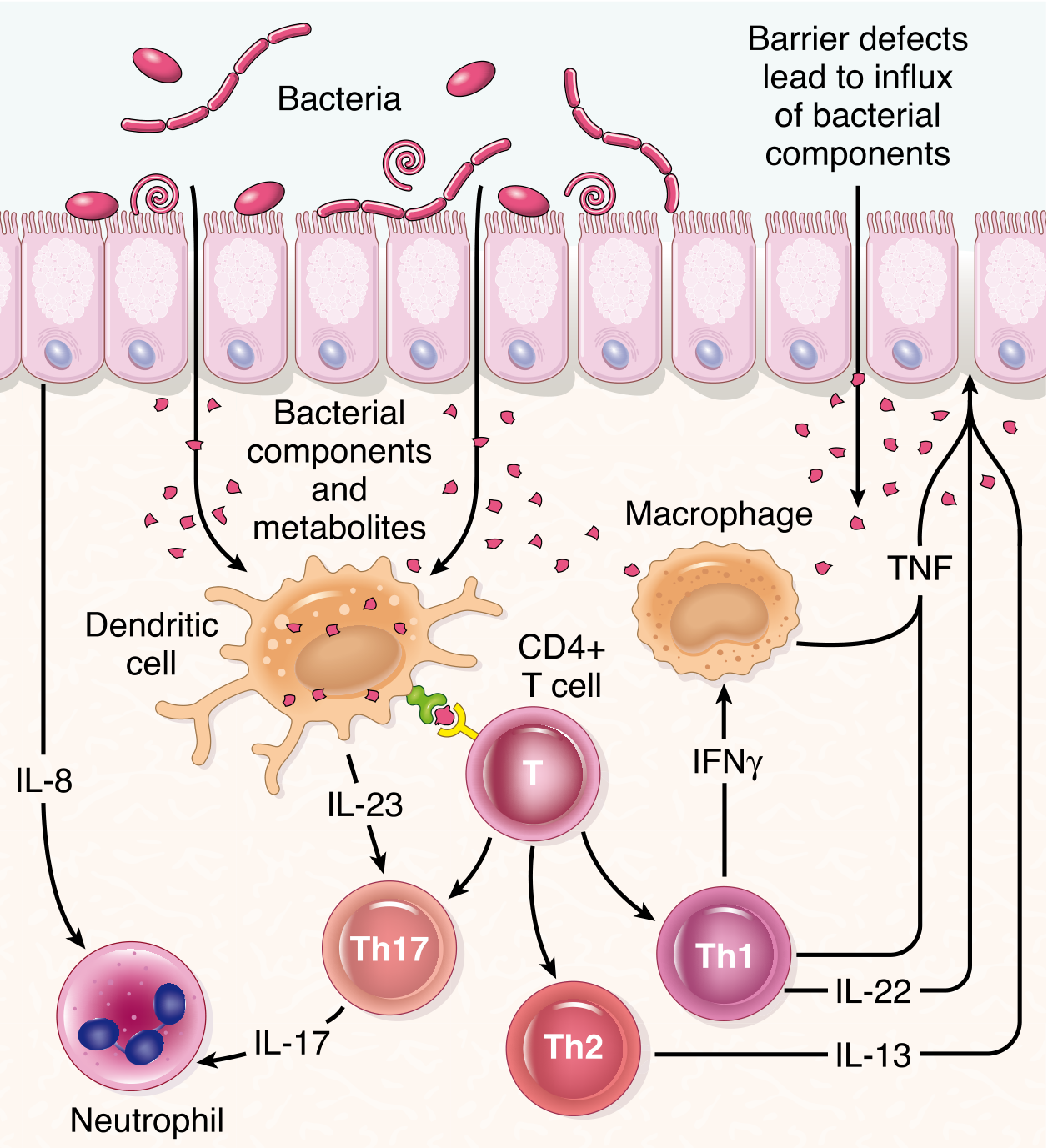
- Epithelial barrier dysfunction - barrier defects allow influx of bacterial components into the lamina propria
- Aberrant immune responses - dendritic cells present bacterial antigens to CD4+ T cells, driving Th1 and Th17 polarization with release of TNF, IFN-γ, IL-17, IL-23, and other cytokines that sustain chronic inflammation
Transmural inflammation leads to:
- Fibrosis and stricture formation
- Fistula and abscess formation (penetrating disease)
- Adhesions to adjacent bowel or organs
- "Fat wrapping" - mesenteric fat encroachment onto the bowel serosa, virtually pathognomonic of CD - Schwartz's Principles of Surgery
Distribution
- Small bowel involved in 80% of cases; colon alone in 20%
- Majority of small bowel disease = ileocecal disease
- Isolated perianal/anorectal disease: 5-10%
- Uncommon sites: esophagus, stomach (usually with concurrent intestinal disease), duodenum
- Skip lesions: discontinuous inflamed segments separated by normal-appearing intestine - Schwartz's Principles of Surgery
Pathology - Key Features
| Feature | Crohn's Disease | Ulcerative Colitis |
|---|---|---|
| Inflammation depth | Transmural | Mucosal only |
| Distribution | Skip lesions, anywhere mouth-to-anus | Continuous, always involves rectum |
| Granulomas | Non-caseating, present | Absent |
| Fistulas | Common | Rare |
| Rectum spared | Often | Never |
| Small bowel | Commonly involved | Backwash ileitis only |
- Robbins & Kumar Basic Pathology; ROSEN's Emergency Medicine
Clinical Presentation
The classic triad is abdominal pain, diarrhea, and weight loss. Disease behavior falls into three overlapping patterns:
- Fibrostenotic - obstructive symptoms from strictures
- Fistulizing / penetrating - internal fistulas, abscesses
- Aggressive inflammatory - active mucosal inflammation
Onset is typically insidious with a waxing-and-waning course. Children may present with growth retardation. Up to one-quarter of patients develop extraintestinal manifestations. - Schwartz's Principles of Surgery
Extraintestinal manifestations include:
- Arthritis / arthralgia
- Skin: erythema nodosum, pyoderma gangrenosum
- Eyes: iritis, uveitis
- Oral: aphthous stomatitis
- Perianal disease (fissures, fistulas, abscesses)
Diagnosis & Disease Activity
Disease activity is classified as mild, moderate, or severe based on response to therapy, systemic toxicity, abdominal tenderness, mass/obstruction, and degree of malnutrition.
The Crohn's Disease Activity Index (CDAI) is the standard research tool:
- Remission: CDAI < 150
- Response to therapy: decrease in CDAI ≥ 100 points
Key variables: stool count, abdominal pain, general well-being, extraintestinal features, opiate use, abdominal mass, hematocrit, and body weight.
Biomarkers:
- CRP - useful for tracking activity; elevated CRP correlates with active disease and risk of infectious complications
- Fecal calprotectin - pooled sensitivity 88%, specificity 67% for active CD vs. endoscopy. Also correlates with relapse risk and biologic therapy response
- Fecal lactoferrin - sensitive marker of intestinal inflammation
Symptoms do not always correlate with objective disease activity - mucosal healing (endoscopic + biomarker-based) has emerged as the therapeutic target beyond symptom control. - Sleisenger and Fordtran's GI and Liver Disease
Imaging: MR enterography with gadolinium shows mural hyperenhancement, mural thickening, and the "comb sign" (engorged peri-enteric vasculature resembling comb teeth) in the terminal ileum.
Complications
- Small bowel obstruction (SBO): CD is the primary cause in ~5% of SBO cases. May result from active inflammation or chronic fibrosis/strictures. Up to 75% of patients undergo at least one abdominal surgery in their lifetime.
- Intra-abdominal abscess and fistulas
- Colorectal cancer: Risk increased after >8-10 years of colonic IBD
- Short bowel syndrome (from repeated resections)
Management
Medical Therapy
Step-up approach based on disease severity:
| Class | Agents | Use |
|---|---|---|
| Aminosalicylates | Mesalamine | Mild-moderate disease |
| Corticosteroids | Prednisone, budesonide | Induction of remission |
| Immunomodulators | Azathioprine, 6-mercaptopurine, methotrexate | Maintenance; steroid-sparing |
| Biologic - anti-TNF-α | Infliximab, adalimumab | Moderate-severe disease, fistulizing CD |
| Biologic - anti-integrin | Vedolizumab | Gut-selective; moderate-severe CD |
| JAK inhibitors / IL-12/23 blockers | Ustekinumab, upadacitinib | Refractory disease |
- Anti-TNF therapies are effective by inhibiting the pro-inflammatory cascade, but up to 50% of patients ultimately become unresponsive to their first anti-TNF biologic. Some respond to a second anti-TNF agent. - Robbins, Cotran & Kumar
- For gastric/duodenal CD: PPIs are first-line; controlled trial data on immunosuppressants and biologics is lacking, though infliximab has been used successfully. - Sleisenger and Fordtran's
- Despite biologic availability, up to 40% of CD patients still require long-term corticosteroids, which significantly increase surgical morbidity (infection, anastomotic leak). - Fischer's Mastery of Surgery
Surgical Therapy
Surgery is integral in CD management. Key principles:
- Preserve intestinal length - wide margins do not reduce recurrence but increase short bowel syndrome risk
- Indications: intra-abdominal abscess, medically intractable fistula, fibrotic stricture with obstruction, toxic megacolon, malignancy, failure of optimal medical therapy, steroid dependence, growth failure in children
- Most common operation: ileocecal resection with primary anastomosis, increasingly done laparoscopically
- The LIR:C trial showed no QOL difference at 12 months between laparoscopic ileocecal resection and infliximab in limited ileal CD (<40 cm) - suggesting primary resection is an acceptable alternative to biologic therapy in select patients
- Strictureplasty is preferred over resection for isolated fibrotic/scattered strictures (bowel-sparing)
- IPAA (ileal pouch-anal anastomosis) is generally avoided in established CD due to high pouch failure rates
- Risk of second surgery: ~30% at 5 years; ~33% of those needing a second surgery will need a third. - Sleisenger and Fordtran's
Surveillance
Colonoscopic surveillance for dysplasia/adenocarcinoma is recommended after 8-10 years of colonic IBD involvement.
Recent evidence (2024-2026):
- A 2025 meta-analysis in J Crohn's Colitis found partial enteral nutrition (PEN) has a role in CD management, particularly in pediatric populations (PMID 39565924)
- A 2025 Lancet Gastroenterology & Hepatology systematic review proposed novel diagnostic criteria and management advice specifically for isolated perianal Crohn's disease (PMID 40315877)
- A 2024 meta-analysis in United European Gastroenterol J reviewed probiotics in IBD - modest benefit but not yet standard of care (PMID 39106167)
Sources: Sleisenger and Fordtran's Gastrointestinal and Liver Disease; Robbins, Cotran & Kumar Pathologic Basis of Disease; Robbins & Kumar Basic Pathology; Schwartz's Principles of Surgery 11e; ROSEN's Emergency Medicine; Fischer's Mastery of Surgery
This is a shared conversation. Sign in to Orris to start your own chat.